



AI Is Redrawing Compute Maps – and Space Is Now on the Perimeter


AI’s expanding computational needs have brought renewed scrutiny to the power and land requirements of Earth-based data centers.
The Department of Energy projects terrestrial data centers to constitute up to 12% of U.S. electrical demand by 2028, driven by advancements in AI, according to an April report by the Government Accountability Office (GAO).
“In an era of Big Data, cloud computing and Artificial Intelligence (AI), the storage and processing of immense data is required, and [terrestrial data centers] have become the digital backbone of modern society,” according to the recent paper “Terrestrial Data Centres vs. Orbital Data Centres: A holistic review,” from Volume 164 of the scientific journal Progress in Aerospace Sciences.
Where AI Is Testing Terrestrial Capacity
Some regions are already acting on their concerns, with Monterey Park, Calif. named as the first city to impose a permanent, city-wide ban on data center construction following an 86% vote on the decision.
“Planning large AI capex has become more jurisdictionally complex and actively contested, and a major economic shift is underway in how data center power gets paid.” -Andrew Cavalier, ABI Research
“Planning large AI capex has become more jurisdictionally complex and actively contested, and a major economic shift is underway in how data center power gets paid,” Andrew Cavalier, principal analyst at ABI Research, told Constellations. Two key decisions stand out on different timelines, according to Cavalier:
- Moratorium: For example, New York’s bill pauses new projects but exempts any that have already “commenced,” creating a strict timing cutoff that can force otherwise ready projects to sit idle for a year unless construction is sequenced to hit that milestone.
- Cost–allocation shift: States are requiring data centers to absorb all grid-system upgrade costs, applying to both existing and expanding facilities and permanently reshaping project economics – even in states with no moratorium, like Florida and New Jersey.
Even with government measures to keep data centers contained, AI is stretching data center power density to the edge of what today’s technology can support, according to an April report by the International Energy Agency. “An individual server rack within an advanced data center is only the size of a large refrigerator, but by 2027 it could have peak power demand equivalent to that of 65 households,” according to the report.
Consequentially, supply chains for electricity technologies are being tested, with some key components only available from a small number of producers – namely China, and the lack of supply chain diversity could pose a challenge if not monitored, according to the report. Additionally, data center component supply chains are particularly vulnerable to trade restrictions, the report said.
“The data center market is no longer driven by land availability but by access to power,” Cavalier said. “Grid constraints are now a primary bottleneck for data center expansion, with demand outpacing supply in key markets and contributing to connection queues, potential restrictions and slowed buildout.”
The intense electricity demands of data centers can also lead to increased electricity prices in a given area, which has been a pain point for consumers, according to the report.
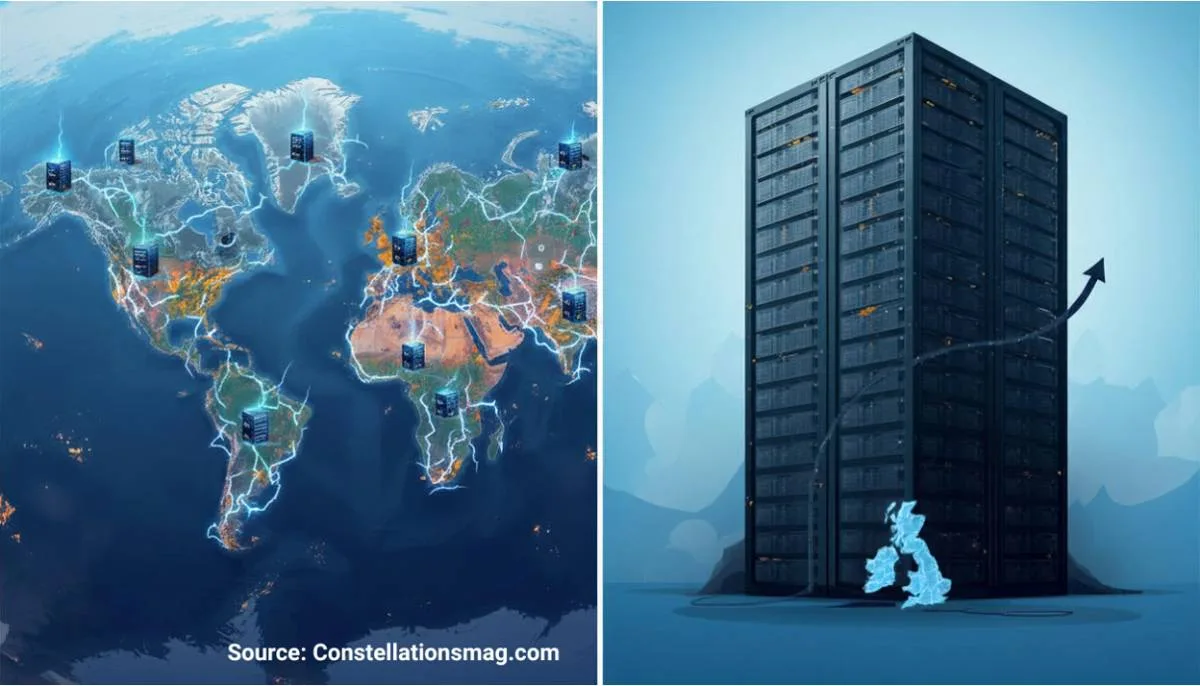
“At present, global data centers consume more electricity than the entire United Kingdom, and this demand is expected to grow. By 2040, digital data storage alone could be responsible for up to 14% of global greenhouse gas emissions,” according to the Progress in Aerospace Sciences paper.
Why Researchers Are Looking at Orbit
There’s presently no clean terrestrial alternative because solar and wind energy are not sufficient for powering large data centers, according to the paper.
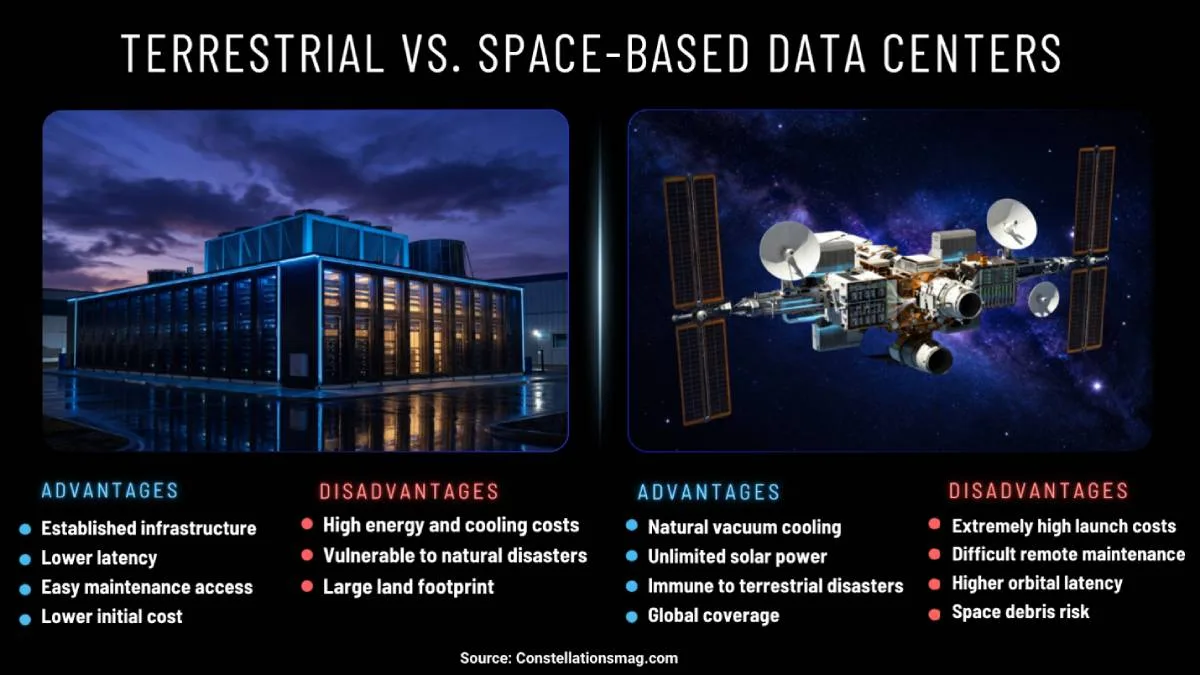
This is where orbital data centers could become a potential solution – they benefit from conditions and resources readily available in the space environment, such as continuous solar energy, vacuum cooling and security of being able to operate autonomously away from Earth, the paper said.
“The concept of [orbital data centers] has emerged in response to the escalating demands placed on [terrestrial data centers]. It envisions deploying data storage and processing infrastructure in Earth’s orbit or beyond as a scalable, transformative alternative to terrestrial facilities, potentially redefining data management while addressing the growing energy consumption and environmental impact,” the paper said.
Hybrid architectures that combine distributed and space-based infrastructure are becoming an increasingly strategic priority for nations seeking to maintain future stability and technological advantage, including AI capacity, Ori Bloch, author of the Progress in Aerospace Sciences paper, told Constellations.
In the near term, launch mass – both annual volume to orbit and cost per kilogram – is the main constraint, driving subsystem size and weight trade-offs due to deployment costs and competition for launch slots, said Bloch, whose work focuses on the strategic development of space and AI infrastructure, including critical-infrastructure resilience, energy security, national security and technological sovereignty.
Over the long run, power storage, bandwidth, batteries and thermal management will be the more persistent limits on orbital data center performance, he said.
Early Signals in the Market
Several companies have already submitted applications to the FCC for large data center constellations in 2026, with Cowboy Space Corp. (formerly Aetherflux) most recently filing plans for up to 20,000 orbital data centers, noted Dr. Karen Howard, Director of GAO’s science, technology assessment and analytics team.
“There has also been recent tangible development by the private sector in this area, with companies launching test satellites, some of which are described as ‘orbital data center nodes,’” Howard told Constellations.
“The launch economics of Starship and Falcon 9 will become more transparent, which will unlock more bargaining power for customers. This also means companies can expect more predictability in launch cadence, which will drive long-term launch frameworks and contracts,” added ABI’s Cavalier.
Beyond launch, a primary bottleneck to scaling true orbital data centers is the downlink – the ground-segment capacity needed to return results to Earth, Cavalier said. “Orbital compute can scale well by launching more satellites and accelerators, but ground station availability, contact windows as satellites pass and weather on optical downlinks make this a bigger friction point,” Cavalier said. “The compute in orbit can continuously scale, but the ground stations and usable contact minutes need to scale with it. In this way, the bottleneck will be moving the data back down to Earth, which will require significant ground infrastructure and on-orbit routing capabilities.”
Once operational, orbital data centers would initially be categorized separately for either terrestrial or in-space services and would require specific capabilities depending on use case. However, over time, these capabilities could be integrated, enabling orbital data centers to serve both space and terrestrial applications, according to the paper.
“A key differentiator is latency: terrestrial use cases will generally face higher delays compared to orbital ones. Ultimately, the choice of communications system design will determine the types of compute and workloads required for the use-cases, and, in turn, the appropriate class of computing resources, whether High-Performance Computing, High-Density Computing, AI-enabled supercomputing or cloud,” the paper said.
Engineering and Cost Hurdles
Cooling hardware in the vacuum of space is a challenge that will need to be resolved in order for orbital data centers to be viable, according to the GAO report.
“The International Space Station (ISS) has a relatively new cooling system operating at the scale needed for a hypothetical 100 kW orbiting data center satellite,” said Howard. Boeing claims that the cooling system can dissipate about 70kW, relying on radiator assemblies and pumped ammonia coolant, Howard noted.
“The International Space Station (ISS) has a relatively new cooling system operating at the scale needed for a hypothetical 100 kW orbiting data center satellite.” -Dr. Karen Howard, GAO
“It is large, complex and heavy,” she said.
Power density in space-based data centers packed with computing hardware will probably exceed that of most other satellites, which will make designing effective cooling systems more difficult, Howard said.
Thermal management is the biggest challenge for orbital data centers, Dr. Greg Autry, associate provost for space commercialization and strategy at the University of Central Florida, told Constellations, echoing Howard.
“Cooling is absolutely NOT abundant or easy in space. It’s a vacuum, the very thing we use to insulate our hot drink bottles. It is a challenge to get rid of the heat from even normal intensity computing on satellites and spacecraft,” said Autry. These data centers will require massive radiators that are potentially great targets for space debris. That said, this is an engineering problem and with sufficient talent, money and motivation most engineering problems get solved.”
Assessing the Long-Term Outlook
As orbital data centers still face questions of viability, some of the skepticism toward the ethics and sustainability of terrestrial data centers may be overblown, said Autry, who previously served on the NASA agency review team and as White House liaison at NASA.
“There is a necessity for sure and to some extent it is an ‘artificial necessity’ [for orbital data centers] being created by the hysteria surrounding terrestrial data centers,” argued Autry, who authored Red Moon Rising: How America Will Beat China on the Final Frontier. “These ‘communities’ are often being provoked by planted media scare stories and organizations I suspect are funded by foreign adversaries determined to undermine American technological development in AI and other areas,” he said.
“These ‘communities’ are often being provoked by planted media scare stories and organizations I suspect are funded by foreign adversaries determined to undermine American technological development in AI and other areas.” -Dr. Greg Autry, University of Central Florida
Intensifying geopolitical competition is pushing faster buildouts and cost pressure, leading companies to look for additional compute capacity, said Cavalier.
“Once capacity in orbit comes online for commercial use, which we expect by 2028, we will see more deals to use the capacity surface,” Cavalier said.
Whether or not a particular company’s orbital data center concept is workable not only depends on the company’s power figure and planned orbit but also by the company’s track record, strength of its vertical tech stack and the supply chain it can leverage, Cavalier said.
“From an economics perspective, orbital data centers become interesting when they are comparable to terrestrial benchmarks,” Cavalier said. ABI Research expects the levelized $/W crossover in the mid-to-late 2030s, but that timing depends heavily on launch costs and rising terrestrial prices, so it could happen sooner, he said.
But terrestrial data center technology is also undergoing new developments in cooling, superconductivity and other technologies that could enhance the efficiency and sustainability of operations, so the long-term demand for an orbital alternative is undetermined, said GAO’s Howard.
“The viability of orbital data centers assumes an increasing need for data centers and computing power, an increasing cost of building and operating terrestrial data centers relative to projected decreases in launch cost to access lower earth orbit, plus engineering advances for orbital data centers,” Howard said. “How these factors develop, and the timing, is hard to predict.”
GAO does not see one pivotal turning point that could shift the trajectory of orbital data centers. Instead, their growth from promising concept to scalable alternative for their terrestrial counterparts depends on the strength of the business case and whether the cost scale tips in their favor, Howard said.
“Companies will likely start to focus on needs that are better met by orbital data centers than by terrestrial data centers value where terrestrial data centers cannot,” she said.
One emerging application is in cislunar space, where orbital data centers could serve as gateways for deep-space exploration and enable long-term autonomous operations, according to the Progress in Aerospace Sciences paper. They could support lunar bases and research sites with computing power, provide on-site edge processing and act as relay nodes to improve communication between Earth and distant spacecraft.
“Additionally, [orbital data centers] offer sovereign and secure data infrastructure for governmental and private stakeholders, while also supporting the broader cislunar economy through services like data warehousing, AI-driven analytics and operational autonomy for mining and in-space manufacturing,” the paper said.
Spectrum and national security will move from secondary issues to primary forces shaping these networks’ design and operation, Cavalier said.
These constellations generate traffic patterns unlike today’s satellite systems, Cavalier said. As orbital data centers take on heavier AI workloads, their data movement needs will surpass what Ka-, Q- and V-band links can handle. As a result, optical links will become increasingly central for both inter-satellite and space-to-ground communications, complementing existing RF systems, he said.
“Furthermore, since orbital data centers act more as infrastructure, rather than communications relay, data sovereignty and jurisdiction will come to the forefront,” Cavalier said.
What Could Tip the Balance
While it’s still too early to know whether orbital data centers will sd long term, continued pushback and bans on terrestrial facilities—combined with advances in launch and cooling technologies – could drive more data processing into orbit, she said.
“Should launch costs greatly decrease and permitting and costs become more challenging for data centers on Earth, then we might see accelerating movement towards orbital data centers replacing the functions of terrestrial data centers,” Howard said.
“When multi-year contracts with defense agencies, Earth observation operators or critical-infrastructure providers for defined workloads that are processed partly or entirely in space would be committed, that would signal a credible commercial phase,” Bloch added. “A tipping point could be an Earth-observation company using [orbital data centers] to significantly reduce image-to-insight delivery time for end-user, or a defense agency using it to improve mission resiliency and decision-making when terrestrial infrastructure is unavailable or vulnerable.”
Despite his defense of terrestrial data centers, Autry does see the orbital data center business case shaping form due to large investments from big players.
“I believe that with Musk, Bezos, Schmidt and others already investing heavily we are past the tipping point on data centers in space. It is happening. We will see if they can make it economical,” Autry said.
The high up-front investment, limited launch opportunities and pressure to scale fast mean this space is dominated by major players. Still, the supply chain and technology needs create huge openings for entrepreneurial companies, according to Autry.
In fact, former Google CEO Eric Schmidt acquired launch startup Relativity Space likely with intentions of launching computing infrastructure into orbit to operate as data centers, said Autry.
“It doesn’t get more serious than that,” Autry said. “This is not a PowerPoint pipe dream.”