



APAC’s 2026 Space Marketplace

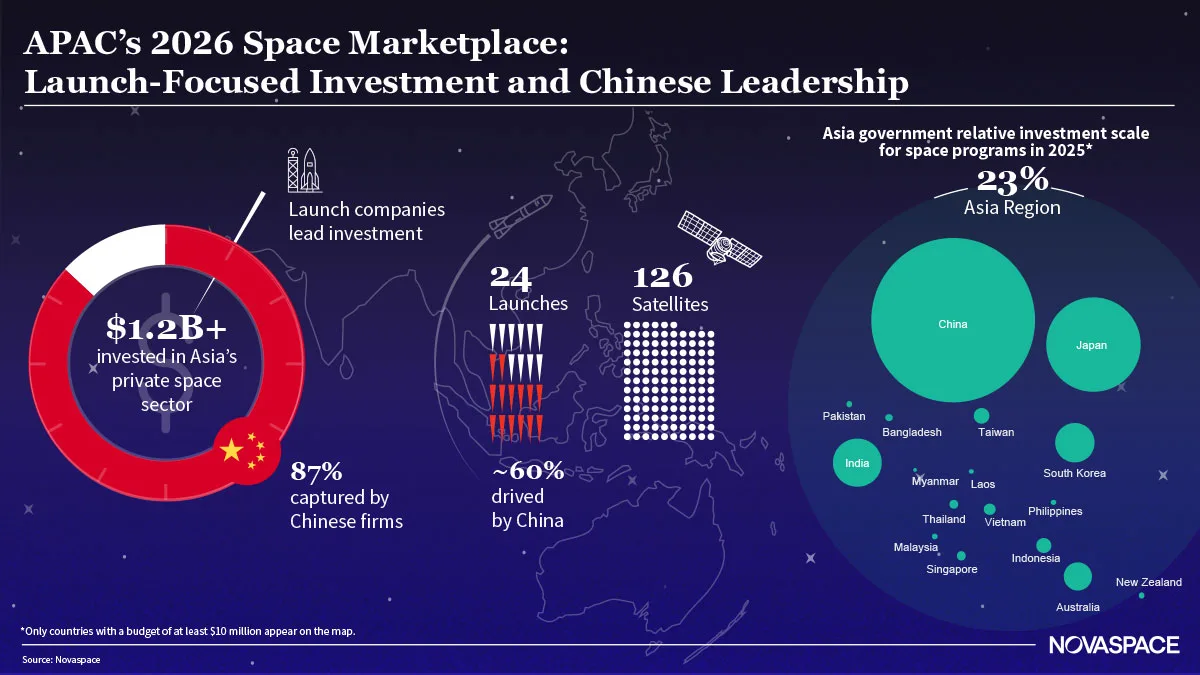
APAC’s space market is increasingly launch-focused, with China firmly anchoring both regional activity and investment. This accounts for roughly 60% of regional launches, capturing nearly 90% of the more than $1.2B invested in Asia’s private space sector.
At the same time, the broader market outlook is expanding. Asia’s share of global governmental space spending has doubled to approximately 23% since the early 2000s, signaling a growing and more diversified demand base. As governments across APAC continue to assess the strategic and economic value of space, this shift creates increasing potential beyond launch, opening opportunities in downstream applications, sovereign capabilities, and enabling technologies as national programs mature.
About the Reports:
Space Market Monitoring
Delivering near-real-time business intelligence on the global space sector, Space Market Monitoring is an executive-level dashboard report designed for space industry stakeholders and observers. It presents 50 key performance indicators alongside curated news summaries that are continuously collected, updated and analyzed to provide dynamic, data-driven insights.
Government Space Programs
Novaspace’s Government Space Programs report delivers the most comprehensive economic and strategic assessment of global government space activities. Covering 95 governments and international organizations with dedicated space budgets, the report provides an unparalleled view across both civil and defense domains, analyzing the full spectrum of government-funded space applications to reveal policy priorities, programmatic choices, and budgetary dynamics shaping national space strategies.