Originally published by Space Intel Report. Read the original article here.
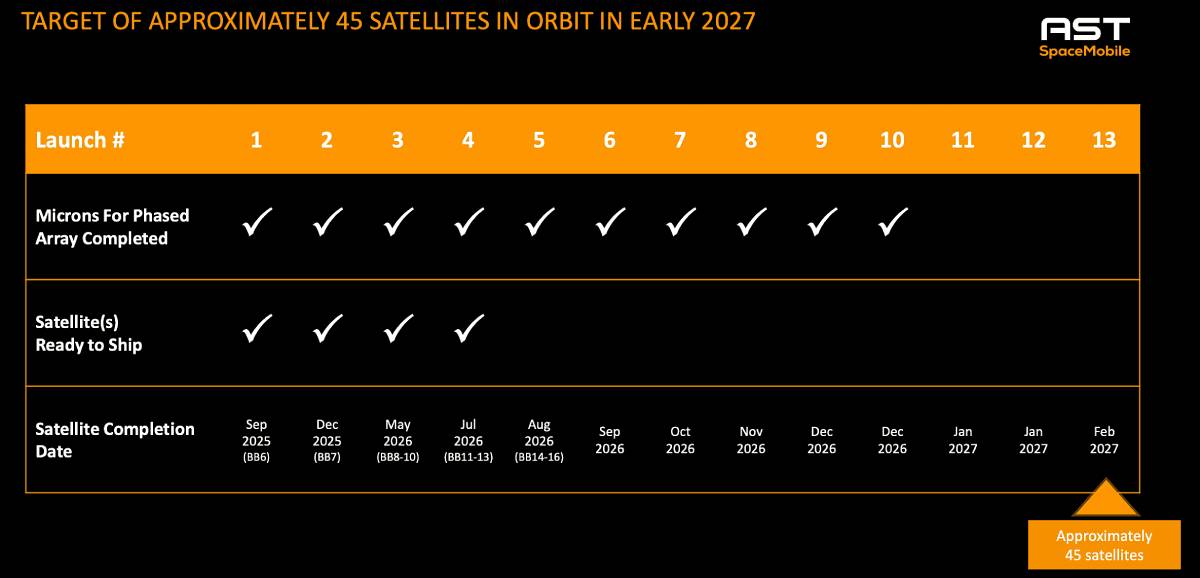 (Source: AST SpaceMobile Aug. 10, 2026, investor presentation)
LA PLATA, Maryland— Satellite direct-to-device (D2D) startup AST SpaceMobile, which has 13 satellites in low Earth orbit, said it expects to reach its goal of 45 satellites by early next year and has booked 10 missions on two launch-service providers to reach that goal.
The 45-satellite target is what AST estimates is the minimum number needed to provide continuous service in its key early markets — the United States, Europe, Saudi Arabia and Japan.
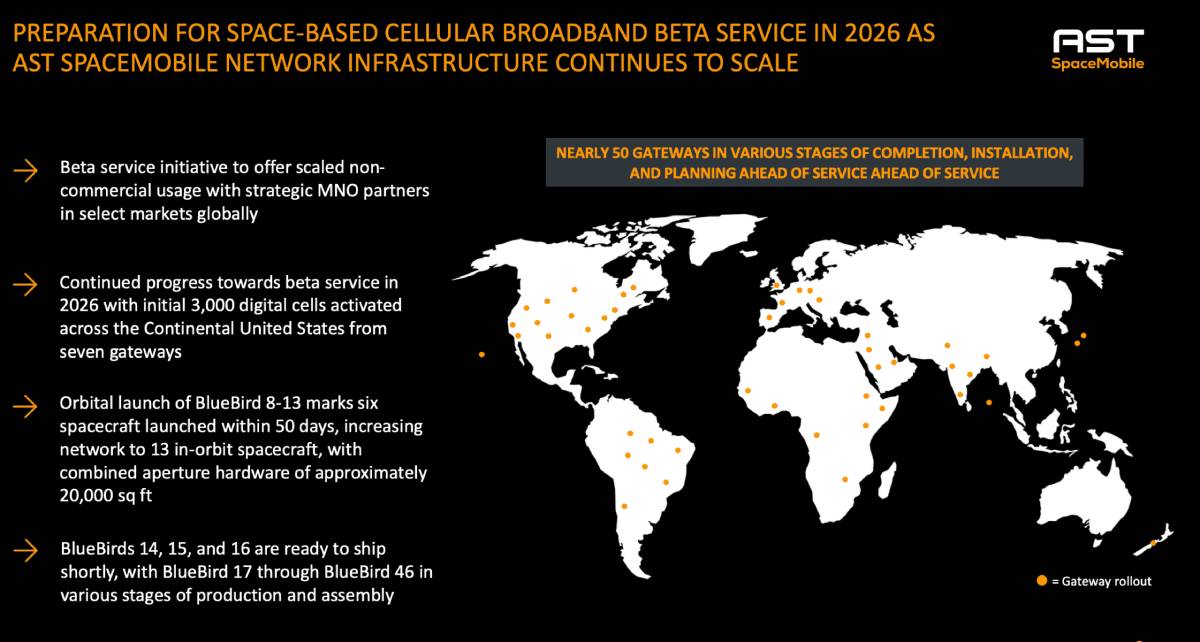 (Source: AST SpaceMobile Aug.10, 2026, investor presentation)
An earlier beta service, with 25 satellites — five AST Block 1 BlueBirds and 20 larger Block 2s — will be able to provide “about half a day of coverage,” AST President Scott Wisniewski said in an Aug. 10 investor call.
It will be up to AST’s terrestrial wireless operator partners, including AT&T and Verizon in the United States, to determine exactly when to open the service to their subscribers.
That makes it uncertain when AST will begin to generate revenue from the service. Wisnewski said that, in principle, commercial revenue will begin to flow to AST as soon as its partners make the service available.
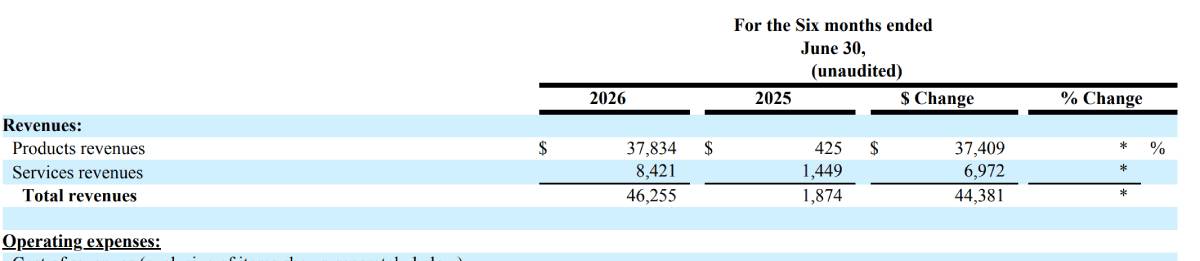 (Source: AST SpaceMobile Aug. 10, 2026, SEC filing)
AST’s current revenue stream — the company expects $150-$200 million this year — comes from its sale of gateway Earth stations to its telco partners and US government contracts. AST Chief Executive Abel Avellan said during the call that 50 gateway Earth stations worldwide were in some stage of planning and deployment.
Avellan said AST’s production facilities are well advanced in the construction satellites number 14 to 46 to reach the 45-satellite target. The Blue Bird 7 satellite was lost in a failed launch attempt, but AST has kept the original numbering.
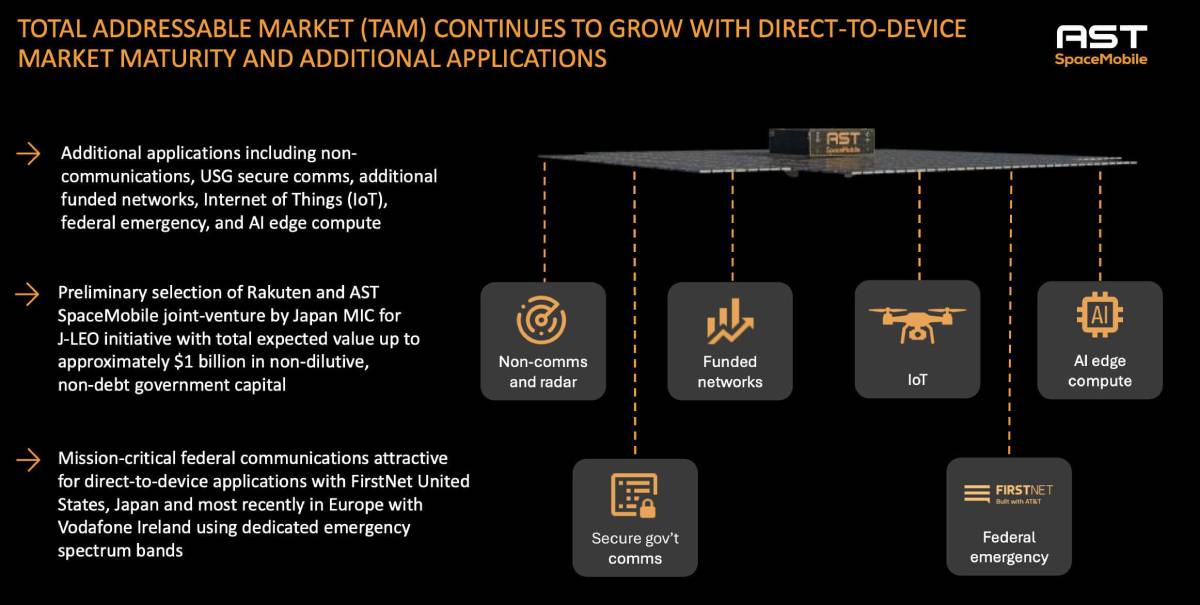 (Source: AST SpaceMobile Aug. 10, 2026, investor presentation)
With each passing quarter, AST’s focus is increasingly on government markets for AST’s D2D and other communications and non-communications services, including radar using government spectrum.
The company in July announced that its Japanese terrestrial network partner, Rakuten, had been selected by the Japanese government to provide a constellation of low-orbit satellites, named J-LEO, providing diverse communications services.
The award, which must still be confirmed, was for 940 billion Japanese yen ($940 million) over three years.
Avellan said the J-LEO award, if confirmed, will provide “non-dilutive, non-debt government capital” to further build out AST’s constellation.
 (Source: AST SpaceMobile)
“The satellites that are flagged Japanese are basically identical to the rest of the constellation,” Avellan said. “They can be used anywhere in the world using the global gateways.”
Wisniewski noted that the J-LEO model has been a feature of the geospatial imagery market for a few years and has recently entered the satellite communications domain. In Europe, Poland and Spain have recently announced sizable investments in satellites that would cater to their national needs while at the same time operating in the broader Iris2 multi-orbit secure communications network.
‘Every G20 nation will want something similar to Japan’s J-LEO’
“J-LEO is a real proof point for how countries think about their own infrastructure,” Wisniewski said. “This is a trend that is going to play out multiple times in the coming years. “If you think about it, having communications capabilities that are resilient and that you control — I don’t know why a G20 country wouldn’t want this, given the price.”
Avellan said AST’s advantage in the J-LEO competition was the fact that it already has satellites in service that have demonstrated broadband throughput and was a long-standing partner of Rakuten.
Also important is sovereign control. “The architecture we offer allows nations another to basically keep all the data and the management of the infrastructure on the ground,” Avellan said.
In addition to partnering with terrestrial operators — 60-plus so far — around the world to use their existing spectrum to expand coverage to dead zones in their territories, AST has secured the rights to L-band spectrum in the United States and to S-band spectrum through a global license.
Planned $100M payment to Viasat placed into escrow by Ligado bankruptcy court
The L-band spectrum was paid to Ligado Networks, which was to transfer the funds to Viasat Inc.’s Inmarsat satellite operator. The first such payment, of $420 million, was made in October 2025. The second, of $100 million, was transferred in late March 2026 but the Ligado bankruptcy court ordered that instead of being transferred to Inmarsat, the funds were to be placed into an escrow account.
Avellan said the satellites being prepared for launch by early 2027 are equipped with the spectrum it’s reusing from its mobile network operator partners. The dedicated L- and S-band spectrum will be added to the satellites produced subsequently.
Originally published by Space Intel Report. Read the original article here.