



Autonomy On Orbit: What Satellites Should Decide for Themselves

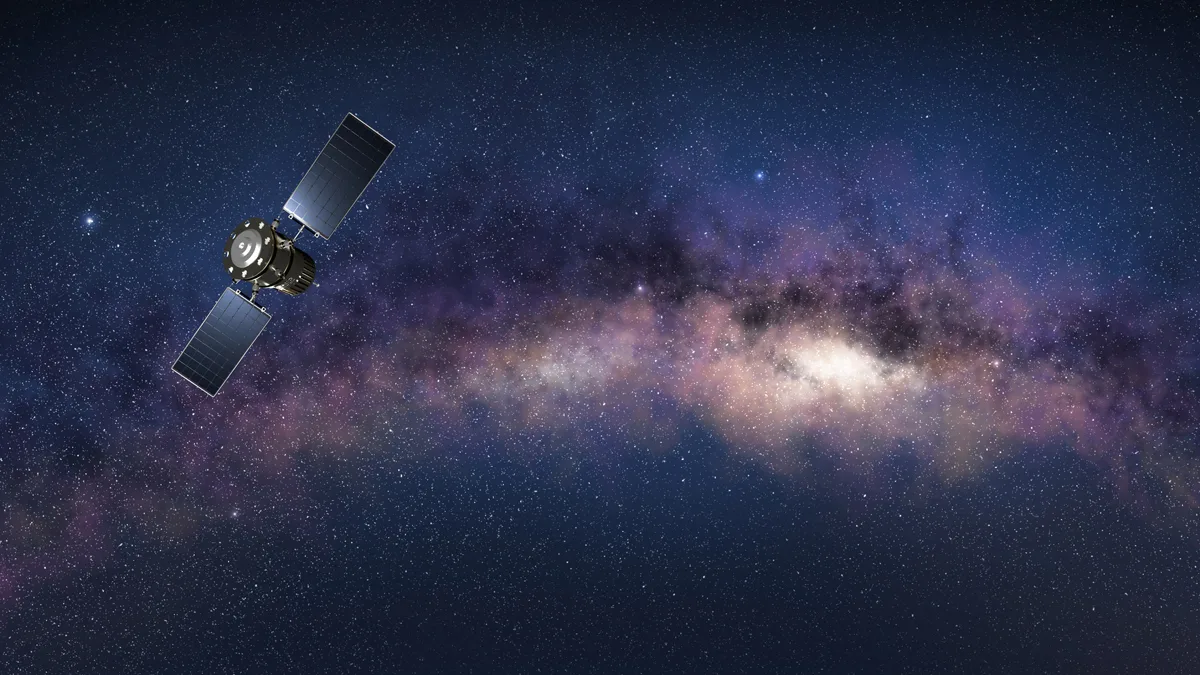
Artificial intelligence and onboard computing are beginning to change how satellites handle data in orbit. As constellations expand and satellites generate larger volumes of information, operators are exploring which tasks satellites can take on themselves while maintaining appropriate human oversight.
Advances in onboard processing are making more of those capabilities technically possible, but the shift toward greater autonomy also raises technological, operational and policy questions about how far autonomous satellite systems should go.
In practice, the shift toward autonomous satellites is likely to be gradual. Satellites already make limited operational decisions on their own, but still face significant technical constraints, said Dr. Phillip Cunio, professor of practice, department of engineering at George Mason University. For example, space-qualified processors typically lag their terrestrial counterparts, Cunio said.
“In general, any processor that’s on orbit is going to be several generations behind the leading ones on the ground,” he said. “Your capability that’s actually on orbit to make decisions is always going to have some limits.”
Connectivity also factors into the extent of autonomy and onboard processing, said Cunio. Individual satellites may only be able to intermittently connect to the broader network, and they may not always have access to the most up-to-date information available on Earth, he said.
“You don’t have the same computing power up there at the edge that you do on the ground, and you don’t necessarily have the same link capability,” he said.
Because of those limitations, satellites are more likely to gain autonomy in stages rather than through a sudden shift, Cunio said.
Filtering Data On Orbit
One advantage of onboard processing is reducing the amount of raw data satellites must send back to Earth, particularly as modern satellites often collect far more information than bandwidth permits them to transmit, Cunio said.
Processing that information onboard allows satellites to prioritize what is transmitted. Instead of sending entire datasets, satellites can identify the most relevant information to send first, he said.
“If your satellite is collecting data on orbit for payload purposes, processing on orbit means you have to downlink less data,” Cunio said. “You can extract what’s useful and downlink that, which is way better than downlinking the whole thing like an open pipe.”
The ability to quickly downlink key insights could prove especially critical in crisis scenarios, said Dr. John Horack, inaugural holder of the Neil Armstrong Chair in Aerospace Policy at The Ohio State University.
“In the case of a disaster—a flood in Texas, a hurricane in Florida, an earthquake in Asia—on-orbit decision systems might be able to respond more quickly, more coherently,” Horack said. “We might be able to optimize across the assets to get better information into the hands of first responders that’s more actionable.”
In addition to allowing satellites to prioritize actionable insights and transmit critical information more quickly, onboard processing can also protect the quality of data and reduce costs, Horack said.
“If you don’t need to send it down, don’t send it down,” Horack said. “For example, in the case of imagery, when you’re taking high-resolution, high-spatial resolution, high-spectral resolution, we can collect a lot more data on a spacecraft than we can bring to the ground in a meaningful way,” he said.
And for many commercial applications, such as agriculture, the value isn’t in the raw data but in its meaning and the decisions it enables, Horack said.
“In space, what I’m really interested in is the answer, not necessarily all the data,” Horack said. “If I’m a farmer, I really don’t want satellite data. I want to know, should I spray my corn crop or not? And that could just be a ‘yes’ or a ‘no.’ I want the decision,” he said.
Processing data on orbit could also change how satellite services are delivered by allowing satellite service companies to provide recommendations instead of large volumes of raw imagery or sensor data, Horack said.
“If I could write a prescription for a farmer—how to plant, when to plant, the density, maybe different seed variations as a function of location based on soil type—that’s much more profitable because I can deliver better and more timely information in a more concise package and not have to support all that infrastructure of moving data back and forth,” he said.
Allowing a degree of autonomy in space systems can prove necessary for unlocking new discoveries as well, said Horack.
Horack previously helped build NASA’s Compton Gamma Ray Observatory, a satellite designed to study gamma-ray bursts and their sources.
“We didn’t know when or where the next flash of gamma-ray energy was going to come from,” Horack said.
To capture those events, the mission used an automated network that could notify other spacecraft when a burst was detected and estimate its location, he said. In some cases, those spacecrafts would then automatically redirect their telescopes to the same region of the sky without waiting on human instructions, Horack said.
“The scientific breakthroughs that were enabled from that were amazing,” he said.
Follow-up observations helped NASA scientists establish the distance scales of gamma-ray bursts, prove that the bursts are cosmological and gather additional data using telescopes, including the Hubble Space Telescope, Horack said.
“When you do this, it opens up not only whole new kinds of missions but enables all new kinds of scientific discovery modes of operations and other things that you couldn’t do otherwise,” he said.
Autonomy and Constellations Operations
Beyond data processing, onboard autonomy could also reshape how satellite fleets are managed, said Cunio. As constellations expand to comprise hundreds of thousands of satellites, the traditional model of assigning dedicated operators to individual satellites becomes increasingly difficult to sustain, Cunio said.
One concept often used in robotics to describe the shift is “fan out,” which refers to the number of autonomous systems that a single human operator can supervise, according to Cunio.
“If you had one operator, and she could operate five or ten camera drones all at once, that would be a one-to-ten fan out,” Cunio said.
Applying that model to satellite operations could allow small teams to oversee much larger constellations, said Cunio. Instead of continuously controlling individual spacecraft, operators would supervise systems that largely manage themselves and intervene when anomalies arise, he said.
“For large constellations, you could size your human team for the worst-case scenario, when the largest number of satellites need attention on short notice,” he said.
The potential economic impact is significant. Personnel costs represent a major portion of operational expenses for complex systems, Cunio noted.
“People are usually one of the larger costs for most complex enterprises,” he said.
Greater autonomy could therefore make larger constellations more practical to operate and allow smaller organizations or startups to pursue missions that require multiple satellites rather than relying on single-spacecraft architecture, he added.
“If you have a mission team and they can work one satellite just as easily as 10 or 50, then the same-size startup can approach a mission that only works with a larger constellation,” Cunio said.
For example, San Francisco-based startup Loft Orbital plans to launch 10 AI-driven satellites later this year.
Policy, Oversight and Learning from Failures
As satellites begin making more decisions on their own, questions about verification and accountability become more prominent, said Cunio. If an autonomous satellite makes an operational judgement that turns out to be incorrect, investigators will need a way to reconstruct how that decision occurred.
“What you want is the highest level of traceability and visibility into this autonomous decision making that you can get,” Cunio said, noting visibility becomes more challenging the further away from the ground a decision is made.
Instead, humans can assess the inputs used by autonomous satellites to make decisions on orbit and evaluate the results of those decisions, Cunio said. Publishing records of any known incidents in space caused by autonomous decision-making on orbit and making these records available for stakeholders or even public consumption can also help mitigate future risks, he said.
“A little bit of transparency and self-policing and self-investigation can do a lot…because now there’s a sort of default procedure in place for reviewing things like this,” Cunio said.
Trust with end users also requires clear agreements, said Horack, returning to the agriculture scenario. “If I’m a farmer and I rely on a provider to do calculations and give me some information, I need some assurance this isn’t just wackadoodle information and won’t destroy my harvest for the year,” Horack said.
Liability can range from a suggestion to advice, but the consumer should also understand its limits, he said. “At the end of the day, if you lose your case, unless there’s malpractice, the bargain was made and you took their advice,” he said.
Greater autonomy could also alter how risk is assessed in space operations, Horack said. As systems become more reliable and their performance better understood, operators can develop a clearer picture of the risks involved, he said.
“I think we’ve seen some of that in the aviation industry,” Horack said. “We haven’t taken a person out of the flight deck, but what we have put around that person is some autonomy, some systems that prevent mistakes.”
Applying similar autonomy to spacecraft could narrow the range of possible outcomes and make missions more predictable, Horack said. “When we can put autonomy in spacecraft that improve their understanding of the risk … you’ll actually see improvements in lower cost of insurance, greater predictability and those kinds of things,” he said.
While commercial applications like agriculture and scientific studies stand to benefit from taking the risks of autonomy on orbit, the payoffs are less likely for the defense sector, Horack said.
“You can afford a false positive if you’re slewing telescopes to look at something in the sky,” Horack said. “But imagine satellites encouraging you to take a kinetic action in the DoD environment. That’s a whole different story.”
Human Oversight Remains Central
Despite the growing interest in onboard autonomy, even commercial satellites are unlikely to operate entirely without human supervision, said Cunio. Machines may increasingly handle routine operational tasks – such as monitoring internal systems, planning maneuvers or filtering sensor data – but humans will remain responsible for broader mission context, he said.
“I don’t see a clear path to no or very limited human involvement, but I do see satellites doing more and more things autonomously,” Cunio said, noting that Starlink satellites already conduct self-maneuvers in orbit.
Even 10 years from now, satellite operations are likely to involve some component of human command, said Horack.
“We’re putting them there to do something: to make a measurement, to do a calculation, to have an observation, to help us make a decision,” Horack said. “The autonomy that satellites will have will exist within an envelope and boundary condition set by people on the ground,” he said.
Instead, autonomy on orbit is more likely to develop as a partnership between satellites and ground teams, Horack said. Satellites will be equipped to handle a growing number of routine decisions, while human operators will continue to provide judgement oversight and coordination across increasingly complex constellations, he said.
“If I have this autonomy and this flexibility and almost this second mind built into my experiment hardware on orbit, I get of the opportunity to go into my lab multiple times a day, tune my experiments, and see what happens,” Horack said. “AI, onboard computing, autonomy—all of that is going hand-in-hand to expand the capability and the speed and the throughput of value that comes from what we do in space.”