



Europe’s Iris2 Constellation, After Adopting Compromises and Securing SES Approval, Looks Ready To Pass Go-Ahead

Originally published by Space Intel Report. Read the original article here.

WASHINGTON — Negotiations to validate the key performance indicators of the Iris2 multi-orbit secure communications constellation are expected to finish by the end of this month after both government and private-sector investors agreed to modifications, according to European government and industry officials.
The SpaceRise consortium of satellite fleet operators SES, Eutelsat and Hispasat, each with different motivations, appears ready to endorse Iris2 16 months after they signed an initial contract for it in December 2024.
Under the agreement, which follows three months of what officials said were occasionally difficult negotiations, SpaceRise would manage Iris2 under a 12-year concession contract and, as promised in December 2024, invest up to 4.4 billion euros ($5.1 billion), with the European Commission and the European Space Agency providing some 6.5 billion euros.
The Commission has been able to firmly commit only 2.4 billion euros for now. The remaining investment will be sought from the Commission’s next seven-year budget, starting in 2028, which has not been voted.
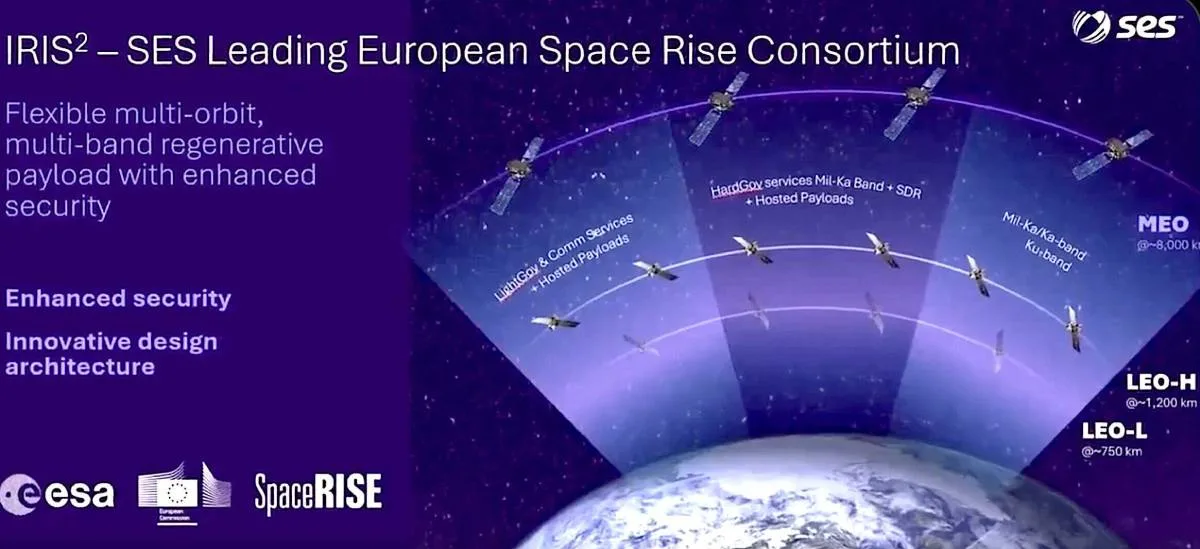
SES is leading Iris2’s 18-satellite medium-Earth-orbit shell, using the same 8,000-km orbit as SES’s current O3b mPower broadband constellation.
SES Chief Executive Adel Al-Saleh has repeatedly promised SES shareholders that the company would refuse to embark on Iris2 if it showed signs of bursting through the schedule, budget and performance goals set in 2024. The company said in late 2024 that it expected to commit 1.8 billion euros to the network.
There has been some schedule slippage, but Al-Saleh evoked Iris2 on several occasions here March 24 at the Satellite 2026 conference, organized by Access Intelligence. He gave no sign that the three months of negotiations during Iris2’s Rendezvous-1 were on the verge of failure.
Notably, he said it’s now SES, not Thales Alenia Space, that will be building the payloads for the Iris2 MEO shell as part of the company’s decision to become more vertically integrated to overcome what he called the sluggishness of Europe’s heritage satellite providers.
While Al-Saleh focused on the company’s order of 28 large MEO satellite buses from startup manufacturer K2 Space of California, other industry officials said Germany’s OHB was still the favored candidate for this work. Al-Saleh agreed that the K2 platform was not intended for the first generation of Iris2.
Iris2’s low-LEO shell, at less than 750 kilometers in orbit, is being managed by Hispasat and will consist of between 10 and 20 satellites to test different technologies. Hispasat has said its investment could be as high as 600 million euros.
That leaves Iris2’s 264-satellite LEO component, to operate at 1,200 km in altitude, the same orbit as Eutelsat’s OneWeb constellation.
In addition to having the French government as its largest shareholder, Eutelsat’s business needs Iris2 more than SES or Hispasat do.
In December 2024, the same month it signed the initial Iris2 concession agreement and committed to spending 2 billion euros on it, Eutelsat contracted for 100 OneWeb first-generation satellites from Airbus.
In January 2026, it booked another 340 OneWeb satellites, also from Airbus, to refurbish the existing constellation.
That first order of 100 satellites is expected to be launched in batches starting this year aboard SpaceX Falcon 9 rockets.
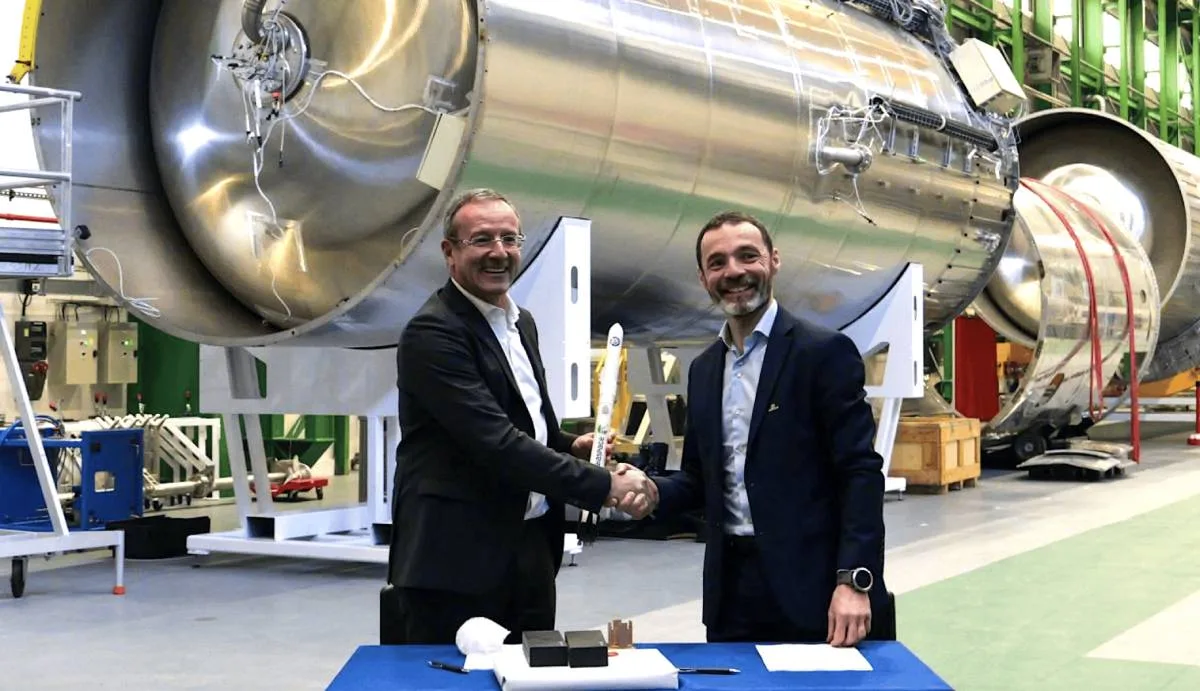
Subsequent launches will be conducted by startup Maia Space of France, under a contract signed in January.
These launches will begin in 2027, following Maia’s inaugural flight, with the missions “spanning several years,” Maia Space said.
In a March 24 appearance here at Satellite 2026, Eutelsat Chief Executive Jean-François Fallacher said that “our current partner, Airbus, is helping’s, building 440 satellites, which we will launch completely recapitalizing our shareholders and our company.
“As a constellation, the 440 satellites will be operational, let’s say, in the years 2030-2031.
“The next question is looking further than that. We are engaged with [SES] and with Hispasat in a very ambitious project, called Iris2, which is building the second-generation constellation with the support of the European Commission and ESA. There as well we are working with the ecosystem, Airbus, Thales Alenia Space and also some startups, like Aerospacelab, to change the rhythm and change the pace.”
This is where things get confusing. The Commission in late January said the investing parties had agreed that, to get to orbit as early as possible, the first Iris2 satellites will not have all the features identified in the December 2024 package.
Some components, like 7-nanometer chips, will not be ready for launch in 2029, Commission and ESA officials said. They will be introduced into the constellation a couple of years later.
Even if Airbus will be obliged to share Iris2 LEO satellite production with Aerospacelab of Belgium, it’s hard to imagine the company going full-on with OneWeb satellite production at its recently expanded facility in Toulouse, France, and at the same time taking on Iris2 production.
In an April 1 response to Space Intel Report questions, Eutelsat said there will be an overlap between Iris2 LEO satellite production and the 440-satellite OneWeb order.
“Transition between OneWeb and iris 2 will be gradual,” Eutelsat said. “Iris won’t come into operation overnight. Even when Iris2 is up and running we will maintain the optionality to do some OneWeb launches — for polar coverage and for specific missions such as hosted payloads and to augment capacity if required.”
Eutelsat had said it would launch perhaps 90 OneWeb Gen 1 refresh satellites this year, using SpaceX Falcon 9 given the fully booked manifest of Europe’s Ariane 6 rocket.
Stress on Europe’s supply chain will only be compounded if, as now seems like, the German Bundeswehr moves forward on its plans to deploy the SatCom Bw4 LEO broadband constellation, also in 2029.
Originally published by Space Intel Report. Read the original article here.