



Germany’s Bundeswehr Wants a Rapid Buildup of Its Space Capacity; Germany’s Industrial Base Is Struggling To Keep Up

Originally published by Space Intel Report. Read the original article here.

BERLIN — The German Bundeswehr is coming to grips with the fact that its national space industrial base is to small to handle the ramp-up required of Germany’s five-year 35-billion-euro ($40.4 billion) military space budget starting this year.
Going outside Germany for some of the capacity is one option. But the Bundeswehr is also urging its established German contractors to team with New Space companies that have demonstrated products that, while not in industrialization phase, can be accelerated with the help of the established space sector.
“We are at the start of exponential growth in military space, Maj. Gen. Michael Traut, commander of the Bundeswehr Space Command, said here June 11 at the ILA 2026 Berlin air show.
“However, our systems, starting with procurements, with personnel acquisition, talent, engineering — those processes are not yet fit to cover exponential growth. They are fit for maintaining or even shrinking our armed forces.
We need to make those systems fit to tackle the exponential growth.”
Already, Germany’s two largest space primes, OHB SE and Airbus Defence and Space, have formed teams with New Space companies and with large non-space contractors, to propose elements of what the Bundeswehr says it wants.
It is still unclear how quickly the industrial base can adapt.
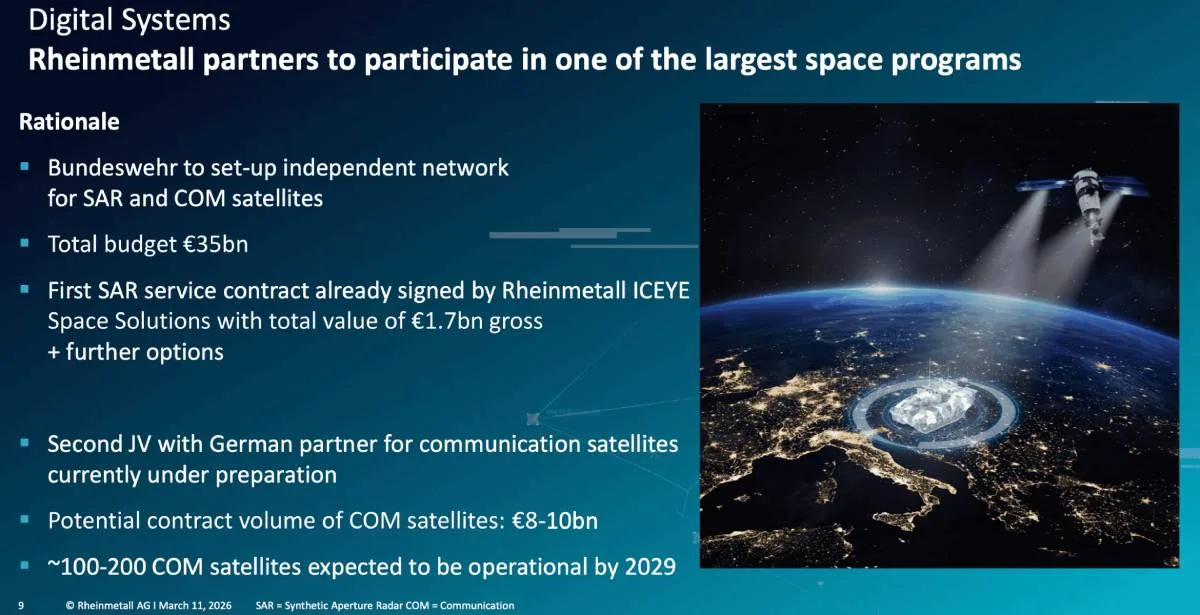
The largest single program in the Bundeswehr’s space plans is the Satcom Bw Stage 4 secure connectivity constellation in low Earth orbit, a multibillion-euro undertaking.
“Where do we stand now? We already have good developments,” Traut said. “Projects have been started, industry is getting in place for SatcomBw Stage 4, one of the largest projects ever done not only in space but in Germany, ever. I am pretty confident we will be able to start those huge projects as well.
“We want to build up a commercially sustainable space industry. No country can do it alone. We need to do that with new partnerships and a model of mutual collaboration, which from our side supports our space industry, like for series production and bring down the cost, and production levels too a sustained level.”
OHB and defense prime contractor Rheinmetall earlier announced earlier this year a partnership to field Satcom Bw Level 4 with OHB as satellite prime contractor and Airbus as a backup manufacturer.
On June 11, OHB and Rheinmetall announced the formation of a legal entity, OHB Rheinmetall Space Networks GmbH, for Satcom Bw Stage 4.
“The aim is to provide the Bundeswehr with a high-performance, secure and continuously available communications architecture within the framework of SATCOMBw Stage 4,” the two companies said in a statement.
“The new company was established to assume overall responsibility – from development and integration through to delivery and operation, including IT security and a Cyber Operations Centre. The future system will connect soldiers, vehicles, platforms and unmanned systems, ensuring the secure transmission of voice, data and real-time information across all command levels.
“Rheinmetall and OHB are strengthening Europe’s technological sovereignty and Germany’s strategic autonomy in security policy. The joint venture also positions itself as a high-performance network operator, with the potential to contribute to NATO partnerships and to the Framework Nations Concept in the future.”
The joint venture, to be based in OHB’s hometown of Bremen, was approved in April by Germany’s Federal Cartel Office.
OHB already has a full plate of likely contracts, including its role as the provider of the 18 medium-Earth-orbit secure connectivity satellites for Europe’s Iris2 multi-orbit constellation.
SatcomBw Stage 4 and Europe’s Iris2 competition for limited work force
SatcomBw Stage 4 and Iris2 appear to be moving forward at about the same schedule, adding to the stress on Germany’s industrial space ecosystem.
Trout did not address the fact that Iris2 and Satcom Bw Level 4 will be competing for talent in Germany and Europe, and that this could lead to schedule delays and possible cost increase.
He reiterated that there is no strategic competition between the two constellations, even if their missions have substantial overlaps in providing global secure connectivity for military and government customers.
“We rebuild up significant national capabilities in order to cooperate,” Traut said. “So we don’t see Iris2 and SatcomBw Stage 4 as exclusive either/or. It’s two solutions, one from Europe and one from Germany, to make sure we can work tighter.
“If you want to be a respected, valued partner you have to have something to offer, especially to larger partners like the US. The US partners see us with some different eyes right now,” Traut said.
New challenges for DLR Space Agency with military space buildup
The German Space Agency at DLR is also feeling the pressure to come up with industrial solutions for the Bundeswehr. Like most space agencies, DLR is not accustomed to the production requirements of military procurements.
We move from single development toward constellations and continuous update and upgrade,” said Gerald Braun, director of the space situational awareness team at DLR. “That is a shift in the market and in industrial behavior. We will need reliable networks, with agile startups to bring new technology and the bigger companies who are able to pick that up and bring it into production and procurement.
“Our American comrades are doing that. They have several commercial integration cells, and offer agile small companies the opportunity to demonstrate new technology with the end user able to evaluate whether this is valuable for the military tasks or not.”
Originally published by Space Intel Report. Read the original article here.