



Negotiations on IRIS² Constellation Cost, Schedule, Performance Need ‘A Few More Weeks,’ SES and Eutelsat Say

Originally published by Space Intel Report. Read the original article here.

JAKARTA — Satellite fleet operators SES and Eutelsat said negotiations on the final cost, configuration and schedule of Europe’s IRIS² multi-orbit secure connectivity constellation will require several weeks of additional work before being finalized with the European Commission.
In separate May 11 earnings calls, the two operators, who have charge over IRIS²’s medium-Earth orbit and low-orbit segments, respectively, said they remain optimistic that the project will land in a form acceptable to all parties.
SES has tentatively agreed to invest about 800 million euros ($939 million) into IRIS², with Eutelsat’s investment estimated at 2 billion euros.
IRIS² RDV-1 began Jan. 9, was intended to close April 30
IRIS²’s RDV-1 final negotiation stage began on Jan. 9 and was slated to close on April 30 with an agreement on the program’s technical and financial requirements and its deployment calendar.
April 30 came and went without a word from the European Commission beyond assurances that an announcement would be soon.
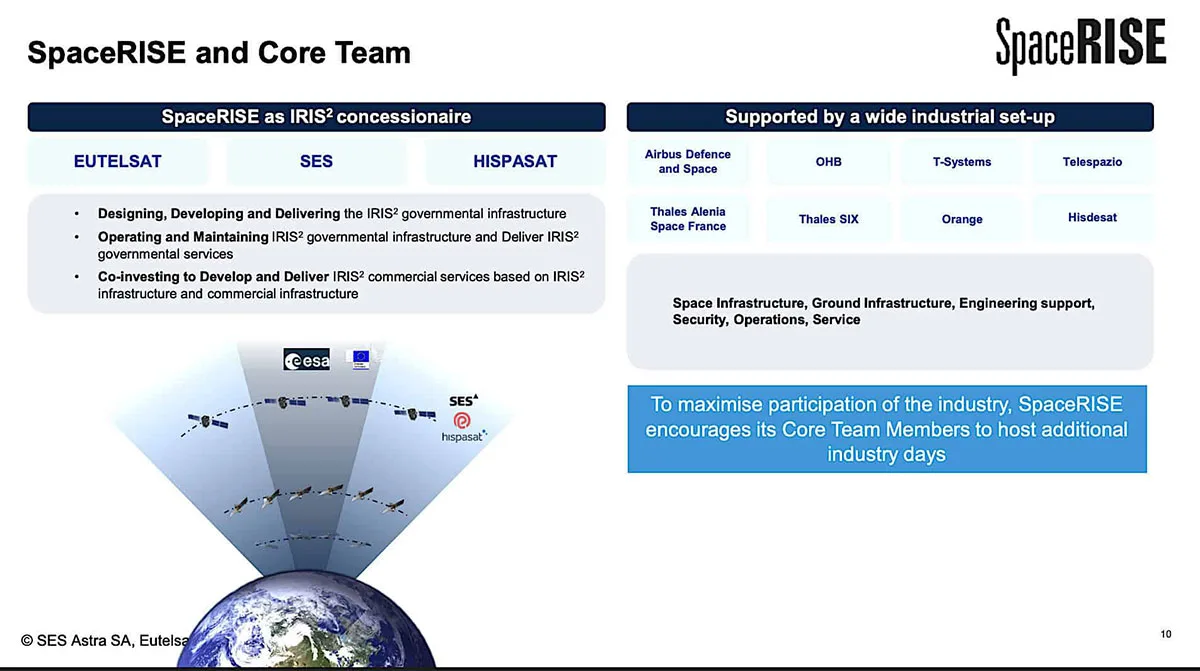
SES and Eutelsat are, with Spanish operator Hispasat, the three members of the SpaceRise consortium that negotiated a 12-year concession agreement for IRIS² that was tentatively approved in December 2024 by all parties — pending a successful RDV-1.
SES said it remains “fully committed” to the IRIS² idea but reiterated that the project would have to meet SES’s internal rate of return requirements.
SES Chief Executive Adel Al-Saleh said that while he remains optimistic on the program, these requirements have not changed.
“There is an unwavering commitment from the European Commission to make IRIS² a reality,” Al-Saleh said. “It is a sophisticated project with multi-orbit. We believe RDV-1 will be completed in the next weeks, if not a month or a month and a half. It’s up to the European Commission to decide when it’s complete.
“The only way we can participate in IRIS² is if it makes sense financially, for us and our shareholders. We have our clear red lines defined and we know what we need to do. If we meet them then it’s going to be successful. If we don’t meet them then it’s going to be a hard decision. But it is a great project with a lot of support and commitment from all of the stakeholders.”
SES booked 40 million euros in IRIS² revenue in the three months ending March 31. Al-Saleh said future revenue this year will vary depending on the results of the RDV-1 negotiations.
In addition to being a SpaceRise concession member with responsibility for the MEO component, SES is also providing the payloads for the MEO satellites, which will be integrated at SES’s new Luxembourg satellite assembly plant. Originally, the MEO satellites were to be built by OHB of Germany for the buses, and Thales Alenia Space of France and Italy for the payloads.
One European industry official said that at this point, the Commission is ready to accept more non-European content in IRIS², at least at the start. “The Commission wants to get this thing done and will do what’s necessary for that,” the official said.
OHB is still slated to be the IRIS² bus provider for the 18 IRIS² MEO satellites, but SES’s longer-term strategy is to have K2 Space of California be accepted as the bus prime contractor, with the satellites still to be integrated in Luxembourg.
“The nature of IRIS² as we exit RDV-1 will be different from what it was prior to RDV-1,” Al-Saleh said. “Post RDV-1, you have to be executing a contract agreement that you signed with the Commission. Prior to RDV-1, you are working on the preparations and the execution of everything leading to the final agreement. That’s why it’s a little tricky to tell you what it looks like.”
Airbus Defence and Space is facing off against Aerospacelab of Belgium to be IRIS² prime contractor for the 272 LEO satellites. Thales Alenia Space is now expected to be the payload provider for at least some of these satellites.

Industry officials in recent months have said SpaceRise is likely to award the first IRIS² LEO contract to Airbus, with Aerospacelab to build later batches, on the assumption that Airbus, already under contract to build 440 Eutelsat OneWeb satellites to refresh the current Eutelsat OneWeb constellation, would be faster to deliver, if more expensive, than Aerospacelab.
Paris-based Eutelsat reported IRIS² revenue of about 10 million euros for the three months ending March 31.
Eutelsat Chief Financial Officer Sébastien Rouge acknowledged that RDV-1 was late in closing.
“It’s a very complex program with different partners and stakeholders. It takes a little more time than anticipated, but doesn’t mean our position would be lower than what we had in mind,” Rouge said.
“We are working with partners and with the European Commission to make it happen. It’s a very large commitment and engagement to [secure] the signature of the contract. The LEO responsibility is under Eutelsat, but with that many stakeholders it does take more time. We believe it’s a matter of weeks to get to the end of RDV-1.”
Originally published by Space Intel Report. Read the original article here.