


The Road to Interoperability
Software-based Systems are Driving Standards. And Vice Versa.


It’s been wonderful to see the pace of acceptance of DIFI as the growing standard for satellite ground equipment. The driving factors are many, including the business opportunities created by interoperability and escape from proprietary vendor lock-in. That said, perhaps the greatest accelerator has been the widespread move toward ground segment virtualization.
According to a recent white paper from prominent research firm Novaspace entitled The Business Case for Virtual Ground: Quantifying the ROI Advantage, “Virtualization is seen as a key factor contributing to the projected $98 billion cumulative spending on the ground segment through 2034 (source: 2025 Novaspace Ground Segment Market Report),” adding “Virtualization is also critical to taking advantage of the largest revenue opportunities in the industry including 5G NTN to connect to terrestrial networks, software-defined satellites to deliver service on demand and multi-orbit constellations to provide service flexibility.”
Another recent white paper from research firm Analysys Mason, entitled “Meeting the Challenge of Starlink and the Mega-Constellations with Software Ground,” echoed the sentiment: “A fully virtualised, orchestrated ground segment will deliver high asset utilisation in multi-orbit, multi-vendor networks whilst maintaining a high quality of service.” The report adds, “An orchestrated, virtualised approach will be best for adopting interoperable networking standards such as DIFI, MEF Carrier Ethernet, TM Forum Open APIs and of course 5G NTN (non-terrestrial networks).”
Analysys Mason makes the additional point that “Virtual architecture provides the best route to supporting enhanced, interoperable services with 5G participation… Virtualized ground infrastructure is the ideal approach for satellite players to enter the 5G ecosystem and prepare for AI-native 6G.”
In the evolution to software-defined networks, DIFI and other standards become essential for a world that increasingly employs cloud-enabled, cloud-based, mobile and similarly distributed architectures, especially where speed to mission and resilience are critical needs, such as in defense applications. As Novaspace notes, “By standardizing on mainstream IT infrastructure, virtualized ground can draw on diverse supply chains, technological progress and third-party applications in the much larger IT and telecom partner ecosystem.”
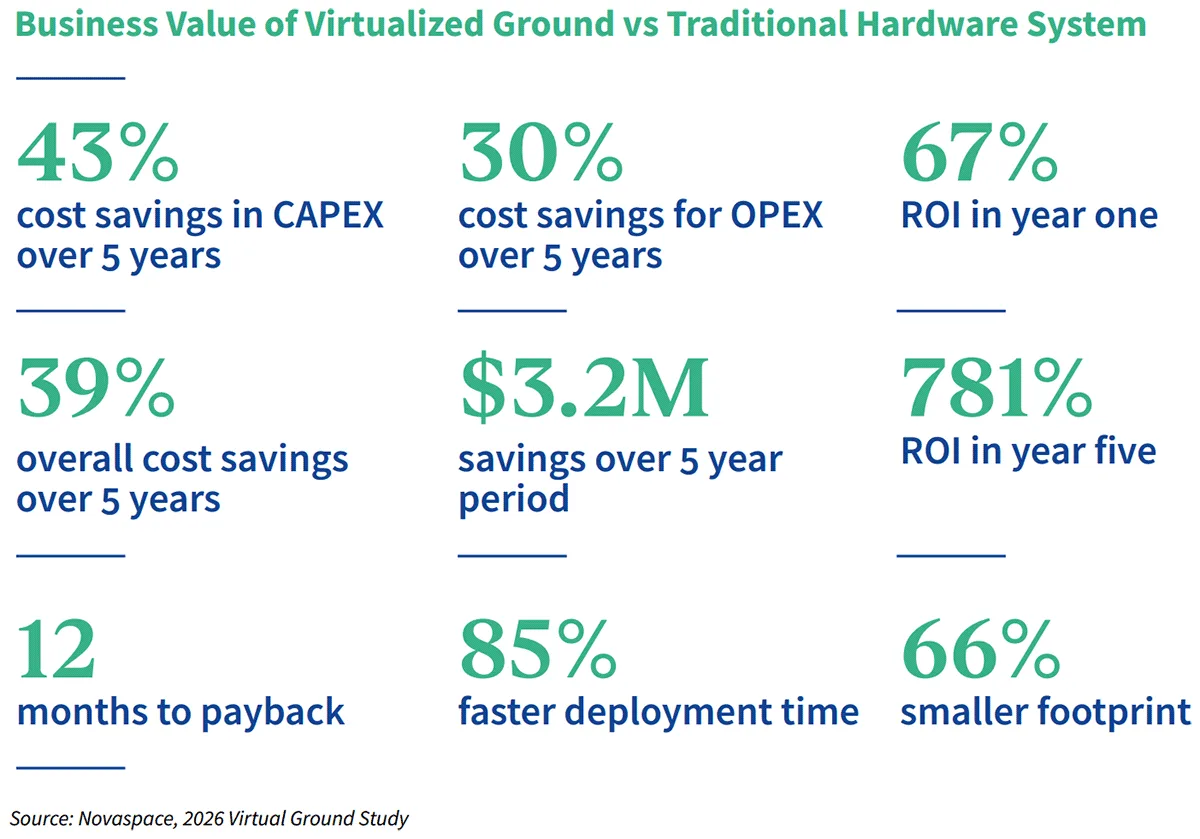
The Novaspace paper includes models that quantify the ROI of virtual ground using generic, off-the-shelf platforms for running virtualized components such as modems and without the need for hardware accelerators. Some of their numbers are below, and they are striking. The key is escaping proprietary hardware in favor of industry standards for network elements.