



Why NASA Is Fast-Tracking Its Plan for a Permanent Moon Base

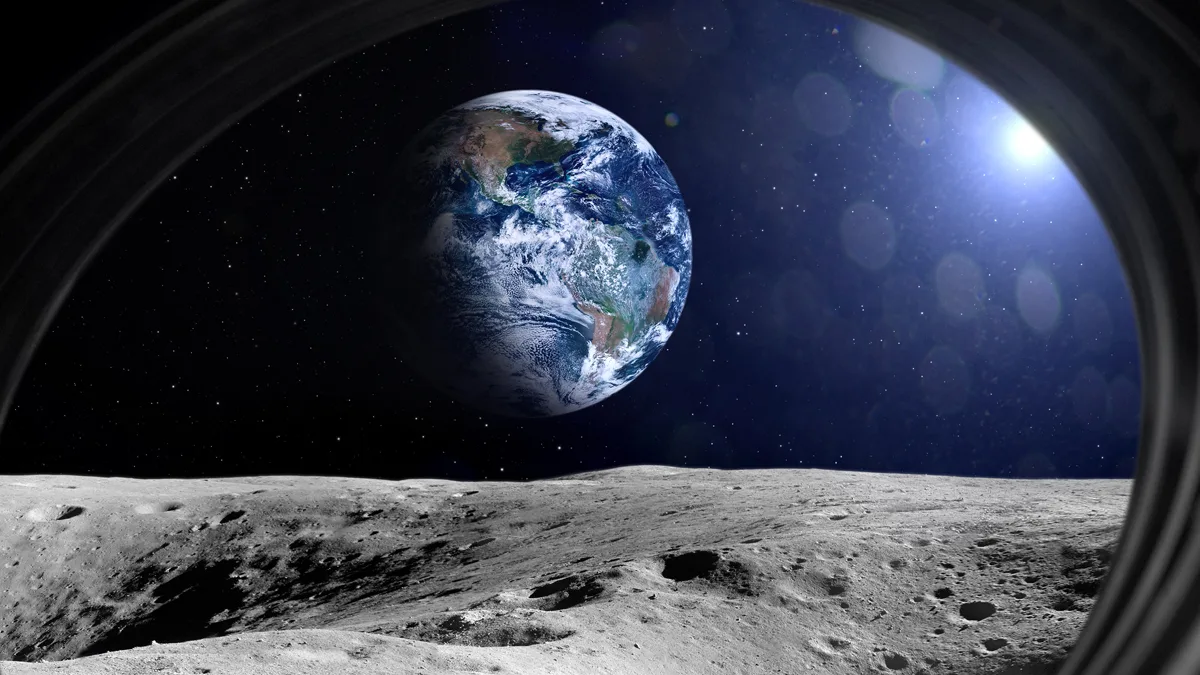
NASA is targeting three moon base launches before year-end, part of more than a dozen lunar missions the agency has in the works.
“The Moon Base will be America’s and humanity’s first outpost on another celestial world,” NASA Administrator Jared Isaacman said during a May 26 moon base event hosted by NASA. “Every mission, crewed and uncrewed, will be a learning opportunity as we return to the lunar surface, build the infrastructure to stay and master the skills required to live and operate in one of the most demanding and dangerous environments imaginable.”
The U.S. government and NASA remain steadfast in establishing a sustained presence on the lunar surface despite the Trump Administration’s proposed FY 2027 budget, which would slash the agency’s total funding by 23 percent.
Science funding is expected to take the brunt of the budget reduction, while the Artemis program could see a 10 percent increase in federal support. But being spared from funding cuts doesn’t mean the U.S. and NASA’s lunar strategy isn’t undergoing a shakeup.
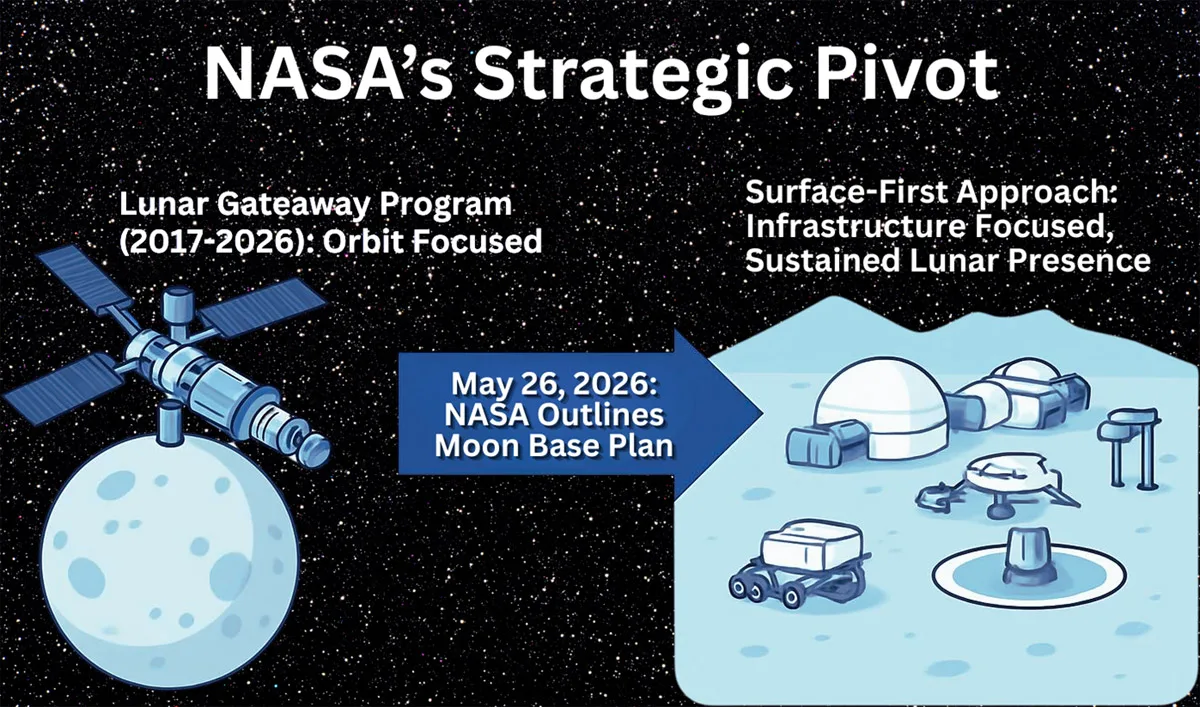
The agency in March opted to end its Lunar Gateway program a year or so early in favor of redirecting focus toward surface development. The Lunar Gateway program – a space station orbiting the moon – was established in 2017 with two orbiting outposts slated to launch in 2027 or 2028.
Shifting Strategies to Win the Race
The new lunar strategy is part of NASA’s broader plan to reduce the complexity of Artemis architecture and accelerate deployment timelines, according to an article by Novaspace, “The End of Gateway? Exploring the Consequences of NASA’s Lunar Shift.”
NASA’s current strategy is centered more on direct Earth-to-surface missions, with a stronger reliance on commercial transportation and logistics services to avoid concentrating all costs and operational responsibilities on government systems, Candice Massucci-Templier, manager at Novaspace, who co-authored the Novaspace article with Senior Consultant Maria Lily Shaw, told Constellations.
“Heavy launchers, transfer vehicles and lunar landers could become critical bottlenecks for mission cadence, cargo delivery and sustained lunar access.” -Candice Massucci-Templier, Novaspace
“In that context, transportation capabilities become a key leverage point,” Massucci-Templier said. “Heavy launchers, transfer vehicles and lunar landers could become critical bottlenecks for mission cadence, cargo delivery and sustained lunar access, especially if only a limited number of actors can provide them reliably.”
This shift also places enhanced importance on communications and navigation infrastructure in cislunar space, Massucci-Templier said.
“Without Gateway serving as a coordination node, operators of relay and positioning systems could hold a more central role in enabling and managing lunar operations,” she said.
Additionally, lunar surface infrastructure itself could become increasingly strategic. For example, landing zones, power systems, storage and logistics assets — particularly around the lunar south pole — could hold a key long-term role in operational access and positioning, she said.
“Overall, removing Gateway would not eliminate choke points, but rather shift them toward transportation systems, enabling infrastructure and surface logistics,” she said.
Why Being First Matters
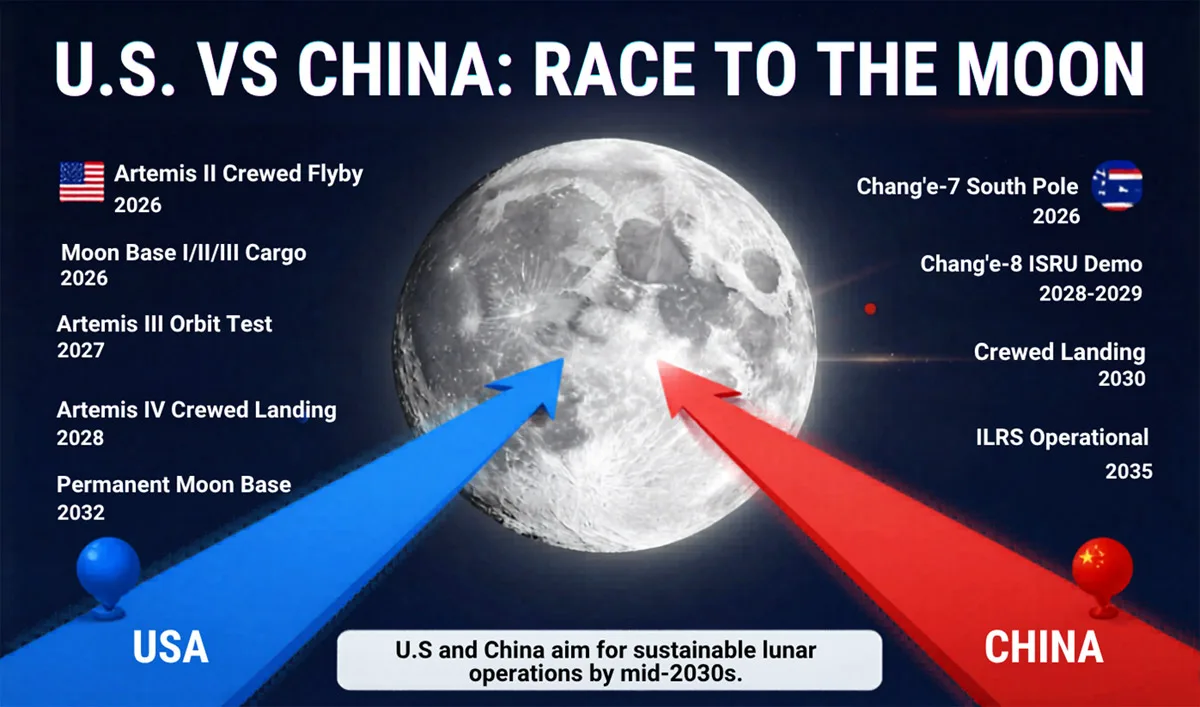
China has been candid about its own plans to build an operational lunar outpost by 2035 in partnership with Russia’s Roscosmos. The U.S. is targeting 2032 for a permanent operational outpost, but the dates are close together enough and tentative enough that the tension is mounting.
“The real key here is to understand the timing of when China, for example, is going to have a sustained lunar presence versus when the U.S. is going to have a sustained lunar presence.” -Dr. Roger M. Myers, R Myers Consulting
“The real key here is to understand the timing of when China, for example, is going to have a sustained lunar presence versus when the U.S. is going to have a sustained lunar presence,” Dr. Roger M. Myers, independent consultant at R Myers Consulting and retired executive director at Aerojet Rocketdyne, told Constellations.
“It’s well-publicized that China is targeting the early 2030s for a sustained lunar presence, and the U.S. is on a similar trajectory,” he said. “It’s going to come down to who establishes it first.”
But the moon is a big place and there’s room for multiple nations to host permanent bases, Myers said. However, some lunar real estate will prove more valuable than others, he said.
“If we land in an area of the Moon first and establish a lunar base, that doesn’t mean we control access to the moon. It just means that there will be an area where people should coordinate with us before coming into that area,” Myers said. “And so China could just land a few miles outside of that and they could continue.”
But certain areas of the moon will contain more resources than others, so nations need to be strategic and proactive in their planning process before staking their claim on a particular region, Myers said.
“We don’t really know very much about resource distributions on the moon, so there’s a lot of uncertainty,” Myers said. “That’s part of the reason that it’s urgent that we do establish a permanent presence on the moon and start this process of mapping resources in more detail, because that will tell us where we need to establish a sustained presence.”
The pressure to demonstrate early operational capability may accelerate positioning strategies across the Earth–Moon system, particularly as China intends to land taikonauts on the moon before the end of the decade, said Massucci-Templier.
As activity pushes beyond Earth orbit, large-scale transport will increasingly define space power, Andre Sonntag, independent space power and policy analyst, said in the recently published American Foreign Policy Council (AFPC) report “Strategic Implications of Lunar Mass Drivers as a Dual-Use Technology.” Lunar mass drivers could enable sustained, high-volume movement of material far beyond what rockets can provide, Sonntag said.
“If developed first by a competitor, this capability would confer more than economic advantage. It would allow control over logistics, influence access to key regions and shape the operational norms that govern cislunar space. Once established, these advantages would be difficult to challenge,” he said.
Without early investment, the United States risks losing both economic and strategic ground. Mass drivers, which use electromagnetic acceleration rather than propellant, have long been studied and could send large amounts of lunar material to low Earth orbit or elsewhere without the inefficiencies of reusable ferry systems, said Sonntag. By eliminating the need for onboard propellant or return trips, they offer an order-of-magnitude increase in transport efficiency, he said.
However, this economic potential carries strategic implications. Mass drivers are inherently dual-use; the same mechanism that launches cargo could also deliver harmful payloads with little warning, operating largely outside current early-warning systems, Sonntag noted. This ambiguity makes them a sensitive element of future cislunar security, he said.
China appears to view mass drivers as central to its long-term lunar industrial plans, which could give it dominance over resources, logistics routes and the norms governing cislunar activity, Sonntag said.
To avoid this outcome, the U.S. should prioritize establishing a sustained presence at strategically valuable lunar south-pole and equatorial locations – particularly the limited sites suited for mass-driver operations and rich in volatiles. Securing these areas would preserve U.S. options, support allied cooperation and prevent their control by potential adversaries, he said.
“Early control of key infrastructure and locations would allow the People’s Republic of China to shape access, influence norms, and establish de facto control over critical regions of the lunar surface and associated transport corridors. Once established, these advantages would be difficult to displace and could define the strategic environment for decades,” he said.
Once lunar activities become more sustained and operationally mature, resource rights and data control will gain importance, but transportation, operational access and the ability to consistently deploy infrastructure will be defining facets of leverage in the near and medium term, Massucci-Templier said.
The Early Movers’ Advantage
Beyond scientific interest, the lunar south pole region – where both the U.S. and China are planning outposts – is strategically valuable for long-term lunar operations due to its favorable illumination conditions and potential access to water ice, Massucci-Templier said.
The lunar south pole region – where both the U.S. and China are planning outposts – is strategically valuable for long-term lunar operations due to its favorable illumination conditions and potential access to water ice.
Deploying this infrastructure early – particularly fuel depots, power systems, communications assets, robotic infrastructure and surface logistics capabilities – could present durability advantages for future operations and could reduce future barriers to access for those already engaged in lunar operations, she said.
Developing integrated Earth-Moon logistics chains will also prove advantageous to growing and sustaining a lunar economy, said Massucci-Templier.
“Actors able to combine launch, transportation, communications, landing and surface operations within a coherent architecture could progressively secure structural advantages in terms of cost, responsiveness, and operational autonomy,” Massucci-Templier said.
Early actors may also have more say over governance on the moon. Current approaches to resource utilization, safety zones or infrastructure access could become de facto norms if repeated consistently over time – potentially before formal international frameworks are in place, said Massucci-Templier.
“Similarly, actors shaping operational and interoperability standards early, for example in docking interfaces, communications protocols or logistics systems, may gain long-term influence by creating ecosystems that others later need to integrate into,” she said.
Navigating a Contested Lunar Space
As lunar exploration becomes increasingly intertwined with geopolitics and the space environment is becoming recognized as a warfighting domain, there are signs that cooperation between U.S. defense organizations, such as the Space Force, and commercial industry could expand in the cislunar domain, said Massucci-Templier. This is supported by recent U.S. initiatives – most notably the creation of a cislunar coordination office and a broader dependence on commercial transportation systems.
Yet this pattern remains largely specific to the United States, Massucci-Templier said. In most other spacefaring nations, civil space agencies continue to lead exploration, scientific missions and human spaceflight. Within the U.S., NASA still heads lunar exploration efforts, though tightening civil space budgets contrast with increasing investment and political attention directed toward certain defense-related space capabilities, she said.
Even so, defense space actors remain primarily focused on missile warning and tracking, communications and space domain awareness rather than on lunar operations themselves, Massucci-Templier said. As a result, it is still unclear whether the current U.S. initiatives represent the beginning of a long-term shift in cislunar governance and operations, or whether they are mainly a reflection of the present political and strategic environment, she said.
Long-term strategic advantage in cislunar space can be difficult to predict, said Massucci-Templier.
“It is still relatively early to clearly identify which single technological area will create the strongest asymmetric advantage, because many of these capabilities are highly interdependent,” Massucci-Templier said. “The advantage will likely come less from one standalone technology and more from the ability to integrate several capabilities into a coherent operational architecture.”
With that in mind, autonomy could prove particularly critical in the longer term, said Massucci-Templier.
“As lunar and cislunar operations become more complex and geographically distributed, autonomous navigation, docking, landing, robotic operations and mission management could significantly reduce operational constraints and dependence on continuous ground intervention,” she said.
Sensing and cislunar situational awareness capabilities are also likely to prove crucial for navigation, safety, coordination and operational visibility in an environment currently under-monitored, noted Massucci-Templier.
“Overall, the strongest advantage may ultimately come from actors able to combine transportation, autonomy, servicing, communications and operational data into integrated and scalable systems supporting sustained lunar activity,” Massucci-Templier said.
Powering Sustainable Operations
Propulsion and transportation technologies will also be central for improving mission cadence, reusability, transfer efficiency and operational flexibility. Moreover, actors that can reduce the cost and complexity of sustained Earth-Moon transportation stand to gain a significant structural advantage, Massucci-Templier said. Capabilities such as in-space servicing and modular assembly are likely to become essential for long-duration lunar operations, she said.
Propulsion and transportation technologies will be central for improving mission cadence, reusability, transfer efficiency and operational flexibility.
Artemis missions and future lunar efforts will need dependable power sources to run surface systems and potentially to produce propellant for return trips, according to the research report “Weighing the Future: Strategic Options for U.S. Space Nuclear Leadership,” written by Myers and former Associate Administrator for Technology, Policy and Strategy and former acting Chief Technologist at NASA, Dr. Bhavya Lal.
While initial power demands may be modest, they will have to grow significantly as surface activities expand, according to the report. Nuclear power, in which China has already made notable strides, is expected to become a key enabler of sustainable lunar operations, the report said.
“You need a nuclear power system because the lunar night is two weeks long,” said Myers. The size of a standard battery required to provide energy for more than a few hours would be too large, and solar energy would not be sufficient for the duration of a lunar night, he said.
Future Still in Lunar Shadow
While NASA is bullish on its plans to have a lunar base in the early 2030s, it will likely be another decade or longer before the U.S. has a sustainable presence on the lunar surface, and even that is subject to multiple conditions being met, said Myers.
While NASA is bullish on its plans to have a lunar base in the early 2030s, it will likely be another decade or longer before the U.S. has a sustainable presence on the lunar surface.
Commercial landers cost more than one million dollars per kilogram for cargo deliveries to the lunar surface. While Starship and Blue Moon boast the ability to bring this cost down to the $100,000 range, options remain limited, Myers said.
“I’d say the late 2040s or early- to mid-2050s as a range for when it may be possible, assuming that the resources are actually in a form that make them economically viable and that we get the transportation costs down,” he said.
Despite the uncertainties, staying fixed on the objective is the only way to unlock the potentially vast strategic and economic advantages ahead, Myers said.
“A mature lunar economy is one where the transportation costs have dropped to the point where we do have a sustained presence on the moon and there is a robotic mining of lunar resources and there are people living on the surface of the moon on a sustained basis,” Myers said. “We don’t know that that’s possible yet; we need more information to figure out if it is possible … and we need to do that by continuing to invest in technologies that would be required for that vision to take place.”