Transcript:
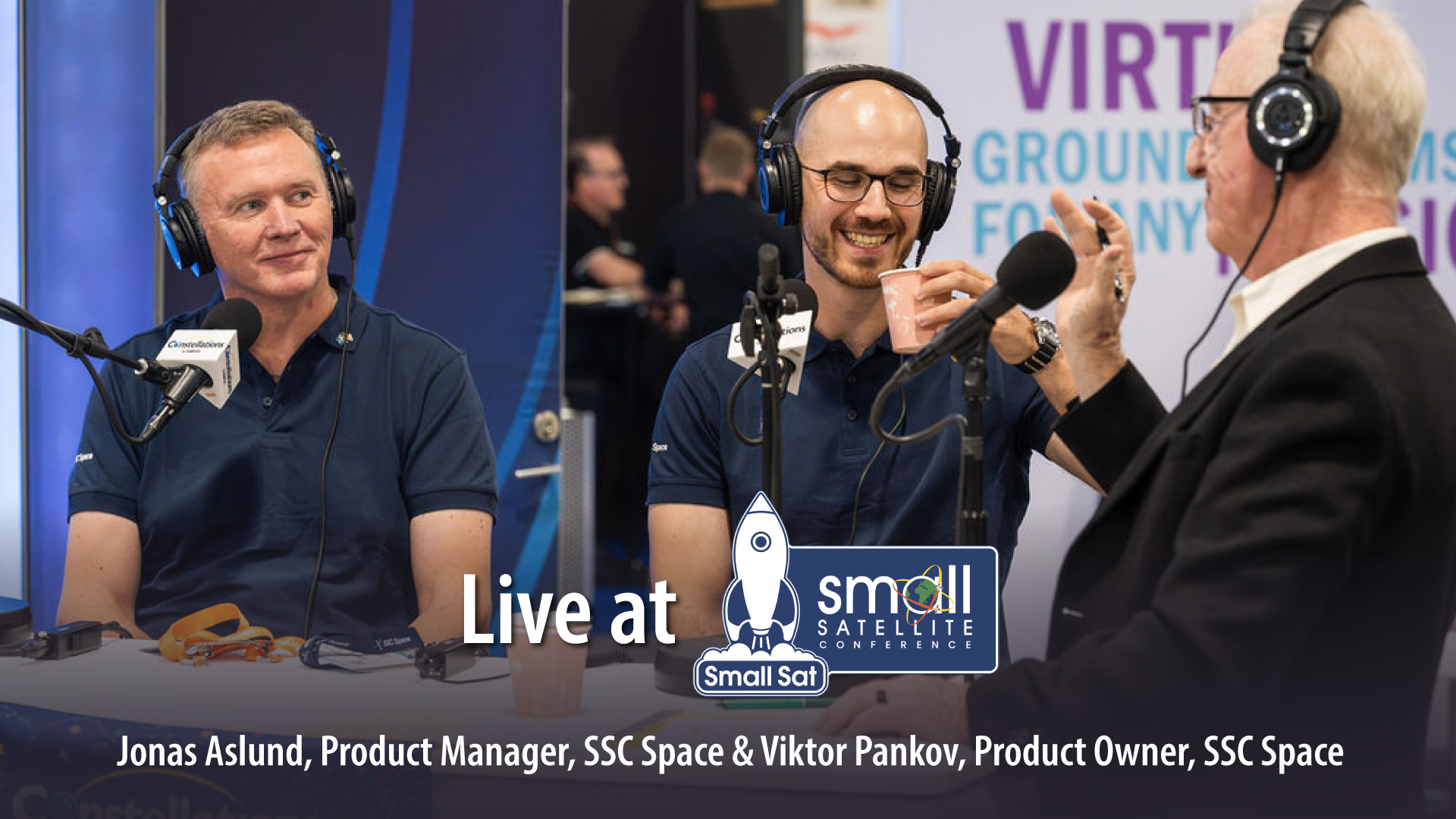
John Gilroy: Welcome to Constellations, the podcast from Kratos. My name is John Gilroy and I’ll be your moderator. On this episode, we’re diving into one of the most important shifts happening across the sector, the emergence of a new space infrastructure built on global ground networks, cloud-enabled operations, automation, a new service model, and these are all changing how missions are launched, scaled, and sustained. As satellite demand continues to grow, this next generation infrastructure is quickly becoming essential. Few organizations have had a closer view of this evolution than SSC Space, and today’s guests have had front row seats. Please welcome Jonas Aslund, product manager, and Victor Pankov, product owner, who will discuss these exciting changes with us. Gentlemen, great audience for your topic today, huh?
Jonas Aslund: Thank you for having us.
Viktor Pankov: Oh, it’s the best audience to have for this. Yeah.
John Gilroy: So in Europe, they have this thing called the World Cup and they kind of go back and forth kicking the ball. So what I’ll do in this discussion, I’ll have a question for Jonas, a question for Victor, kind of go back and forth. And so don’t argue between yourselves, just lean towards me. I have a couple that both of you can answer. Does that make sense?
Jonas Aslund: That’s very good.
John Gilroy: Good, good, good. Okay. First question for Jonas. Many in the industry talk about a new infrastructure of space. From your perspective, what fundamental shifts are driving this transition and why now? Why is it happening now?
Jonas Aslund: Well, we can see it from one point and that is that you see a few years ago we had a few, let’s say, large programs run by government and now we see the trend shifting a little bit from the larger projects or programs to the smaller constellation-driven, commercial-driven systems and programs. So the higher number of smaller spacecrafts and constellations, data-driven systems and such is also part of the new requirements for this type of solution. We also see that the trend is going for higher data rates, more data from space as well. And this is also giving some input to where we need to be. So the shift from what we have seen is based on, let’s say, dedicated hardware and getting that into more softwaredefined, more agile systems to handle today, to be able to cope with the dynamic situations, also the scalability that we have in that sense.
John Gilroy: Yeah. Victor, kind of interesting you talk about small, and I forgot to tell the audience that we’re recording this at the Small Sat Conference in lovely downtown Salt Lake City. Pretty far from Sweden, I’d say.
Jonas Aslund: Very far.
John Gilroy: But appropriate for talking about small satellites and this whole concept of new infrastructure. Jonas, let’s go to Victor this time. I’ll give him a shot here.
Viktor Pankov: Okay. Thank you. Thank you, John. Thank you.
John Gilroy: Earth observation, IOT and multi-orbit constellations are increasing demand on ground networks.
Viktor Pankov: Absolutely.
John Gilroy: How do you see ground infrastructure evolving to meet these new data and latency requirements?
Viktor Pankov: Thank you. Thank you, John, for passing the ball to me. I’d say that ground infrastructure is going to a direction of orbit-agnostic. We need to be able to handle all the orbits there are. It’s not just LEO, it’s not just MEO, it’s not just GEO. We need to be really flexible and our infrastructure should be able to handle not just a certain subsection of missions, but the whole gamut. And IOT and the proliferation of IOT constellations is really driving the demand for flexibility within our ground network. Something that, as Jonas mentioned, with the big government programs wasn’t really a concern, but there’s one buyer that’s going to buy for 15 years and going to be the same thing. Here we’re seeing from year to year, the technology stack is getting more advanced, more complicated. People are launching more capable satellites and we need to be able to meet that on the ground as well.
John Gilroy: Yesterday I did an interview about VLEO, which about five or six years ago no one talked about it, and talked about HLEO, so many different things. I guess it’s important to be agnostic for some of this technology.
Viktor Pankov: Absolutely, John. Absolutely.
John Gilroy: So Jonas, SSC has been involved in expanding global ground station access. What does a truly global interoperable ground network enable for satellite operators that wasn’t possible 10 years ago?
Jonas Aslund: Oh, that’s a very good question. And the technology evolved over time dramatically. So let’s say a decade ago, you had the same possibility to support the same situations as you do today, but also that we see the evolution over time gives us the possibility also to meet the current demand from the customers and the market. So yeah.
John Gilroy: Good, good, good.
Jonas Aslund: I think it’s good.
John Gilroy: So Victor, we’re here at the Small Sat Conference, been around for 40 years, and the theme for this conference is the cloud. They talk about the cloud this and the cloud that.
Viktor Pankov: Absolutely.
John Gilroy: So what do you see the most important or the most impactful market benefits of moving key ground functions to the cloud? Are there any examples maybe you can share of these benefits?
Viktor Pankov: Absolutely, John. First, maybe I’ll lead with this. So in a way, my history of doing space has always been on the cloud. I’m part of this new generation that’s born on the cloud-native way of doing operations and doing data management. And I see no reason that really we should be going back to just having things on-prem, the multi-staged approach. So having things both on-prem and on cloud give us the flexibility that’s needed today. But in terms of applications, what we are really trying to enable with our cloud-based ground stations as a service offering is time to insight. We want to be able to get images downloaded from your satellite and within 10, 15 minutes, you already have actionable insight as to what has actually happened on the ground, where are the assets you’re tracking, where’s that storm heading, and that can only be achieved by doing processing at massive scales that are really enabled by the cloud.
John Gilroy: Jonas, I’m not a big fan of automation, self-driving cars and Waymo. I’m just not a big fan of that. I’m kind of maybe stuck in my ways for that. So let’s talk a little bit more about automation here. So how do you think automation will reshape the way economics and scalability of future space missions?
Jonas Aslund: You see a huge upside of how to add automation into the solution. So let’s say for scheduling purposes, you can have automated scheduling. It makes every orchestration also easier. For also data distribution and orchestration there as well, I think that the automation makes the hands of operations more easy to attract for this type of service. So this will also reduce cost over time. Operational cost will be reduced. And we see that it’ll also drive the possibility for scaling up and add more complex situations into the solutions when we see operations to be provided in this sense.
Viktor Pankov: John, let me challenge you. Okay, automation. No, it’s the way to go. Come on. It’s the way to go. And maybe this is a place for my shameless plug on how much we like Kratos’ open space system because I’m really responsible for running that kind of automation on our ground stations. And it’s really been a game changer for us. It’s the ability to have a single pane of glass where you can see all the assets that are involved in your ground station chain is revolutionary for us and it’s allowed us to really increase the rate at which we can get new people onto the system. And also it has allowed us to simplify the processes for scheduling, for doing telemetry, for doing telecommanding, which has then allowed us to scale back on the number of people that we need to do this. And then from there we can increase the number of missions that we support and we can train our staff on this really, the forefront maybe of automation here.
John Gilroy: So Victor, that’s why you want me to do your podcast, but not your space architecture.
Viktor Pankov: Ah, okay. Okay, John. Okay.
Jonas Aslund: [inaudible 00:09:28]. Don’t wear that hat.
Viktor Pankov: I have a mechanical watch. Okay? I like old-fashioned things as well. It’s fine.
John Gilroy: Victor, you talked about being orbit-agnostic. Well, it’s probably pretty important. If you walk around the show floor here with 5,000 of our closest friends, multi-orbit constellations are increasingly operating together. What does the industry need from modern infrastructure to support this reliable cross-orbit mission management? Wow, what a topic.
Viktor Pankov: Wow. Okay, okay, okay. Okay, let’s go here. So I think the industry needs a single way to schedule contacts from assets that are spread out around the world. There are different classes and they want to be able to get their information and they don’t really care how that happens. And this is where we come in as SSC Space and we’re there to really do that lifting, to do heavy undifferentiated lifting for our end customers so that they can get their payload data down, they can get the telemetry up and we can handle the minutia and the really big lifts of how this actually happens behind closed doors. So I’d say the industry’s looking for a service. It’s looking for service, not looking to build, it’s looking to buy a service.
John Gilroy: So Jonas, I walked around the floor today and I imagine you walked around the floor. All kinds of small companies, all kinds of innovation here. So which emerging technologies in ground infrastructure do you think will have the biggest impact on shortening time to orbit or maybe even time to revenue?
Jonas Aslund: I think you’re going to echo back a little bit on what they talked about in the previous question and their automation for sure. And that’s during the whole mission lifespan. You have from the starting point to when you start to onboard, you have the automated part already included there as well as for scheduling operation purposes. So this will be part of the easier access and shortening of lead time, but also you have the software-defined systems and also the way to operate within software. You can upgrade, update much easily in software if you compare with the hardware and need to deploy new hardware components as well as for the access for current network communications systems as well or networks instead of building something yourself. So if you combine these parts overall, yes, it reduces the lead time for getting operational.
John Gilroy: Victor, my previous guest was Dr. David Voss from the Space Force, and he likes to talk about hybrid. Hybrid this and hybrid that, that’s really a thrust in his projections of what’s going to happen in the future. Many operators are exploring hybrid architectures that include combining owned ground assets with shared global networks. What strategic advantages does this hybrid approach offer?
Viktor Pankov: Okay. Okay, John. So hybrid infrastructure, not just for hybrid clouds, as I mentioned before, not just having your own on-premises servers to do your payload processing and then running some things in the cloud. People are also looking for hybrid ground stations nowadays. I see this trend where you would have a core set of ground stations that you own, maybe for sovereignty reasons, maybe for increased reliability, something that you maybe want two antennas at the same time and you’re not willing to pay for that. But at the end of the day, when it comes to flexibility, you would look at other suppliers at other providers, someone that can expand your network at sites where you don’t have the local connections, at sites where the footprint is just too difficult to establish. And that’s a great place for us at SSC to come in with our really enviable ground station network spread around the world. And we can be that kind of partner to people and institutions that require the reach all throughout the world.
John Gilroy: Gentlemen, I have an RF question. I’m going to give each chance to toss in and maybe disagree with each other or walk away from the interview. What do you want to do? Go to you first, Jonas.
Jonas Aslund: Yeah, great.
John Gilroy: We talked about innovations earlier. What innovations are helping operators mitigate RF interference and maintain signal quality and situational awareness? What do you think?
Jonas Aslund: Yeah, so it’s also related to the technology used. So if you have software components, software-defined radios, for example, that can also be used for the analysis and identify this in an early stage to be able to cope with that type of interference. But we also have a signal, how to treat the signal and also to treat the waveforms. We can have the channelization also if you have some technology, you can also narrow down the channel how to see that it gives minimal risk for interference. But you also have the separation, of course. So physically, yeah, you need to have some separation to avoid interference.
John Gilroy: So Victor, a young modern guy like you, do you even know what RF is?
Jonas Aslund: Good question for you.
Viktor Pankov: Oh my gosh, John, what is this? What is this, John? Okay. Why do I deserve this attitude towards you? Okay. Well, let’s go back to Jonas. Jonas, we’ve been doing space and ground stations at SSC for 35 years, so Jonas knows what’s going on here. And I think he’s seen, I’d say the somewhat slow pace of innovation within this industry for the last maybe 20 years, and then now it’s really picked up in the last 10. So maybe a question for Jonas, actually. Jonas, how do you think that our digitization that we do nowadays for our goal services compares with what you saw maybe 20 years ago when you were doing ground stations?
John Gilroy: Yeah, that’s a good question.
Jonas Aslund: I think it’s a revolution, to be honest. So it gives much more flexibility in the way we can treat the, let’s say, RF data. So also the extension from the antenna, the front end itself until where you modulate or demodulate the data. Yeah, you can have what distance you like today. And in the past, it was some specification of the length of the cables you could use to be able to have sufficient data.
John Gilroy: So many changes. I think a big tsunami wave in the last 10 years has been artificial intelligence.
Jonas Aslund: Absolutely.
John Gilroy: So Victor, what new efficiencies can AI unlock as communication networks go so complex?
Viktor Pankov: All right. So okay, imagine this. You have a constellation of 300 satellites. Okay. You have a constellation of 300 satellites. You have three operators on your night shift. They’re not going to be able to schedule contacts with 300 satellites.
John Gilroy: No way.
Viktor Pankov: There has to be a system behind that that does all of it. There has to be an intelligent, really an artificially intelligent system that looks for the constraints, looks for when you have contacts, looks for when you need to task your satellites, and then does all of that math and decides I need seven minutes here over Kiruna. I need maybe six minutes down here over Western Australia because I’ve tasked my image acquisition to happen over Southeast Asia. I’m going to capture it on the downside when I go towards Australia. You can’t have people make these decisions at this scale. So AI is going to definitely enable us or is enabling us actually already today to do the clever scheduling, to do the clever satellite control.
On the ground station side, it actually enables us to do things like preventive maintenance. It’s looking at how our antennas perform. It’s looking at all the metrics that we collect through the open space system that we use with Kratos. It’s showing us maybe this antenna’s moving slightly too slow, so maybe we should send John out with the car and then he can go and see the servo motor is broken and then put on the big jackets because it’s like minus 20 outside. Yeah. John, would you like that? Would you like that?
John Gilroy: No, no, no.
Viktor Pankov: Avoid the reindeer there.
John Gilroy: So Jonas, I was at a presentation this morning by a guy from the European Space Agency and he was talking about structuring organizations to handle going to the moon. And I wonder if someone has an experience here of handling the moon here. I think you do here. So that’s my moon question for you. Last year you supported spacecraft tracking and communication services for the first commercial moon landing.
Jonas Aslund: True.
John Gilroy: Can you tell us a little about how that compared to supporting terrestrial services and what surprised you about that mission?
Jonas Aslund: Yeah, that’s a very good question. But getting to the moon and the distance to the moon, it adds a lot more complexity if you compare it with, let’s say close-to-earth operations. And this is something that we learned about that is the level of coordinations that we needed to provide both within organizations as well as between systems as well. And I see that this is not an easy way to do services, but yeah.
John Gilroy: Another moon question though. Here’s a real question. What capabilities are required when always-on connectivity, when it’s not just locally, it’s all the way to the moon? A whole special set of problems, isn’t there?
Jonas Aslund: That’s true. That’s true. And then you can segment that into a few pieces. So you have the, let’s say the network, the connectivity grounds to the lunar surface or up to the moon. This is dependent on deep space connectivity solutions and networks. This needs to be enhanced and you have the coverage area that fulfill these overlapped areas. And then you have also the connectivity and you see that you have a seamless connectivity between the terrestrial part orbital as well as the lunar network for communications. So if you combine these in a fancy way and have also intelligent data handling as well, yes, you can find good solutions to have seamless operations there.
John Gilroy: Yeah. Seamless is difficult that far away, isn’t it?
Jonas Aslund: It’s very difficult. And it’s increased depending on the distance you get and also the latency that you see.
John Gilroy: Yeah. All kinds of flexibility there. Jonas and Victor, I think you’ve given our listeners a better understanding of space infrastructure evolution. I’d like to thank our guests, Jonas Aslund, product manager, and Victor Pankov, product owner from SSC.