Transcript:
John Gilroy: The views expressed in this podcast or on www.constellationspodcast.com do not officially represent the views of the US military or the United States government. The appearance of US Department of Defense, DOD, visual information does not imply or constitute DOD endorsement.
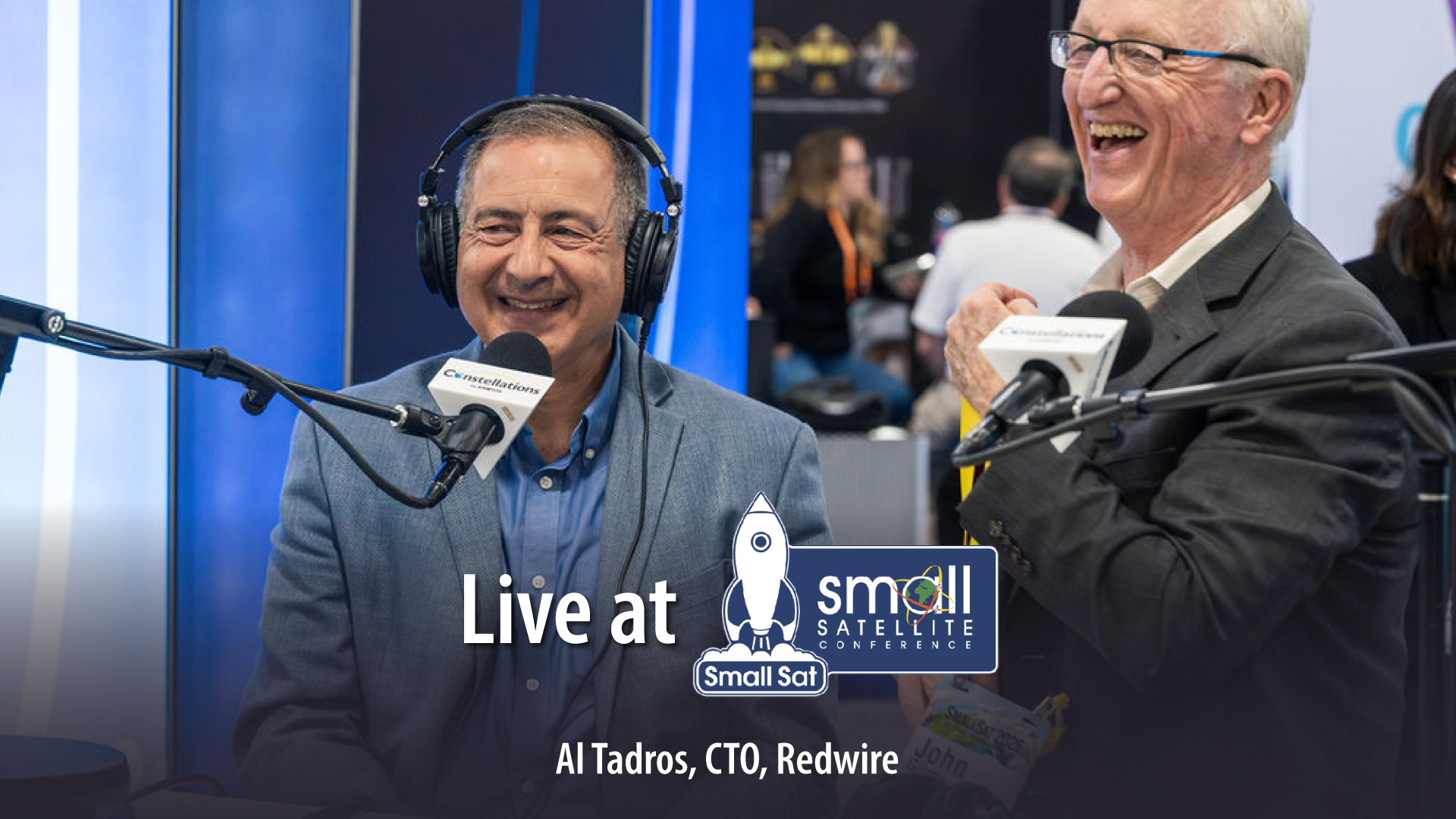
Welcome to Constellations, the podcast from Kratos. My name is John Gilroy and I’ll be your moderator. Our guest today is Al Tadros, chief technology officer at Redwire. We are recording this from the floor of the Small Sat conference in lovely downtown Salt Lake City. Have you ever been here before, Al?
Al Tadros: I have, and it’s a great city and great conference, and thank you for having me, John.
John Gilroy: True confessions, Al made the mistake of being interviewed by John Gilroy previously. That was probably the worst day of your life, wasn’t it, Al?
Al Tadros: No, no, no, no. It’s always great. Yeah, it’s a great discussion always.
John Gilroy: Okay. Okay, back to the regular official introduction. Al Tadros, his career has spanned some of the most significant advancements in the commercial space industry. In this episode, we will discuss why orbital data centers are quickly becoming a realistic and exciting architectural possibility, what’s driving that shift, the engineering challenges we still need to solve and how autonomous operations are redefining the future of space infrastructure. Al, okay, welcome back.
Al Tadro: Thanks. Thanks, John.
John Gilroy: Last time we talked about how artificial intelligence is transforming space domain awareness. Orbital data centers feel like a natural extension of that conversation, don’t they?
Al Tadros: Absolutely.
John Gilroy: So I’m going to jump right in. And if Elon Musk wants to call in and make his opinion, we’ll [inaudible 00:01:59].
Al Tadros: We’ll let him jump in a bit.
John Gilroy: Yeah. He has some opinions about this as well. Al, the concept of orbital data centers has moved from science fiction to serious engineering discussion. What has changed over the years that make this conversation credible today?
Al Tadros: Yeah, it’s pretty amazing. Over the last few years, as you mentioned, AI has gone from research labs to kind of everyday dinner table conversations and tools. People are using ChatGPT, they’re having agents they converse with and have them help make decisions in their daily lives. And data centers are critical for all of this. There’s a tremendous amount of discussions about data centers, building out of data centers. And of course there’s a lot of controversy, whether they increase cost of utilities, water usage, blight, not in my backyard. So it’s been an approach from outside the space industry looking in as, hey, is this a credible approach to putting data centers outside of our area using resources from outside the Earth, heating air or heating areas that are outside?
So there’s been a logical, hey, does this solve some of the problems that we’re seeing here? And quite frankly, there’s no physics that says we can’t. There’s a lot of engineering, there’s a lot of hard problems, but that’s what we do in space industry. So that’s where it’s happened over the last couple of years. And quite frankly, it’s been pretty exciting because there is a lot of history that says we can do quite a bit with data centers in space.
John Gilroy: Al Tadros, T-A-D-R-O-S, very well known in the industry, write articles and appear on podcasts as well. In a recent paper, I think you focused on power and thermal management rather than processors or AI. Processors, that’s the front page of the newspaper, Al. They don’t talk about thermal management or power. So why are those two disciplines really the architectural drivers that determine whether orbital data centers become real?
Al Tadros: Yeah. Well, the challenge is really to scale all of it simultaneously. There’s a tremendous amount of investment as you can see going into companies like NVIDIA and Google and others building out GPUs and scaling that production. That’s great. Now you need power to run those GPUs and thermal management and bandwidth and comms and data. And there’s solutions and industries working on those solutions across the board, including in the space industry. Repeatedly, people look at the space industry and think, well, do you have enough power that you can run GPUs? Do you have enough thermal? And I’m hearing a lot of different things and some of it wasn’t quite founded on real engineering.
And we wanted to just set a level set on all that discussion with, okay, this is what we do in space and these are the equations that we live by, the physics behind it and what the supply chain provides, whether it’s solar cells and the efficiency of solar cells, deploying solar arrays, single satellites versus constellations. And then where you generate power, you have to manage heat and we do manage waste heat in space. So it goes into how do we do that and what are the equations that define radiation versus convection of waste heat? So that paper was kind of tying things together to, hey, if you have GPUs, if you have the launch, this is how you manage the power and thermal. And it’s not anything that has to be invented, we actually have solutions for those.
John Gilroy: You’re listening to some background noise. This is 5,500 people walking around Small Sat and I’m sure there’s some software developers here. If you sit down and have lunch with a software developer, especially with a large enterprise one, they may use the phrase, “Lift and shift.” You’ve probably heard that. Okay. Many people think of orbital data centers as simply putting today’s data centers into space, lift and shift. No, no. How different is the architecture likely to be and what assumptions from terrestrial computing just don’t longer apply?
Al Tadros: Yeah. So yeah, orbital data centers are not just putting a building in the rocket and launching the building. There’s a lot of process and well-trod procedures for how we put things in space and how they survive, survive even launch. So I’ll describe it like we do for communication satellites. So you have cell towers and there’s cables running out to them, power running out to them, antennas on the cell tower. You have different companies putting antennas on the cell tower. Well, we have the same thing in space, communication satellites that have antennas on them, but they have solar arrays. So they generate their power. They have heat radiators, so they radiate their waste heat. And then they have RF antennas that communicate between other satellites or between ground. In very much the same way, data centers are extracting the core, the GPUs, the processing, the connectivity, the memory, and putting it into an infrastructure that can be launched, deployed, and operate in space.
It’s that simple. And in fact, as some people have heard Elon Musk and others talk about, it’s actually simpler than communication satellites in that you don’t have the antennas that are required and the frequencies and so forth and link budgets that are required. This is literally compute and use of the energy that you’re generating in situ and waste heat in situ. So it’s all combined. You don’t even have to point at Earth. Most of these are intended to point at the sun, consume energy in the GPUs, and then radiate heat towards cold space, which is ideal. It’s almost made for the space missions that we build.
John Gilroy: Al, I was at a keynote this morning and one of the speakers said, “We used to just think of one satellite going up. Now we have to think of satellites in constellations.” So as AI continues driving demand for compute, where do you see orbital computing fitting into this overall computing ecosystem now? That’s what it is. Is it a replacement for traceable data centers or just another layer in a much broader architecture?
Al Tadros: Yeah. So I see it as not a replacement. In fact, it might be a very small percentage of total compute. We might only see five to 10% of total data center compute in space, but that’s a huge actual content and budget and value in the space industry. So 10% of the global data center capacity in space, and I believe there’s over 5,000 data centers now around the Earth, even 10%, 500 equivalent data centers is major. So I see that as augmenting and in some cases being a necessity, whether it’s for sovereign nations or US government needs, security, and then eventually as we expand into the solar system for in situ compute. So how are we going to practice going to Mars? Well, we’re going to set it up at the moon. We’re going to have data centers there. So there’s different avenues for why we would put it in space and why it benefits us to put it in space and those are some of them.
John Gilroy: I mentioned that Al’s very known in the industry, written a lot of articles and participated in a lot of panels. If you look at your work, one of the themes of your work is treating power and thermal management as system-level design problems right from the beginning. Is that representative where the space industry is heading more broadly, thinking in terms of integrated architectures rather than just an individual aircraft?
Al Tadros: Yeah, very much so. A lot of people look at compute as, oh, you have a processor, let’s put that processor in space. Well, it’s possible, you can slap it in there, but a smarter way to do it is let’s package it in a space rated packaging with power and thermal management thought through. An integrated solution will oftentimes be more mass efficient, cost-efficient, power efficient. So there’s benefits to doing that and sometimes it’s necessary. When we go to space, we launch things. And when in a launch vehicle, it’s quite violent. There’s a lot of vibration, acoustic energy, shock at separation. So we actually have to think through it and we have to think of it as a system, not only a system at the spacecraft level, but then at the whole architecture.
How is it interconnected? How big is the individual satellite? How many satellites in the constellation? What orbits are they in? And then what mission are they serving? So all that we think about together and even, well, what’s the supply chain have available? So we don’t want to design something and say, “Hey, it’s a perfect constellation,” and nobody can make that solar array. So we try to think about what’s all the practical, pragmatic decisions that have to be made and optimize across all of them.
John Gilroy: In a previous answer, you mentioned lunar, so I’m going to jump on that one here. Building on your previous discussion about sustainable lunar infrastructure, how do orbital data centers fit into the long-term vision of permanent commercial infrastructure in space? Is this another step towards an actual, I mean a for-real space economy?
Al Tadros: Yeah. So first of all, as most of the audience probably knows, NASA is heading towards having private habitats in low Earth orbit and making use of private habitats in low Earth orbit and having humans permanently on the lunar surface. So where humans go, we like to have our compute capabilities, our AI, our search, our data. So I see that that’s going to propel a lot of the space economy. And definitely, as NASA has stated, we are going to use the moon to prepare for going beyond the Earth-moon system. And when we do that, we want to operate the way that we’re going to explore, and that includes taking our compute with us. So in the lunar architecture, even if we don’t absolutely have to have it there in order to make it work because of how close it is to Earth, what we want to do is practice the way we’re going to explore. So that’s some of what I see on the lunar surface.
John Gilroy: Let’s jump around here from orbital computing to maybe a more interesting topic here. So what supporting capabilities have to mature first before we have orbital computing? Is it launch? Is it onboard servicing? Is it robotics? Is it optical networking? Is it standard? So which one of these do you believe is the lead in the pacing item for this?
Al Tadros: Yeah. Well, one of the biggest ones, and I’m very hopeful, one of the biggest barriers has been cadence of launch, mass of launch, and cost of launch. That has to be solved. The access to space is one of the biggest barriers to large scale industrial level infrastructure in space. So if we can get super heavy lift, things like New Glenn and Starship and others on a cadence of multiple times a week or multiple times a day, you start to see a scenario and the price points dropping, you start to see a scenario where it’s very feasible to put up things like massive data centers in space in a cost-effective way. And by that I mean down below $200 a kilogram, $50 a kilogram, those kind of numbers, and you’ll start seeing it make economic sense. I personally am hopeful that that is our future. I know that people are working very hard towards that, not only Falcon-9-sized vehicles, but super heavy lifts. And that is one of the biggest barriers.
Some of the others are, yeah, if we had robotic servicing or refueling, that’s great avenues in the trade space, but quite frankly, I see the need to continuously upgrade and replace. So why? Well, terrestrial compute is going in that direction. If we want to stay relevant to terrestrial data centers and terrestrial compute, we want to be constantly upgrading and replacing what we have in space. So that’s how I see it. Yes, we can make things last 5, 10, 15 years in space, but instead we will most likely want to replace and de-orbit or replace and deplete what’s up there in order to constantly be relevant and modern with our compute.
John Gilroy: Al, I live in the Washington DC area. I’ve done a lot of interviews with military folks and they like the word resiliency. This is really popular word at the Pentagon, we know that. I’ll put it in perspective here. Governments in general, governments are increasingly discussing resilient space architectures rather than individual systems. So could orbital computing become part of the future national security architectures? And if so, what unique advantages would that capability have?
Al Tadros: Right, right. Well, yeah. So the government has already exploited that feature of space. Some of our military’s protected communication systems are in space for the reason of, first of all, high ground, but also separation from threats, so physical threats or tampering. So there are definitely those advantages, government and military advantages for having things in space or just having a variety of different avenues. So having them on Earth, great. Having equivalents in space, greater. So you have that resilience from a heterogeneous type of architecture. So I believe that’s going to be the case. Yes, some of it will be in space for space, but more likely in the near term, it’s going to be largely in space for the purpose of supporting ground troops, ground activities.
John Gilroy: When you go around the conference here, I’m sure you sit in different individual presentations, you see different themes. It seems that space systems are becoming more distributed and autonomous. So how do you see AI, onboard processing, orbital compute, how do they all change the way these constellations in the future operate compared to today’s where we’re mostly ground-based?
Al Tadros: Yeah, yeah, yeah. So I’ve been very fortunate to live in Silicon Valley for 35 years. 15 years or so ago, Google started this project called Waymo, and they had the most bizarre looking experimental cars and slowly they became more consumer-like and behaved more human-like. I think that there’s been so much advancement in the last 10 years in autonomy, in human interfaces, of course in AI, that’s leapfrogged a lot of the barriers historically. I think that’s coming in the space industry.
I think it’s going to leapfrog a lot of the conservatism that we’ve had in the space industry, a lot of the platform autonomy, but more importantly, a lot of the mission autonomy, meaning that a constellation is trying to serve a certain mission. You can back up satellites with each other or ground and space or ground, air, and space and operate in an autonomous fashion across all those domains. So those are the things that I expect coming at us, and quite frankly, we’re excited to be working those at Redwire. So yeah, the level of autonomy in platforms, but at the mission level are all going to be accelerating.
John Gilroy: Waymo was, of course, an emerging technology a while back. Every emerging technology goes through a period where expectations just exceed reality. So from your perspective, what are the biggest misconceptions you hear about orbital data centers and what technical challenges still need to be solved before they become commercially viable?
Al Tadros: Yeah, it’s a very good point. And quite frankly, I think self-driving cars were touted 15 years ago to be right around the corner. And the reality is these are hard problems. And yes, we have very passionate technologists and visionaries and that’s important, but the reality is things sometimes go badly and we learn and that learning curve can bite us. It can cost us a lot. It can impact our credibility, but the persistence that I’m seeing in the space industry around projects like orbital data centers, like private habitats, I know that we might stub our toes here and there, but that’ll only teach us what doesn’t work so that we can go in the direction of what does work. So I’m very hopeful in that regard.
John Gilroy: Tough to make presentations with predictions here, but I’m going to ask you some predictions here and see how you wound up. If we look five to 10 years ahead, what milestones should the industry watch for that would tell us that orbital computing finally it’s moved from experimentation to operational infrastructure? What do you see?
Al Tadros: Yeah. Well, number one, I think the launch challenge that I described, the frequency, the capacity and the cost, if we get to that mark where we’re below 1,000 and heading down to $500 a kilogram, $200 a kilogram, I think you should go all in. I’m giving financial advice here, go all in. I think that that was one of the biggest barrier. It doesn’t mean that the first one out will succeed. It just means that at that point we have the kind of VC kind of environment for going out, starting, trying, and then the combination of trials will get to the envisioned capabilities.
So that’s number one is the launch capability. Number two, quite frankly, is the adoption. If it becomes the human experience to have AI agents, if it becomes a natural part of our daily lives, that means the economic value of putting it in space is there. And that motivates us and justifies the efforts to putting it in space. So those two items, and if they both are occurring in the next two to three years, which I’m hopeful those will, I think you’re going to see a huge jump in deployment and build-out of orbital data centers.
John Gilroy: Al, I mentioned a previous interview, you spoke with us earlier about sustainable lunar operations and AI for space domain awareness. Looking across all these conversations, do you think we’re beginning to see the emergence of a true space infrastructure stack, communications, sensing, compute, power, servicing, autonomy? Do they become interconnected rather than separate markets?
Al Tadros: Yeah. I think most people might not realize that their daily lives depends on space in numerous ways. First of all, GPS, how many ways is that integrated in our daily life? How many times did I put it in even here in Salt Lake City to figure out where the restaurant is and where to walk versus drive versus whatever? So GPS, communications over satellites is an avenue that we use and it’s completely out of sight. Weather, how many times do you look at weather forecasts? Well, that’s aided. And yes, the more that we depend on data and information, the more space is relevant. And I think data compute in space is going to be part of that ultimately.
John Gilroy: Al, I think you’ve given our listeners a better understanding of orbital computing infrastructure. I’d like to thank my guest, Al Tadros, chief technology officer at Redwire.
Al Tadros: Thanks, John. Appreciate it.