



AST Has Too Few Satellites for Beta Service This Year, 2027 Outlook Uncertain; Co Building a Rocket with Firefly Technology

Originally published by Space Intel Report. Read the original article here.
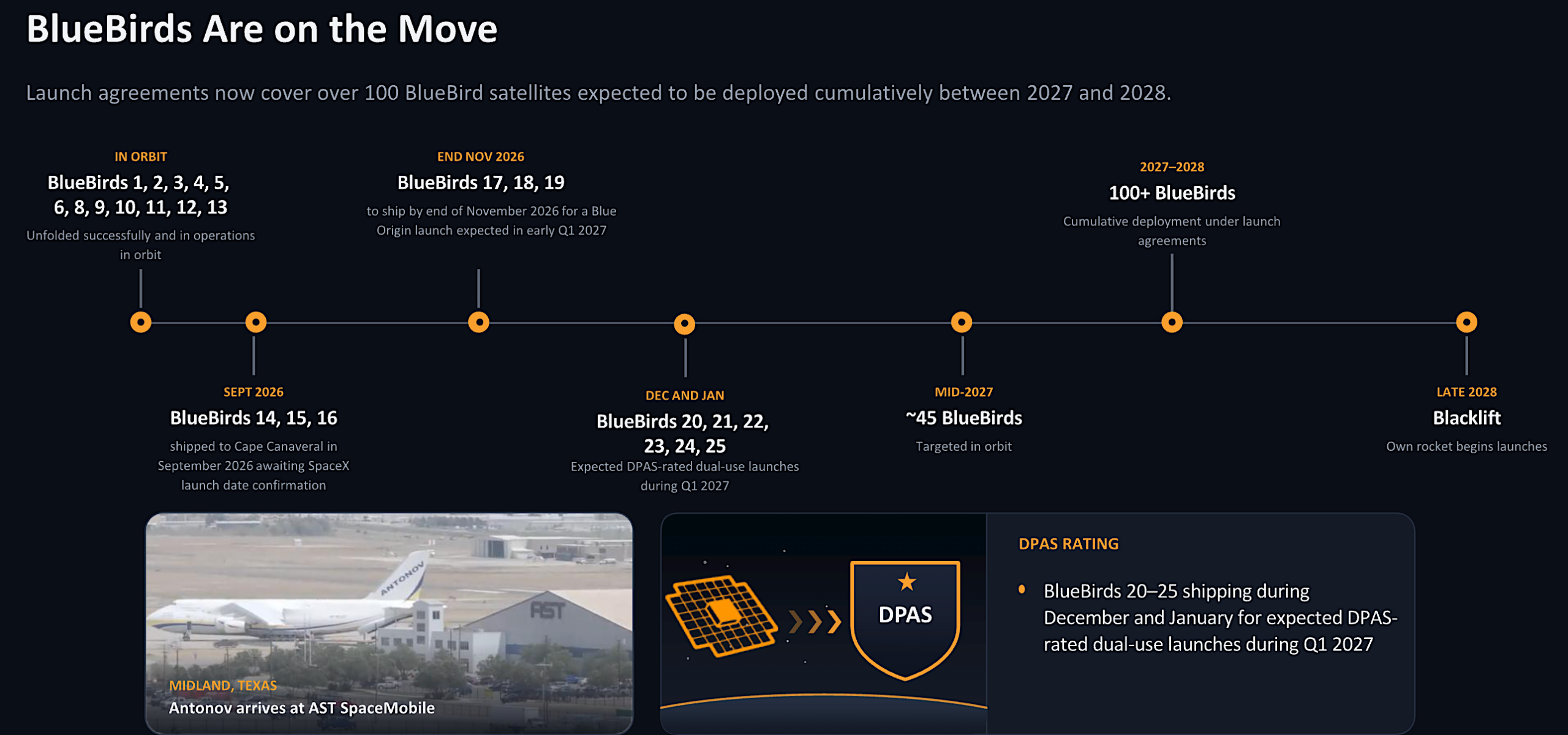
Satellite direct-to-device startup AST SpaceMobile said it expects to start intermittent trial commercial service in the United States and a half-dozen other key national markets by late December but will not have enough satellites in orbit to conduct even beta trials by then.
As has been the case for some time, AST’s plans are running up against the same limited launch availability that is slowing satellite deployments in many regions.
AST has 13 satellites in orbit. It has said it needs 25 to be able to offer intermittent direct-to-device service in its key early markets. With 45 satellites in orbit, continuous coverage could be provided to these markets. With 90 satellites, the company can offer continuous coverage in most of the world.
The company shipped BlueBirds 14-16 in September to Cape Canaveral in anticipation of an early SpaceX Falcon 9 launch. No launch date had been fixed by SpaceX as of Nov. 9.
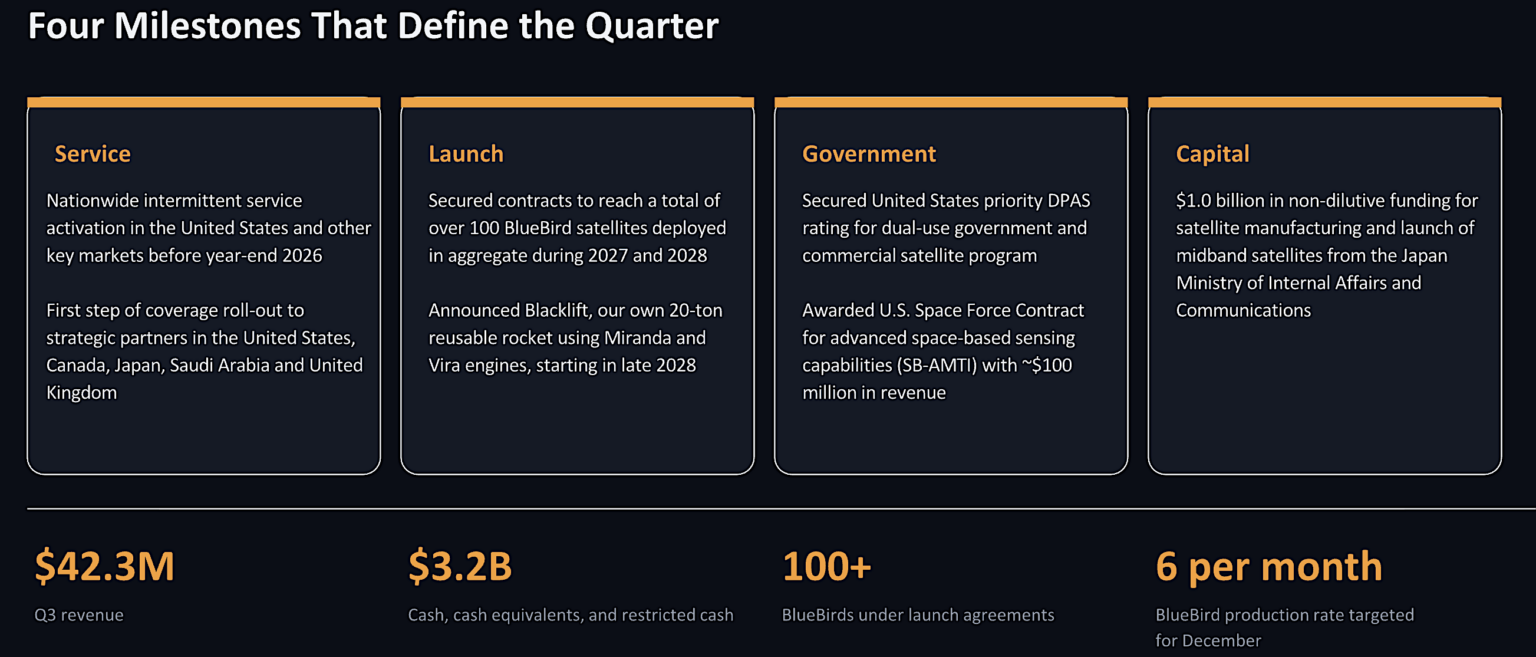
Sometime in late November, the company expects to ship three more satellites, this time to Blue Origin for a New Glenn launch before March. AST is putting just three BlueBirds on the Blue Origin New Glenn out of caution; the rocket in April suffered an upper stage malfunction, leaving BlueBird 7 in a useless orbit from which it de-orbited.
In a Nov. 9 investor call, AST SpaceMobile management said the company would ship BlueBirds 20-25 in December and January for launch on multiple rockets between January and March. The vehicles will benefit from a Defense Priorities and Allocations System (DPAS) rating under the US Defense Production Act.
Hardware given this rating has priority in the US industrial supply chain. But given that both Blue Origin’s New Glenn and United Launch Alliance’s Vulcan rockets are returning from in-flight anomalies, it’s unclear how much spare capacity these vehicles, plus the SpaceX Falcon 9, will have in Q1.
It will be up to AST’s mobile network operator customers, meaning AT&T and Verizon in the United States, to determine when to switch on commercial service, even in beta mode, and when they will begin paying service fees to AST.
What does AST plan as an initial intermittent service by December?
“The coverage that we’re lighting up for our top partners in a few key markets is providing the service to them. What they’re going to see is a combination of gateways working, spectrum available and nationwide availability when a satellite is overhead,” AST President Scott Wisniewski said. “That’s a very key step here and that’s what we can do providing beta to the end user with our customer. So those trials we see happening in early 2027, after we’ve provided this initial availability. We think those beta trials are best with about 25 satellites, although there is some flexibility there.
“Our long-held target has been to light up that network for them and that’s what we’re focused on right now, with beta to follow shortly thereafter, early in the year.”
The company now expects to reach the 45-satellite milestone for continuous service in its early priority markets by mid-2027 and 90 satellites deployed by late 2027 or early 2028 under existing launch agreements.
Does AST view the initial service with just 13 or 16 satellites as pre-beta, which would be followed sometime in 2027 by a full beta regime with satellites available perhaps half the day in the priority markets? That’s not clear.
AST Chief Executive Abel Avellan said the company is “on track for nationwide intermittent activation in the US and other key markets before the end of 2026.” Later during the call, he referred to “initial intermittent service in key markets by end 2026.”
Blue Origin recently announced that its return to flight, planned for late this year, would slip into January as it completes the rebuilding of its Cape Canaveral launch pad.
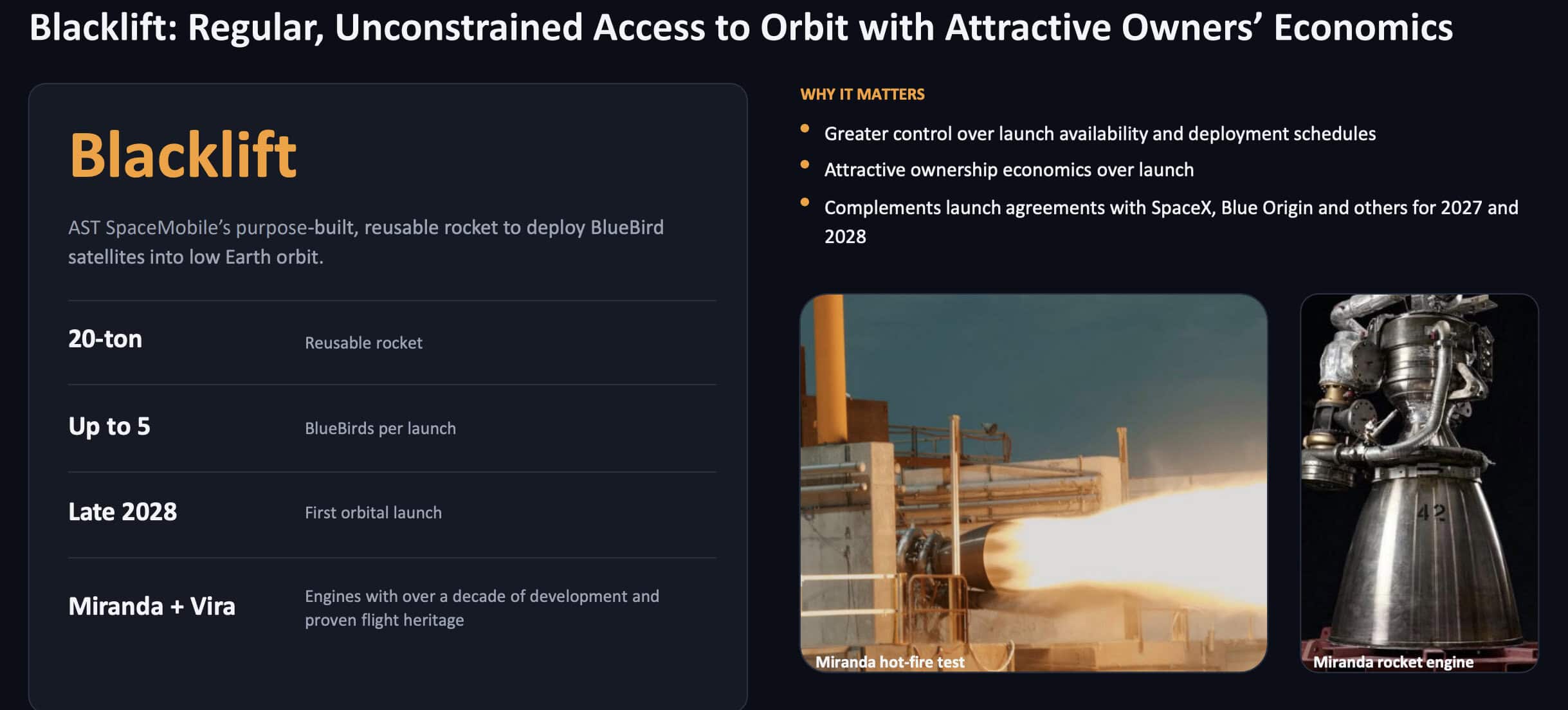
To mitigate future launch availability issues, AST announced an agreement to purchase Firefly Aerospace’s Miranda rocket engine to develop an AST-designed, all-composite Blacklift rocket that will carry five BlueBirds at a time to low Earth orbit.
Here too there was confusion about Miranda’s history. Avellan said the engine offers “flight heritage, with attractive ownership economics,” and would be ready for orbital flights starting in late 2028.
But Miranda has no known flight history.
Wisniewski said: “Miranda combines successful testing and maximum performance, with more than 175 hot-fire tests and a completed flight-like test. We’re not just buying any rocket technology, it’s more than a decade of development and proven flight heritage.”
AST is paying Firefly a total of $1.3 billion, including $800 million for the license to build Miranda engines — $400 million in cash, $400 million in stock — and $500 million for Firefly to provide Miranda and Vira engines for the three first Blacklift rockets and three years of engineering support.
Asked whether a two-year program from licensee purchase to orbital flight is realistic, Avellan said:
“Every successful launch company starts smaller and then upsizes. We have bypassed that process, which takes years. Eight launch companies in China, how long have they taken? We acquired the IP with certain parameters, to [manufacture] the engines and use the same technology that has been hot-fired more than 150 times.
“We have extensive history with composite. Satellites are not so different from a rocket and we are using this history for Blacklift. The satellites are all composite now and this vehicle is all composite as well.”
Originally published by Space Intel Report. Read the original article here.