Transcript:
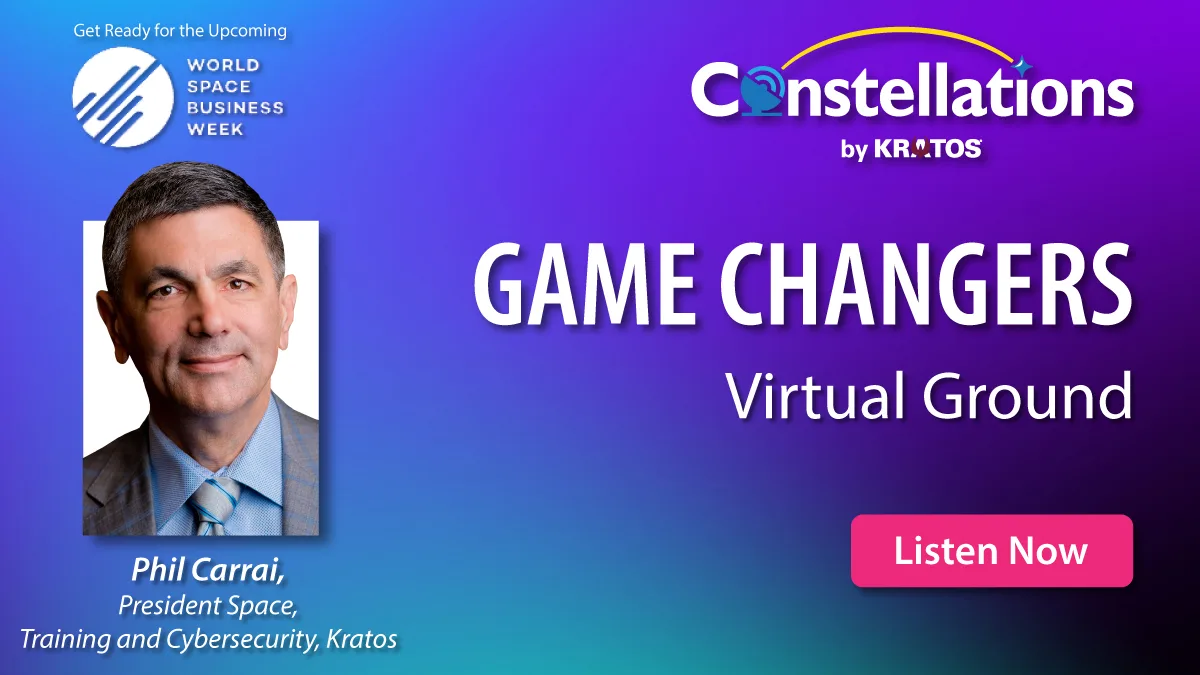
John Gilroy: Welcome to Constellations Game Changers, a limited series of short podcasts, each focused on a pivotal new technology or trend for the satellite industry. Our guest today is Phil Carrai, President of the Space, Training, and Cybersecurity division at Kratos. And the topic we’ve chosen for Phil is Virtual Ground. Phil, I have three questions for you. My timer’s set for 10 minutes. Are you ready?
Phil Carrai: I’m ready.
John Gilroy: Okay. So Phil, as satellite ground systems embrace modernization, the term virtual ground system has become more prevalent. Can you explain the concept?
Phil Carrai: Sure, John. So virtual ground is us moving, the industry moving from what has been purpose built, stovepipe, or static systems that were focused on very specific business applications within the communication or satellite space to a software-based system that is more dynamic and less dependent on a specific application or a specific use case.
John Gilroy: Good. Well, Phil, this series is called Game Changers. With that in mind, how can virtual ground transform the industry?
Phil Carrai: Well, I think it’s about the industry already in transformation. For the last 10 years, we’ve been moving away in space, specifically in the commercial sector from what had been a very much broadcast dominated world where you were providing broadcast and occasionally data services to a world today where we’re providing a variety of data services. Broadcast clearly has declined as a component of revenue in every communication sector. Data has increased, and that has had a fundamental change in how we provide service. Secondly, we’ve seen the emergence of earth observation imaging sensing spacecraft commercially, which 10 years ago it was very much a niche business controlled by government. So those two factors moving away from a broadcast dominated single area into a more dynamic area in terms of the services provided more data, more different types of data, and then also the kinds of things that we’re communicating: imaging, sensing, those sorts of things, has really changed how a satellite operator, how a managed network operator, how a consumer, and whether that consumer is a business or an actual consumer, takes the data. So where we see the ground fitting into that environment is we have to drive flexibility on service type. We’re unable to predict the kinds of things that they used to. You could predict 10 to 15 years worth of broadcast life in a 15-year-old GEO spacecraft, impossible to do today. So the flexibility and the kinds of service that you want to deploy and where you want to deploy that service is really essential. You’ve got to drive the cost of service down. It’s a very elastic marketplace. We see that in the terrestrial world. We see it in the wireless world, and we’re seeing it on the space-based data world. The lower the cost of the service, the more service you can go deploy. So that’s a second big factor. The third is that you really have to improve the time to service. The timeframe that it took to deploy a new service 10 years ago is unacceptable with the kinds of services that people are looking to deploy today, whether they’re mobility services, whether they’re enterprise services, or whether they’re consumer services. So the timeframe to services has to improve. The last one is I think the industry has to get there to compete with the new emerging players, the new emerging players, SpaceX, Starlink being the biggest, is coming to the marketplace with their own fully virtual ground system as part of an initial offering. So the last piece is we’re going to have to get there to compete as an industry with what’s happening in the competitive landscape. So those are the four things that I think are the benefits and are the drivers flexibility of service, lower the cost of service, improve the time to service, and frankly give the industry an opportunity to compete in the world that is emerging or in the world that has emerged over the last several years and will continue for the next decade.
John Gilroy: So Phil, when you look to the future, in the next few years, will virtual ground systems become mainstream?
Phil Carrai: Yes. I think we’re already starting to see that. I think like in many cases there’s the talk precedes the activities and some of that has to do with how long it’s been taking to get some new capacity, the new dynamic capacity up at the space layer. But I think if you look out three to five years, the only way that the industry will be able to effectively compete with who are big emerging players is to have a ground system that’s virtual and dynamic. That’s our supposition and able to take or manage different services, different applications in a cost- effective manner. So we are absolutely a believer if you look at five plus years. The majority of the new ground systems that are deployed will be virtual ground systems.
John Gilroy: Well thanks, Phil, for being our guest in this short episode. Constellations is partnering with Novaspace to bring you exclusive content leading up to the World Space Business Week. Hear more from Phil at the event, and we hope you enjoyed this episode in the meantime.