Transcript:
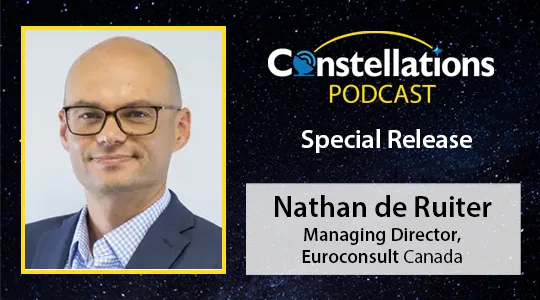
John Gilroy: Welcome to Constellations, the podcast from Kratos. My name is John Gilroy and I’ll be your moderator. It’s no secret that data-driven decision-making is also smart decision-making, especially for entrepreneurs and senior executives in just about any industry. Euroconsult market intelligence has spent more than 30 years tracking all levels of the satellite space value chain resulting in several million data points, continuously enriched and refined to provide actionable insights. Today, we’ll be talking about the state of play and prospects for the satellite communication sector. I have a hunch that Nathan de Ruiter, Managing Director for Euroconsult Canada, will leverage market intelligence to help us understand the changes, drivers and trends in the satellite industry today. So Nathan, we’re going to jump right in here. As with all markets and pretty much every situation with humans, the challenges we face help us find the opportunities that we may not have seen otherwise. After all, necessity is the mother invention. So what are some of the biggest challenges facing the satellite industry today?
Nathan de Ruiter: Great John, thanks for having me. Yes, surely, the biggest challenges that we have seen already now for a few years is this decline in broadcast revenues. So historically satellite operators have really benefited and had a lot of revenues coming from DTH, which has been on a downward trend for years right now. So they’ve definitely recognized the shift and have started to make significant investments in their networks as well as in organizations and this has been a pretty significant shift for them.
Nathan de Ruiter: So if you look at what we’re basically seeing today is that all these kind of massive investments in new satellite infrastructure in place are basically coming to the market and it’s kind of right now the time to see how they will play out. And I think it’s a new area of the satellite operators to see, can we drive sufficient revenues and monetize this new market opportunities to bring return over our invested capital. So yeah, definitely a lot of challenges today but it’s all there to break something, a new turn to the industry and with a lot of growth opportunity.
John Gilroy: Now, if you look at the last five years, lots of changes in satellite space industry, but lots of changes in other industries. Look what COVID’s done. It’s caused big companies to pivot, change, and move. I think that’s what we’re getting at here, is that they can survive if they pivot and change and move. So my question to you is, what are the opportunities that you see are born from all these changes and challenges?
Nathan de Ruiter: Yeah. So again, as I said, we see the shift to broadband, and if you break it down for broadband, there are three big opportunities and as we break it down is first, what we call the universal broadband access. So think about connecting, let’s say villages, schools, and hospitals, all to bridge this digital divide. Helping the more rural communities also be connected to the internet. That’s one big opportunity. The second one is what we call the mobility segment. So think about the ships or airplanes that go over oceans and not be able to connect to terrestrial networks. So here again, satellite has a natural play. And the third one is defense and security, which has a longstanding kind of satellite connectivity play, but we see increased interest to use secured satellite communications to either connect UAVs, ships or even base camps where soldiers, for example, are situated.
Nathan de Ruiter: So altogether this is a very significant market opportunity. By conservative estimates, we think the opportunity is up to close to $60 billion in annual revenues. And the satellite industry has only scratched the surface of that opportunity today.
John Gilroy: Right. It’s incredible the changes just in universal access and the federal government here and what they’re funding. It’s really amazing what’s going on here. Let’s delve into this a little bit deeper here. So Nathan, can you share with us a little about some of the key demand drivers that are driving fundamental change in these satellite markets?
Nathan de Ruiter: Yeah. There are a few. So I would say first and foremost, the digital transformation. You see a lot of enterprise users typically use cloud applications, typically new applications that really drive more demand for bandwidth. As well as on the consumer side, Netflix, YouTube, I think everybody is using it. It’s part of our daily lives. So when you’re a crew at a ship, you also want use of those applications. So altogether, these applications really drive the need for demand for satellite connectivity.
John Gilroy: Yeah. Speaking of drivers, let’s talk more about those. When you look at the market, and you break it down, there are many market drivers impacting the satellite industry, but it seems like the demand drivers influence the structural drivers and satellite capacity sort of influences the change rate. So can you explain the dynamic between all these drivers?
Nathan de Ruiter: Yeah, so we talked a little bit about the demand exponentially growing, and I think the other key element is to it that historically we’re very much limited by what the satellite systems could supply, and that’s really drastically changing. So what we now see is these kind of data caps or limitations being taken away, and that does definitely translate into much greater usage. One of the key findings of the report, and it’s a significant, I think, data point, is that if you look at the total capacity flowing over satellite networks in 2022 to 2021, there’s a 70% increase. So it really showed, we’re now at the part there we see exponential growth on the traffic flowing over satellite networks.
John Gilroy: Well Nathan, let’s focus in, maybe put our sites on this report. I’ll bring it up and tell you bit about it. One of the structural drivers from your 29th Edition Satellite Connectivity and Video Market Report, is satellite and 5G network integrations, essentially 5G from space. This is one of the aspects of this report. So does it look like we’ll be seeing a 5G satellite solution anytime soon?
Nathan de Ruiter: Yeah. There’s just different ways to look at it. So on the one hand we have let’s, what we call the more traditional, basically what we call cellular backhaul. So you’re basically a 5G site, remote located would be using satellite to backhaul its traffic. And we see now the first deployment, so in United States and Japan, there’s the first 5G sites now that are being backhauled over satellite. And we expect this definitely to grow over time, especially in more emerging regions. And based on our latest forecast, we think that it could even go well beyond 10,000 sites by 2032. The other domain where we look at with a of a lot of interest is what we call the direct-to-cellphone play. So basically it transforms satellites into what we call mobile towers in space, and you can connect directly to an unmodified cell phone. So today you have the Apple and Globalstar example where today it’s only an emergency service, but there are kind of companies working on new technical solutions that would also allow to bring probing capability to those cell phones. So I think we’re still a few years away, but that’s definitely on the horizon to bring this truly 5G from space.
John Gilroy: Well, Nathan, you and I have been around long enough to remember when SMS texting was first introduced, it was an announcement, “Okay, now I’m going to send an SMS text to Nathan.” And it was like a big deal. Now teenage kids are doing it, everyone’s doing it, so it’s just a matter of planting the seed and then people really see the power that it gives you.
Nathan de Ruiter: Very true.
John Gilroy: Let’s talk about operator strategies here. Have you seen any change in operator strategies to adapt to this changing market environment?
Nathan de Ruiter: Yeah, I think the biggest change is that we see less of a focus on hardware only, like building the infrastructure, but really seeing a stronger focus as well on reaching to the end users. Would either be in mobility or in our fix prob and connectivity. And that also translates into the revenues. So if you look at revenues today, about 20% of the revenues from satellite operators are derived from services to the end users. And if you look at it five years ago, that was much smaller percentage. So there’s a real change from the operators to get closer to the customer.
John Gilroy: The Constellations Podcast was launched back in 2017. It was a small step for man, but a giant leap for podcasting. Today, thousands of people from all over the world listen to Constellations, and thanks to you, we’ve grown into more than just a podcast. Sign up for the Constellations newsletter to receive articles on current industry issues, podcast summaries, and contributed blog posts at constellationspodcast.com.
John Gilroy: Well, I’ve done many interviews and I’ve always asked people to project what’s going to happen in the future, but it’s going to be a real tough one for you, Nathan. So I hope you get your crystal ball out and shine it up because this will be a tough one. So if you look at the next couple of years, what do you think the most important changes for the satellite industry will be in the next 20? Maybe the report covers some of these, next 12 to 24 months?
Nathan de Ruiter: Yeah. There’s a lot of few exciting things about the next 12/24 months. So everybody heard about Starlink and we talk maybe later a bit on your podcast about their impact, but other new NGSO constellations are coming as well to the market. The OneWeb will start service, O3b mPOWER and more to follow. So I think it is going to be very interesting to see their market take up and how much change they can bring to the market. Other kind of interesting, I think elements to follow is, for example, we’ve seen this, I refer to early trying to shift to service, so there has been a lot of vertical integration. So M&A activities, where operators, for example, acquire service companies, there also been horizontal consolidation. So I would say the full ecosystem is kind of redesigning itself. So yeah, definitely very interesting to see how that at the end will stack up. But yeah, we expect definitely more activity in the next 12 to 24 months on the M&A front.
John Gilroy: Yeah, yeah. Well, I asked you to get out one crystal ball for the previous question that involved the next two years. So now you have to have two crystal balls to tell me about what’s going to happen in the next 10. I mean, this could be radically different or just more of the same. So what do you expect to happen maybe in market segments, which one market segment will have the fastest growth in the next 10 years?
Nathan de Ruiter: Yeah. So as I said, we see quite a number of segments where there’s a lot of growth. One that I think is pretty interesting, and where we see quite a bit of momentum is what I would call the civil government space. So here you see on multiple levels. So on the one end we see much more RFPs or projects announced for governments that want to connect their schools in very rural areas. And it’s pretty global phenomena, from Asia to Latin America to Africa. And that’s very important because at the end you need a government driving and supporting really these networks to be built on the ground, which is an very important part. And what you also see is that still major governments and one example is most recent announcement from Canada where I’m based, is that the government is willing to invest in companies like Telesat with their new Lightspeed infrastructure to really help and build those programs. And they only not see that there’s a benefit for those operators in their countries or the industry in the country to help build them grow, but also really feel it’s important because they bring those connectivity services in Canada, the Nordic communities, for example, to help to bridge the digital divide. So I think where we see a very active role from government to help grow this market. So again, that’s I think one of the strong fundamentals that would help to underpin the growth that we project in our report.
John Gilroy: Well, when you get all this innovation, and we were just out in Utah and there were just dozens of companies, all kinds of innovation going on in this area. And so what happens is if you get 15, 20, 100 different companies all with innovation, it’s awful hard to pick what’s going to happen. Company B is going to take company C and they’re going to merge and they’re going to produce something incredible. So do you see any new verticals emerging with this advances in satellite connectivity?
Nathan de Ruiter: Yeah. One particular vertical, I think what we actually spend a lots more time thinking about is what we call land mobility, which really entails delivering broadband to RVs, to trucks, to buses, to trains. And it’s primarily for passenger entertainment. There’s never really been a big market, I would say up to a few years ago and now most recently. And I think the RVs, where Starlink has designed a specific solution for, has really started to take off. And we see many more new kind of developments, either on the terminal front, but also on the service offerings to really address that market segment. So yeah, we are pretty optimistic that this is a new market segment what can help drive growth over the next 10 years. I think realistically, we should be able to see about 400,000 terminals being connected in that segment, which from a market that was really pretty non-existent just two years ago, that’s quite significant growth.
John Gilroy: Well, Nathan, it’s Labor Day and down here in the United States, people think about professional football and everyone’s got a … “This is going to happen to this team, and this team’s going to do that, and that team’s going to do that.” And inevitably what happens is the team that looks like it’s loaded doesn’t do anything and all of a sudden a surprise team comes out of nowhere and they make the playoffs, they go to the playoffs. So are there any notable market insights that have surprised you lately and you weren’t really expecting to be as big as they were or as small?
Nathan de Ruiter: Yeah. This is a good question and I think for what surprised me the most is Starlink’s uptake outside what we call the consumer market, where it’s originally designed for. So I mean, when we see the success they had in other markets, like maritime for example, I already talked about the RVs and some of the enterprise, it’s something that we didn’t expect. It’s a little bit like you’re playing football, but you also suddenly have a very good run in NBA, right? It’s like two different kind of fields.
Nathan de Ruiter: And I think that surprised us a little bit, when we’ve doing these forecasts for a long time and often you see things take more time to play out. And actually here they outperformed our initial projections if you look from a year ago. And I think that’s pretty impressive. And again, that also shows a testament that what they bring to the market has created a shift, I think, in terms of the service offering, the speeds they provide, but also the economics. And yeah, we’ll definitely see how that will go over the next year. But their initial kind of take up in markets like Maritime Merchant Shipping, it’s been quite impressive. And my biggest surprise, I would still say, although everybody’s been looking at Starlink, everybody knows Starlink. I think this is a part of the growth story that was positively surprising to me.
John Gilroy: Yeah, it’s great news really for everyone in the industry, I think. If you look around the world here, big place, all kinds of countries. I know people that travel internationally and every area has a community, whether it’s in Brazil or if it’s in Ethiopia, a lot of communities out there. And the needs change from community to community. It depends on where you put the microscope or whatever you’re going to take a look at. So what are the key market indicators that look different from the overall picture when you just take a regional focus, whether that’s Indonesia, whether that’s Latin America, whether it’s Africa. So how does this change maybe regionally?
Nathan de Ruiter: Yeah. That’s an important point. I think that sometimes people, we forget, right? When you look at the big macro trends, you forget about the very local domestic plays that are. Just as an example, I was earlier speaking about broadcast being on a declining trend. Well, there are countries in Africa and in India for example, where broadcasting is still growing. It’s a growing market. So there are maybe either a different path in the kind of development or there are always very specific local circumstances. So there’s always this kind of, I would say country differences that are pockets of growth that you would not necessarily see on the larger scale trends. I think the other kind of important element where what we see, if you still look on big picture, we see the growth, I think, in the emerging regions for let’s say the NGO constellations are still limited today, but we do expect that to particularly grow over time. Sometimes it takes a bit more time to get local market access to develop those services. But again, I think all the major investments in new satellite infrastructure, as I talked about in the beginning, I think the biggest advantage with those new investments is that in principle, every country around the world will be able to benefit from it. So it might take a bit more time before they have full access to that, but at the end they should all benefit to some similar extent.
John Gilroy: Nathan, I talk to a lot of technology companies and visit the websites and everyone wants to be a disruptor. We’re going to disrupt this market identification. We’re going to disrupt this market and disrupt this market. And sometimes disruption can be good, but sometimes it can be fraught with all kinds of troubles. And so that’s the question I have for you. Final question here is that forecasts, a lot of forecasts are based on assumptions. So what are the potential changes that can disrupt the SATCOM market? I mean, what can possibly happen that may throw a monkey wrench into this whole prediction business?
Nathan de Ruiter: Yeah, no, that’s always, that’s the basis of forecasting. You need to set up assumptions. I think that the biggest positive impact that there potentially could be is what we call eliminating friction points. So for this market and some of the satellite systems, they don’t necessarily are very interoperable with each other. So basically mean if I have a Starlink terminal, I cannot necessarily use another satellite network. So there’s a lot of fragmentation, a lot of closed systems, which I think there are very, let’s say strategic and business reasons for making those choices. But if you look at from a purely, let’s say, market uptake, which we are forecasting in our reports, definitely a fully, let’s say seamlessly, able being to connect to all different kind of networks, either being satellite or terrestrial with the same device would obviously take out a lot of friction points and facilitating the ability to pay for those services. And that are again, frictionless, which definitely I think help enable to attract more users to adopt those services. So yeah, I think that’s something that would definitely be, if we would be able to achieve that and that potentially is there are a number of, let’s say terminal manufacturers on the ground looking how to be able to better benefit from that in multiple satellite networks, either through hardware and software solutions. And again, if you can make more advances as that, integrating terrestrial networks in our network offering too, that would definitely boost, I think our forecast to potentially triple what we have now in our numbers today.
John Gilroy: Now Nathan, we have listeners all over the world and people may be listening now and they want to dig deeper into this conversation. So it’s real simple. All you have to do is download the report, Satellite Connectivity and Video Market 30th Edition, and you can go to euroconsult/ec.com and get that. Nathan, I think you’ve given our listeners a very, very good handle on current market conditions for satellite communications. I’d like to thank our guest, Nathan de Ruiter, Managing Director for Euroconsult Canada. Thanks, Nathan.