Transcript:
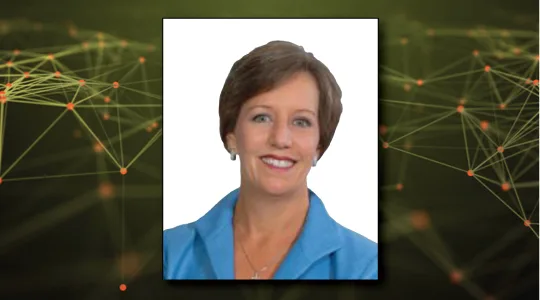
John Gilroy: Welcome to Constellations, the podcast from Kratos. My name is John Gilroy and I’ll be your moderator today. Our guest today is Rebecca Cowen-Hirsch, senior vice president for Inmarsat. Rebecca, how are you?
Rebecca Cowen-Hirsch: I’m doing very well, John. Good morning.
John Gilroy: You know, I did my research on you, got your background, and I’ve got two hours of background knowledge. Just give us maybe a half a minute on the mountaintops of your background, please.
Rebecca Cowen-Hirsch: Alright, well, I actually started in my professional career with the United States Air Force as an electronics engineer actually designing avionic system for integration into aircraft. From there, that actually took me into the space arena, where I was a mission commander for the Advanced Ranged Instrumentation Aircraft, or ARIA. First ever female civilian mission commander where we did telemetry, collection for satellites, reentry vehicles, and cruise missiles. From there, a number of different positions, senior executive positions in the Department of Defense, and just a little over nine years ago, I joined Inmarsat, where I’ve had the opportunity to work with some of the finest satellite communication capabilities in the world.
John Gilroy: When I heard that, I wanted to run out of the room. Telemetry projections? You don’t want me doing that! Telemetry is a word that most people understand, but there are very specific words involved in your world, and I’m going to throw a couple at you and maybe you can tell me what they mean, what they don’t mean. One word is called “assured communications.” What does this mean to you? What does this mean to your industry, really?
Rebecca Cowen-Hirsch: Assured communication really picks up on the meaning of reliability, availability, and knowing that you can get your information from point A to point B in a fashion that is secure. It can’t be intercepted. It can’t be degraded. But importantly, when in our case, supporting the United States military, allied militaries, and other defense and federal users, knowing for certain that you have satellite communications anywhere you go so that you can plug in, operate, and know that your communication can get where it needs to be whether it’s voice, video, or data.
John Gilroy: Also, there has to be some resiliency built in, as well, I assume.
Rebecca Cowen-Hirsch: Resiliency is incredibly important. It’s really paramount to everything that Inmarsat does, and today in the defense industry, especially in the satellite communication, satellite arena, resiliency covers a range of different attributes from redundancy, reliability, distribution of capabilities, and it’s all about making sure that whether it’s a threat environment or just an interference environment, communication in the mission can be accomplished. From an Inmarsat perspective, we look at it as having the highest availability of any satellite communication capability available today. For safety services, so that you can ensure that your safety services for aeronautical operations or for ships at sea that you have, what we call, four nines of availability. You know for certain that you’re going to have a redundant, fully capable safety service, as well as mission-critical data and relying on that satellite communications for all of your missions.
John Gilroy: Rebecca, I mentioned in the parking lot on the way in here, we’re talking about all these new things going on in the world of satellites and space and so many different new terms and everything else. One concept that people are talking about is something called a “wideband global satellite,” or what you may call “WGS.” Where does it fit with this whole picture of resiliency?
Rebecca Cowen-Hirsch: The wideband global sat comm system is the workhorse for the military satellite communication capability today. It’s a program that started as a gap-filler program some 20 years ago to be able to provide that communication for military operations. It operates in two separate frequency bands and it is around the world to be able to support military wideband communications. Of course, the challenge that is facing the military is recapitalizing their existing and legacy capability, and this is very true for not only wideband global sat comm, but also their narrowband communication and their protection communication. It’s a part of a military architecture today where the government owns and operates exclusively their own satellite systems. In the recapitalization effort, what is being looked at quite intentionally for the first time is ensuring that commercial capabilities, which has been providing the preponderance of military traffic for a generation now, are intentionally embedded into this architecture and planned up front, rather than what has traditionally been ad hoc purchasing of spectrum or filling in the gaps, if you will. What we are looking towards the future for is this integrated sat comm architecture where commercial is the foundation, augmented with the legacy capability of wideband global sat comm, and then filled in with a small purpose- built amount of capability to address the most specific, unique military-specified missions for which there is not a commercial model or for which new R & D needs to be accomplished.
John Gilroy: When we get in the car and drive down to the Pentagon here, they use this term “visibility,” to focus on terms here. My question is, how can the commercial sector provide this visibility into the commercial satellite network that the military folks really need to assure their mission?
Rebecca Cowen-Hirsch: Well, one of the new considerations, if you will, is looking at satellite communications more as a network. We’ve traditionally focused on the satellite. That is certainly true within the United States Air Force and its base in missile systems and where they acquire satellites. With satellite communications, the satellite is just one node on the network, if you will. To have the full communication capability, it’s the satellite, it’s the ground network, and it’s also the user terminals. If you look at that more in a telecommunications environment, that is a network. The satellite is just one other node on the network. When you look at a full end-to-end capability of this network of telecommunications supplied by satellites, having visibility into that to be able to see what your network management principles are, your availability, any interference you may be experiencing, the ability to reprioritize where necessary, is readily available in today’s environment. Many of our mission partners, to include the host for this particular podcast, Kratos, excel in that network management, the visibility, and the surety of access for satellite communications.
John Gilroy: I was at a trade conference with a bunch of people, focusing on data centers. Most of the room was filled with “govies”. They’re interested in what the commercial world was doing to improve the federal government’s use of data centers. The parallels got to be with the satellite world, as well, too. Is there anything the military can be doing now to take advantage of technology already under development in this commercial sector?
Rebecca Cowen-Hirsch: There are a couple different areas, specifically, that they can focus on. As I mentioned earlier, using commercial as the foundation, commercial satellite communications has provided the preponderance of capability for military and defense operations for a generation. But it’s been acquired on an ad hoc stock market-type environment. Well, so if you shift that paradigm, put that foundation of commercial sat comm in first, intentionally and strategically put redundant and resilient satellite communications provided by commercial in place, then that is a very different mindset. It’s not only a philosophical shift, but it’s also an acquisition shift. Then you can actually bring greater value to bear, greater capability, distribution of capability, redundancy, other elements of resiliency to the network, allowing the military, then, to focus their exquisite talents on what are traditionally called “warfighting missions.” Leverage the commercial, not only what we provide today, but importantly, the new technological advances that are coming into the environment on a very rapid basis to be infused into this network to bring the best to bear so it’s very responsive to what military operations require for worldwide communications on the move.
John Gilroy: What you’re saying is this technical capability is almost a checkbox item. We have to take in and maybe overcome some of these cultural impediments. I think you talked about this in some quotes, and you’ve said building additional wideband global satellites would be pressing the easy button for this transition. I want to go to the Office Depot or Staples and get one of those easy buttons.
Rebecca Cowen-Hirsch: Absolutely. Wideband global sat comm is a fantastic satellite communication capability. As I mentioned, it’s a program that was started quite some time ago as a gap-filler. It’s in its final stages of deployment, nine satellites are on orbit. The 10th is scheduled to go up next year. But it’s also this very mature technology and the same company and the same production line that builds wideband global sat comm is the same production line, the same value chain, that builds the commercial satellites, to include Inmarsat’s. In the meantime during this period from concept to now deployment of a military satellite communication capability, satellite communication industry has evolved orders of magnitude in terms of different generations, improvements on technology, agility in responsiveness. Communication is now a worldwide managed service environment that you can plug into. I think the government is today quite well-served by the capabilities provided. There are more exciting things that are coming in the future.
John Gilroy: Rebecca, you’ve got a background in electrical engineering. You toss out a phrase like “order of magnitude,” it means something very precise for you. For someone like me, big, big changes and wide difference, I’m trying to apply this to high-throughput satellites. Is HTS a high-throughput satellite? Is this an order of magnitude change? Or is this just a bump?
Rebecca Cowen-Hirsch: It is an order of magnitude change. It’s not only technically more advanced and more capable, but it’s also a different architectural implementation. The military has traditionally used satellite communication systems that are designed more for television broadcast. When you bring in, certainly as our architecture, a high- throughput system, you have small spot beams that makes for greater resiliency and anti-jam resistance. But it also, actually, the way the system is designed, enables organically mobility operations so that you can actually traverse from small spot beam to small spot beam without having degradation of capability. If you take off in Omaha, Nebraska, and land in Paris, France, as an example, you actually will be able to go from spot beam to spot beam seamlessly to be able to have connectivity and access to information that entire traverse and that route of flight. That certainly is relevant in military applications, as well as in our commercial applications and what we as citizens enjoy. It provides enhanced technological capability, but also greater mobility and greater implementation.
John Gilroy: I was trawling through your website. Some of the words I saw on your website maybe fit in with HTS. You talk about cost-effective augmentation. Is that tied in directly with HTS, or is that a different concept?
Rebecca Cowen-Hirsch: They are tied together. Certainly, the way that we design our high-throughput satellites and our global express constellation is designed with affordability in mind. That means not only is the service provided very affordably with great attributes, such as reliability, availability, trusted, and secure, but since it is designed with a fully redundant ground segment that is a small footprint, each of our satellites have two fully redundant satellite access stations, the ground infrastructure is affordably deployed. The satellites are designed for flexibility, as well as mobility. This allows you to actually have this consistent, ubiquitous capability wherever you operate and design with a cost factor in mind so that you actually can not only have that value proposition of availability and reliability, but at an affordable rate. When you put that in from a taxpayer perspective, that actually says you can actually have the capabilities to have the throughput and prosecute the mission whether it be a command and control capability or advanced airborne intelligence surveillance reconnaissance, telemedicine. Also, of course, cybernet cafes. You want to take care of those troops as they’re deployed to ensure that they can have the ability to reach back to their family. You do it in a manner that’s affordable but also highly reliable and secure.
John Gilroy: I’ll be teaching in January. I always assign my students Harvard Business test cases to read. They read those and they come in class, we talk about them, and in the software world, let’s talk about use cases. To bounce back to the wideband global satellite, give me an idea what a use case might be for wideband global satellites. Is there something obvious?
Rebecca Cowen-Hirsch: The wideband global sat comm system was originally designed to support, predominantly, the Army. Troops on the ground, as well as other military applications. Of course, subsequent to its original design, and there have been some enhancements to that, there have been new capabilities that have come online that were not even envisioned as long as 15 years ago, and that’s the advent of airborne intelligence surveillance and reconnaissance, the very high- throughput and data-intensive applications that require greater throughput and greater flexibility and greater mobility. This is really where our systems come in as a fantastic compliment to wideband global sat comm so that you can actually have wideband global sat comm with its beams fixed to support certain different type of mission sets. Bring on top of that interoperable and complementary commercial capability immediately adjacent in frequency band, as well as location, to be able to add that more flexible and adaptive sat comm as a service to overlay and integrate into the military environment, offering not only two different or diverse satellite communication paths, but also with our steerable beams, the flexibility to follow airborne traffic, put additional throughput when and where required. The complementing capabilities that we bring and the commercial industry provides —actually enhances—the flexibility of military operations.
John Gilroy: Sat comms, this again falls back to the cultural change. Cultural change goes back to acquisition, and there are certain types of procurement practices with the federal government now where, “This is the way we’ve always done it.” Now, technology has come about with innovations from your company. They’re saying, “No, no, no. This is a whole new way to do it.” It gives you more flexibility, more redundancy, more resiliency, and the whole checklist. But we have this cultural procurement challenge here, don’t we?
Rebecca Cowen-Hirsch: There are some disconnects. One of the opportunities that sat comm, as a service, provides, is really it stitches together the satellite into a communication capability. By that I mean with communications via satellite, it’s satellite, ground segment, as well as user terminals, and the fiber connectivity that makes that an interconnected environment. It is the full end-to-end. When we use the term “sat comm” as a service, it means that you’re actually getting a capability, not just buying a satellite and then having to stitch together elements to create a communication path. Sat comm as a service allows military or commercial users to be able to, if you will, plug in and enjoy the service, the complexities of the network management, the ownership of the satellite, the maintenance on the ground stations, the technology insertion, all are done by the owner/operator making sure that it is the best of breed at all times. The consumer in this case, the military, benefits from that investment. Rather than focusing just on the space segment alone, it is the full capability and the technology insertion, and all of the other measures of effectiveness that make communication a capability and not just a commodity are enable through sat comm as a service. The corollary to this would be very similar to your cell phone. The network behind whichever device you prefer, whether it’s an Apple product or a Google product or anything else between the network behind that, the cellular infrastructure, the towers, all of that is provided as a service. You’re not concerned so much about owning a part of that tower or worrying about a piece of fiber that connects it. You just really want to turn your phone on and use your application. Sat comm as a service does that for the military so that the applications are available when and where needed. You can plug in. It’s available when you need it. You can actually benefit from advancements. That includes when you renew your service and you want a newer, different terminal that’s more capable or incorporates new technology. That also can be embedded as part of the service. While it’s not new in the telecommunications industry, the acquisition process today in the department of defense for commercial sat comm tends to be spot market is also really more buying of spectrum, or piece of fiber, if you will, rather than the actual service. When you do sat comm as a service, you have a service level agreement, a commitment of availability, guaranteed committed information rates, other things that make it a capability rather than just leasing spectrum new opportunities for improvement, and also to do it in a value proposition so you get performance-based capabilities rather than driving down cost in a LPTA or a leased price, technically acceptable methodism, which is used predominantly today.
John Gilroy: Well, I’m going to take the satellite discussion and bring it down to ground level. I have a son whose friend is in special service, special forces. Last time we spoke, we talked about this anyplace, anytime thing. He talked about new initiatives involved anyplace, anytime, really letting the military with feet on the ground be able to communicate through satellites. Some of the innovations here are just impressive, aren’t they?
Rebecca Cowen-Hirsch: Very much so. There is no one more impressive than the Special Ops community. They just innovate in a way to be able to get that job done so quickly. We’ve been working with the special operations community to ensure that they have access to the most advanced technologies, but also they are very agile in the way they deploy. They want to be able to have very small form factors and very light equipment. The terminals that they carry, the user equipment that they carry with them, needs to scale for their applications. We have with them and with some very interesting technology advancements in, and in technology as well as air interface technology, reduce the size of the terminals that they carry while continuing to increase the amount of throughput or data or information that’s available to them. That’s not just the soldier on the ground, but also the very small form factor of aircraft, whether it’s manned or unmanned, so that they can use a capability that we’ve developed in partnership is what we call Whistle, which is wideband streaming on L-band, which allows an airborne or ground-based to have very high throughput in a very small form factor, up to 10 megabits per second streaming bi-directionally to a form factor for an aircraft that is somewhere on the order of about eight to 11 inches. Very small form factor allows them to be connected in the most austere environments with the most unique and small and highly deployable assets, and yet use these phenomenal satellite communication capabilities globally.
John Gilroy: That’s one of the purposes of the podcast here at Kratos, is just let the community know about so much new stuff out there. You can’t keep track of it. Maybe we’ll have Rebecca in next week and do what’s like this week. There is so much out there. Small sizes of antennas. It’s got much, much more impact than just reduction in cost. Makes them more portable, don’t they?
Rebecca Cowen-Hirsch: It does. There are many aspects of a military operation that are critical that need to be addressed, not just price. I don’t mean to imply that cost is not a factor. It is an important aspect. However, it really is being able to execute the mission. It needs to be reliable. It needs to be present. It needs to be capable. It needs to be small form factor. It needs to support the mission where it lives.
John Gilroy: In the NFL, they say, “Oh, the team coming up on Sunday has good defense, good offense, good special teams, good something or other.” Different areas of concern. If you looked at the next four or five years as far as applying newer technology and helping our government listeners here, what are the two or three areas you’d think are the biggest challenges?
Rebecca Cowen-Hirsch: Certainly power management is always a challenge. You need to be able to have this disconnected user, somebody that’s not going to plug into the wall, be able to ensure that they have power to support their antennas. There is a lot of solar technology that’s being invested to be able to power that. This is very exciting. You’re not dragging a case full of batteries along with you. On the satellite side, the spot beams are getting smaller, the flexibility to be able to respond to the environment and support the user. This certainly came in with what we’re now calling “HTS” systems or high- throughput satellite systems, and the agility to be able to steer and beam form to be able to be more flexible to support the users. There is quite an enamormant today in what is often referred to as “new space” technologies. I think what will come from that adventure is capabilities in space to support imagery and other elements, as well as some advancements, perhaps, in communication that can then be deployed into the blue chip companies, such as Inmarsat and others, to be able to continue to evolve the technology to stay long ahead of the curve. We certainly invest in advance of need and insert technology to make sure that we can capitalize on the satellite asset, which is on orbit for a minimum of 15 years, and in some cases, well over 20, to be able to capitalize on that asset and innovate on the ground to be able to get the best out of that space segment.
John Gilroy: Whether that’s looking at new antenna technology, new battery technology, or technology comparing building versus leasing transponders. There are so many aspects to this besides the technical element. That’s the lesson, I think, from the interview today is that, “Wow, you know, we got the technology. Now we have to take it and integrate it into a system and take and apply it to the Special Forces person who is going to jump out of an airplane somewhere who knows where? Carrying what?” Batteries are a big part of their life, aren’t they?
Rebecca Cowen-Hirsch: Certainly. The business relationship that exists between the industry, supporting the national security enterprise. The government is looking at an analysis of alternatives right now to recapitalize their wideband communications systems, and they’re engaging very fruitfully with the commercial industry to look at new business models, the technologies, the advancements that are available so that the government can focus their energies and their investment on the most exquisite capabilities, but intentionally leveraging commercial in a very different fashion to be able to respond to these very dynamic and changing environments.
John Gilroy: We need commercial to help our listeners. We like that a lot. Rebecca, unfortunately, we are running out of time. I’d like to thank our guest, Rebecca Cowen-Hirsch, senior vice president for Inmarsat.