
Podcast Episode #15: March 27, 2018
Satellites, Lasers and Data at the Speed of Light
Satellites have now become routers and are inter-connected with lasers forming an optical backbone in space.


Space is a Network.
Constellations is Your Connection.

Transcript:
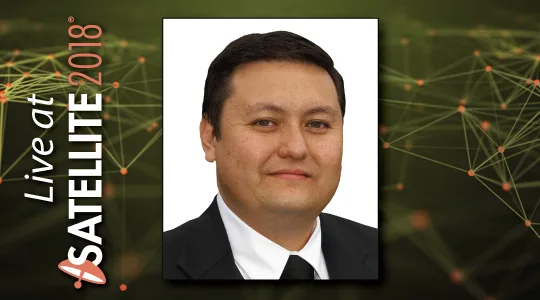
John Gilroy: Welcome to Constellations, the podcast from Kratos. My name is John Gilroy. I’ll be your moderator today. Our guest today is Michael Abad-Santos, Senior Vice President, LeoSat. Michael, how are you?
Mike Abad-Santo: I’m doing great, John. How are you doing?
John Gilroy: Well, you’re a local fella. Glad to have a local fella here in Washington, DC. We’re at SATELLITE 2018, all kinds of exciting things going around here. If you met someone at the show here, give us a little, 10-second introduction to what your company does.
Mike Abad-Santo: So, LeoSat is a new satellite company that is launching 84 satellites into low Earth orbit, with a focus on high throughputs, low latency, high secure communications.
John Gilroy: Oh. Constellations, huh? An amazing term.
Mike Abad-Santo: It’s a great name. I think we got that from something around here.
John Gilroy: Yeah, the Constellations podcast. Well, I’m going to ask you the tough question. Now, I’ve done a lot of interviews with people in software development and they talk about open-source software. And you think of free software. And there’s a concept here called free space optical communications. So what does that mean, when it comes to your company? Free space optical communications?
Mike Abad-Santo: Free space optics is just a fancy way to say lasers. So, lasers in space. That’s what we’re doing. Now, we are doing, the best way to put it is, free space optics or optical inter-satellite links, just represent a portion of the technology that we’re putting on the satellites. We are using the free space optics or laser com to inter connect our constellation of satellites in space. The way I like to say is, we’re taking a terrestrial fiber light system, converting it to laser and launching it up into space. So we have a seamless mobile backbone.
John Gilroy: So what is the advantage of this seamless backbone?
Mike Abad-Santo: So the advantage of that is you can actually deliver data from any point on the world to any other point on the world seamlessly, quickly, at a much lower cost than you could if you were burying traditional terrestrial or submarine fiber cables. So I always like to say the easiest way to bring global fiber connectivity to the world, is through space. And interconnecting those nodes in space and allowing the transfer.
John Gilroy: So this company is founded in 2013. Someone had this vision for next year, for 2019 for six years out.
Mike Abad-Santo: So our founder is a gentleman by the name of Cliff Anders. And his background is, he was at Schlumberger. And he was responsible for all the internal networking across Schlumberger. And they were large consumers of commercial satellite capability. And what he found was that the traditional geo and FSS satellite networks weren’t optimal for the applications that he was trying to run. So after he left Schlumberger, he came up with the idea of LeoSat, which is to, it was designed to provide enterprise level connectivity to enterprise grade customers. So, banks, health insurance companies, the US government. So our mission is really focused on enterprise grade customers and providing high quality secure services.
John Gilroy: So I went to your website. And you talk about some unique characteristics. One unique is a polar orbit. That’s different then, huh?
Mike Abad-Santo: Yeah, absolutely. So right now, the only real global player in the satellite space is Iridium, as you know. They’re operating current network and they’re launching their next constellation, the Iridium next constellation. Like Iridium, we are providing a full global network. So we communicate at the poles. We’re looking forward to working with the national science foundation as one of our launch customers to provide services down at McMurdo station down at the south pole that clearly, if you look at what’s happening in the northern latitudes and north pole, the northern shipping routes, there’s lots of activity going up there. So it’s a great opportunity for us to be able to solve this communication issues.
John Gilroy: So walk around the show here at Satellite 2018. I would think that the differentiator that you have is the combination of low latency and the speed, the gigabyte speed. That’s the advantage of this type of network. Is that right?
Mike Abad-Santo: Yeah, absolutely. This is a really high throughput network. We have 84 satellites as I said. We have our standard user spot beams that do 1.6 gigabits per second, in synchronous communication or bi-directional. Our high capacity beams actually do 5.2 gigabits per second. So we’re talking about really large data capacity that we can transit at really low latencies. So in terms of latency, if you’re in the same area of operation, you can go up and down in less than 19 milliseconds, round trip time. We have routes that are from London to Singapore that are 119 milliseconds.
John Gilroy: Wow.
Mike Abad-Santo: If you look at the current submarine cables, the fastest terrestrial cable route is 198 milliseconds. So we have an improvement upon terrestrial fiber.
John Gilroy: I was walking around the show earlier and I was talking to a gentleman who owns a company, CEO of a company over here, he has a PHD from Berkeley in Mathematics, so he understands a lot of these concepts. And a lot of people on the show here understand this concept. So, I’m just going to throw this out to you as basic, but maybe you can run with it. So there’s RF communications, there’s optical. So give us the strengths and weaknesses of both of them. These are big, general categories we’re talking about here. RF versus opticals.
Mike Abad-Santo: So I’m a philosophy major. So I will do my best to-
John Gilroy: To quote Aristotle. Aristotle designed RF.
Mike Abad-Santo: Yeah, so I’ll do my best to take some fairly complex topics and simplify them. But in essence, free space optics and RF are very similar. They just use different segments of the electromagnetic spectrum. So, when we’re talking about free space optics or lasers, you are talking around usually 150 to 400 terahertz. Whereas we’re operating in KA band, which is at 28 gigahertz range. It’s all just different parts of the same thing.
John Gilroy: So if optical is such an improvement, why has it taken so long to commercialize. I mean, I think this technology has been around since the 90s, hasn’t it?
Mike Abad-Santo: Actually I think the very first optical network was in the 1960s.
John Gilroy: Even earlier.
Mike Abad-Santo: Yes. Actually, one could argue that the very first optical link might have been a signal flier.
John Gilroy: Well, that does go back to Aristotle.
Mike Abad-Santo: Yeah. The stone age times. So optical has been around for quite a while. It’s a well proven technology. It’s used in a lot of terrestrial applications. It’s ideally suited for space, especially for the way that we’re implementing it, in terms of interconnecting our satellites. Lasers perform better in vacuum and free space, without any kind of atmospheric interference. As opposed to trying to go from space to ground. So, it’s an ideal solution for us. It also helps with our security footprint. Laser links are very hard to intercept, because of the diameter of the tightly focused beams. So, from a cybersecurity perspective, it’s a much smaller threat surface.
John Gilroy: I’ve been involved in software for many years now. And years ago, I would study these tests. And I’d have to study about border gateway protocol, BGP.
Mike Abad-Santo: BGP.
John Gilroy: That’s a big deal. And you had to learn all the sayings and take the test and you move on. And the word gateway is kind of interesting, especially in regards to your company. I think the way I understand is that gateways are not a prerequisite for LeoSat to operate your network. So it allows for premises to premises connections with no terrestrial touchpoint in between. Now that is different. That is new.
Mike Abad-Santo: That’s absolutely correct. And it’s, once again, it is something that we took into account. And if you think about LeoSat, what we’re really trying to do is provide point to point connectivity in the most efficient, secure and seamless way. So by utilizing the laser backbone on spacecraft, we are able to create a network in which we do not need extensive ground teleport infrastructure in order to land and route traffic. So not only do we have the lasers on the satellite, we have onboard processors that perform routing function, routing and switching functions. So what we’re done is we’ve created a really secure, robust communications and switching infrastructure that does not rely on terrestrial gateways.
John Gilroy: You mentioned a few minutes ago that in outer space the lights kind of, in a pure environment. However, you know, I think that optical signals are subject to atmospheric turbulence. So how do you handle issues like atmospheric issues? Can a bird get in its way? Can a blimp get in the way? Or how do you handle something like that?
Mike Abad-Santo: We don’t have those issues at our altitude. So our satellites are operating at 1,400 kilometers. So we won’t have birds or hopefully we won’t have birds at 1,400-
John Gilroy: What kind of birds up there?
Mike Abad-Santo: Not the organic kind, that’s for sure. So we don’t have those atmospheric scintillation issues. Now, that does become an issue if you were doing laser from space to earth. Clearly you would have to-
John Gilroy: I see.
Mike Abad-Santo: Yeah. You would have to account for those issues. And the way to do that is you build a more robust ground infrastructure. So you have to build more ground gateways in order to do that. So you can find a different area that does not have the extensive cloud coverage or has free atmospherics.
John Gilroy: Yeah. This is the challenge doing a podcast. Is that, if I had a whiteboard here, you could diagram it out, and say, “Oh I get it. So it’s not going from earth. It’s going from one point in space to another point in space.” And so it can leverage that. It’s doesn’t have to really worry about much atmospheric conditions, because it doesn’t need no stinking atmosphere. It’s way out there.
Mike Abad-Santo: That’s absolutely correct. We do utilize RF, so KA band frequencies for our space to earth links. So that’s how we are doing that. We’re not doing laser from space to earth.
John Gilroy: Washington Nationals are going to start playing real soon. They’re talking about making trades and sometimes a trade will complement the team. Actually fitting well with the team. So, are you developing something to replace RF satellite communications or complement them? What’s the … is it a competitive world? Or where do you stand in regards to RF?
Mike Abad-Santo: As I just said, RF is a part of our current constellation. We think it’s the most effective way to do space to earth communications at this point. The laser optics are the most efficient way to carry data across the space satellite network and do that really efficiently. But in terms of space to earth, RF is always going to be here in my belief. And it’s a much more weather friendly frequency than laser and optics as well.
John Gilroy: Before the show you told me you had a degree in economics and philosophy. So I know you’ve heard of Clayton Christensen. And he uses the term disruptor a whole lot. And so my question is, “Is this technology going to be a disruptor?”
Mike Abad-Santo: I don’t think the technology, the components themselves are disruptors. I think the method in which we are putting all the parts and pieces is really a disruptor. So, everything that we’re putting on the satellites has been space proven. The optical links are space proven. The RF links are space proven. We have a great partner in Thales, who has a space proven satellite bus that we’re using. RF chain is space proven. So, what’s really disruptive is the way we’re putting the architecture together and creating a seamless, highly secure, high throughput architecture. And that’s … I think it’s a combination of all those things that makes LeoSat Technologies disruptive.
John Gilroy: Well if we can pronounce that correctly. T-h-a-l-e-s. Thales. Yeah, that’s always hard for me. I can’t-
Mike Abad-Santo: Thales Alenia. Yes. Yes.
John Gilroy: So how will these optical networks interface with terrestrial networks? Through the RF signal, or will they challenge them in some applications?
Mike Abad-Santo: So, as I said, we’re not … we’re using the optical, the lasers on board the satellites to basically provide the backbone. But traffic is, originates in the RF form, is converted to a digital signal across the network, and reconverted back to RF to go back down to space. I think they’re very complimentary.
John Gilroy: The way I understand, your network is going to be ultimately, here in 2019, consist of over 100 LEO communications satellites. Are these small cube sats, or large? What size are these?
Mike Abad-Santo: Not by any stretch of the imagination. So our filing is for 108 low earth orbit satellites. The satellites will weigh roughly 1,500 kilograms fully loaded with fuel. So these aren’t cube sats or microsats, by any stretch of the imagination. I believe that the dimensions are roughly 4 meters by 3 meters, 80 centimeters deep. So these are not what we would consider cube sats.
John Gilroy: They’re substantial. Yeah.
Mike Abad-Santo: Absolutely. Yeah.
John Gilroy: Good. Some of these are constrained by some issues. I don’t know if yours are. For example, electrical power, low gate antennas in scarcity of available radio spectrum. Will any of these impact your satellites?
Mike Abad-Santo: Well, power is always an issue when you’re in space. But because we have a much larger bus, we’re sizing the satellite payload.
John Gilroy: Well actually, the optical addresses all these issues, doesn’t it?
Mike Abad-Santo: Yeah. Yeah. It does.
John Gilroy: 1, 2, 3.
Mike Abad-Santo: Yeah. So-
John Gilroy: We don’t have to worry about low gate antenna, because you’re using laser.
Mike Abad-Santo: Yeah. And we’ll have four lasers on each satellite. Each laser will be pointed to the next satellite in the constellation from the north, south and east, west perspectives.
John Gilroy: Well, this technology is kind of unique. And it will be a boost to the small sat industry. What about players like OneWeb and SpaceX? Are they looking at this technology as well for their small sat constellations?
Mike Abad-Santo: You know, if you look at OneWeb’s filing, they are not using inner satellite optical links. They are using a much more traditional vent pipe architecture. SpaceX mentioned it in their filing, but there’s not a lot of data that I could point to that would say definitively they’re going to have an entire constellation that’s linked by laser communications. You know, I think it all depends upon the market you’re going for that determines your architecture. And I think OneWeb and SpaceX, with their goal of trying to bring internet services to the masses of the world is, they have the right architecture for those types of services. LeoSat is different. Our focus is commercially and strategically is on the high end, high grade enterprise users who really need robust, large pipes and have a need for high security.
John Gilroy: And that’s what I want to get on here about the commercial customer. Here we are in Washington D.C., sitting here at Satellite 2018, you know that across the river. There’s some military organizations that can purchase a whole lot. So what’s your prioritize? It’s mostly commercial target then, it’s the government? Or who are you going after?
Mike Abad-Santo: Definitely the government we believe is going to be a big user of the satellite network. But also other commercial and enterprise users. Enterprise, oil and gas. All of these industries that are becoming more and more data centric. And larger consumers of data and need big pipes are going to be targets for us. And it’s not just the amount of data, but really high quality, low latency data.
Mike Abad-Santo: I always like talking about one of the first customers that we signed up, who is in the finance market. High frequency trader. And the reason they chose us was because our links are faster than terrestrial fiber.
John Gilroy: Well, I kind of alluded at the Pentagon earlier. I’ll dig deeper in here. One of the generals over the Air Force there talked about the inevitability of space combat. I don’t know how to say this.
Mike Abad-Santo: Contested space.
John Gilroy: Yeah. That’s a much more delicate word. Contested space. You know. It seems like this would be an ideal circumstance for the military to have, as space gets more congested, they can send signals cleaner and quicker. It just seems almost like a lead into congested space.
Mike Abad-Santo: Well, absolutely. And you know, space is becoming a contested area. But, we are launching a constellation of satellites. So we will have more than just one satellite in space, which offers resilience and redundancy. And I think it’s very complimentary to sovereign geo-stationary assets that the government may have. And it’s always good to have a commercial backup.
John Gilroy: But here we are at Satellite 2018, all kinds of folks walking around here. So who would you like to meet on the show floor here? Anyone in particular? What’s your goal this afternoon? I always have goals when I go out and meet people at shows like this.
Mike Abad-Santo: Well, our goal is, we’re still a startup company. We have a great initial strategic investor in JSat. We’re looking to close out our series-A financing. So, if you have lots of money and you want to spend it on a satellite constellation, come talk to me.
John Gilroy: So you walk around for a bit. “Hey, got any money? Talk to me.” So who is your competitor? Can we see someone from the table here? Who do you compete with?
Mike Abad-Santo: The cheeky answer is we really don’t have any competitors. This is a fairly unique satellite architecture and constellation. As I mentioned earlier, I view OneWeb, SpaceX, O3B and the others as complimentary to us.
John Gilroy: It used to be more, I guess the word, boutique, than the larger ones. It seems like very, very specific targeted audience here.
Mike Abad-Santo: Absolutely. You know, we’re targeting the top 10% of the VSat market. Right. We’re not looking at gathering the bottom 90% of the pyramid.
John Gilroy: So the company initially started around 2013. And I guess the network should be completed by about 2022, does that make sense? Something like that?
Mike Abad-Santo: That’s our goal. So next year in Q3, Q4, we’ll be launching our bring it to use mission. And assuming everything goes well after that, we’ll start launching our production satellites in 2020. And hope to complete the constellation by 2022.
John Gilroy: So what do you think will be the biggest impact we’ll have on commercial and military communications?
Mike Abad-Santo: I think LeoSat will really redefine how the government architects satellite constellations. You know, I think the government will use a combination of geo- stationary and non geo-stationary or low earth orbit satellites in a unified enterprise way. And I think that will probably be a very big game changer for us.
John Gilroy: Would your technology give the people in the Pentagon a strategic advantage in a contested area? How’s that for discreet. In the contested area.
Mike Abad-Santo: I certainly believe so. It’s not just one satellite in a plane. If something were to happen to one of our satellites or to a component of one of our satellites, we would be able to re-route through our 84 other satellites in space.
John Gilroy: You know, when I talk to people about technology and I look forward 4 or 5 years, I just get dizzy with the changes. You monitor new technologies taking place there, not knowing what’s going to happen. You’ve already got it planned out to 2022, huh? So where do you see going beyond 2022? I mean, you’re pretty confident. See into the future.
Mike Abad-Santo: Well, I definitely have my views on how I would like to see the next generation of LeoSat. I believe that the cost for access to space is going to be getting much lower. And as a result, we’ll be able to refresh the fleet much quicker. We’ll be able to add very user specific payloads to the constellation at a much quicker pace, increasing capability in space. So I think it’s really interesting and there are a lot of opportunities that we’re not really thinking about right now that will present themselves in 2022.
John Gilroy: Really? Because actually, when it started in 2013, there’s been new developments you’re applying now in probably the next three or four years, and we develop them to apply in the future, and beyond that.
Mike Abad-Santo: Absolutely.
John Gilroy: Well, great. Well unfortunately Michael, we’re running out of time here. I’d like to thank our guest Michael Abad-Santos. Senior Vice President at LeoSat.
