Transcript:
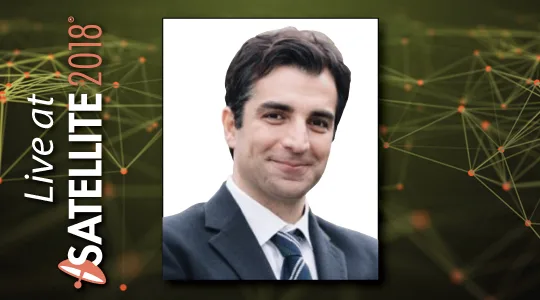
John Gilroy: Welcome to Constellations, the podcast from Kratos. My name is John Gilroy and I’ll be your moderator today. Our guest today is Kambiz Aghili, CEO of Blue Sky Network. Kambiz, how are you?
Kambiz Aghili: Good morning! How are you John? Thanks.
John Gilroy: A lot of action here for Satellite 2018. A lot of people here, a lot of buzz.
Kambiz Aghili: It’s just amazing. We had a few meetings already this morning. It’s great.
John Gilroy: I was upstairs 6- 700 people up there listening to six people talk about satellites and satellite technologies and that why we have you here, because you have got some innovation here that we want to talk about for our listening audience. I’m going to focus on asset tracking. You know it’s been around for a good while, but with the emergence of IOT, the Internet of Things, it’s magnified its importance to supply chain management. Is that a fair statement there?
Kambiz Aghili: That is a fair statement, John. I would like to first express my gratitude to Kratos and to you, John, for inviting me and Blue Sky Network for this discussion. We believe that real time asset tracking monitoring is not only magnified by business use cases such is IOT as you indicated. Also by mission critical as safety use cases. You look at, I’m just going to start with a few examples. Malaysia Airlines 370 disappeared in 2014 en route to Beijing. It was never found. It cost over $150 million for the search and 227 passengers died. You look at Air France 447 crashed in 2009. The black box was not recovered until two years after that. You look at other use cases beyond aviation, looking like maybe LAN mobile space. Two UN journalists were kidnapped in March 2017 and beheaded while investigating a violation of UN crimes in Congo. 15 UN’s peacekeepers were the same. They were on a peace keeping mission in Congo then were killed. You’re looking at maritime applications and just one of the major countries we work with in Southeast Asia. On average they’ll lose $300 million to illegal fishing every year. So at Blue Sky Network, we’re surgically focused on mission critical logistics and how we can help our clients with three key objectives: One is to increase the safety of their operations. Two, to bring more revenue through their organizations and how they manage their fleet. And three, to help optimize the cost components of their business. Our value to either military, government, commercial clients can vary uniquely and greatly across. We help our clients with real time geospatial monitoring, being not just on the IOT but also on situational awareness, surveillance, battle management, or with commercial clients on how they utilize their assets better, their safety mandates, and search and rescue coordinations.
John Gilroy: I looked around the show here. There must be other similar companies to yours. When you go around this show, you meet people and talk to people and they go, “Well hey Kambiz, what’s your differentiator. You have a PhD, you got an MBA, you’ve got lots of great experience, but why is your company different?”
Kambiz Aghili: I think the most important element of our business is our clients and the unique use case we get to work on and help our clients with every day. We take a great pride in our military government commercial clients in over 50 countries. We have a wealth of unique use cases in business security safety for situational awareness surveillance and IOT. We have a full solution offering multi-moral operations air, land, and maritime. We have FAO approved products that we also apply to the land and maritime solutions in place. We have an end-to-end ecosystem of hardware, software, analytics, and real-time SAFCOM. We provide on-site product demonstrations for our clients or our clients to be. And I think something we also get, take a great pride in, we are made in the U.S. We build all our products in the USA. We build our software in the USA. We offer all our software from the U.S. and we think that’s a great thing.
John Gilroy: While we’re here in Washington DC, I teach a school just up the road called Georgetown. In my class I talk about the Pareto principle. 80/20, 80/20. You see it in so many things. You see it in car racing. You see it soccer. You see it in football, baseball, everything. We see it in asset efficiency practices too. I see it right here, you know? A recent study, I was doing some research this morning, a recent study shows that 85% of manufacturing companies globally are aware of asset efficiency, but only 15% of the surveyed group has implemented it at a systematic level. It’s the old 80/20, isn’t it? Do you see that implementation growing or flat, or where do you see it?
Kambiz Aghili: Absolutely. Absolutely, you’re on point in that. One of the industries, as an example as what we are working with, the average asset realization is only around 30%, and if they get around 50%, they’re actually super happy.
John Gilroy: They’re bragging.
Kambiz Aghili: Yeah. Oh yeah. That’s not good. I think one is we can clearly draw the business case of why, and show how a business can really use real-time tracking of operational and safety metrics, including their fleet assets. The implementation would not actually see the fuel to grow. We are in a business, we are in a place as we do today, to help companies raise the asset utilizations and safe them either make more money, or save on costs on a day-to-day. We are in an upward bit of pace at that trajectory today.
John Gilroy: So let’s say we could just snap our fingers and show up at a customer’s site, one of your customers. Give us a profile of your typical customer.
Kambiz Aghili: As I indicated before we have clients in over 50 countries. The typical customer-
John Gilroy: You’ve been in business for 15 years, lots of places, huh?
Kambiz Aghili: Yeah, yeah. The clients could range from military operators and militaries worldwide, Air force operators, oil and gas companies. These are search and rescue operations. These are regional airlines, charter airlines. They vary greatly based on what they do. We have United Nations operators. So they vary greatly. I think we categorize them based on military operators, government operators, as well our commercial operators. We also span across the aviation for a very, very good part, as well as maritime, and land, and mobile worldwide. Each of them have very, very unique use cases that I’d be happy to touch on, and how they impact what they do.
John Gilroy: You know, Kambiz, I never really understood the importance of all this asset until a few a months ago when my daughter moved to rural Ethiopia. All of a sudden I’m looking at Africa, looking at maps, looking at that. Looking at all kinds of different things, no so this is just a small slice of my world, but for many companies that’s their whole world is tracking your assets all over, whether it’s airplanes, or it’s boats or ships. It’s a very complicated puzzle.
Kambiz Aghili: It is, it is. You are absolutely right.
John Gilroy: Well we’re going to go from the Pareto principle to the cloud.
Kambiz Aghili: Fantastic.
John Gilroy: Blue Sky is a cloud based solution. Just maybe for our listeners, explain the difference between a cloud based solution and an on premises asset tracking system.
Kambiz Aghili: Absolutely. We actually offer two classes of solutions, both at cloud based with a 99.99% uptime and an on premise solution as well, which is has a full end-the- end encryption, authentication algorithms and et cetera. The latter, which is the on premise solution, also has been a primary interest of our foreign military clients and government operators worldwide who are in need of very advanced security requirements. So we off actually both solutions.
John Gilroy: They’re both up. I was in a data center last week. Cloud solution can be very, very secure. I think some cloud solutions are more secure than the server down the hall. I was at this data center and there were seven layers of security in this data center. I thought I was going into like a federal penitentiary. You had to show IDs, and eye scans, and multiple authentications. The cloud can be, I don’t know, I’ve seen situations where I think I trust the cloud more than on prem for security.
Kambiz Aghili: You’re absolutely right. We host our data on the cloud based on a SOC 1 SOC 2 compliant data centers. That being said, some of our military and government clients for their security reasons, they have to keep things in the firewall, in the periphery, in the perimeter of their operations. We understand, we appreciate that too.
John Gilroy: Well of course, yeah. Yeah. Georgetown has a big event on supply chain. It’s coming up in about a month. How does asset tracking impact the company’s supply chain and logistics operations?
Kambiz Aghili: Absolutely. Let me give you an example of how one can save money. You look at a Black Hawk. A Black Hawk can cost around $50 thousand an hour to operate as an example. Taxiing can be taking anywhere from a few minutes to up to ten minutes on each such flight mission, which costs in a very expensive fuel, flight time, pilot time, and et cetera. Automatic analysis of flight times and taxiing across the fleet guides our operators to identify anomalies and help save minutes of idle time on runway. Just to give an example again on that, saving just two minutes of taxiing time can translate to $500 per flight, which over even a minimum 10 trips per month can lead to $5000 of savings per month per fleet, and it will cost them only a $100 to earn that $5000 per month, and that’s an investment anyone would take on the book.
John Gilroy: That’s just for a helicopter. If you look at major jets like 747s, these checks can be three and four million dollars when they’re no online or not being used. Very, very expensive if you don’t manage your assets correctly. From your perspective, what are the leading industries that are adopting asset tracking solutions?
Kambiz Aghili: Some of the industries that we have a great footprint in and I’ve helped improve their operations include wildfire containment, search and rescue, battle, illegal fishing, mission critical air charter, cargo operations, oil and gas, battle management coordination, military-
John Gilroy: Okay, what haven’t you had? Just across the board, doesn’t it?
Kambiz Aghili: Yeah. It’s amazing. That’s why we’re really humbled by the opportunities to be given every day to work with very, very unique use cases. In summary, it’s all across the air, land, and sea, and everything in between.
John Gilroy: Yeah. So when you go to the store, they get the little bar code thing out, and they check out, you know, and maybe in some warehouses they have RFID tagging. What’s the difference between GPS tracking versus bar code and RFID tracking?
Kambiz Aghili: Sure. RFID or bar code solution can also possess a GPS chip by the way. I think the challenge is the availability of a link to communicate, to gather data, including the position to the operation centers or other mobile units in the M to M. Cellular networks can be one option to accomplish that to be the channel communication data to the rest of the fleet, or the rest of the ecosystem. However, and despite the general belief, people think that we are all connected all around the world, which we are not. As reported by Rockwell Collins in 2015, more than 75% of the Earth’s surface lacks ground based radar and connectivity. For instance, you look at Croatia, it has more than 1000 islands. You look at Indonesia, comprises over 1700 islands with no infrastructure in place.
John Gilroy: Whoa.
Kambiz Aghili: When you’re traveling over the water, say outside the US, there are no ground stations to fully connect you to your assets in real time in a continuous two way data and voice link with low latency. The satellite communication link is the only mean of offering true and real time connectivity of assets for which we’ve been working with and working on for the past 17 years.
John Gilroy: It’s like the mortar with the bricks, you get the bricks out there, but the mortar is probably by the satellite, yeah.
Kambiz Aghili: Yup, yup, yup, yup.
John Gilroy: In a GPS tracking solution, can radio frequency interference, RFI, affect tracking accuracy?
Kambiz Aghili: Yep. The answer is yes and no, and I will tell you why that’s not an issue for us. That’s exactly why we’ve gone through the extra mile with FAO approved products, so to ensure that none of our clients face any interference. We bring these key quality approvals such as air worthiness and SDC, not to only our aviation clients, but also to our maritime, land mobile clients within the same family. To give you an example in principle, anything that operates close to 1616, to 1626, or 1560, and 1606 megahertz will interfere, for instance with Iridium GPS and GNSS. That being … And iridium can work for instance in that range, and not recommend to improve it in that range either. However, we have no see any evidence or interference to the space, but moreover our products have additionally been tested and passed the DO-160, section 21 category M, title emissions of radiofrequency of energy, give us a great confidence that they have never been causing such interference. With respect to accuracy as you mentioned, in our position systems are quite accurate. We have accuracy horizontally up to 3.5 meters, and vertically to 5 meters, and with an operational limit of 65 feet, 6000 feet altitude, and 1000 knots in a speed test.
John Gilroy: That’s good.
Kambiz Aghili: So we are pretty, pretty robust.
John Gilroy: Well companies, we are in Washington DC at the Washington convention center. You go out the door a few blocks up is Capitol Hill. They make a lot of laws there. Some people like the laws, some people don’t like the laws. Usually there are legal issues involved in GPS tracking. You get privacy. You’ve got what data do you have? How long do you keep it? You’ve got what liability people have. Address some of these issues for our listeners. The whole lawyer up on Capitol Hill issue that we don’t want to talk about but we have to.
Kambiz Aghili: Yeah. Yeah, yeah, no, absolutely. I think we implemented one of the most secure on premise solutions in the industry for our military clients worldwide in need of a private server solution, for instance. Within their firewalls, along with three levels of encoding encryption with strict authentication access protocols. Our clients, geospatial and operational data points are indefinitely archived. They’re backed up and restored for their needs at any time, either for operational audits, in a chain of custody analysis, or to help support their missions. We take that to the heart in making sure that’s never a problem.
John Gilroy: Earlier when you were talking about GPS, you kind of tossed out real fast M to M. There’s a lot of people who understand M to M, machine to machine. Some people don’t. But M to M is going to be a big, big part of our future whether we like it or not. There’s a lot of stuff going on out there, all kinds of IoT, and so what role does M to M technology play in asset tracking, satellite asset tracking?
Kambiz Aghili: Sure. Machine to machine, M to M allows the real time connection of all the assets to each other without the need for a ground based line of sight technology. We use Iridium’s low orbit satellite network with 100% global coverage to accomplish an M to M mission network of assets connected to each other, and the operation center at a very minimal financial and physical footprint for the operators.
John Gilroy: I went to your LinkedIn, your company LinkedIn profile. A lot of interesting hashtags there. You cover a pretty broad spectrum there. #satellitetracking. #military. #satcom. #automatedaircraft. Wow. Do you sleep? You’re in so many different areas geographically; it must be a different business to run.
Kambiz Aghili: Oh it’s an amazing business. We have clients in 50 countries. We have presence across aviation, tremendous footprint across aviation, maritime, land, mobile, big government, military, or commercial operators worldwide. It definitely keeps us up at night, but it gets us very excited to do what we do every day.
John Gilroy: What about this phrase that I see called geofencing, what exactly does that mean?
Kambiz Aghili: Geofencing is a term used for grouping across a mission. So you define circles or areas of importance. Let me give you an example. If a fire is happening somewhere in California Montecito, you define that region, you draw that region dynamically on our map, and you basically monitor the assets being helicopters that are attending or fixing attending to the incident in and out of the periphery. So you manage that area. You manage that mission. You manage that project. You manage alerts and everything that gets in and out of it in autonomously real-time without having to keep track of all the hundreds of assets that are helping with that mission.
John Gilroy: I always try to maybe condense things and boil things down. I’m a chef at home, I like cooking, so I’m trying to come up with four words. Would it be something like sitting next to you in the airport, and “So what you folks do is you do mission critical fleet management.” That summarizes a lot of these different hashtags, doesn’t it?
Kambiz Aghili: It does, it does. You’re absolutely right.
John Gilroy: Good, good. Mission critical fleet management. Well Kambiz, we’re running out of time here. This is a crystal ball portion of the interview here where you have to predict … I love saying this, with 100% accuracy, exactly what’s going to happen in the world of satellite technology. Could you imagine that? Can anyone do that? Well you can take a stab at it. What do you see the future of this whole business four or five years down the road?
Kambiz Aghili: That’s an amazing question.
John Gilroy: It’s impossible.
Kambiz Aghili: That’s an amazing question. We have a wonderful five or ten years of emerging use cases ahead of us I think, with machine learning and big data to truly help extract the value special monitoring. I think we are working with numerous clients that keep us thinking on our feet. We’re working for a specific client for instance that on average has lost over 300 million to illegal fishing annually. The international civil aviation organization, ICAO is guiding the mandate to help avoid another MS370 type disaster taking place where an asset is always connected autonomously. We’re surgically focused on our client use cases to unravel the next phase of competitive and financial advantage through realtime monitoring of their assets for their safety and our personal efficiency, and we are committed to that.
John Gilroy: What I’m going to do now after this interview, I’m going to roam around the show and try to meet people. So if I take you with me, who would you like to meet at the show here? Lot of important people at this conference.
Kambiz Aghili: It’s actually amazing. I think there are a ton of smart people. I think it’s a great show.
John Gilroy: You’re included in that list.
Kambiz Aghili: Thank you, but I think a ton of smart people here, very senior people here. We are thrilled to be here. My business partner and I are attending the show. We are really excited. We have two talks coming up on Wednesday and Thursday, one is ICAO, one is machine learning, so I invite anyone … I invite people to …
John Gilroy: Oh wow, machine learning, yeah. ML. Oh wow.
Kambiz Aghili: Yeah. It’s a wonderful topic, so I invite people to come and enjoy the talk. I think it would be great.
John Gilroy: I think next year if we can grab you for this again we’ll have to get like a little dictionary. M to M, ML, AI. All these acronyms are changing and have different applications, and what exactly is the implication of artificial intelligence with managing assets? This is an application, and you, with a PhD in computer science, should be right on top of this.
Kambiz Aghili: Yeah, I appreciate that. We definitely are. Thanks for that.
John Gilroy: Kambiz, unfortunately we are running out of time. I’d like to thank our guest, Kambiz Aghili, CEO Blue Sky Network.