Transcript:
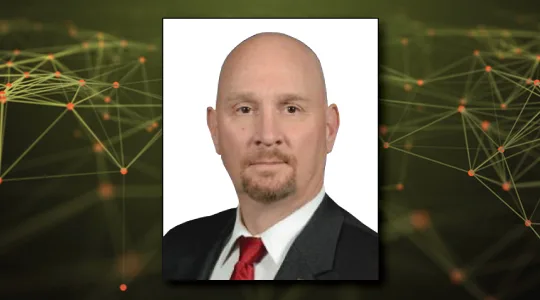
John Gilroy: Welcome to Constellations, the podcast from Kratos. My name is John Gilroy, I’ll be your moderator today. Our guest today is Dave Mihelcic, Federal Chief Technology and Strategy Officer, Juniper Networks, how are you Dave?
Dave Mihelcic: I’m great, how are you John?
John Gilroy: Let’s have a little thumbnail sketch of your background please.
Dave Mihelcic: I was with the Department of Defense for about 32 years total. I started out working for the Naval Research Laboratory doing research into secure communications networks, building those networks for naval combatant ships. I took a little time off, and I worked in industry doing some consulting. Then I went to work for the Defense Information Systems Agency initially as the deputy for command-and-control engineering, and then later as the Head of Network Engineering, and finally as the Chief Technology Officer. For about the past year and a half I’ve been the Chief Technology and Strategy Officer at Juniper Networks taking what I’d learned in those many years building federal networks, and applying that to helping industry better make solutions for federal customers.
John Gilroy: You’ve been from the mountain tops on commercial and federal as well haven’t you?
Dave Mihelcic: Absolutely.
John Gilroy: Well great, I guess if you wander the halls of the Pentagon, or wander the halls of the Ford Motor Company, everyone talks about the cloud, the cloud this, the cloud that. Because this is Constellations we talk about satellites and space, and it seems to me that the satellite industry may be a few steps behind the folks at the Pentagon, and maybe at Ford Motor Company. What do view the whole idea of the cloud and the satellite world?
Dave Mihelcic: I think there’s a potential for convergence of satellite technologies as well as cloud technologies. Cloud really isn’t anything mysterious, it’s just a modern style of computing that allows you to make use of assets that aren’t located near you, and also aren’t necessarily owned and operated by you. Essentially you can just rent computing time, you can use that as either infrastructure as a service, so you basically just have remote computers that somebody runs for you, and you run your own software, or you can use it for software as a service where the entire application is operated for you, and all you do is reach in say through a web browser and access what you want, say email, or collaboration, or word processing. I think there is a lot of potential overlap between satellite technologies and the cloud, because satellite technologies are really allowing you to extend a network from a disadvantaged location, to anywhere in the world, potentially accessing cloud assets.
John Gilroy: Well that sounds like a military word doesn’t it? A disadvantaged location, and the military’s got to deal with a wide range of applications out there don’t they? Locations as well.
Dave Mihelcic: Absolutely, it would be great if our military only needed to deploy into Super Bowl cities, but that’s often not the case. They need to be able to go anywhere on the surface of the earth at a moment’s notice. Communications need to be provided, and unfortunately you can’t always rely on local infrastructure to provide those communications. Traditionally the military has built, owned, and operated their own communication systems, whether they be RF line of sight, or over the horizon systems to include satellite communications. We’re now seeing the military rely heavily on commercial infrastructure, even forward deployed relying on mobile communications networks that might exist in countries they deploy too, or more often the not commercial satcom.
John Gilroy: You’ve looked at this from many different perspectives, both inside and outside the government, so what do you think the biggest opportunity is to embrace cloud computing in the satellite world here?
Dave Mihelcic: I think there’s a couple of opportunities, first of all the satellite development community, people who build software for satellite modems or satellites themselves can leverage cloud computing to give them access to development platforms at a much lower cost, and much more quickly than traditional approaches of buying servers and racking and stacking them in data centers. That’s going to allow the satellite industry to embrace agile development methodologies, as well as dev ops, development and operations merge together, so they’ll be able to deliver software updates much more quickly than they traditionally could. A second area where I think we’re going to see some synergy between the satellite industry and the cloud industry, is being able to take certain functions that are performed on dedicated hardware at a downlink site at say a DoD teleport, and moving those into a cloud data center. For example, instead of doing all of the digital signal processing in a piece of dedicated hardware at that downlink, uplink site, you could just sample the RF waveform, encapsulate that in IP, the Internet Protocol, send that across a wide area network to a cloud data center where you can perform the digital signal processing. Once again, this will potentially lower the cost of the equipment at those teleport sites, it also has the possibility of enabling much more rapid development of software, and the insertion of that software allowing the satellite industry to roll out innovative products more quickly. Then the final aspect of convergence, is going to be as we see satellite communications continuing their importance in not only disadvantaged areas in the Third World, but even in this country. I like to call them the W states, so if you look at a map of 4G deployment in the continental United States, you’ll notice big holes in the 4W states, West Virginia, Wisconsin, Wyoming, and Washington. A high-speed, commercial satellite can potentially have a big impact in those areas obviously for mobile platforms, airliners, and ships as well. What the satellite industry needs to do, is think about how they’re going to optimize the use of satellite communications to access services that exist in cloud data centers. I think that’s going to drive us to a cloud and edge compute model. What kind of phone do you use John?
John Gilroy: An Apple of course.
Dave Mihelcic: An Apple, an iPhone, so an iPhone is actually edge computing that works with the cloud. Your little apps on that phone are accessing services that are provisioning cloud data centers, some of them Apple data centers, some of them other cloud data centers, and it’s doing computing at the edge to make that experience more seamless to. That’s why you have those little apps on your desktop, so I think that the satellite industry is going to have to partner together with makers of mobile devices that are going to use next-generation satellite networks that might be accessible through protocols such as Wi-Fi, to optimize those applications, so that they’ll be able to transit that satellite network, which generally has latencies that are a couple of orders of magnitude higher than terrestrial latencies.
John Gilroy: Well, when it comes to cloud, a lot of people think about security, especially being the position you held for many decades. I was reading an article in a publication called Breaking Defense, and someone wrote in there that five clouds are better than 200 data centers. From a cyber security perspective, what do you think?
Dave Mihelcic: Did I say that?
John Gilroy: I read it, somebody said that.
Dave Mihelcic: Five clouds can have much more capacity than 200 data centers, that’s for sure. In fact, there are some people who predict that in the endgame all computing will converge to five data centers. Those will be big targets if that happens, so I think that moving forward security is going to remain paramount for all computing deployments, whether they be legacy on premise as well as cloud. I think we’re going to see a mix of multiple cloud providers, as well as on premise computing. We’re going to move from a notion of cloud to multi-cloud, where an enterprise like the Department of Defense is going to have multiple cloud providers in place. Some of them are going to be dedicated to them, private clouds on DoD premise, others of them are going to be pieces of the public clouds they provision for the entire world. They’re still going to have on premise computing, whether that be bare-metal, or virtualized, or even self developed private cloud. The key is going to be how do we tie all of those things together, and minimize operator impact and maximize security?
John Gilroy: Well, I am going to quote you from an article you wrote for a publication called FedTech, and you talked about intent-based networks. You don’t look at a monolithic cloud, you look at maybe subclouds, or clouds within clouds, is that what you’re talking about with an intent-based network?
Dave Mihelcic: With an intent-based network, and an intent-based network can include not only the underlying network fabric, but the computing fabric, cloud or otherwise. Basically you want to move away from thousands of system administrators typing away on keyboards managing thousands of network or compute elements individually, and instead they want to specify their high level intent for the network, or for the computing system. That intent might be something as simple as application A as priority over all other applications. With intent-based networking, you need to take that high- level statement of what it is the operator wants to achieve, and parse that into the individual commands and instructions for thousands of devices.
John Gilroy: I want to go from the cloud down to the nitty-gritty. If you talk to people in networking and software developers, there’s all kinds of issues and problems with managing these networks. I’ve worked with many software companies, and usually you hire some person out of college, and their job is to review the logs, which is really boring. It’s at the point now with IOT and with the amount of information we have, megabytes, and petabytes of data, that something has to be automated in order to assure cyber security in the cloud. What’s the role of automation with this whole idea of securing the cloud?
Dave Mihelcic: It’s going to be essential moving forward. It’s funny you mention somebody being hired to review logs, nobody ever reviews logs, and that’s a problem. All of this data is being accumulated and being ignored, and that can be security relevant data, or it can just be performance related data. It can help network operators avoid their networks being compromised by an adversary, or it can help detect a failure and actually diagnose and mitigate that failure before it occurs. With automation, we can integrate event driven network telemetry, so basically all of the health and status information coming off the network elements and the computers and the applications, we can have machine learning. Then take that data and understand what’s going on with the network, and potentially proactively make changes to that network in real time. In fact, Juniper Networks has released a series of things we call bots, and one of those bots is a health bot, which measures the health of the network based on streaming telemetry. Then advises operators on the overall status of that network and where they should address, focus their troubleshooting. We actually have developed other bots that can go so far as to detect intermittent faults on the network, automatically open up a trouble ticket that will dispatch someone to repair that piece of the network, and reroute all the traffic around that, so there are no network outages impacting customers while that maintenance has to occur.
John Gilroy: A decade ago a young person out of college would manually review logs.
Dave Mihelcic: Well actually they didn’t review all the logs.
John Gilroy: They should have.
Dave Mihelcic: They should have, nobody ever did.
John Gilroy: Now today we’re talking about maybe event driven activities, and we take this one step further, we go into the systems control themselves, or they self-drive themselves. Is that back to the future, is that the next step here?
Dave Mihelcic: Absolutely, so our goal should be self-driving networks, just like self-driving cars. I know self-driving cars have taken some hits recently with some well-publicized failure, but longer term I think what we’ll see with self-driving networks and self-driving cars, are much more reliable and much lower cost solutions to problems we’ve had for years.
John Gilroy: It’s interesting, so how would you define machine intelligence, and where does this all fit in?
Dave Mihelcic: Step one with our existing network infrastructure isn’t to move immediately to AI, it’s going to be to simply automate many of the manual tasks that we perform today. There are various standards-based protocols that manufacturers of network gear either support or should support, that allow you to remotely manage a device. Moving ahead then, you can put systems, open source systems that can then drive hundreds of devices simultaneously. Technology such as Puppet and Ansible, which are open source technologies originally developed for managing networks of computers, and have now been extended to managing networks themselves. Then moving even further forward, we’re going to see machine learning and artificial intelligence drive those automation systems to understand when the network, when the computing system is beginning to fail, or when it’s under attack, and take proactive steps to mitigate that failure or that attack.
John Gilroy: I think Ansible’s primarily with Red Hat, is that right?
Dave Mihelcic: Red Hat supports Ansible, it’s an open source product part of their portfolio. You can use it for free if you want, it’s open-source, you can also buy supported versions, which the government does. It will automate any infrastructure, whether it be the compute elements themselves, the applications that run on top of them, or the underlying network elements.
John Gilroy: Well, I want to go from Ansible to YouTube. I teach a course in marketing, I teach my students about using videos, and what I tell them is that minutes matter, because the longer someone stays in a video, the more important it is from a marketing perspective. Look at it from a cybersecurity perspective, if a human being is reviewing events, and there’s a delay there, there’s a problem there. Not only minutes don’t matter, but seconds matter, and an automated system can respond much quicker than any human can’t it?
Dave Mihelcic: Absolutely, and not only that, it can ingest more information simultaneously. In something like the DoD network, basically they’re being subjected to millions of attacks a day. Now some of those attacks are really probes, they’re annoyance, but correlating all of that information together from all corners of the network can help an automation system make a much better decision as to whether or not an attack is actually occurring.
John Gilroy: Well I’ll ask the obvious question, the 500 pound elephant in the room. Everyone’s talking about these autonomous cars, and what happens when they hit a pedestrian, or they go off the road? What happens with an autonomous system like this that fails, or doesn’t respond quickly enough? Where do you point the finger?
Dave Mihelcic: Well, I guess we’ll point the finger back at ourselves. Yeah, absolutely, there is a learning curve. I think initially we’re going to start to see these automated cyber defense systems operate with what do they call them in the automated test cars? A safety driver if you will, an operator who’s going to sit there and initially validate the decisions it’s making. Instead of that decision being automatically pumped to the network changing things, that human may be given a prompt, attack detected from X, Y, Z, recommend mitigation. Then the human can say okay or not, and I think over time as confidence is developed, we’ll take that human out of the loop, they’ll start to just watch those decisions being made as potentially a check. They’re not necessarily confirming it, they’re just potentially reversing it later, or just having situational awareness. Moving even further forward, we’ll have less and less humans involved in that kind of operations, and instead they’ll be doing more deep cyber defense in the network, hunting for adversaries who may have already penetrated the network, and using analytics to detect things that those machine learning systems aren’t catching.
John Gilroy: The early days of many technologies there are always problems. In the days of aviation there were problems, in the days of automobiles there were problems. There are problems now with machine learning, but if you take a look at the Chinese People’s Liberation Army and their focusing on machine intelligence, and the DoD has to be there too. There are going to be problems, but if you don’t keep pushing into the new race of technology, you’re going to be left way behind.
Dave Mihelcic: Yeah absolutely, for better or worse cybersecurity professionals in the Department of Defense are perhaps a little bit … They like precedent, right? They do things based on what’s been done before, and perhaps they’re going to have to start getting out of their comfort zone, and be more innovative. Our adversaries are being more innovative, and it’s like an OODA loop, if our adversaries are able to make changes more quickly than we can observe or/and decide and act, they’re going to overcome us. We need to leverage technology to get our decision time within our adversaries decision time.
John Gilroy: I would say machine learning will allow a system to react to a known threat. What about the evolving threats? There will always be new threats out there, so the systems have to not in minutes, but in seconds, and they have to adapt to new threats as well. That’s almost like being human.
Dave Mihelcic: Right, and I think that will be a natural evolution. Those machine learning systems aren’t simply going to have canned signatures that show what’s happened before, and they look for that, and that say it’s an attack. They’re going to have a large classes of behaviors that they’ll recognize, and they’ll be able to correlate multiple things together to make those decisions. They are going to learn over time, and in fact, if you look at some of the state- of-the-art in advanced threat prevention, being able to detect next-generation malware, a large percentage of that isn’t based on signature-based detection, it’s based on behavioral detection. Where you look at the malware, you allow it to detonate if you will inside an artificial environment. The machine learning system is starting to understand more and more about behaviors that could be characteristic of malware. Then being able to detect them more rapidly later.
John Gilroy: I’ll bet there’s 15 conferences going on in town now, and there may be 15 definitions of the word convergence. Everyone has a different definition of what it means. I’m sure Nutanix has one definition, and in the satellite community there’s a little different definition of what convergence is. Today we see integrated pools of computer and storage and networking resources applied to satellites as well isn’t it?
Dave Mihelcic: Right, so you’re absolutely right, convergence is in the eye of the beholder. I think we are going to see convergence being adopted by manufacturers of satellite technologies. They’re going to be able to make use of lower costs, more integrated compute storage and networking systems to support their developments.
John Gilroy: What kind of a company is going to be able to take advantage of this new technology? Is it going to be the IBM’s out there? The Oracles like your father’s Oldsmobile? Is it going to be a startup? Is it going to be a larger company that partners with a startup? Who’s going to be able to understand this technology Dave?
Dave Mihelcic: For better or worse, startups do have an advantage, in that there are a lot of them, and they’re able to get funding from venture capitalists. The venture capitalist theory, is that they make a whole bunch of bets, and if even a small percentage of those bets pay off big, it doesn’t matter that all the rest failed. I think we’re going to see a lot more innovation coming from the startup community, and they’re going to innovate around not technologies, but applying these technologies to novel problems. Problems we didn’t know we had, so when the iPhone was released, no one knew they needed an iPhone. It was solving a problem no one had ever had before, and now iPhone, or Android phone, any smart phone, pick your poison, they’re indispensable in daily life. I was on a West Coast trip recently, and the plane landed, and I got off the plane, and I turned my phone on. It was having problems, it was a Sim card error. Until the next day when I was able to get into my provider’s store and get a new Sim card, I was absolutely hamstrung. I couldn’t send my email, I didn’t know where I needed to go, I couldn’t text the guys and meet them in the bar for a beer, it was awful.
John Gilroy: We speak to large companies about the satellites industry and innovation, and companies like Lockheed Martin like to partner with startups and just maybe help them along and maybe apply some of their concepts. Big organizations like the Department of Defense are opening up offices in Silicon Valley and trying to do the same thing. Well maybe this is the balance we see, public-private balance, well Lockheed’s doing it, and the government’s doing it as well.
Dave Mihelcic: Yeah, and I don’t know where that eventually is going to all fall out, that balance. I really like some of the things that are going on with DIUx and the other innovative outreaches that we’re seeing from the DoD, like SOFWERX out of SOCOM. I think those traditional integrators have the ability to invest and help guide some of these startups in being able to deliver products that are going meet the government requirements.
John Gilroy: Well the Redskins have a new quarterback, and he’s going to have to learn how to do the two minute drill here in Washington DC. I’m going to give you the two minute drill here Dave.
Dave Mihelcic: All right.
John Gilroy: Tell me exactly in the next five to six years, where do you see this whole word convergence, and machine intelligence, artificial intelligence, who knows, maybe quantum computing, where’s it all heading in the next five years?
Dave Mihelcic: One thing is clear, consumerization is driving everything. We’re going to see continued emphasis placed on smart platforms for the average consumer. They want it easy and consumable, privacy is now paramount in everyone’s minds. It’s funny, just a couple of years ago no one worried about what they did online, now all of a sudden there are calls to regulate the big social media companies. I think we’re going to see focus on privacy and security increase even more. What the next big thing is? I don’t really know, once again, I think it’s going to come out of someone who sees a problem in daily life and says, “That’s a problem that most people don’t even know they have, and if I apply technologies in certain ways, they’re going to help solve it.” Quite frankly the advent of initially 3G, then 4G, and 5G. The advent of platforms like the Android platform and the iPhone platform and cloud computing make it much easier to develop innovative solutions to solve those problems that no one had. I think the sky is the limit, and satellite will continue to be an important part of that, because not everybody lives in a Super Bowl city. If you’re in one of those W states, or you’re on a 747, or you’re on a cruise ship down in the Caribbean, you still want to be connected to that web as well.
John Gilroy: Well unfortunately Dave, we’re running out of time here. I’d like to thank our guest, Dave Mihelcic, Federal Chief Technology and Strategy Officer at Juniper Networks.