Transcript:
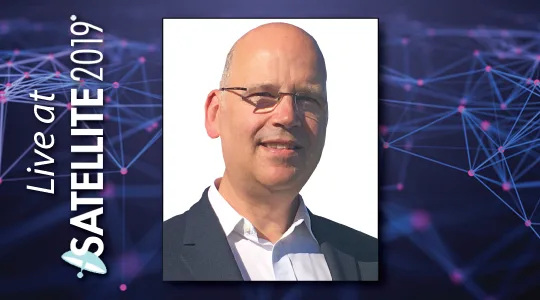
John Gilroy: Welcome to Constellations, the podcast from Kratos. My name is John Gilroy, and I will be your moderator. Our guest today is Ian Jones. He is the founder, chief executive, and owner of Goonhilly Earth Station. He has transformed the world’s most famous teleport on the verge of demolition. Really?
Ian Jones: Absolutely.
John Gilroy: On the verge of demolition, to a modern operation with a vision of becoming a multi-faceted space hub. Goonhilly today is a highly innovative …not innovative. How do you guys say it? Innovative?
Ian Jones: Innovative.
John Gilroy: Innovative teleport operation, adjusting today’s new space environment by forging ahead in a number of commercial and scientific endeavors. Ian is uniquely qualified to address today’s topic, as a highly experienced entrepreneur and innovator, especially in the field of satellite communications systems engineering. Wow. You’re pretty famous, aren’t you?
Ian Jones: Yeah, I don’t know about famous, but…
John Gilroy: Here we are at the trade show in Washington D.C., and you walk around and get hit over the head with innovation. New this, new that, new this, I mean so many new things here. How does that impact the teleport in the ground?
Ian Jones: Well, I think the whole industry has been changing very rapidly in the last few years, partly that’s been the geostationary satellites have become, you know the high throughput satellites, lots of additional bandwidth available, and the market has changed as well, so I think all those things have put pressure on teleports. They squeezed the prices. The bandwidth costs have come down, and has made it a difficult environment for teleports. So, we have really had to look at keeping abreast with the times and investing in new technologies.
John Gilroy: When I did some research on your operation, Goonhilly has been around for decades and decades, and you must have had a lot of older equipment there to begin with.
Ian Jones: Absolutely. When we first started, just looking at things like uninterruptible power supply systems. There were rooms full of batteries. So looking at modern equipment, new amplifiers don’t need to be as powerful, so there were many things that could easily be replaced. We literally started from seeing what we had, doing an inventory count, and seeing where we needed to improve and upgrade things.
John Gilroy: I think you could just jump on the metro here in town, ask someone, they could talk about innovations in space with Bezos. Everyone is talking about innovations in space. It has to be paralleled with innovations on the ground.
Ian Jones: It does, yes. The teleport has to keep up, of course all of those assets in space, the multi-billion dollar industry of the space sector and where it is going in the future, all of that has to communicate back with the ground. So teleports add that vital link to make all of that work.
John Gilroy: You know I was on my way over here, and I was on the train, and I saw a young man get on the train. He was a real cool guy, he had on like cornrows and the shirt he had on is a NASA shirt. And finally it dawned on me, you know, Ian, back when you got involved with this, it really wasn’t very cool. Now you talk about teleports and space, and satellites, all of a sudden, it is really a popular topic. I mean, people want to know.
Ian Jones: It is and I think there is the whole inspiration of space and the public just love the concept of space. And we from the industry send to look at our own little silos. And I think that’s one of the real problems the satellite communication industry has had for the last few years. In the same way many other little vertical silos have. If you ask the public about space, they think about rockets, and astronauts, and flying around, going to the moon, and they think about stars, and astronomy, and it is all one big subject for them. But for us, we think about our narrow subjects.
Ian Jones: So when I first looked at Goonhilly, as potentially to rescue Goonhilly, it was clear to me that the whole teleport industry was a very mature industry, and we have to take that wider view of the whole sector. And I think that has proved very positive for us. It has proved our sort of “making it” if you would like, because we did look at those wider things. And I think now the industry is starting to catch up. You look around at this show here, if you look at the number of new companies and new space companies that are here, that just weren’t here two or three years ago. It is just a testament to the fact that the whole space sector is changing a lot.
John Gilroy: What role will the cloud, and software to find networks play in the progress of teleports?
Ian Jones: It is certainly a challenge isn’t it? That so much data is now delivered via terrestrial means. We used to think in the satellite industry that we had this unique selling point that we could multicast or broadcast to millions of people at once. But now they want to receive their individual content that’s tailored for themselves. So I think that the teleport, and whole satellite industry, needs to embrace that and sort of be able to merge with the terrestrial world, but also be able to tailor content and be able to have a means of delivering that via satellite as well.
John Gilroy: We know that you’ve been able to transform Goonhilly, and this is not my first time at the rodeo, I’ve seen companies go in and try to make major transformations and fail. And they failed probably ninety percent of time. But you have pulled it off, somehow you have managed to transform Goonhilly from, and you used the word historic, because it has been since 1960s, to something new and modern. Can other companies here at the trade show learn lessons from you?
Ian Jones: First of all we had a belief in what we were doing. A lot of people believe in what they are doing. But I believe it was grounded in the physics and the electronics, and an understanding, the basics. So, one of the first things that we did, we picked up a contract for providing some TTNT services for a drifting satellite. And we talked to some of the technicians from BT who was sort of helping us get started. And they told us, “Oh, this dish can’t do that, you know it doesn’t have the capability.”
Ian Jones: But you know looked at the antenna, it was a parabolic dish, and it had an antenna control unit, and pressed a few buttons, and sure enough the dish could actually slow and track a drifting satellite. So it is a matter of knowing that capabilities. That was really important. And also, I really did have this realization we were coming late to the market, there were lots of teleports out there. And so we deliberately tried to do something different and try to have wide range of revenue streams that were not necessarily doing the traditional sort of up linking or doing TV transmission, or whatever.
John Gilroy: And you are looking way beyond the space here too. I think what you’re doing, is you are trying to come up with multifaceted space hub. Is that the next generation for you or where is that down the road for you?
Ian Jones: It is, that really is the theme. It is looking at how we can use the facilities that we have and the extensive facilities we have got very good terrestrial connectivity, we have got the ability to communicate up in the space. We are very closely situated to subsea cable stations. All of those various buildings, and offices, workshops, we looked at how we could use all of those facilities for creating different revenue streams. And they all have to have connection with space, somehow, and Goonhilly was that sort of space glue that pulled things together. But we have lots of interest in developing new technologies, going into manufacturing, as well as the traditional provision of communication services for other clients. And that’s where that sort of multifaceted nature of the business comes in.
John Gilroy: I just finished teaching class last week, I had fifteen graduate students, and I think if I walked into the room and said and now we are going to have a presentation on lunar pathfinder mission by Ian Jones, you would get a full house there. I mean, this is really exciting, people love to hear this topic, and you are right in the middle of it.
Ian Jones: It is exciting stuff, and you know, Mike Pence is going to give his talk at the satellite show at lunch time today. And he is going to be talking about going back to the moon. Everybody is talking about going to the moon, currently. It is a very exciting time for young people to get involved. It is amazing how many small new companies with the next generation of graduates are really now starting to appear, and their ambition is to work and operate in this new space era and create a new economy in space exploration. So lunar pathfinder is our answer to that. We are planning with European space agency and SSTL, to sort of help our business around providing communications really from lunar orbits back down to Earth.
John Gilroy: One new area for Goonhilly is radio astronomy. Now when I think of radio astronomy I think of those poor academics who fight and claw to try to get their evenings in that Keck observatory in Hawaii and they fly all the way out there and they spend two years to get their week and then it rains. Call suicide hotline. But radio astronomy is part of what you are into now too, isn’t it?
Ian Jones: It is. And it came right from the very beginning of our business plan. That we realized that the large antennas at Goonhilly were probably a bit of overkill for traditional commercial communications, and we could use the smaller antennas on the site for that purpose. Leaving the bigger antennas free for other exciting things. We are straight in touch with the radio astronomy community to see how we could work with them and provide them with a service. Now I have to admit that I have a family connection here because I have a brother who is a professor of radio astronomy at Oxford University.
Ian Jones: And so, over the years I had many conversations with him around the kitchen table about how the world of radio astronomy and the world of communications are very similar, but we have a completely different set of jargon. So the two communities could have a conversation without actually digging into the depths. We would realize that we were talking about the same thing with different language. It is really interesting that for, as you mentioned the radio astronomers work very hard to get their funding and to make innovations, and there’s very little funding available. So they have to work extra hard, and whereas we in industry are looking, we work hard to make a few percentage difference to get a competitive advantage. The radio astronomy community have to make a order of magnitude change to get their funding. So by working with that community, and if we can transfer their technology into our industry, we can make order of magnitude changes in the capability. And that’s what we are working to do.
John Gilroy: The people I know involved in radio astronomy really like being isolated. I mean, on top of a mountain in Hawaii, in the middle of who knows where in Russia, I mean, so they like to be isolated and remote in order to catch the signal. So you must participate in remote areas as well, I imagine.
Ian Jones: Yes, and I think the radio astronomy community really need a radio quiet area. One of the issues that we had at Goonhilly at the beginning is that we want to transmit. We want to use the teleport to do commercial operations. Part of that really is finding the gaps in the spectrum where the radio astronomers can work. I think as a community now, we are finding the sort of inactionable rise of the mobile phone sort of grab for bandwidth and with 5G now we are seeing C band is disappearing and there is real push to grab all of the bandwidth in the sort of 10s of gigahertz area. So the satellite community is now experiencing what the radio astronomy community had been experiencing. The just needing to find and fight for these areas of bandwidth.
John Gilroy: Yeah.
Ian Jones: It is really important.
John Gilroy: And it is a fight too. You know, Ian, thousands of people of people from all over the world have listened to this podcast. If you are listening to this now and want to get alerts with new episodes that are available, simply go to Google, type in “Constellations Podcast”, click Kratos and sign up and we will send you out the next podcast interview that comes up. And who knows what topic it is going to be. Maybe LEO and MEO. What about LEO and MEO and you?
Ian Jones: Well LEO and MEO, we are very interested, of course. That is where a lot of the industry is looking. So to explain to people that the geostationary satellites have really been the staple of the industry for decades now. And really the industry hasn’t changed that much. And the reason is that the business has been all about trying to get millions of customers to point their little dish to what your plot points in space where your geostationary satellite is, and make that point, that geo spot as lucrative as you can possibly make it. And that is why the industry has not changed for a long time.
Ian Jones: There have been things like Iridium come along and to try and change that model, but they haven’t really picked up until now. But the drive really has been the push for more and more bandwidth. And so that has really led to now this change, this revelation in low orbiting satellites and constellations, and also the fact that the small satellites have really become standardized. Small satellites design companies can come into existence and sort of build a capability. Grand stations really need to embrace that. You need the space to do it and the new antennas, the tracking antennas. So, absolutely, we are embracing that. We already host tracking antennas for some companies and we are starting to build out own network as well
John Gilroy: If your company wanted to set up a data center in Silicon Valley, they would be paying a million dollars an acre. And I see here you have 160 acres. I mean you are in a really good situation to be flexible and have all kinds of different, I mean it is not in a bad shape you’re in.
Ian Jones: Well not only, we have all this space, we are actually located at the center of the planet in terms of where all the data comes together because we sit in Cornwall. Cornwall juts out into the West coast of the U.K. into the Atlantic Ocean. And it is where when many of the world’s subsea cables land on their way into Europe. On their way from the Middle East and the Far East, through Europe into the Americas. So we sit right at the epicenter of all these internet connections coming together. And one actually comes directly into Goonhilly. So it is a really interesting place to have a data center and indeed that is what we are investing in.
John Gilroy: There is a big fancy word that is going to impress some people, I will say it: deep space communication network. Is that something from a Sci-Fi novel or something you’re actually designing and looking forward to?
Ian Jones: Someone of my age, I can remember the moon Apollo moon landings. It was amazing to be woken up early in the morning to see Neil Armstrong landing on the moon. And that picture was beamed actually down from the moon to a dish in Australia, and then it was beamed around the world from Goonhilly, from an antenna at Goonhilly. I can remember it really clearly even though I was 5, 6 years old. That was done by the deep space network. The NASA deep space network. And for the decades since, there have been a couple of deep space networks.
Ian Jones: NASA and the European Space Agency, but with this real push towards commercial exploration, and real resurgence of interest in going to moon with space agencies, there’s a real requirement now to provide more deep space communications services. And that is one of the areas in innovations that we are developing at Goonhilly. We are in the process of building our first deep space dish, an upgrade of an existing 32 meter dish. We are now upgrading a second dish, in collaboration with our radio astronomy partners, that is a 30 meter dish at Goonhilly, and now we are looking for sites around the world to expand and have a global deep space network.
John Gilroy: Take off your teleport hat, take off your electrical engineering degree, and put on an MBA hat. So you are sitting over at Wharton or at Harvard and you are studying an MBA, and one of the challenges they have in business schools now is just working with companies to make them transform into something they aren’t now. And what with Amazon web services, the cloud, IBM, Google coming in, it is changing so fast software to find networks are changing, IOT is everywhere, it is very hard to transform business in an effective manner. But you seem to do it. So what is the magic sauce? Is it hiring good people, is it just get lucky, is it you know you are in the right place, a prestigious place and people just show up and want to work?
Ian Jones: That’s a very good question. I do think it is a matter of, on the one hand, getting lucky. It is a matter of surviving long enough to get lucky. I think I ran my own small company for twenty years before starting Goonhilly and it is very difficult to hold on to intellectual property (IP), really, really difficult. It is a balance between being the sales person and getting out and telling people about your technology and then the bigger companies coming and just saying ‘Oh, that is a great idea, we will have that idea, thank you.’ It is very difficult to protect IP because your ability to protect it is only as good as the amount of money you got to pay the lawyers.
Ian Jones: So the hard work was actually acquiring Goonhilly in the first place. And getting over the hurdle of paying the money to British Telecom and buying it from them. Goonhilly is such a famous name, it has such amazing facilities and capabilities. I think that was a huge hurdle to get over. But now moving forward it is a matter of, okay we have investment, how do we best get multiples on returns on that investment. As a management team now we look very hard. We spend a third degree of our time thinking very hard about where the market is and how we can make an impact and what is unique about what we have and how we can really push that forward. And that is an important thing that you have to spend time on. Thinking about it very hard, and maybe sometimes some of the things that you would like to do that perhaps do not have the returns, to leave them behind.
John Gilroy: Well in America, here, we have this phrase call public private partnerships, and what you did is you took a public organization and bought it. And what I see on your LinkedIn profile, you are connected to a lot of leading Universities in U.K. that teach aerospace. It seems like what you are doing is, out of the kindness of your heart, you are working with people in the area of radio astronomy, but gaining a reputation in that community as a responsible partner and then the smarter people can apply and find out more.
Ian Jones: Yes, and it is partly about being the responsible partner. It is partly about the fact that with an organization or a site like Goonhilly, you know Goonhilly is so famous, it played such an important part in the history of satellite communications. The U.K. public really realized that and the public around the world who have a technology bent to them, know the name as well. And they let us know, and we feel a responsibility to do the right thing, to a certain degree. But it is not all altruism. It is a realization that by working closely with the Universities and working directly with the PIs who are doing this new research, it can give us a commercial advantage. And so, it is absolutely right to find a way to draw them in and to have a good reason to work with us because it is so easy to get on with your own thing and not do that. So we spend a lot of time trying to nurture that relationship, but it definitely has a commercial sort of underlying reason for doing it.
John Gilroy: Well in American football, they have the two minute drill, and we are right about at the two minute drill here. And so what I want you to do is take off all these hats and put on your thinking hat. So what is going to happen four or five years from now, six or seven years, in general in this community? What kind of transitions do you see taking place?
Ian Jones: I think there will be the rise of the constellations. I think space exploration…
John Gilroy: It sounds like a movie doesn’t it: the rise of the constellations.
Ian Jones: Who knows what we will be seeing in space. I think supporting constellation providers, I think exploration, new data coming down from space, all these Earth observation satellites, and other applications. That’s where the changes will be, and then the key to that will be to find ways to monetize it, to find commercial applications of this new space data.
John Gilroy: Ian unfortunately we are running out of time. I would like to thank our guest Ian Jones CEO of Goonhilly Earth Station.