Transcript:
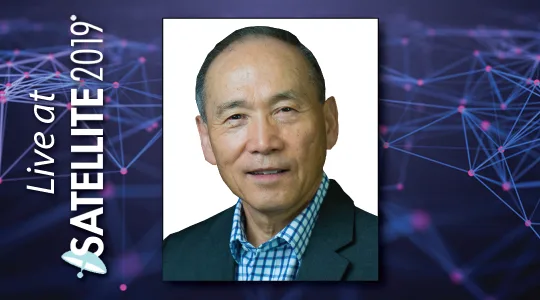
John Gilroy: Welcome to Constellations, the podcast from Kratos. My name is John Gilroy. And I will be your moderator. Our guest today is Barry Matsumori, CEO of a company called BridgeSat. BridgeSat is a company that’s enabling future space missions using optical communication solutions through a global network of ground stations, and complementary satellite terminals.
John Gilroy: During this episode of Constellations he’ll talk about optical communications, and how it’s different than traditional radio frequency, RF or fiber networks. Are you ready there California kid? Are you ready to go?
Barry Matsumori: I’m ready to go. Thank you very much.
John Gilroy: Okay. Great.
Barry Matsumori: Happy to be here.
John Gilroy: Let’s start by talking about what exactly is optical communications.
Barry Matsumori: Oh. It’s great. So, everyone knows RF. RF is what our mobile phones use, what most networks use. But, what’s different is the ability to do the same sort of transport of information using photons, instead of electromagnetic waves.
John Gilroy: Pretty simple for a physicist to understand. What could the person on the street… Comparing it with lasers, is similar, dissimilar, or what’s the difference?
Barry Matsumori: Actually, all kinds of people have practiced at some point in their early career the use of communications by simply taking a flashlight and turning it on and off. That’s communications. It may be slow. The bit rates very slow. But, it is optical communications. And then, if you speed it up where you’re using something like lasers, or LEDs. And then, using a modem to modulate the signal, you can get a lot of high speed data. A lot of it.
John Gilroy: Here we’re at the floor of SATELLITE 2019. Everyone walking around here seeing what’s going on, listen to people in panels. Like the panel you’re going to be on real soon. They pretty much know what RF communications all about. And so, would you lift and shift and kick out RF and put in your system? Or, would you augment RF? Or, where’s it fit in the matrix here?
Barry Matsumori: Oh, that’s a great question. Because, by all means it is complementary. RF is here to stay, it’s never going to go. But, there are times and places where one needs security as a feature. One needs very high speed as a feature. One needs a lot of capacity. If any of those apply you’ll think about doing something other than RF. Or, at least complimenting an RF system.
John Gilroy: I guess, if you have a Honda Accord in your drive way. And you got 12 family members coming over. You rent a bus or something? So, you use this for specialized applications where high speed’s required?
Barry Matsumori: Maybe, the metaphor is you have a Honda Accord, and then there’s a Porsche also available.
John Gilroy: Of course. You’d call it a Porsche instead of a van. These California people they think about Porsche’s and Lamborghini’s that’s top of the head here. So, we know that you have a faster solution for communications here. So, where’s the market for optical communications? How big is it? Who are the customers? And what’s the projected growth rate?
Barry Matsumori: Right. That’s a great question. Because, we’re here at a space conference, at a satellite conference. And the applications for space are very clear. But, there are applications for air, and there’s applications for ground. Ground to ground communications. And if you combined air, space and ground, the market is large. I’ll say it that way.
John Gilroy: Oh. Last year you were on Federal News Radio and talking about your company. So, there’s a federal market there to? Is that correct?
Barry Matsumori: Oh, very definitely. Actually since we’ve last talked, we’ve increased the number of government programs that we have. Because, there’s definitely a national need for this capability, along with the commercial need.
John Gilroy: When you talk to people at the DOD, or other agencies. The first word that comes out of their mouth is going to be cyber security. What do you want for lunch? Cyber security.
Barry Matsumori: Super important.
John Gilroy: And so, where does cyber security fit in with this type of technology?
Barry Matsumori: So, let’s talk about what cyber security is. It’s a number of protocols, a number of processes. And that also includes things like encryption. Encryption, by it’s very definition means you protect something because the signal got away to someone that may be an unintended target. Unintended receiver. And what we try to do is, we try to add layers by getting a signal only to the intended receiver. And that way you can apply encryption also. But, it’s a layer. And that’s the big security aspect that optical communications provides.
John Gilroy: It seems like it’s related to this federal concept called zero trust. It’s only allowing certain people access to certain documents, in a certain situation. And they’re pre-vetted. And then, it’s almost reluctantly releasing the information to that person.
Barry Matsumori: Yep.
John Gilroy: A reluctant release. Changing the way people do things. Changing the way people think. Humans don’t want to change. They’re emotionally committed to “We’ve always done RF”. So, my question to you is can your system have that kind of transformational effect on the business model for the government or a commercial company?
Barry Matsumori: I think that’s probably one of the key questions. Because, it is a change. The entire community that’s walking around here, for a very long time has done nothing about RF. And the notion that photons are augmenting, possibly replacing in some circumstances, a communication vehicle. Is pretty dramatic. That said. The need for cyber security for high throughput and for other reasons is getting very large. And now, we have many more competitors. A larger community is going “Yes. We need to augment with optical communications.”
John Gilroy: So, if I had a whiteboard in front of me, I’d get an old marker and I’d draw a satellite dish, and then a satellite. And I doodle a little communication going back and forth. So, is your system that directional, or is it between satellites?
Barry Matsumori: It can be both. Between satellites and space means that they’re propagating through a vacuum. And so, actually that’s one of the easier problems. Because, the challenge then is just aiming, it’s just a pointing error. Whereas, if you’re going from space to ground, one has to go through atmospheric conditions. And that’s the big challenge. And that’s the hard problem we try to solve.
John Gilroy: So, optical communications can support both space to space, and space to ground applications?
Barry Matsumori: Yes, and air to ground, again, in numerous applications.
John Gilroy: So, what is an optical mesh network?
Barry Matsumori: Optical mesh network depends on the application that one is talking about. But, it simply, For what the application you’re talking about, is if you have optical links between satellites and they link each satellite. It’s a mesh network. And they can send signals around. For example, if one wants a very low latency signal they go satellite to satellite. Or, ground satellite, satellite, down. And they bypass much of the servers and routers in the internet.
John Gilroy: You know, Barry, people from all over the world. China, Japan, India, all over the place. Even Brazil have listened to this podcast. If you’re listening to this now and you want to get email alerts when the new episodes are available, go to Google type in Constellations podcast. Go to Kratos and give us your email and we’ll make you know what’s going on next.
John Gilroy: I went to your website Barry, and you talked about ground station site diversity. Why is it even important?
Barry Matsumori: Oh. Yes. So, there’s no free lunch. All communication systems have their advantages and disadvantages. In the case of optical communication, optical wireless communications. We do work with atmosphere. We have to work with atmospheric conditions. And one of the classic techniques is diversity. Having a multiple of sites that you go down on Earth, in case there are weather conditions that don’t allow coming to a very specific area.
John Gilroy: I was doing research this morning about your company and your offering. And here in Washington D.C. there was something in around 2000 called TSAT that was introduced and never got funded. Is this similar to that? Or, is it a different concept completely?
Barry Matsumori: TSAT was a program that was developing optical communication, optical wireless communications. And I won’t go into details of where it didn’t go. But, needless to say, it was probably ahead of it’s time. And this is a key point, is that the time for optical communications does not appear to be ahead of it’s self anymore. It’s the right time.
John Gilroy: What do you think the hurdles are into all these companies in the fold here adopting your technology? What’s the big challenge that they have?
Barry Matsumori: I think the biggest is just awareness. I mean, we have to do advocacy so people understand what can be done. What can not be done. How to work together with RF systems. For example, if in the satellite case, if a satellite is using opticoms through down link, and they run into a very sever weather condition that there is the choice to actually use a lower rate RF system, x-band let’s say. And you use an adjacent site on the ground so that if an image, or a signal really has to get down you can do that. And working through a hybrid system that is well managed.
John Gilroy: I keep thinking of software development, and agile, and flexible, and pivoting and changing with requirements. It seems if we have a good situation everything’s clear we can use the high speed, or bump down to RF providing you have that ground station site diversity, huh?
Barry Matsumori: There’s a corollary that we all know, and it’s called your cellphone. Your mobile phone goes through multiple modes. And it picks the mode that is optimal. And then, selects a mode that if the conditions change, then mode will select one that works in the conditions that are provided.
John Gilroy: You know, before this interview started I was chatting with you. And you talked about your travel schedule, which is amazing. So, I think that’s what your job is, is awareness. You’re awareness man, “Hey. I’m here. Come over here and let me tell you about my product.” So, you’re on the road all the time talking about this.
Barry Matsumori: It’s important that people understand whether it’s U.S. Government. Whether it’s other countries. I think it was publicly announced that we have a cooperation with Es’hailSat in Qatar. And it’s great that we can talk to them, and talk about what we can do in the world of communications.
John Gilroy: To me, if we look at your company. It seems like the wireless industry might provide a good fit for your offering, your technology. Can optical networking benefit the emerging 5G network space?
Barry Matsumori: That’s a great question. Because, the answer is a most definite yes. For front hall, back hall applications that using optical in some cases, instead of millimeter wave I think applies. And certainly we’re advocating that.
John Gilroy: Well, I wish I could define 5G by saying millimeter wave. It’s just I try to define it. And every time I try, I say “Not going to try anymore”. And then, the people at ATT give me another definition. And then, maybe Barry can give you another definition. Give me Barry’s definition of 5G.
Barry Matsumori: Well, I’ll go with the millimeter wave bit first. And that’s very clear. It’s just frequency band that is licensed. Going to 5G. 5G at the end of the day is about much lower latency, and very high speed. Without that combination 5G would just be a slight extension of 4G. But, it’s much more than that.
John Gilroy: But, as far as sight diversity goes, there’s a lot infrastructure that has to be built. That’s why these big companies like Verizon are putting millions of millions of dollars into it. And ATT. I just think of the different geographic areas of the world that have to be changed and altered. I mean, I guess I’m not as optimistic as the youngsters are about 5G. I think it could take a few years.
Barry Matsumori: I can only suggest that with every generation that there’s always been challenges. I remember when 2G transitioned into 3G. And there were a lot of challenges then too.
John Gilroy: Do you remember then they would lay those cable crazy things in your neighbor hood and people would say, “We’re never going to use this stuff.” Now, they’re used up.
Barry Matsumori: The one thing it really points to something and that’s we talk about speeds now that are not megabits anymore. We’re talking about gigabits, and lots of gigabits. And people go how much do you use? How many people can use? I don’t know. A hundred gigabits? And the answer is… Actually, just give it a little time. It will all be used up. Just like we do now with our phones.
John Gilroy: I think they used to call it dark cable, or something didn’t they? They had all this cable that no one knew about and all of a sudden now there’s a constant use for it. I think that’s what going to happen with the number of satellites going to be out the next five to ten years. Then it’s faster communications because we’re going to fit in.
John Gilroy: A lot of people fly from all over the world to come to the satellite show here. I was updating some coffee I heard five languages in five people. All kinds of people, all over the world. Do you think there’s partnerships for you with this optical communication?
Barry Matsumori: Around the world?
John Gilroy: In this room.
Barry Matsumori: In this room. Most definitely. I can’t tell you who we’ve been working with. But, yes. Most definitely.
John Gilroy: It’s a secret, but it should be a secret. And believe me it could be pick the country. There’s a 135 countries, and every one is here today.
Barry Matsumori: And I can tell you that Saturday morning I’m on a plane to Europe.
John Gilroy: Oh, there’s a hint. Breaking news. Stop the presses. Call The Washington Post.
Barry Matsumori: Europe’s a big place, but it’s okay.
John Gilroy: Call The Washington Post. Or, The Paris Tribune, or whatever the heck it is. In Washington D.C. we have these public private organizations. And we have organizations like NIST that work in a lot of areas of the federal government. And they’re respected outside the federal government. Is there an area in the public private world that, maybe, you can apply some of this fast technology?
Barry Matsumori: With the government there are some programs we can’t talk about. But, most definitely the government has applications across the board.
John Gilroy: It’s crystal ball time. And I always try to look in the future. And, Barry, someone like you, you have 20, 30 years in the industry. You’re an entrepreneur. You have a real good idea of what this technology can do. So, you must… Here’s the conclusion. You must have an idea of where it’s heading in the next five to ten years. Every booth I am at. Every guest I have, I go, “Wow. I never expected that.”
John Gilroy: So, what are you going to tell me that’s going to dazzle me five years from now. What are we going to look back at? Only gigabyte rates? Or, what’s next?
Barry Matsumori: Well, beyond what’s happening on Earth, in space, in the air. There’s going to places like the moon. And if you’re going to lunar communications you’re going to have orbiting bodies around the moon. You’re going to have a lunar gateway. And that lunar gateway will well have an optical link to support the traffic that’s coming from the moon. So, we can expect that. Remember we have a five year mission to get back to the moon? And somewhere in that timeframe we can also have a high speed optical connection from the moon back to Earth.
John Gilroy: You and I both have adult kids. And I think about kids all the time, and talent. So, how do you attract the type of people that can understand what you’re doing and jump on board with your vision? I think that’s a real challenge here. There’s some talent out there. But, this is kind of difficult to articulate, I think, to the tech audience? Is it? Or, will they jump on board?
Barry Matsumori: It’s not. Because, what everybody relates to is I need the latest app. I need the latest game. I need something that can support the communications I’m doing. I need mass communications. Everybody understands that communications challenge. And then, the next part is well how is it implemented? And that how is it implemented is evolving. Whether it’s 5G. Whether it’s optical communications. It’s going to continue to evolve.
Barry Matsumori: And so, not only is optical part of that future. There are other elements that are coming together. Processing speed plus communications speed go hand in hand with how cell phones. Other things evolve and become the modern technology that we all know now, and that it’s going to evolve in the future. So, it’s not difficult for me at all. Because, all I have to say is how much eventuality you want in your future that all things are going to improve.
John Gilroy: You’re making people happy and this is a part of it to. Well, Barry, unfortunately we are running out of time. I’d like to thank our guest Barry Matsumori, CEO of BridgeSat. Thanks Barry.
Barry Matsumori: Thank you.