Transcript:
John Gilroy: Welcome to constellations the podcast from Kratos. My name is John Gilroy. I’ll be your moderator today. Our guest today is Jim Marshall, business development director at Space Dynamics Laboratory. Today on the Constellations podcast we will discuss how small satellite technology is being used in innovative ways to solve technical challenges faced by the military, science community, and industry. We will find out how custom sensor, software, hardware, and thermal management solutions are making significant contributions to national defense and scientific discoveries. You will hear about the programs where this technology is being applied to better understand global temperature changes in the thermosphere, identify the population of potentially hazardous near earth objects, or NEOs, and mitigate the adverse effects of space weather.
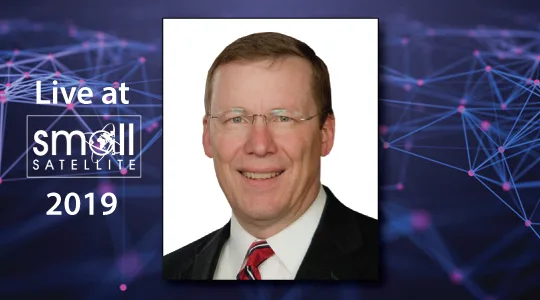
John Gilroy: Our guest today is Jim Marshall, and as I mentioned earlier, business development director at the Space Dynamics Laboratory. Jim provides oversight and integration of business development operations for the Space Dynamic Laboratory. He has broad government and industry expertise and is on the frontiers of helping to solve complex issues in space, in air, on ground, and at sea for the government.
John Gilroy: Well Jim, I’m just going to jump right in here. How is being a nonprofit research corporation an advantage for the Space Dynamics Laboratory in an industry that’s filled with commercial contractors and partners?
Jim Marshall: Well, a nonprofit organization is an organization that has a mission. We are a 501(C)(3) nonprofit corporation, wholly owned by Utah State University, so the first major purpose that we have is to advance the academic and research purposes of our host university, Utah State University. And then secondly, Space Dynamics Laboratory is a UARC, that’s a university affiliated research center, for the department of defense. That’s something that was established back in 1996 to make sure that the DOD helped us to maintain certain core competencies that are vital to the DOD. So every new opportunity that we have we measure against those two purposes. Does it serve the university, and does it serve the national interest?
Jim Marshall: We’re not driven by quarterly earnings. I used to work in the corporate world. I enjoyed it, and they have a worthy role to play in the ecosystem, but we really see ourselves as being in a different space.
John Gilroy: I’ve talked and I’ve written about public private partnerships all the time. In areas like agriculture, in areas like space, in areas like communications, like DARPA, it just makes sense because there’s certain limitations that commercial companies have, and certain strengths that government has and nonprofits have, and you put them all together and one plus one plus one can be five. I mean I think that’s the role of the nonprofit is trying to act as an intermediator, an interloper, between all of these various factions. So when it comes to small sat technology … here we are at the small sat show … what are the advantages of small sat technology that can help your organization provide innovative solutions for the government?
Jim Marshall: The first one is cost. I believe that we’re in an era where budgets are going to get tighter and tighter, not that there’s less money, there’s just so much to do with it. I think small satellites allow us to demonstrate new technologies on cheaper platforms. We still have a very disciplined engineering process but we’re applying it to cheaper parts and cheaper platforms, and things like that. You can launch a lot of small satellites on a single launch vehicle, so I think in that sense you’re beginning to see a lot of the promises fulfilled that we’ve been making here at the small satellite conference for a couple of decades. As electronics get miniaturized, as the software gets better and better, we’re able to do more and more. And John, if you look around here, you see a lot of small vendors. You see this market opening up to a lot of players that would be marginalized in the larger markets. So it’s a lot of fun.
Jim Marshall: On the NASA side. When we do the work for NASA, we’re doing really focused, really valuable science investigations from small satellite platforms that we’re actually starting to get some traction. And I don’t know if you have time for stories, but you know I’ve been director of business development here for 13 years, and 10 or 15 years ago we were turning in NASA Explorer proposals that had small satellites and we were just getting clobbered. And I think there were two reasons for that. I think NASA wasn’t quite ready to embrace the risk profile of small satellites, and they’ve become much more willing to do that now. And I think our own team was having a hard time embracing the rigor that it was going to take to really fly real science investigations on small satellites.
Jim Marshall: And last year we won two Explorer proposals. So I’ve got this bookshelf in my office where I’ve got 12 or 13 losing proposals, and then I’ve got the NASA award letters framed. I’ve got two them framed in my office now, you know. So I think NASA as a customer is ready to embrace small satellites, and I think that a lot of the players that are doing small satellites have really increased the engineering rigor that we’re applying.
John Gilroy: And the range of capabilities to small sat is just amazing. Last year I sat in this booth and I saw a gentleman from the air force walk by, and I figured well yeah, that makes sense. Then I saw a gentleman from the army walk by, and I said, “Okay,” and then we had a Marine walked by and I said, “There must be a real wide range of applications for it that’s coming out of the labs or these small businesses.” Or maybe your organization is spawning small business as well. I think you might be.
Jim Marshall: We do nearly all of our work directly for the government but we team often with small businesses, and I’ll tell you that they’re the dynamic ones. They’re the ones bringing the new capabilities and the new business models.
John Gilroy: Tell us about N 10’s satellite software capabilities and service helping … so how are these satellite services and capabilities helping the government achieve some of their mission? We talked about army, navy, and air force, but what about other aspects of the government? How do they achieve their mission with end aid software capabilities?
Jim Marshall: For one thing, if you have an end to end solution then our customer doesn’t have to integrate across a bunch of modules that came from various vendors. I’m a fan of standards-based tools so that we can help our customers avoid vendor lock, and everything that we do is modular and extensible.
Jim Marshall: You know where the Space Dynamics Laboratory but we’ve got a 25 year legacy of doing software to exploit aircraft-based tactical reconnaissance imagery, and radar, and other kinds of data. So we have this long history of building modular software that you can integrate in different ways for different applications. And we’re doing that in the space domain now, where we’re either processing and helping to disseminate data coming off a spacecraft, or we’ve got end to end software for running mission operations center for small satellites.
John Gilroy: Well, before the interview we were chatting and we talked about this concept of reusable core flight software for small spacecraft, and you may use the word modular. There are other companies in the United States that are using terms like ‘low code’, and ‘no code’, and ‘reusable software’. It’s getting to the point where people, maybe in order to be more agile and flexible, they have to develop software quicker so they have to rely more on modular components, and writing every code from the beginning. Is that right?
Jim Marshall: Yeah, it is. I remember early in my career I felt like every program we did it’s like we’d never done it before. You know, it’s hard to start every race from a flat- footed at start. And so when the space engineers get together they usually talk about hardware and stuff like that, but the software stack is really the key to our small satellite architecture.
Jim Marshall: We have an architecture that we call Pearl. It’s built around a modular avionics stack and a modular software stack that goes along with it. We’ve got a very robust software development group. A quarter of our technical staff or more are software engineers.
John Gilroy: That many? Wow.
Jim Marshall: When I got into the space business a few decades ago it seemed to be all about hardware, and now the software stack really tends to be your secret sauce. So when a customer comes to us and says, “We like what you did for us last time. Can you do this next thing?” we’re not starting from a flat-footed start.
John Gilroy: You can customize the existing modules.
Jim Marshall: Yeah, we can customize the existing stuff.
Jim Marshall: And the other thing, I guess that maybe is an artifact of our nonprofit status, is that our customers pay us to develop the software that we have, and therefore we grant to the government full government purpose rights with no royalty fees. We really try to avoid holding our government customers hostage with our intellectual property strategies. And that seems to really help us get traction with some of these customers.
John Gilroy: Let’s talk a little bit about the software, your spacecraft platform for small satellite missions. So give me some examples of how that’s being used today.
Jim Marshall: I’m just loading RAM. So we’re doing NASA science investigations from Cube Sat platforms. Sometimes we’re providing the satellite. Sometimes we’re providing the payload. Sometimes we’re providing software for it. We’re teamed with some of the great universities and great principal investigators or scientists in the country to do those. By leveraging the development work that we’ve already done before we’re able to provide some solutions pretty inexpensively. I mentioned the Pearl architecture that we have.
Jim Marshall: For our military customers I would say that most of the work that we’re doing has to do with technology demonstrations, where they need to build heritage and prove out a technology that’s going to eventually go into a program of record, or an operational program somewhere. And they want to know will this thing work, and will it work on a small satellite, and if it would work on a small satellite why put it on a big satellite? Many parts of the DOD are beginning to embrace the kinds of missions that you can do from small satellites. As things get smaller they’re able to do more relevant missions.
Jim Marshall: You’ll see a lot of that reflected in the conference this week. You’ll see people in uniform here. You’ll see people from air force research labs and space vehicles directorate that we’re working with. They’ve got a great small satellite program going that we’re participating in.
John Gilroy: You know Jim, thousands of people from all over the world are listening to this podcast believe it or not. We’ve had people come up to show from China and all over the place, and if you are listening now and want to get email alerts when new episodes are available, simply go to Google, type in Constellations podcast, click on Kratos, and sign up.
John Gilroy: I was doing some research on your company and I’ve come up with a pretty long phrase as an acronym. I’ll try to pronounce it correctly. It’s the auroral spacial structures probe, or ASSP. So how is that program helping us understand global temperature?
Jim Marshall: Well, that program is actually a sounding rocket program. What we did was we fired seven sounding rockets into the same volume of the atmosphere, in the aurora, from Poker Flats, Alaska.
John Gilroy: I love that name.
Jim Marshall: Poker flats. So you sense they had a long winter there sometime a hundred years ago. Right?
Jim Marshall: But we were doing in situ measurements of the magnetic fields and the electric fields. When the solar energy interacts with earth’s magnetosphere it tends to come into our atmosphere through the poles, and we were measuring some of the phenomenology associated with that to see how that works. We’ve been doing sounding rocket measurements for decades, it was really where the Space Dynamics Laboratory started, and that’s kind of a good stepping stone to space.
John Gilroy: But there’s another acronym and a concept that’s associated with your organization, it’s called the hyper angular rainbow polarimeter, or heart mission. is that involved with Cube Sat, or what’s that involved with?
Jim Marshall: That was a Cube Sat mission. So this is a good illustration of the way we can use Cube Sats to do a technology demonstration. I mentioned that for the NASA science investigations they tend to be reluctant to fly unproven technology when they really, really need a scientific measurement. And one of the decadal surveys recommended that a mission called ACE needs to be flown. ACE stands for aerosol cloud ecosystem, and it would fly a suite of instruments on it and some of those instruments weren’t mature enough to really fund a major mission around it. So the point of HARP was to do a technology demonstration of one of the key instruments that would be onboard the ACE mission if we ever get ACE over the hump and and flown. That was an instrument on a three U Cube Sat that was three axis stabilized, which is kind of unusual as we developed the new capabilities to stabilize or put propulsion on a Cube Sat.
John Gilroy: Now you get home from work, you have a little food, you put on Netflix, and about half the movies are about asteroids hitting the earth. They’re all over the place. People going to asteroids and mining them and everything else. Now I think you are assisting NASA with trying to identify some of these potentially hazardous near earth object NEOs. Is that right?
Jim Marshall: Yeah. NASA has a great program characterizing near earth objects that’s run out of their planetary science division, and their program executive is a great guy named Lindley Johnson. The first thing we did there was a mission called WISE, which stands for widefield infrared survey explorer. And we flew that mission more than 10 years ago now, but it was a 40 centimeter infrared telescope that went into a low earth orbit, always looking out. And the point of that mission was to build a new atlas of all of the objects that are visible in the infrared part of the spectrum throughout the entire scene, 360 degrees by 360 degrees.
Jim Marshall: And in the process of updating that atlas we discovered many, many new asteroids and near earth objects that had been previously undiscovered. We were able to characterize their orbit, and which direction they were going, and so forth. And NASA has a congressional mandate to identify 90 percent of the near earth objects that are 140 meters in diameter or larger. So that’s big enough if it impacted the earth it’d be a seriously bad day for a lot of people. Right? And in order to do that mission we needed to fly another other survey. So we have been teamed with the NASA Jet Propulsion Laboratory to propose a mission called NEO WISE. That’s a play on words and a nod, you know, a tip of the hat to the previous WISE program, NEO standing for near earth objects and WISE referring back to the wide field infrared survey explorer.
Jim Marshall: We proposed that as a Discovery mission a couple of years ago with JPL. It didn’t succeed as a Discovery mission, but NASA is working with JPL now to try and formulate that in some way and fly that mission, and we would be the instrument provider for that.
John Gilroy: Well, let’s go from Poker Flats to Egypt. Let’s go to Egypt and talk about Osiris, Osiris Rex. Talking about asteroids, I think this is a mission to go to an asteroid and mine it or control it, and you’re supporting that endeavor aren’t you?
Jim Marshall: We are. So the Osiris Rex mission is a great NASA mission, which is going to go rendezvous with the asteroid Bennu, circumnavigate and take a lot of pictures.
John Gilroy: This just sounds like a movie doesn’t it? Bennu.
Jim Marshall: It does.
John Gilroy: It definitely does.
Jim Marshall: And then it’s going to capture a sample from the surface of the asteroid and return it to the earth and land it on Utah’s west desert. So our role in that program was to build a camera suite that monitored the approach to the asteroid, that took the images of the asteroid as we’re circumnavigating it, and then monitors the process of capturing and stowing the sample. That was our role. And what that does for Space Dynamics Laboratory is it helped us to establish a heritage in the planetary sciences, you know, in planetary missions. Now we’re preparing some instruments to go out to Europa, it’ll be our next planetary thing. So most of our heritage had been in near earth orbits and now we’re getting out farther into space.
John Gilroy: You talk about Bennu and Europa you’re going to recruit a lot of college students. I’m sure you’ll get a lot more applications just as people hear about it. This is kind of an exciting concept.
John Gilroy: I was in the Metro in Washington DC and I saw a couple of teenagers approach me, and I thought they’d have like rock and roll tee-shirts- they had NASA tee- shirts on. I mean so young people can hear. They’re listening to your interview. They’re going, “I don’t know, maybe I’ll apply for that laboratory and get to work with Jim and talk about all this cool stuff, like Sunrise.” This is another product you’re working on.
Jim Marshall: WWW.SpaceDynamics.ORG. Click on the employment tab.
John Gilroy: Smart people only.
Jim Marshall: Well, yeah, and we have 875 employees at Space Dynamics Lab and 150 of them are college students.
John Gilroy: Wow.
Jim Marshall: They’re working for us part time. We’ve got interns from all over the country and it is a great place for young people to come and develop their skills in this world. And we’ll try and hang on to you, and if you don’t want to stay in Logan, Utah, you can find work anywhere.
John Gilroy: Yeah. More and more young people these days want a mission, a passion, and you can provide that. So tell us about Sunrise and your NASA work with Sunrise.
Jim Marshall: Well, I mentioned to you that I’ve got two NASA award letters framed on my wall. Sunrise is one of them. Sunrise is a mission where we won a competition and it resulted in the opportunity to do a formulation study. We still don’t know whether this mission will be flown yet, but this would be a six Cube Sat constellation operating like one radio telescope to investigate how solar particles storms, so the matter that is ejected from the sun, how that gets accelerated and released into planetary space. NASA concluded that the science investigation had a lot of merit, but they want us to mature the technology further before they confirm it for a mission.
Jim Marshall: We’re teamed there with a great principal investigator named Justin Casper at University of Michigan, and with Jet Propulsion Lab. We’ve got a great relationship with the NASA Jet Propulsion Lab.
John Gilroy: We know we’re on the campus here of Utah State University. They’ve got a football team just near the parking lot here and I’m sure they practice a two minute drill. So I’m going to give you a two minute drill here Jim. So two minute drill here: tell us exactly what’s going to happen in the next five years, and the whole idea of satellites, propulsion, and laboratories here for you?
Jim Marshall: I think you’ll see the government continuing to try to buy earth imaging data, or earth observational data, from the commercial companies. I think that in the next five years we’re going to see some of these commercial massive proliferated Leo constellations. We will know whether they succeed or not, and I think you’ll see the government trying to embrace those. You see them already trying to embrace that. I would expect to see more technology demonstrations and more focused science investigations being done on small satellite platforms.
Jim Marshall: I think you’re seeing a lot of things accomplished in software for small satellites that we used to have to do in hardware. And for a lot of government applications one space I would watch is the engineering trade off between how much onboard processing you have to do, versus how much communications back and forth, how much data can you afford to pass across your communications networks. And there was a great article by Christian Burroughs in the May, June edition of Foreign Affairs Magazine, where he talked about the future of warfare, the networked ubiquitous sensors, massive scale computing, big data, and AI. And I think that the technologies that we’re developing for the government in the small satellite arena, whether it’s the space segment or the ground segment, are going to wind up being key to the government’s answer to the new challenges that we’re facing.
John Gilroy: Well, unfortunately Jim we’re running out of time here. I’d like to thank our guest, Jim Marshall, business development director at Space Dynamics Laboratory.
Jim Marshall: Thank you John.