Transcript:
John Gilroy: Welcome to Constellations, the podcast from Kratos. My name is John Gilroy, and I’ll be your moderator. Our guest today is Pacôme Révillon, Chief Executive Officer of Euroconsult. Today, we’ll talk about the explosion in satellite capacity and new technology capabilities that are drastically impacting the ground segment. The space segment with high-throughput satellites and new mega constellations are often the focus of the industry, but the ground segment is critical to the success of this end-to-end system. The space and ground segment need to work in tandem to deliver on the promise of SATCOM and earth observation applications. In this episode, find out how the ground segment is evolving in the forecast for the future.
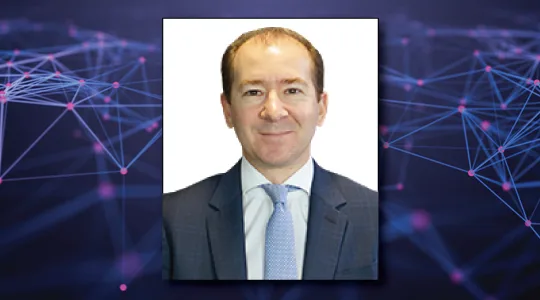
John Gilroy: Today, we have someone uniquely qualified to discuss how the ground segment is rapidly evolving to meet the new demands of the advanced satellites in space. Pacôme Révillon is the Chief Executive Officer at Euroconsult, a leading global consulting firm specialized in space markets. He has 15 years of experience working in the space sector and consults with high-level clients, particularly in satellite broadcasting, communications and finance.
John Gilroy: In this podcast, Pacôme will share some insights from Euroconsult’s recent executive report on the ground segment market prospects forecast for 2028. Wow, 2028. Wow, that’s exciting. There’s all kind of excitement today in the space segment. Most of it’s involved with companies New Satcom and EO Solutions using multi-constellations and high-throughput satellites. But Pacôme, we’re just hearing now about the impact on the ground. Why’s it been so delayed? Pacôme Révillon: Well, first, thanks for the kind introduction. I don’t know if I’m uniquely qualified, but will try to do my best to share some thoughts, and I’m already moving close to 20 years rather than 15 of experience. Well, coming back to the question, I think, certainly the portion of the space segment itself, meaning space infrastructure, usually starts earlier and tends to be more visible or maybe more symbolic for the media. In addition, it’s a sidetrack looking more like new satellite programs themselves. The space infrastructure usually tends to represent a larger part of the capital expenditure. This being said, and as you certainly rightly pointed out, there will be absolutely no possibility of success for any of the new generation program, whether it be SATCOM or earth observation, without innovation and new capabilities coming from the ground segment. Pacôme Révillon: And certainly, any new design has to come from space to ground in a fully integrated manner. And in addition to that, I would say that even if it’s a bit less visible on a global scale, I’ve had the opportunity to come to quite a number of countries in 15 years, and at the local level, even today, the presence of a national ground side is often really a national pride. It can represent for a country a guarantee of successful control of its communication and/or access to imagery, typically. And it will also guarantee to host highly-qualified jobs locally. So, this I believe will also continue to represent an important consideration in particular in emerging space nations where a lot of the satellite-based solutions are consumed.
John Gilroy: Well let’s transition here from the nations themselves to the applications. What applications do you believe will drive growth in this ground segment? Pacôme Révillon: Well, I think there are at least two to three aspects to consider. If you look really at the network parts that would represent the larger antennas and ground stations. Certainly, the larger stationary constellations will represent a key driver for innovation and deployment, and this for two obvious reasons, that would be the number of sites involved, that could be up to dozens for any new program, and then coming down to the number of antennas that can go over a hundred and then all the related equipment. If we then go to really, let’s say the end-user level, for what I would call the SATCOM segments, all that are related applications, it’s more major news should and will represent an increasing part of the overall business mix. Most of the broader networks will also have to come with new ground segments in order to enjoy better testaments and related codec and transmission technologies or just because they will need to use a different frequency band within particular the KA band in the near term. Pacôme Révillon: And talking about KA band, and while it’s certainly been here for a number of years now, it certainly remains in its infancy in many regions of the world, typically in Asia. So although in that context I think universal access that will be a combination really of public programs, Wi-Fi hotspots or cellular, that all will represent key segments. And mobility will also represent high value segments in terms of just the price of those ground segments, but also the innovation that will have to come to serve that segment. Pacôme Révillon: Just thinking of implied connectivity, we are talking about more than 6,000 aircraft to connect and informing in the next three to five years. And in that particular industry, you could see installation of ground terminals, you’d say, aero terminals including becoming as a standard light fit installation for new aircraft. On the defense side, military use of terminals should also contribute to growth with a new ground segment coming together with the use of both military and commercial systems by different forces. In the US, certainly modernization programs are on the way, as highlighted by the latest different projects, while taking the example of Europe, the so-called GOVSATCOM initiative promoted by the European Commission could see the use of SATCOM solutions by more government users in the the next decade. Pacôme Révillon: And well, certainly not forgetting earth observation, in that particular part of the industry, it is more the diversity of platforms and control that will play a role in the need for more ground segments, together with two items to consider at least. One is an increasing use of KA band transmission together with the satellites and the ground stations, that should boost world segment requirements. But also the need in a number KDs for a lower latency, meaning reducing the time from the data capture to the availability of the final product to the end user and further to approve having ground segments located in a number of strategic locations will be important and should drive installations in the coming year.
John Gilroy: You know, Pacôme, with KSAT already having an established position and the introduction of Amazon’s ground station and now Viasat entering the “As A Service” market, how do you see the cloud and “As A Service” ground models evolving in the future? Pacôme Révillon: Well, I think this concept of “As a service” could a ring a bell in two directions at least. If you think again of more of the SATCOM part of the industry, you could think of the larger programs with satellite operators as direct customers of the ground segment. They increasingly provide managed capacity and services as opposed to provide the role capacity as they used to do. So to a certain extent and in that particular value chain, this transition to managed services and capacity looks more like “As A Service” market compared to what it was. In earth observation, clearly, we see an increasing rationale for sharing one segment, in particular, as new constellations get deployed. For the constellations on the one side it certainly represents a way to optimize their CapEx spending, while at the same time it can multiply the point of contact on the ground. Again, it can comply with the requirements that national or local authorities may have. Above all, it will improve the ability to deliver services in a very short time.
John Gilroy: In his speech yesterday at the National Space Council Meeting, the American Vice president Pence said that in the past decade, more than $22 billion has been invested in nearly 500 different space companies. So, there’s a lot of new players out there, and players in the future. So well, who do you think the new players are who will emerge as data mobility and 5G become a larger part of the satellite revenue stream? Pacôme Révillon: Well, following, I would say, the current investment, for example, made by Amazon Web Services, it would certainly come at no surprise if certain other companies positioned on data transfers and geo information would also position into that market. So, certainly we could see in the U.S. or other companies having data, owning data centers or managing data on behalf of clients could get involved. This is being said, in addition to tech giants from the U.S., we could certainly expect their support in typically Russia or China to embrace the same direction. And I would be quite surprised, if another player, such as, whatever, Alibaba, or the companies from those countries would not focus relatively on similar services over the next decade.
John Gilroy: That’s interesting. Pacôme Révillon: With regards to, what I would call more the telecom operators, I think with regards to connectivity, data management, ground segment ownership, certainly relationship between satellite operators and telecom companies will have to evolve in the context of the 5G environment and may have an impact on who would be the ultimate owner of the ground segment in valued geographies.
John Gilroy: You know, Pacôme, earlier in this interview, you talked about different nations, it’s obvious that you’re on a plane a lot. You’ve been a lot of different places. So if you look at a regional perspective in different parts of the world, where do you see most of the growth in the ground segment today and in the future? Pacôme Révillon: Well, I think there are really two aspects to that question. If you think of where would the customers be located and thinking of the next few years, I think in terms of global volume and dollars, the vast majority of the clients and revenues will still be in what I would call Western countries, typically the U.S. and Europe, where you would find most of the satellite operators typically, and a large part of the leading service companies. So, in terms of where the customer would be located, that could be the place. However, if you think of where the ground segment would be deployed, we certainly talk about global infrastructure and location and vast majority of the networks could actually be deployed in areas such as African, Asia, Latin America, etc. Just thinking of the demographics and where a large part of the services would be consumed, certainly Asia and Latin America, for example, would represent important markets.
John Gilroy: You know, Pacôme, thousands of people from all of the world have listened to this podcast and are probably listening now. If you’re listening and would like to get email alerts when the next episode arrives, then simply go to Google, type in Constellations podcast, you wind up at Kratos. Give us your email and we’ll send you out a reminder every time we have a new show. You know, there seems to be a lot of pressure in the space segment to make the ground infrastructure more productive and dynamic and at the same time lowering costs. So how does that become even possible? Pacôme Révillon: Well, again, in our context of innovation certainly, we see the pressure now apply to the entire satellite industry, where with the need to provide higher cost efficiency end-to-end solutions. And while this used to apply initially more on the space infrastructure, for example, clearly now this pressure is addressing all the parts of the industry. And thinking of ground segments, I think one aspect is really about the economies of scale with manufacturing, for example, of more international base end equipment. And it’s another area where the current development of NGA sub-constellations is important because suddenly as you have to deliver a larger number of units, significantly larger number of units, you can start rethinking your manufacturing process, which however, obviously can come at a cost and can involve its own investment tree.
John Gilroy: The other aspect is about automation of operations. If you think of the future satellite operators that need to operate dozens to hundreds of ground stations dynamically, clearly higher focus on automation and overall how to make, let’s say, the value created by the ground segment higher for the users, that could be satellite companies, service providers or other organizations. Pacôme Révillon: So and the third item that’s quite important to mention, we start seeing more of the reorganization or consolidation move in the ground segment and it would come as no surprise to see more organizations joining forces or coming together just to be able to manage larger complexity and be able to optimize the production cost typically.
John Gilroy: Earlier we talked about ground station as-a- service, and typically when companies look at as-a-service moving into the cloud, the word that pops up frequently is standardization because that really makes it all possible. So what role do you believe standardization needs to play from a ground segment perspective, especially as many operators are looking at 5G as an integral part of their strategy? Pacôme Révillon: Certainly standardization has been an important concept also regularly challenging to apply to quite large parts of the satellite activity in the past, but looking at the next decade it has to play a role to maintain the relevance of satellite-based solutions. So how it could happen, I think possibly, further standardization could apply to certain elements of hardware. But as much as that, I tend to consider that additional software they use could facilitate a transition to more digital driven management of the assets, and that could be a way to try to integrate in a more seamless manner both the satellite infrastructure and ground segments from different networks, constellations, etc., but also having a better integration with the terrestrial telecom networks. So this being said, I would be humble enough not to claim to be the world- leading expert in the network integration.
John Gilroy: Well, let’s stick on the ground here and talk about terrestrial network technologies. There are some terrestrial network technologies, such as software-defined networking, open orchestration and provisioning systems. How are those three new concepts really impacting the market? Pacôme Révillon: Well, I think that these concepts will certainly have to resonate in the satellite industry and they will have to address three major requirements that are not necessarily fully captured yet. So the first will be the need to manage seamlessly larger networks of satellite payloads of ground stations. If you look at our environment by 2025 or so looking at satellite only and looking at what you may need to integrate with certain end users, we’re talking about multiple constellations of up to hundreds, maybe thousands of satellites combining assets in different orbits and where you may have to dynamically use different ground stations around the world to accommodate traffic and the needs of the end users, depending on the status of the network, in really a dynamic manner. And you will need to manage all that network in a largely centralized manner, because you will want to limit the demands, activity and presence within the network around the world, and not even mentioning that a good part of the assets could be located in pretty remote places. Pacôme Révillon: The second part that is very important is we are transitioning to a sector where you could have to dynamically adapt the resource allocations for different clients and applications. Typically thinking of mobility, you will have assets moving and transitioning from one asset to another and with different levels of capacity, resources, or applications being run on them. Pacôme Révillon: So compared to an industry that is quite fixed in nature where many clients had a fixed resource allocated and then had a fixed set of applications running, clearly the industry will have to move to a much more flexible commercial approach and flexible management of the applications and resources, almost by the second, shall I say. And the last aspect will be then the need for the integration between the satellite and terrestrial mostly 5G environments as operators of the terrestrial infrastructure will be willing to run such networks and such processes, such as open orchestration to manage their resources throughout their entire network that could primarily involve terrestrial assets, such as a mobile-based station, but could also involve some pieces of satellite networks as part of their global services for enterprise typically, and they may want to apply the same tools and methodology to manage both their terrestrial and satellite-based services.
John Gilroy: You know, Pacôme, I’m taking notes as you’re speaking. I’m writing down dynamic and flexible, dynamic and flexible, all kinds of changes in the market now. So what changes in the ground segment do you believe will need to happen for the SATCOM market to continue to be viable to make money in this area? Pacôme Révillon: That’s a pretty interesting and critical question. I think first, if you look at the global nature, one absolute critical aspect for the entire satellite sector and ecosystem is to make sure that end users, whoever and wherever they are, can embrace the new satellite-based solution that can be either connectivity or imagery or other resources, and in the environment, where we will be, we will have a transition to a number of legacy services that used to generate most of the revenues for the industry to a new environment that will be data-driven to a certain extent, closer to terrestrial telecoms and ICT industry, where you will have an exponential growth in the volume of data you need to exchange and carry. Pacôme Révillon: And in order to do that, you will have to make sure to have a fully efficient end- to-end solution. So, just taking very concrete examples, constellations, VHTS satellite systems, the promise of terabit satellites, terabit systems and traffic can only happen if new generation of ground antennas, mobile antennas, in particular, is cost-effective enough and flexible and reliable enough to support those networks. And talking about the end users, we talk about cheap highly- flexible antennas and units that the end-users will be able to enjoy. Pacôme Révillon: So to that respect, the innovation and the ability to provide those equipment at scale and at a lower cost is critical. It’s where, I think, innovation in the manufacturing process and potentially even digital transformation, so Industry 4.0 is a big word but certainly will start more of that applied to the satellite industry, including the ground segments. You know, digital RF, digitizing a good part of the RF chain is one good example where innovation could also take place. So that’s an important part. Pacôme Révillon: Overall, I think part of the ground segment industry should think of baseband solutions have had for a long time, an obligation to conduct a strong innovation policy. If you think of baseband equipment modem of 10 years ago and today, capabilities have changed quite dramatically. I think the same will have to apply to the entire ecosystem, compared to the situation that used to prevail. And some new topics, such as cybersecurity, may also take more importance in the future, and will have to be addressed, whether it be for commercial or government solutions.
John Gilroy: You know, Pacôme, you have a pretty good handle on legacy system integration, cybersecurity scaling. Now, I’m going to take and throw you in a time machine five years from now.
John Gilroy: And when you look back, or you look in the next five, ten years, what changes do you think will happen from the ground segment perspective? What are you predicting is going to happen in five years? Pacôme Révillon: Well, I think where we really see a change today is that if you think of five years from today, we really talk about a complete new generation of ground segments that will have been deployed. You see, you used to think of baseband equipment, five years was kind of good cycle for new generation. So this has just been accelerating. If you think of the number of gateways, ground segments and new infrastructure that will be in the sky and, as opposed to legacy equipment, I think we’ll have an accelerated upgrade of what used to exist, and the deployment of brand new solutions all around the world. So that’s really an important part. Pacôme Révillon: And in parallel, if we look at the industry as it is today, I believe that while we saw already some more mergers, for example, within service providers in the satellite ecosystem and could see some also at the level of base infrastructure with a lot of reorganization that has already taken place in the U.S. typically, I expect that we’ll see a deeper transformation of the ground segment industry. I would be very surprised if there was not a number of mergers, acquisitions, partnerships that would allow the companies to get scale, get access to new capabilities of technologies, and that will allow the new leaders in the industry to embrace the new complexity and be able to have even more ambitious innovations, strategies and policies moving forward. Pacôme Révillon: So, to that respect, I really think that we’ll see a change in the ecosystems. And between those potential new leaders or reorganized companies and startups that could continue to emerge and challenge them, there would be a particular challenge for small-sized companies that used to exist in a context of more stable industry and that will have to really reinvent themselves and if they want to remain players in the future environment, they will have to specialize in high value solutions, addressing maybe niche requirements, that will allow them to maintain the differentiation. Pacôme Révillon: I think contributing to the overall efficiency of the industry and solutions, but also the ability to differentiate and innovate in a continuous manner will be really what we will offer and will be, I think, a major, major wave in the next five years for the ground segment industry.
John Gilroy: Well, Pacôme, a lot of insight there. I can’t wait till I read the transcript from this and pick out some quotes there. I think you’ve delved very deeply into many different aspects of ground segment and what’s going to happen in the future. Unfortunately, here, we’re running out of time. I’d like to thank our guest, Pacôme Révillon, Chief Executive Officer of Euroconsult. Pacôme Révillon: Thank you very much.