Transcript:
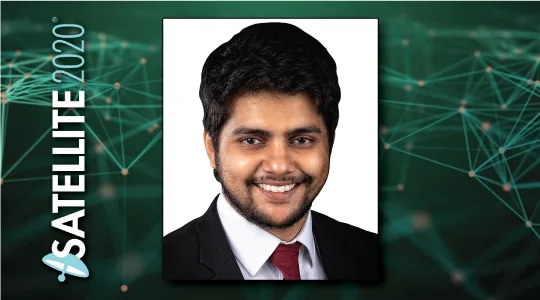
John: Welcome to constellations, the podcast from Kratos. My name is John Gilroy, and I’ll be your moderator. Our guest today is Shivaprakash Muruganandham, and he’s an analyst for a company called Northern Sky Research. People call them NSR. Today, we’re going to do an interview right from the floor of Satellite 2020, and then we’re going to turn our attention to innovation. New approaches to satellites, virtualized networks, and dynamic ground stations. The space industry today has experienced massive growth and innovation, especially from a satellite perspective, from HTSs all the way to small sats. The ground system has not developed at the same pace, and risks becoming a bottleneck to realizing these new capabilities in the sky. Shiva today, works for Northern Sky Research, is a leading global market research and consulting firm focused on the satellite and space sectors. Shiva will share insights from a recent NSR report entitled Satellite Ground Network Virtualization. It outlines how the ground segment needs to become more virtual, software defined, and cloud-centric to meet the needs of newer satellites.
John: So Shiva, you having fun at the show today?
Shiva: So far so good.
John: Yeah. You walk around and talk to new people?
Shiva: Learn something new each day.
John: Lots of innovations floating around here. And there have been a lot of innovations in small SATs, and high throughput satellites, and software defined payloads. So why hasn’t the ground segment kept pace with these innovations?
Shiva: Sure. Thanks for that John. It is like you said, there have been a lot of innovations in the space segment, so you have, we’ve had HTS satellites come through in the past over the last decade or so. And now we’re having LEO constellations, we’re having more satellites being launched with more launch service providers, with more satellites per launch. And you have this whole “cloudification” game that has been touted around as the next big thing in the satellite industry.
Shiva: To answer your question in terms of why the ground has not really kept pace with the space segment. You have to see what has been driving the space segment in the first place. So you have all these innovations, firstly, like with launch service providers, and there’s a lot of, I would say venture capital backed new space companies that have been coming into the industry, who are driving a lot of the technological innovations on the space segment. What is lacking I suppose on the ground part of the equation, is that a lot of the improvements. We have seen improvements on the ground, but a lot of it has been very in- silo focused performance, incremental performance driven innovations.
Shiva: So you’ve had, initially how it traditionally worked in the ground segment earlier, was that you had this mindset of having one thing to own it, pretty much as much of the entire system as possible. But now that seems to be changing slowly where you have companies looking to, perhaps, only own it partially, only parts of their system, wherein they’re much more open to outsource some of their requirements. And now you also have new space companies coming into the picture and saying, “You know what, we will look towards an external provider for pretty much all our use cases.” And that is something that’s only been happening recently. But like I said earlier, it’s mainly just the fact that a lot of improvements on the ground earlier was just very incremental.
John: Shiva, we’ve done 70 interviews, more than that, here. First time I’ve heard the word “cloudification”. I guess that’s an indication of what’s going on here.
Shiva: Yeah, for sure.
John: Good, good, good. All kinds of new capabilities with these satellites. So how does the ground system avoid becoming the bottleneck to space innovation?
Shiva: Yeah. The perspective of being the bottleneck guy, I can take the example of say a one particular segment in the satellite industry with earth observation, right? So like I mentioned, we’ve seen so many improvements on the space side of it where you have better sensors, better optical payloads, better radar imaging satellites, and you’re talking about having, launching more and more satellite up there, who will down link larger volumes of data down to the ground. And how will the ground keep up with this pace is, apart from just being very hardware centric alone, it needs to be able to adapt to a more software oriented approach. Start thinking about having a software as a service kind of play, or an infra as a service kind of play, or even start thinking about platforms.
Shiva: In such a situation you are not just being a bottleneck here in this entire value chain, but you’re also improving your capabilities to better serve your customers. So if you have those cloud capabilities that allow you to better integrate with, say existing cloud service providers and their existing product portfolios, you can start having existing customers with those service providers just onboard directly onto your systems, or connect directly to your APIs, and have better and more cost effective types of relationships there.
John: A wise man once said, “There’s nothing new under the sun.” And if you look at different industries, many of them looked at this challenge before, and moved to the cloud. The telecom industry, the IT industry, they face similar challenges, and it seems like the satellite industry is facing right now. So what can we learn from their experiences?
Shiva: For sure. Yeah. One of the first IT type organization that moved towards adopting this whole software as a service business model was Salesforce, right? That is something that you can learn a lot from. And apart from that, one of the big things I would say here that can be learned from the wider IT sector is just standards, standardization. It’s probably one of the most important things that we need to think about on the ground. Right now they’ve had multiple different sort of ground systems, service providers developing their own solutions, developing their own modulation schemes, or adhering to particular building specs that is compatible with specific types of flight radios, and whatnot.
Shiva: But is there an industry wide standard in place? Is that something that we are moving towards? I think that is one of the key things that we can learn from the IT sector. Take a phone for instance. Whether it’s a Nokia or a Samsung, you’re talking about just whatever companies that you need to manufacture one, you have inbuilt standards in place that a lot of different vendors provide you the competence for, competence with rather. If you were here day before yesterday, when Elon was talking about reaching out to the mass market with, what was it that with the UFO on a stick, a Dyson solution on the ground? Yeah, he was talking about two things, right? It’s got to be plug and play, and it’s got to be a system that comes in with just two instructions. It’s got to be plug and play. You got to be able to plug it in, and you have to point it at the sky. And to have that kind of ease on the ground, you need to have standards in place.
John: I think if there’s only listening to this and they have a trepidation about moving to the cloud, they just go to San Francisco and look at that Salesforce building. It’s a success story right there. That’s documentation that it’s been successful. How does the traditional analog RF based ground system compare to a digital and virtualized one?
Shiva: Sure. With the traditional model it’s just much more hardware focused I would say. So you have all these different boxes from the antenna, to the teleport hub, and to the modem and all its different subsystems. And going forward from there you have the intermediate frequency, and then the base band unit, and all of this sort of layered on top some kind of protocol, an IP based protocol, or something such. But when you’re talking about virtualizing all of this, you’re simply just talking about converting as much as possible of the hardware into a more software oriented type network. So you’re talking about having more software functions in place, wherein you could just, perhaps if you have an existing modem system, you could just update it with a particular software badge, and that is ready to go with the most recent kinds of functionalities that you might need within the network itself.
John: What would you say are the key technological developments that will serve as building blocks for ground network virtualization?
Shiva: Yeah, there are a few different technological trends I suppose, that have been driving this movement here. So one is definitely big data analytics. That’s been a very key, not just in the satellite industry, not just with the ground segment here, but also with a lot of other aspects of the satellite industry, whether it’s downstream analytics and such. So you have the ability to use machine learning algorithms to really understand what is happening with your signals and improve, just be more dynamic with your network there. Apart from that, there is also the case that you need to be able to service to the whole integrated enterprise corporations we are that are looking to us now.
Shiva: Where we have a lot of the end users of SATCOM in general moving towards the cloud, and having these digitalization strategies in place. So having a virtualized ground system that connects to such an enterprise would be, it would go a long way in just building or expanding this market itself. And apart from that, just further digitalization across the entire RF chain, whether it’s on space, on the ground. Just network functions virtualization at different levels. Just really virtualizing different layers of the ground system itself.
John: Yeah. Yeah. Shiva, thousands of people from all over the world have listened to this podcast. If you’re listening now, all you have to do is go to Google type in Constellations Podcast, and you can get to our show notes page from there. Here you can get transcripts for all 71 interviews. You can also sign up for free email notifications for other interviews with people like Shiva, talking about virtualized systems.
John: So Shiva, small sat companies have been early adopters in moving to more innovative and virtualized ground networks. So what can be learned from their experience?
Shiva: Sure. Again, I’ll take the same example I mentioned earlier, with earth observation, small satellites. Or if you go back a few years and look at how EO was done traditionally, you had one of these big satellites with huge sensors that were launched, and it would potentially, it would pass over a particular ground station at a particular time. You would have this pass window, and once you acquired your images and data to whatever degree, you had a relationship with the ground service provider, and can just down link your data during that pass. So now we’ve seen these satellites become smaller, the electronics become better, you have more data coming in, you have more data being down linked, the volume is just huge. And this requires, like I mentioned earlier, that the ground segment does not become a bottleneck here.
Shiva: And what some of these small satellite companies do is, they would try to have their own grounds stations. But when that did not work, they started outsourcing parts of it, and then eventually now you have new space companies, and even non-space companies come into the picture and say, “You know what, we will provide you the ground infrastructure ourselves, and you can just plug and play into our API as you can use it as a subscription service.” And this has changed the game for them quite a bit, or is changing it rather, we are in that transition.
Shiva: Because what it essentially helps them do is, once they have that data being down linked onto the ground stations, they’re able to immediately, or be more efficient with the link to the customers, or towards whatever applications that they’re building with their in house teams and technologies for better analytics services, whether it is in maritime, or whether it’s in agriculture or whatever else. But this is the kind of transition that we’ve seen in the earth observation sector, and smallsats in general. And much of the rest of the SATCOM industry could potentially go the same way as well.
John: While you were speaking, I wrote down the word dynamic. And it gives you the possibilities of configuring things that will best result in outputs for your particular category there isn’t it?
Shiva: Yeah, for sure. Yeah. Dynamic and being more flexible. Yeah. And if it is going to be more software oriented, you’re able to just configure, like you said, to any particular type of customer demand almost immediately, compared to having to possibly just replace an entire box physically.
John: So traditionally you’d have a silo of information, and now what you’re trying to do is flatten that. Because there’s a company in this town called the SiloSmashers. Maybe that’s what this is doing, is smashing those silos, and taking those bricks and using them dynamically for whatever happens to be the current need, because it’s going to change.
Shiva: Yeah. That’s pretty much exactly what is happening.
John: So Shiva, what do you believe the evolution to a virtualized ground system will look like? And how long do you think that’ll take?
Shiva: On the timeline, I’m not really sure, but in terms of how the evolution will happen. I guess you could talk about it in a few different steps. First you start with connecting, just provide the connection, the base connection, that is required between points of presence on the ground, whether it’s for SATCOM or from space to ground in the case of data down links, and data, and observation imagery.
Shiva: And then after that you move on to digitizing and virtualizing this entire structure, and start adding different layers on top of it that are just software applications, to put it bluntly. And then you start thinking about extending these solutions. So you start extending it to the customers themselves to see what they have existing in place already with their prior cloud service providers, and what applications they’re looking to serve their customers, and how you can integrate with those systems. And then eventually, you put all of this together into your bundles, and provide it all as a service. At whatever type of pricing schemes you might think about, or there are different approaches there to the business itself. Yeah.
John: We’re recording this from the floor of Satellite 2020 we did several interviews today, and a couple interviews yesterday. And the general from yesterday, talk about a specific application in the area of oil. And there are so many different applications. The people behind us earlier we’re doing a show about precision agriculture. And I’m sure there’s category after category of different areas where this can be applied. So Shiva, what types of organizations do you think will benefit most from a virtualized ground system, and why is that?
Shiva: Types of organizations that would benefit most? Go back to my favorite example here with the observation satellites, because these are the ones that seem to be most, I guess in the immediate future rather, most able to take advantage of such a transition on the ground, because they are so tied into so many of their things on the cloud already. It’s not just the earth observation satellite operators, but also the entire value chain from there, where you start thinking about value added services built on top of these satellite images. And then information products where you start adding layers of information on top of the images. And then the whole sort of deep big data analytic type services, whether it’s precision agriculture, oil and gas like you said, or just a mining conglomerate who wants to know more about their volume of production somewhere.
John: In the industrial role they talk about the supply chain, and how important it is. In fact, it’s top of mind now, this time of year talking about supply chain and securing that, and you use the phrase value chain. So maybe that’s what this flexibility of a virtualized ground station gives you, is that it can increase many different levels of value you can provide for ground station operator, for whatever topic they happen to cover.
Shiva: Right. Yeah, for sure.
John: Good. So what becomes possible with dynamic satellites and dynamic ground working in synergy that you really can’t accomplish today?
Shiva: Flexibility. It is something that you already alluded to earlier. It is the ability to be able to configure to different needs, to meet different customer needs, in a much shorter timescale. And apart from that, being able to just provide to a variety of different customers as well. And while that is happening now, I think the addressable market there could be much wider too.
John: So we’re talking about dynamic capabilities here. So Shiva, how does a more dynamic ground system, open up opportunities for the satellite industry to create new business models, and move beyond really its core market?
Shiva: New business models in the sense of, you see that happening already to some degree with some of the non-space actors coming into the satellite industry. So you have all these cloud service providers, whether it’s an Amazon or a Microsoft, integrating their solutions with existing SATCOM service providers and their solutions to. And you have this new type of managed services that are happening. And wherein you just have a much more automated type of, I guess just a service it is, really. Where a customer can just configure whatever they want, to whatever type of specifications they might need with a satellite operator, and they’re just able to adapt to it instantaneously. That is the eventual goal anyway, or would be if you’re talking about being more dynamic and flexible.
John: But here we are in spring 2020, and I saw an image on the internet this morning of a cruise ship docking. And I’m sure when people talked about satellite imagery, never dawned to their mind that it could have impact in the medical world. I mean this could be a whole new world there. There are all these possibilities that dynamic and creating systems, and satellite and ground stations, that you never thought of before. So standardization is kind of a term that people run away from, or they run to, and it scares people of limits some people, it gives people some opportunities. So what role do you think standardization plays from a ground segment perspective, especially as many operators are looking at 5G as an integral part of their strategy?
Shiva: Oh definitely. So I mentioned this earlier as well. But the standardization being one of the key things that we’ll have to start thinking about in the ground segment, because without that what we have is different service providers, or systems developers just developing either their own standards, or having to cater to different types of schemes and schema, and standards. That is a much more labor intensive process. Having industry wide standards would definitely be very essential in having this transition happen with the ground.
John: Well we’re kind of limited with our show props here. I don’t have a crystal ball, but if I had a crystal ball I’d hand it to you, and maybe get a picture of you looking, gazing into the crystal ball, and see where Shiva’s going to be in five years, and where this market’s going to be in five years. But I’m sure that’s part of your job as an analyst to see where things are headed. So if you’re looking at that crystal ball and look at five years, how do you believe the ground system will have changed?
Shiva: So it’s a long process. We’re starting to see a virtualization at different levels happen right now, and I think that is definitely going to continue with the coming years. It’s exciting times, because it’s only now that a lot of the cloud, or rather, if I had to step back and just look at the wider IT and telecom sector, they’ve been doing this for a while now. And it’s only now that the satellite industries seems to be kind of waking up to this whole “cloudification” strategy, and digitalization, and it’s starting to, it’s hit the space segment already, and now they’re thinking about it. We’re thinking about software defined radios already, and now it’s slowly coming on the ground too, and it’s a long drawn out process. But it does eventually… That is the direction we’ll be going to, where we’re having more and more parts of the system being virtualized. Being able to provide customers much more dynamically.
John: So if we come to the satellite 2025 show, there may be more software vendors here than actually antenna vendors and what not.
Shiva: Quite possible, yeah. It might just be changing now. We’re already seeing some software vendors around here.
John: That’s a surprise, isn’t it? They get a booth and there’s not a piece of hardware there. There could be some software developers talking about software as a service, and ground stations as service too.
Shiva: For sure. Yeah. I come from more of a software, big data type background, itself. And to me, it’s a bit of a surprise that it’s been so slow here. I don’t know how well it’ll pan out, but I’m hoping that what you say does happen.
John: Yeah, yeah. Well, Shiva, unfortunately we are running out of time. I’d like to thank our guest, Shivaprakash Muruganandham. He’s an analyst from Northern Sky Research. Thank you Shiva.
Shiva: Thanks a lot, John.