
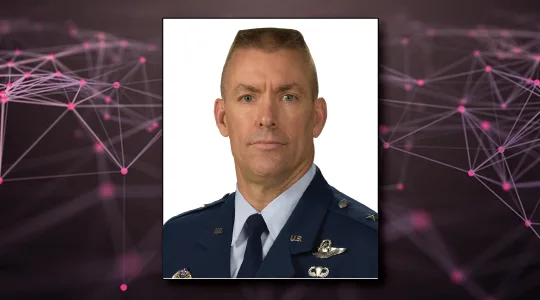
Podcast Episode #93: January 13, 2021
U.S. Space Command, Innovation and Defending Space Assets
U.S. Space Command and the importance of innovation in a warfighting environment.



Space is a Network.
Constellations is Your Connection.
Transcript:
John Gilroy: The views expressed in this podcast or on www.constellationspodcast.com do not officially represent the views of the U.S. military or the United States government. The appearance of US Department of Defense, DOD visual information does not imply or constitute DOD endorsement. Welcome to Constellations, the podcast from Kratos. My name is John Gilroy and I will be your moderator. Our guest today is Brigadier General Leonard, Chief of Staff U.S. Space Command. He is principal advisor to the USSPACECOM Commander and Deputy Commander. We will go over the role of US Space Command, the importance of innovation in a warfighting environment, and where the digital space race fits in. This is going to be a quite exciting conversation. We are fortunate to have you on the podcast, General. Can you start off with just telling us some of the responsibilities you have as Chief of Staff for the US Space Command?
Brig Gen Leonard: Yeah, John, absolutely. And thank you for the opportunity to join you on your podcast, very excited to be here. And you already hit on one of them, that’s the principal advisor to the Commander and Deputy Commander. In that role, I try to integrate things that I’ve heard across the staff, both internally and externally, and making sure that he is fully informed on all his decisions. The other job that I have is as the Director of the Staff, I try to coordinate our eight different functions across the command. Everything from how we deal with personnel, to our budget, to our plans, and to our operations and intelligence. And then my third job is to build the command towards fully operational capable. And that’s a saying in military lingo of, making sure we can fulfill all the duties that the President and the nation has levied upon us. And so, those are my three roles, or three jobs I should say. My three roles and really it expands throughout the entire command and so oftentimes I say, “I’m about 10,000 miles wide and about an inch deep.” But really enjoy the job and it’s great to be in Space Command.
John Gilroy: Wow, that’s a whole lot of responsibility there. The way I understand it, the US Space Command was reestablished a little over a year ago. It seems to be acquiring new areas of responsibility all the time. As of today, what areas does US Space Command cover? Missile warning? Satellite operations? What areas?
Brig Gen Leonard: Yeah, John, you hit on a lot of those. I’d like to say that we absolutely are expanding. It’s a growth business these days, as I know you and your audience know. We like to call ourselves Space Command 2.0, though. And what I mean by that is 1985, we stood up US Space Command for the first time, gave it certain roles and responsibilities. And then as we progressed towards 9/11, after that, we stood down Space Command as we had to stand up Northern Command, and I think everyone’s aware of the reasons for that. But as we re- stood up Space Command 2.0 last year, we adopted not only all the roles and responsibilities of the first Space Command, and that’s essentially providing support to terrestrial operations. So as you hit on it, missile warning, operations, precision navigation and timing, satellite communications, those are the things Space Command has always brought to the American way of life.
Brig Gen Leonard: But what we added when we jumped into Space Command 2.0 last year was our roles that protecting and defending our satellite assets on orbit. And so that’s a huge role that we’re stepping into. We also got what we call an area of responsibility, essentially, 100 kilometers and up is the area that we’re responsible for. So, we like to say, “To infinity and beyond.” There is no boundary to that, but it definitely ends on one side at 100 kilometers. And so with that, Space Command is trying to not only provide the support that terrestrial warfighters, as well as the American people count on every day, but we’re also trying to protect and defend not only our on-orbit assets, but those of our allies and partners to include our commercial partners. In the end, we’re about protecting and defending our American way of life each and every day.
John Gilroy: Now I’m just thinking if I met you at a Thanksgiving get together something or not and I said, “What do you do?” And you said, “I protect and defend our space assets.” I’d figure this is a science fiction movie or something. I mean, it really sounds like state of the art. I mean, you must attract some very, very bright and really hardworking people.
Brig Gen Leonard: No, absolutely. In fact, people are where we like to start because for one thing, we obviously feel like it’s important for us to protect and defend the American way of life. And so, how do we do that? Particularly because space, as you alluded to earlier, is a growing, booming business. But not only is it booming for the American people, it’s also booming for our adversaries. And so in that constant competition, we need to make sure we stay ahead. And the way we do that primarily is by outthinking and outmaneuvering the enemy and to do that, we need some really smart people. So, you’re absolutely right. That’s the foundation of how we want to build the command with some really bright and innovative folks that understand space, but also understand warfighting.
John Gilroy: When you said the word, “outthink,” I wrote down innovation. And the DOD must continuously innovate in order to remain competitive and stay in a position to win against sophisticated adversaries. However, Dr. Will Roper, the Assistant Secretary of the Air Force for Acquisition Technology and Logistics, recently wrote that, “We have remained a flip phone military in a smartphone world.” So how do you foster a culture of innovation at USSPACECOM in a way that drives new warfighting requirements?
Brig Gen Leonard: Yeah. John, I love that analogy that Dr. Roper used. I will tell you, our primary mindset again is warfighting and innovation has to do something, it has to allow us to win. Or, even on a more infinite mindset, we have to have that continuing advantage. And so we’re focusing our innovation on our ability to understand, decide, and act and really out-understand, out-decide, and out-act our opponents and try to break their capability to do so. And so we really break it down into three primary ways that we think we need to be innovative. First is how we think. Second is the technology that helps us do that. And then how we’re organized. And so along those three lines, we’re really looking for how innovation helps us make those really big leaps. It’s important for us to go big because China or Russia, if we just continue to evolve, they’re going to continue to evolve in some ways faster than us. So we need to make those revolutionary jumps and innovation, we think, is key to that. And so overall wise, we’re very focused on holistic thinking. In other words, what we call, “no lines on the map.” A lot of times we’ve thought of the world in terms of geographic regions, but we need to think about it globally and we need to think about the entire enterprise that feeds into space. We also prioritize loop learning. That’s really our ability to stay agile, to continuously guess, experiment, test, scale, learn, and repeat. And then third, we’re looking at making sure we have a shared understanding across all of our force, from the youngest, we call them E-1’s, and so the lowest enlisted rank, to the highest officer rank, to anybody that either has a functional component or a combative component to Space Command that they understand the same. And then our fourth is making sure we have decision superiority. So, that’s our ability to make decisions at a faster rate than our enemy, and so that’s our thinking. It’s a volume game. It’s about understanding the enemy and how they think. It’s also about empathy. It’s about understanding how others think around us and considering their ideas, because we got to produce volume and so we got to take into account everybody’s ideas. And so volume, go big, what have we done? We’ve entered into collaborative environments with everybody. One example of that is Designing Space. This was a collaborative environment, stood up on the internet, and we just really took all comers. We had space experts from the military. We even had an assistant elementary school principal helping us out on how to think about space.
Brig Gen Leonard: We’ve stood up a competition and we’ve put money as prize money to really get the best out of a couple different organizations competing on how we do warfighting leadership in space. We’ve worked with the Stanford d.school. We’ve also worked with the Joint Special Operations University. And so those are several examples and folks we’ve worked with to get better at thinking. And then innovatively, we also want to make sure we mature our technology. Definitely get out of that flip phone, but at least get to the state of the art, if not beyond. And so we’re looking at technologies that allow us to pull in all levels of data from just commercially available data, everything up to the highest top secret sources and integrate all of that, making sure that we can use machine learning and AI, as well as team that up with human experts, functional experts, operational experts, and then get that data back out for decisions in a customizable way across all ranks. And so that’s where we want to innovate in terms of technology. And then organizationally, we’re looking to what I call Cyborg, the organization, on top of that technology. In other words, a lot of organizations will take what they have in terms of how they’re organized and then add the technology to augment that. Instead, we’re looking at the technology to be the core and then to wrap our organization around that. We want an ambidextrous organization. And what I mean by that is an organization that preserves that design, that creativity, that forward-thinking, as well as has the ability, like all military organizations need to do, and that’s really get after the nuts and bolts and do that planning and execution. We have to be good at both. And so our organization, Cyborg, across that technology has to be able to do both as well. And so we’ve stood up a strategic initiatives group, a group that’s primarily focused on that creativity. And we are starting to invest to where, hopefully, we’ll be able to get to what we call an 80/20 split, to where 20% of our time and organization is dedicated to that forward creative thinking while still keeping in place that machine of execution. So those are examples of how we’re getting after innovation across US Space Command.
John Gilroy: Well, General, I met Dr. Will Roper at an event last year and it was an event for start-ups. He goes to events with startups and he just tries to be a sponge, just soak up as many ideas as he can about innovating. And I think your concepts here are resonating throughout the industry, throughout the Air Force as well. It’s just really exciting times for innovation in your world, and I think our world here too. Ensuring the protection of America’s and allied partners’ interests in space seems to be pushing the US military to more closely integrate within its services. Can you tell us some of the programs and efforts US Space Command is part of to support the sharing of data and integration of all service branches and international partners?
Brig Gen Leonard: Absolutely. And I’ll tell you, we’re not only looking to integrate across all the different facets of US Space Command, but we’re looking to become interoperable. So not only do we want to make sure we can mix all different flavors and capabilities, but we want those to be interchangeable so that we have a resilient architecture. And so that’s key. So who are we trying to mix together and who are we trying to be interoperable with? I’ll tell you, first of all, it starts with what we call the Joint Force. And so as a combatant command, US Space Command is full of Army, Navy, Air Force, Marine, and space professionals. And so all the different services in charge of different domains bring their experts to US Space Command and leveraging their understanding of their service and their capabilities and their sensors, as an example, we’re trying to stitch those together. Anybody that has capability, we want to put something that can affect space, whether that can sense space, whether that can help us decide what to do in space, or whether that helps us act in different ways in space. It’s really important that we can outmaneuver the enemy and partnering with our joint forces in our command to be able to go out to those services to make sure that they’re organizing, training, and equipping their forces to have space capabilities will just give us that multi-dimensional, multi-layered capability that we want to make sure we can make interoperable across our commands. And then on top of that, we also want to go out to our allies and partners. As an example, we already have over 160 sharing agreements with different allies and partners. And again, stitching together, making sure it’s interoperable. Space satellites going around in orbit. They visit different regions and areas of the Earth. And so the more friends we have in more places, the more capability we have to understand, decide, and act in space. And so that’s really a lot of the folks we’re trying to stitch together. And then last, but certainly not least, is us stitching together relationships and partnerships with the commercial world that’s moving out in amazing ways when it comes to space these days.
John Gilroy: Yeah, that’s what I want to touch on now in this part of the conversation here. It looks like the US Space Command is competing and fighting every day to maintain our space superiority over our competitors. Is it possible, these people you mentioned, can the commercial industry help? Do they have a role in helping our defense stay competitive?
Brig Gen Leonard: They absolutely do. And I love that you said space superiority, because that’s what we’re focused on. We’re focused on preserving the American way of life and how do we do that? We maintain our competitive advantage so that we have the ability to act where we want to. And that’s how we define space superiority. And so absolutely, the commercial world really can help us out and I really think that there’s three categories. And I would say, how do we learn from the commercial world? How do we leverage what they have? And then, how do we lead in that area as well? And so, an example from how do we learn? Well, how are they thinking about technology? How are they organized? What are they using? At least the state of art we need to adapt from the commercial world, because it’s far ahead of what the military is doing in some ways in space. And so how do we bring ourselves in a partnered environment to learn about their capabilities and then move into leveraging those capabilities? Just a small example, reusability. Cuts down on costs from a logistic standpoint, allows us to refresh and refurbish our assets on space at a lower price point. So more rapidly, more robust, more resilience. And so that’s just a small example of how we can leverage that technology. Stitching together small sensors that are more numerous and more interconnected, another example that we’re looking at overall. And then last but not least, I say lead, and I don’t mean from a parochial standpoint, but from a secure, protect, and defense standpoint. As an example, back a couple of hundreds of years, as we started exploring and trading across different continents, it was very much so the military that allowed the safe passage and the peaceful and proactive development of the littoral, and then the open water, and then between continents in a very progressive sort of way. And so we want to make sure as the military, we start looking alongside our commercial partners to the economic benefits and the peaceful development of space and how we, as a military, can protect those lines of communication, those lines of trade. And so we need to make sure that we understand where the commercial entities in our nation and other nations are going so that we can help protect and defend those different areas and opportunities out there.
John Gilroy: General, thousands of people from all over the world have listened to this podcast. Go to Google and type in Constellations Podcast to get to our show notes page here, you can get transcripts for all 90 interviews. Also, you can sign up for free email notifications for future podcasts. General, I was listening to a marketing podcast two days ago and the question was, what company is going to win in the next five years? The best software developers? And the conclusion was, the companies that are going to win are the most creative. Nothing to do with degrees or anything else. The most creative are going to win. It has been said that innovation is the new competitive advantage. We also know that our near peer adversaries are doing what they can to be more competitive than us in the United States. How do we keep our competitive advantage and how can we ensure it in the future?
Brig Gen Leonard: John, I absolutely agree with you. I think that innovation is the new competitive advantage. And I’ll go back to a point that you made earlier is just how important people are. And so, it starts by investing in our people. And in every single way, whether it’s how those people think, the technology that they use, or how they’re organized, it’s really important that we have loop learning, like I talked about earlier. So with our people, how do we equip them? How do we enable them to learn? How do we set up an environment at work where they feel safe and feel creative and their ideas are valued, and we can bring those out and talk through those? Like I said, it’s a volume game and it really starts with your people, not only having the tools and the mindset, but having a safe and open environment where we can really glean those great ideas and put them to use. And then we have to have the ability to resource failure. We have to be able to get to that edge if we’re going to keep pushing the edge forward and stay on that leading edge. And so that means failure. That means we need a resource, things happening, like for example, a lot of the folks that are experimenting in space and doing great things, they’ve started off or they’ve walked a path of rockets blowing up on the launch pad. It’s nothing that we would ever want in final execution, but something along the path you have to experience that blood, sweat, and tears. It’s like going to the gym, you want to be able to go to the gym and walk away sore because you know that’s going to cause growth. And so we have to have that tolerance for risk. We have to have that empathy that allows a creative space for our people. And we have to invest in that. I’ll go back to our ambidextrous organization, an organization that preserves and protects that creative design space, that rewards people for creative ideas. Most often those ideas will be left behind, or they’ll be laughed at. But in reality, do we keep trying and do we keep trying to foster that environment? And at the same time, protecting the folks that do that everyday sort of execution. And so we need to build an organization where both of those are valued. And then overall, I would say, we need to stay hungry. We need to stay humble and understand that a lot of different people have great ideas. And also our enemies are in constant pursuit. And then we need to keep that mindset of taking those huge leaps. And so in those ways, I think that’s how we ensure our future competitive advantage.
John Gilroy: Former Defense Secretary Mark Esper said that our competitors are seeking new ways to exploit our systems and undermine our military advantage. The space race, I guess in some ways, is a digital race. It’s become a digital space race. Is artificial intelligence the technology that can help us out here?
Brig Gen Leonard: Well, John, I would tell you, the digital age is affecting everything, whether it’s space, whether it’s our everyday life, there is so much out there that affects what we do. Just as kind of an analogy, how we understand and decide and act, we have apps on our phones that tell us, “Hey, there’s traffic here. Or maybe there’s a detour here.” And then we can decide which route is best and then we actually use that app to actually act out and drive that route to our destination. That’s just an everyday almost old archaic example of how the digital age has invaded every single area of our lives. But how it has invaded space is very important for us to recognize because not only has the digital age brought about this incredible amount of connectiveness, but space really brings out an incredible amount of connectedness across our joint force to include our allies and partners and to include our commercial assets out there. And so, our focus is to break our enemy’s decision cycle and connectiveness and to build on our decision cycle and connectiveness. And so you bet, whether it’s artificial intelligence, I think right now the state-of-the-art is great machine learning. I would tell you that both of those need to be coupled with a human warfighter, an operator that understands the information that the computers are helping us digest. And so we think about that human and machine teaming that’s really important. And where we would like to get to is that technology, machine learning, AI to be predictive and prescriptive, that will help us run a decision cycle that’s faster than our enemies and maintain that competitive advantage.
John Gilroy: We talked about Dr. Will Roper earlier, and just want to talk a little bit more about what he said. He said that he wants to fast forward a digital engineering revolution. So, what are the steps needed to fast forward the type of capability for you at Space Command and for the DOD in general?
Brig Gen Leonard: I absolutely agree with Dr. Roper again. I think he has great thoughts on this and
I would focus that comment on: we need to fast forward a digital engineering revolution in the military. I think in many ways that digital engineering revolution has swept our society, our American way of life, and everything that we do. And I would tell you, our enemies have really gone to school at how we fight, how we fight in space, and how we fight across the joint force. And they understand that innovation and technology and space capabilities are central to that and so they’re obviously going after that. And so we very much need to accelerate our piece in that area as well.
Brig Gen Leonard: I would tell you that we look across the digital engineering revolution as accelerating our people’s capability, our partnerships, and our persistency. So I made that word up. It’s a combination of being persistent, consistent, and excellent. I’ll get to that here in a second, but back towards the digital engineering revolution with our people. If our people are just hungry enough to take the technology they use in their everyday life and adapt that capability to understand, decide, and act into the military, again, if they’re able to really explore and also communicate their ideas. I’ve talked a lot about that, but again, people are so important to this and their ability to bring to bear their ideas and really stay hungry. And then partnerships, absolutely making sure we leverage all the different thought ideas out there, all the different technologies, whether it’s allies, whether it’s commercial, whether it’s the other services. And then that persistency part. So we need to make sure we stay focused, that we don’t just add two scoops of digital engineering and then revert back to our old ways of focusing just on hardware, but not on software, or focusing just on certain machines, but not the web that connects them. And then be very consistent with our requirements to where, if you’re going to build something for US Space Command, it needs to connect. It needs to be a part of a larger web of sensors, deciders, and actors. And then excellence. We need to demand that capability because it has to stay ahead of the enemy’s capability. And so we’re looking to make sure that we stay on point with big leaps. We’re not interested in small evolutionary technology, but what is that that’s around the corner that’s really going to pay huge dividends and change the game until our enemies don’t even understand what game they’re playing anymore? So that’s how we think about the digital revolution. And we think, again, that people, partnerships, and that persistency are going to help us get there.
John Gilroy: Wow, what a terrific interview. General, our listeners appreciate the view of satellite technology from an articulate war fighter like you. I’d like to thank our guest, Brigadier General Leonard, Chief of Staff US Space Command.
