
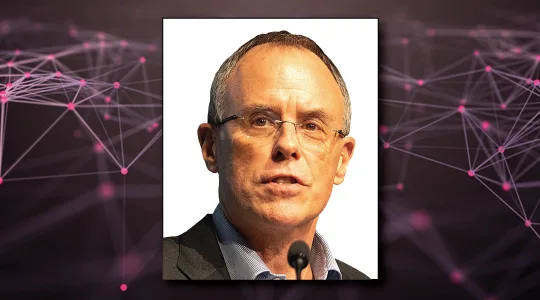
Podcast Episode #98: March 24, 2021
Virtualization, Cloud, and Growth Opportunities for the Teleport
Robert Bell shares the findings from the recent report entitled “The Virtual Teleport”


Space is a Network.
Constellations is Your Connection.

Transcript:
John Gilroy: Welcome to Constellations, the podcast from Kratos. My name is John Gilroy, and I’ll be your moderator. Our guest today is Robert Bell, Executive Director of the World Teleport Association. Today, we’ll talk about the growing adoption of virtualization in the satellite industry. Virtualization holds the promise of enabling significant benefits for the teleport, including scalability, cost savings and better integration with customers, vendors, and partners. During this episode, Robert Bell, as we said, the Executive Director of the World Teleport Association, shares the findings from a recent report titled, “The Virtual Teleport”. Robert discusses the extent to which teleport operators have embraced virtualization, its benefits, the barriers and challenges it presents and what the future might hold. He shares insights based on interviews from thought leaders from the satellite, teleport and ground technology segment. He is uniquely qualified to discuss this topic based on 30 years of experience in the industry. Advocating for the interests of teleport operators, he is a sought-after speaker has authored numerous articles and World Teleport Association research reports. Robert, the term virtualization means different things to different people. So how are you defining it as it relates to the teleport?
Robert Bell: Well, it really actually only means one thing. It just has different flavors. Virtualization is all about abstracting the software level of what goes on in your computer from the hardware level. So back in the old days, when I bought my first IBM PC, it was a totally hardware-driven thing. The operating system resided there, it could do certain things within that framework. Fast forward to the days of servers that we exist in now and you have the server, the physical infrastructure of the server is almost completely independent from what runs on it. And you can run a single program across multiple servers, you can divide up that server into multiple bits and use each one independently. So it’s really incredibly powerful technology that runs everything from email and internet to the very sophisticated systems running inside teleports. And it is of course the foundation of cloud services. So it’s really in pretty much everything we do today.
John Gilroy: Robert, I always remember the original IBM 5150, it wasn’t much for virtualization. But the bigger systems, the big 360s, they did have virtual memory. And so this virtualization has really been around for a while. So question is, why is it now becoming more prevalent in the satellite industry?
Robert Bell: Well, actually, yeah, according to my research, it was 1968 that IBM came up with it for a mainframe and it ended up being the engine that powered their single most popular mainframe of all time System/370. Why? Well, the satellite industry has always lagged behind IT and telecom partly for psychological reasons, right? We’ve been in our own little niche, serving very narrow markets and offering proprietary solutions that nothing else really needed to work with. So you’ve got that, you’ve got sunk investments, you’ve got this level of proprietary standards, and just it’s what the industry does. It runs standalone, closed loop systems. But those days, I don’t know exactly when the change began, but it has become a sea-change in our industry to realize that rather than being 1% of global telecom, which is about what satellite is in terms of its revenue, satellite and all its associated services. If you plug into the rest of telecom, gosh, you could actually get to 2 or 3% or even more, and that’s a lot of money.
John Gilroy: I remember back in 2005 with VMware started remaking inroads, and it took a while for that to be applied as well. Let’s talk about the teleport operators themselves. So how were they applying the power of virtualizations to their businesses? Can you give us some examples here?
Robert Bell: Absolutely. And it’s interesting the way that it spans from the cost to the revenue side of the business. And on the cost side, what the first and probably foremost application remains automating that network operations center, which of course something that the terrestrial telco has been doing for decades at this point. But there’s all these things running in the NOC that have been done manually for a very long time. And virtualization gives you the ability to monitor performance across a whole enormously dispersed set of assets, whether they’re in your facility or thousands of miles or kilometers away. One of our interviewees talked about the fact that it lets you go from being reactive in your network monitoring and maintenance to proactive because you can see trends evolving because of the level of information you have in everything. A level above that is something called service orchestration, which is basically, if you will, kind of the manager of managers. So we have all these network operating systems and the service orchestration is about bringing all that together and aligning those applications, the data, the infrastructure with your business requirements. So now we’re getting to business rules and policies, automated monitoring of service levels, the ability to dynamically reconfigure systems automatically, based upon some rules that we’ve given it, to take into account changes in whatever the customer might be doing. But it goes on from there, in some very interesting ways. One of the hot new areas is in radio frequency, right? That’s a very physical thing. We bring down some RF from the sky and we run it through waveguides and we eventually get it into a receiver and we convert it with a modem. The trend now is to push that conversion process is as close to the antenna as possible. And thereafter, just to be dealing with a stream of bits because the flexibility it gives you in your operation by virtualizing that physical signal is enormous. And I’m talking about the ability to run multiple facilities from a single control center to trade traffic with fiber in new and exciting ways. You go from there to the cloud, right? Because now once we’re good at virtual, it becomes a lot easier for a teleport operator to begin to integrate the cloud into their services. And now you even have this new revenue model called ground segment, is a service, which is still pretty small, but I think is going to end up being transformative of all operations over time.
John Gilroy: You’re taking away the different layers and I’m taking notes, like layers of a birthday cake here. You layer and layer and layer, and then getting closer and closer and faster. So we know pretty much what it can do. And I want to ask the practical question, the old Tom Cruise question, show me the money. So the ROI. So where do you think the opportunities are for return on investment for virtualizing the teleport?
Robert Bell: I think this is a good place for examples, right? In our study, one European teleport operator that runs hundreds of video channel monitors for more than 5,000 devices. So it’s monitoring 5,000 devices at local and remote sites around the world through this very sophisticated network management system. Just imagine the army of people and the army of the equipment those people would need to be using if you weren’t operating in this virtualized world. So they’re able to serve their customer much faster, they’re able to do it at a much lower cost and they’re able to get scale, right? Which means basically you can have more and more to it and make a very nice dollar from it, in terms of margin. Another one, talking about sort of a simpler level of running, in this case they run two teleports, and one of which is staffed and the other which is completely unstaffed. And by working out their problems with that, and there’s always problems when you’re implementing a complex system, they’ve proven it works. And so their plan is for all their future expansion to be doing it in unstaffed facilities because they can run it all from one central place. And then a lot of the people we talk to talked about this as something that really helps them build revenues because they can expand geographically with a very light footprint. And so that gives them the opportunity to access business they would never have been able to access otherwise. And I guess the final and probably in some ways, the most profound where the money answer is, their customers of teleports, particularly anybody who’s serving telco or data customers or enterprise customers, the customer’s increasingly demanding that you not run a manual operation and have to give them a website to go to, to see what’s going on. They want the teleport operator, the satellite operator, to integrate right into their operational support system, their OSS, or their business support system, their BSS, so that it’s all automated, so that it all looks the same as what they’re already running. And that’s the power that real success with the virtualization provides to a service provider in this industry.
John Gilroy: Wow. Good answer for ROI there. Let’s jump around and talk more about software here. And this is a related topic here, it’s software-defined networking. I think it’s also included in your report. So how does this concept of a software- defined network relate to virtualization?
Robert Bell: Well really, it’s the virtualization applied to the network. Software-defined networks are really, again, it’s kind of magical. If you step back, it really reminds you of that Arthur C. Clarke law that sufficiently advanced technology is indistinguishable from magic. But the idea is that they have a layer with an SDN that’s monitoring multiple channels. So let’s say we’re talking about complex network with fiber, with a bunch of satellite hops, maybe because let’s say we’re serving cruise lines, we also have cellular operations in some of the ports. And so it’s all ours and we all need to control it. And on a software-defined network, all these different channels can be monitored automatically, every few milliseconds, to find the ones that have the best quality service, lowest contention, highest throughput, lowest error rate. And traffic, whatever it might be is automatically routed to that. And so what that ends up doing is instead of just sitting there with one circuit that’s doing well on another one that’s doing badly and trying to figure out what’s going on with it, the system has taken care of that for you. And the net of that, in addition to quality of service, is that you have optimized your usage. You actually need less overall bandwidth because the system is looking at optimization all the time.
John Gilroy: It seems like it really increases flexibility for the operator in many different ways to control their quality service.
Robert Bell: Absolutely. It’s very much like what you’ll hear from a cloud services company trying to sell you on their service. It is about flexibility. It’s about them being able to bring it up when you need it and take it down when you don’t need it. It’s about optimizing the capacity, which is of course the most expensive part of certainly of any satellite service. The capacity you’re paying for to deliver the greatest value to your end customer, because traditionally satellite has been, you nail it up and you’re usually wasting a whole lot of that capacity because your usage of it changes over time. You don’t really have the fine grain control of it to know what you can get, you sort of have to buy a whole lot to make sure you’ve got enough margin. And this SDN really does a lot to strip that down, which makes satellite ultimately a more cost-effective solution.
John Gilroy: Robert, you just mentioned something about satellite hops, and let’s talk about satellites here. This generation of satellite that’s going up now, they’re much more dynamic than the previous ones. So how does virtualization and software- defined networking enable the teleport to better support these operations?
Robert Bell: It’s going to be crucial. When we talk about dynamic generations of satellites, it’s actually a pretty big bucket there because we’re talking about the existing NEO configuration, where you have spacecraft, high capacity spacecraft, moving across the sky. We’re talking about the new generation of LEO, which is increasingly actually becoming a real thing, thanks to Elon Musk’s apparently unlimited revenues and capital, and debt no doubt. But we’re also talking about the electronically configurable satellites being conceived, not yet put into orbit where we can change their service, all those things. Well, if you think about the complexity that all creates for a service provider, the antennas are one thing, but the complexity of level of the service is they’re going to actually need a highly virtualized network management system overlooking everything just to simply to be able to deliver the quality of service that they need and to get the advantage of that massive influx of bandwidth that’s being provided.
John Gilroy: Yeah, these levels of abstraction are really kind of hard to describe. It’s really amazing, and who would have dreamt it? Robert, thousands of people from all over the world have listened to this podcast. Go to Google and type in Constellations podcast to get to our show notes page. Here, you can get transcripts for all 90 plus interviews, also sign up for free email notifications for future podcasts. Earlier, you mentioned this concept of a ground station as a service provider, and they have been early adopters of virtualization in the cloud. Pioneers always get the arrows. So what lessons can be learned from their efforts and applied to the wider satellite industry?
Robert Bell: Quite a few, right? The idea of the virtual teleport, I think was actually the first time I ever heard the phrase was from the mouth of an executive of Vyvx back when they had—of course, they’re a big fiber operator—and they had a bunch of teleports that they’d picked up. And so they were thinking well how do you link these all together so that we don’t have to have them all, they’re not all just sitting independent little fiefdoms, but they actually can exchange traffic, they can serve as each other’s backup facility and so forth. They’re still pretty primitive level at that point. But when you’re talking about this ground segment as a service, what you’re really talking about for most of these companies, their secret sauce is the operating system they’ve developed. And it’s really kind of an amazing idea. It’s based on the idea that you’ve got a lot of facilities sitting around the world, antennas, power, connectivity, all the things you’d like to have, and it’s underutilized, right? You’re not utilizing a 100% of it, certainly, and I don’t know what the average figure is. But there’s a lot of spare capacity out there and wouldn’t it be great if it could be used. And so what these operators have are systems, basically partnerships, with a lot of owners and operators of physical infrastructure to use capacity on their systems when it’s available, when it’s appropriate. And if they amass enough of those, then they’re in a position to provide a lot of potential service. So what’s interesting from a business standpoint is you sort of almost think of them as competitors, but they’re actually teleport customers, right? Because they’re paying to use the facilities when they need them, as well as being business generators, bringing new kinds of business to teleport operators. So it’s a really interesting business model.
Robert Bell: We were talking just a couple of days ago with the CEO of one of these companies, and he was talking about some of the problems that come with it, right? One of the hidden problems of virtualization is that when you put everything into data and all you’re connecting all these disparate facilities and doing things, you are now in the land of gigantic data pipes, I mean really enormous amounts of data connectivity, which costs something, right? So it’s not free. So they’re constantly trying to manage that balance between what they can do with the one or two facilities they operate versus remote facilities and the cost factor is always fluid and difficult for them to manage. And the same thing applies to when they’re using cloud compute capacity, as part of their solution, the cloud companies are growing so fast and are so profitable because they charge pretty good fees for what’s called ingress, egress, getting onto their network and off their network. And so that’s another thing that you can run those up pretty fast and produce an uneconomic solution if you don’t really design it carefully. So it’s a really breakthrough idea, but like most of them, the arrows are always there waiting to hit the pioneers if they don’t get the new fundamentals of the business. And they’re kind of inventing these fundamentals as they go along, if they don’t get them right.
John Gilroy: Robert, you really carefully listed a lot of these benefits to virtualization. You talked about some of the challenges here with the pipes and everything else. So are there any barriers to adopting this new technology that you can see?
Robert Bell: There’s always tons of barriers to something new, and they’re the things that you would expect. It is expensive to get started, right? I mentioned these big data pipes. Probably even though most teleports already have some form of data center or other, you’re probably going to need a bigger one because again, there’s always going to be a need for local compute capacity and storage capacity, as well as these other things, just to make the whole thing work. You’re certainly going to need new skills. So you’re going to have to change out the skills you have. The same CEO I was talking about at the company said, he said, “It’s interesting I hadn’t thought about it before now, but we don’t actually have any RF engineers.” I said, “Really?” He said, “Yeah.” And I said, “The reason you don’t have RF engineers,” I said, “is because you get to borrow the ones at your partner facilities, right?”
Robert Bell: He said, “Yeah, yeah, that’s it. They’re the experts about that, that’s not what we do.” And I thought that was a fascinating answer. So yeah, there’s a lot of new skill sets that need to be brought into the company. There’s a lot of new equipment that you have to understand very deeply and you really then have to think through the fact you’re going to need big capacity pipes and you’re going to need to work out your business models to make all of that work. So it’s not a slam dunk for anybody. The reason I said originally that I thought it was going to ultimately be really important is that I think it opens a doorway to optimize teleport operations, wherever they might be. And no matter how traditional the facility is, there’s a lot of play here for business improvement.
John Gilroy: Now when you mentioned the concept of an RF operator there, I was kind of trying to put it in perspective here. But the traditional way of managing satellites and communications and this concept of operation change when applying virtualization and cloud technology, it’s really a major leap, isn’t it?
Robert Bell: Yeah. Well, it makes you think of that old saying that to err is human, to really screw it up takes a machine. When we go through this process of virtualizing and more importantly, automating any set of processes, you have to get into very serious change management. One of the more advanced operators that I know in the UK has just put a tremendous amount of energy and effort and time into building out their change management process so that it’s very, very rigorous because you don’t want to get it wrong and unleash the machines on it. And so yeah, that is going to be, I think, a change. All teleports have tried to be extremely good at this. I think it’s a step change in operations.
John Gilroy: When you speak to the people in the federal government, the DOD, the word that’s tossed around is interoperability. And it’s really just a maybe enhanced word of integration. So it would seem to me that virtualization can play a pretty big role in this whole idea of integrating satellite and terrestrial networks. It seems like a perfect solution for it.
Robert Bell: Well, it is. And it all comes down to those things I mentioned before, the BSS and the OSS. If you can get what looks like a seamless connection, that is of course, extremely difficult to pull off, between your satellite, your satellite systems and your terrestrial systems, you’ve accomplished something that has been standing in the way of the industry for its entire history. The idea that we’re going to run in our little silo and we have our special processes and the terrestrial folks are scared to death of satellite. They think it’s expensive and it’s unreliable and it’s crazy, and they don’t understand it. If it’s just a port on their router that follows all the standards that they’re used to, that goes away.
Robert Bell: And standards actually is a really big part of this. Again, our industry has always been very resistant to open standards. The video industry has been a little bit better with DVB and so forth. But generally speaking, we’ve always tried to play the proprietary standards game and IT and telco industry left that behind a long time ago. And this is an opportunity for our industry to catch up and plug into the standards, not only will help us get business, but quite frankly, that will make the satellite and teleport business better as well. So it’s a big deal.
John Gilroy: Robert, COVID’s made it very difficult to predict anything down the road, all kinds of changes was just a problem like that. So let’s look four or five years down the road. And I think because of all the benefits you’ve listed as the increasing adoption of virtualization. So what’s a teleport of the future going to look like four or five years down the road?
Robert Bell: Like I say, the teleports are already data centers with dishes because they have to be. Even if you’re carrying broadcast quality video, ultimately they’re carrying bits. So I think you’re going to see that optimal kind of connection point between terrestrial telco, terrestrial IT and satellite. There was a business executive who was on our board for a while, he put it really nicely. He said, “I got 12 salespeople here. His was a medium sized company. “I got 12 salespeople,” he said. “One of our partners is Georgia Telecom. They have 5,000 salespeople.” He said, “I want them to be selling my service without even really needing to know that they’re selling my service. It’s just part of the solution.” And so you see this in places. AT&T has had a partnership with what used to be Globecomm and absorbed into Speedcast, to be the satellite part of their IoT solution. I don’t know if it’s still going on or not, but that’s an example of what you’d like to see huge amounts of. And yes, it will make the teleport, if you will, less, it’ll make it more invisible, which is kind of an odd thing to say. It’ll press to even make satellite more invisible. But for once that invisibility, which has been kind of a problem I think for 50 years, will turn out to be a huge advantage because it will become part of accepted global infrastructure and everybody will make a lot more money.
John Gilroy: Well I like to end on making more money. That’s certainly a positive way to end. Robert, that was a great job. It’s always hard to articulate the benefits of an abstract concept like virtualization. I’d like to thank our guest, Robert Bell, Executive Director of the World Teleport Association. Thanks Robert.
Robert Bell: Well, thank you very much for the chance.
