Transcript:
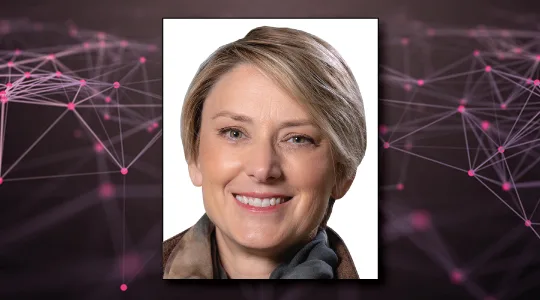
John Gilroy: Welcome to Constellations, the podcast from Kratos. My name is John Gilroy and I’ll be your moderator. Our guest today is Melanie Stricklan, co-founder and CEO of Slingshot Aerospace. Melanie is a 21-year Air Force veteran, as well as co-founder and CEO of Slingshot Aerospace. She provides her insights on the benefits of space data for decision-making in Space Situational Awareness, sustainability, interoperability and virtualization across the space data landscape. She does this to enable LEO sources.
John Gilroy: Melanie is no stranger to the space domain. She was recently recognized as one of Inc.’s top 100 female founders. And shortly thereafter, her company Slingshot was named to Fast Company’s annual list of the world’s most innovative companies for 2021. The right information at the right time, all in one place, is key to successful responsive operations around the world. Collective datasets from the most critical sources provide a complete picture to commercial and defense entities for mutually beneficial decision-making. Melanie, so what’s your perspective on the current state of our orbits in space?
Melanie Stricklan: Yeah, thanks for having me, and my perspective on our current orbits in space are, you know, we are in midst of a space revolution like I’ve never seen, and I think maybe even more than back in the ’60s. So, 87 countries, 10,000 companies launching, operating spacecraft, private human space flight, off earth manning, interplanetary travel, moon bases, space stations, and maybe even some hotels on orbit. So, there’s a lot going on up there. Whenever I left, or retired rather, from the Air Force, we were tracking about 1,800 satellites, operational satellites, and today our software’s tracking a little over 7,000. And we’re on track to have about 115,000 operational satellites by 2030. And that’s just modeling off of what has been applied for licensing and those types of things.
Melanie Stricklan: But the vast majority of space investment today still goes into hardware, so more rockets, more satellites, more ground stations, more components, which is a good thing, but I do believe that there’s a lot of uncertainty going on on- orbit today. Whether that is from exponential growth in those launches of satellites and mega constellations coming to bear, uncontrolled space debris, major coverage gaps with different nations, different providers, different schemas, different models, crowded spectrum, aggressive behavior geopolitically. And the fact is, we’ve got a problem, and it’s really just uncertainty. Not necessarily the world’s falling apart, or the sky is falling rather, but we’ve created a bit of a wild wild west, and we need to tame that by reducing the uncertainty.
John Gilroy: A guy named Simon Sinek is famous for asking the question why. Why, why, why? So, I got to drop a why on you here. So, we know thousands and thousands of satellites are projected here by 2030. So, what are the drivers for all this growth, especially in LEO?
Melanie Stricklan: Yeah, I think the drivers are transparent pricing on launch. Launch used to be the most expensive thing, but it’s now in a place that allows for lots of folks to hop on a rocket and get to space and understand the pricing. And understand that anyone across the globe can launch a satellite today, whether you’re a small academic, or a STEM group, or a high school group, or a company that has always had the passion to do something on orbit to increase or improve humanity here. So, that’s one avenue. The other is just Moore’s law. More COTS capability that has been matured and scaled through use of smartphones and those types of things have also enabled our space industry to leverage those and get capability on a LEO path a lot faster. Resiliency of those types of proliferated LEO constellations prove valuable when it comes to the comparison of that versus monolithic satellites that cost millions, if not hundreds of millions, of dollars and are built over years and years and years so that they can operate years and years and years. So, it’s just a complete paradigm shift in how we think about our architectures on orbit and on the ground.
John Gilroy: Earlier, you mentioned the 1960s. I think there’s going to be a TV show called Lost in Space from the 1960s. I think they should rebrand it Crash in Space. I mean, thousands and thousands and thousands and thousands out there. So, what are the causes and effects of some of these collisions in orbits?
Melanie Stricklan: I think there’s the simple answer, which is as we get closer to the 115 satellites. Matter of fact, I think there was a study recently that said that the inflection point is around 40,000 in low earth orbit. But we will start to have more collisions. And those collisions can lead to a cascade event called the Kessler syndrome. And if that were to happen, that could deem our orbits unusable not for a year or two years, but for potentially tens to hundreds of years. And so, we don’t want that to happen. That’s one big risk. The other risk I think is more readily seen, and that is some of the operational efficiencies around understanding thresholding when it comes to collisions and mitigating that risk. Mitigating spectrum interference. Spectrum’s getting pretty crowded today. So, the more objects that go up on orbit and without a digital opportunity to deconflict what I call space space, like airspace but for space, then I think we get closer to those inflection points that will render us a non-space faring world.
John Gilroy: Space space. I’ll have to remember that one. That’s a good one. Melanie, there’s some concerns now about the sustainability of all these projected launches, particularly in LEO. In a recent panel session on the 36th Space Symposium, a group discussed the management of the physical room in space in the LEO orbit. You just mentioned that earlier. And there’s no rules, apparently, who gets space and how much of it’s used. A recent study by a company in the DC area called MITRE on behalf of the Science Foundation found that the current projections for launches are not sustainable for a variety of reasons. So, what do you feel can be done to support sustainability in our orbits and manage who gets what?
Melanie Stricklan: I used to think that the first step was space sustainability from an international effort for more regulation, but I think that that’s failed and failed again. And if we want governments to truly figure this out and prevent those types of disasters, then what we have to do is look at different ways, different, more progressive ways for the industry, whether it’s civil, commercial, or government, to better collaborate across borders. As you know, space has no jurisdiction, right? There’s no regional jurisdiction like Airspace. And so, we need the ability to communicate, collaborate, and coordinate across civil, commercial, and defense organizations globally. And I believe that those types of tools that connect our operators across those different organizations will help get us towards space sustainability faster, cheaper, and better. I come from the government, so I have faith that the government can be world-class, but I haven’t seen a huge stride in truly taking the steps towards ultimate space sustainability. So, I think it’s time for the community that operates in space to come together and solve the problem ourselves.
John Gilroy: About two hours ago, I went to your LinkedIn profile. I mean, you’ve got a long history of space data. Can you tell us more about data sources that are necessary for real time decision-making and how they work together?
Melanie Stricklan: Yeah, for sure. So, space domain has many different orbits. The closer you are to earth, the faster you go, the further away, the slower you go. And there’s different phenomenologies, whether it be radar, optical, RF, that observe these different orbital domains or orbital regions, so to speak. And so, when it comes to data, to be able to bring multiple data sources together, whether that’s radar that works really, really good at the low earth orbit or optical that works really, really well way out at GEO, to bring that type of data together, there are no standards today for Space Situational Awareness data. And so, one has to curate and normalize that type of data in order to get a more holistic view of what’s going on on-orbit.
Melanie Stricklan: And so, that’s something that we’ve been working on for several years here at Slingshot is, how do you curate and normalize that and make an ensemble virtualization environment of the actual space operating domain from low earth orbit out to cislunar and hopefully, in the future, even interplanetary. But to do that, you have to understand the phenomenologies that work best at certain altitudes, and those that can see 24/7 versus those that can only collect at night. And so, it’s a big opportunity for the industry, but it’s also a very complicated set of technological feats that have to come together to make the holistic common operational picture for the space domain.
John Gilroy: Phenomenologies. I haven’t used that word since I was in college in philosophy class! Wow, that’s a pretty impressive word, phenomenologies. I guess that’s a good way to describe it, though. I think your company recently launched new software technology that can help space industry collaborate and share data and avoid collisions in space. Can you tell us about that technology and then how it came to be?
Melanie Stricklan: Yeah, so I believe you’re talking about Slingshot Beacon. Slingshot Beacon was inspired by a few different things. One, whenever I used to fly on JSTARS back in the day, before we stepped to the jet we had to read all of the NOTAMs and those notification to airmen. And whether your commercial, civil, or a defense air crew, you have to understand where to fly, where not to fly, and that’s a dynamic situation. Hey, the air box out by Huntington Beach is going to be used for air show over this weekend, so let’s not fly there, right? Those are sent out globally and that does not exist for space, number one. So, how can owner operators inform one another, that they’re going to be orbit raising, or they’re going to be doing an out of sequence maneuver that may have placed them somewhere in harm’s way or in your flight path? And so, that was number one. That was the first thing that we started thinking through.
Melanie Stricklan: And then the second was also from my time flying, we had what was called guard channels. And those guard channels were up all the time. They’re global frequencies, that if you’re in the air, you’re monitoring. There’s something like that in marine as well. But I think understanding that people have to communicate around deconflicting risk. And so, the space world also has no guard channel. So, could we bring those two ideas together? At the same time, bring a virtualized world together that maps and understands positional knowledge, weather knowledge, spectrum knowledge, so that our owner operators have all of that information, along with business logic knowledge, that triggers at the right time and the right place so that these companies can talk to one another in deconflict their airspace in a secure, trusted global communication platform for operators to do that.
Melanie Stricklan: And to plan outcomes and to just make better decisions around their operations to do that, complexities therein or around business logic. Like different companies have different thresholds for when they want to address a potential construction and when they want to maneuver and those different things. So, it’s not just a secure chat that throws two companies or organizations together in a room to work it out. There’s a lot under the hood from all of those phenomenologies that we talked about earlier, to advanced Astro, to AI and ML, within sites that scale very modularly, but do scale. And so, there’s a lot going on in Slingshot Beacon today, but with all of that comes the ability to optimize operations across the space industry.
John Gilroy: Well, you just said the phrase that pays, artificial intelligence, AI, and ML, machine learning. I was taking notes as you were speaking, and I was running out of ink with the complexity here, I mean, this and that, and then all the business. And so, you have to use these modern types of technologies in order to be efficient. You have to use AI because it’s so complex, don’t you?
Melanie Stricklan: Yeah, we have to. So, it really starts with machine learning and deep learning. But what we found is, when we use AI machine learning combined with high power compute, in that confluence we can rapidly extract information around the vast amounts of information that we’re pulling in. And earlier we mentioned a whole lot of phenomenologies around observation, but there’s other contextual information that also comes in to play there. And so, our technologies use all of that vast amount of information and combine that with machine learning to characterize space object, detect threats, enable confident decision making, all of those things. But here’s the kicker. There are not a whole lot of collisions to train those AI models from.
Melanie Stricklan: So, we’ve had to be very proactive and build out a simulation capability that actually helps us overcome observed imprecisions, and insufficient SSA force modeling, and unknown and unmodeled events, right? So, like an unknown space weather event, or an unknown maneuver, or unknown breakup or fragmentation. So, those under sampled observations and algorithmic deficiencies can be overcome with some of the simulated data that we’ve brought into the equation here.
John Gilroy: You know, Melanie, thousands of people from all over the world have listened to this podcast. Go to Google and type in “Constellations Podcast” to get to our show notes page. Here, you can get transcripts for all 100 plus interviews. Also, you can sign up for free email notifications for future episodes. Melanie, apparently there’s some space industry big hitters piloting this software. Are you able to share anything about their hopes and goals are as they move forward utilizing your technology?
Melanie Stricklan: Yeah. So, I think each one of our customers wants to optimize their operations and reduce the probability of accidents. No one wants to be that guy, or that gal, who caused an irreversible event, right? And so, Slingshot Beacon from the beginning has had just an immense amount of magnetism. And we’re super happy that we are there to be that first collaboration coordination platform to help mitigate those potential risk and facilitate safer and better satellite operations. Not only are our customers receiving that critical data in a more digestible way, but it enables them to make better decisions faster.
Melanie Stricklan: But what we are getting from this is very important as well. So, having those big hitters, as you called them, sidesaddle with us, we’re getting very, very important feedback on what our customer’s needs are, as they’re helping us, as we continue to develop and mature the technology. So, by having them all on this platform, I believe we are many, many, many steps further along in creating a safer, more sustainable space economy.
John Gilroy: So, I think I understand generally what you do. So, what other problems can be solved with the software, and can a military or commercial entity capitalize on this level of space data collaboration to benefit earth and everyone on it?
Melanie Stricklan: Yeah. So, I mean, I think I heard this the other day. I believe someone said the average person touches space 30 times before breakfast and doesn’t even know it. So, our way of life has come to depend upon satellites that enable our cell phones, live streamed sporting events, TV of any nature really, GPS systems, ATM machines. The timing for all trades globally are either GNSS or GPS timing sourced. And it’s imperative that we create a more scalable way of ensuring that these capabilities stay on orbit and that we can continue to progress humanity, leveraging space as a global tenant of our economy for generations to come. I think that other entities that could capitalize on the space data collaboration are anywhere from space mission design.
Melanie Stricklan: So, we’ll stay on the space side for a little bit, but space systems manufacturing, the what if analysis that comes from digitizing the space domain is very powerful if you can get it into a place of what ifs. Space moves really, really fast, but what if you could take any moment in time and play out a number of scenarios? Bring your own models forward and play those out for optimal outcomes. And so, when you start thinking on that level, I mean, you start thinking about insurance companies, you start thinking about autonomous space as a nervous system to that autonomous space traffic management system of the future. And I think, you know, there’s use cases that we don’t even know yet. But the first step is to get that information in the right place with the analytics and capabilities to extract insights from it.
John Gilroy: Melanie, in a recent interview you did with From the Top, you mentioned that virtualization and interoperability are important to support space sustainability and collaboration. Can you help us understand virtualization and the benefits of virtualization and interoperability? I think you talked about it a little bit. It’s almost like a digital twin or having a sandbox to test things out in. Is that what we’re talking about here?
Melanie Stricklan: It is, it is. The word virtualization really just means using software to simulate hardware functionality or processes. And so for me, virtualization means our orbital domains are actually full of hardware. They’re full of other things like space weather and other events. And they are representative of processes. And so, if we can simulate the hardware, and the space that the hardware flies within, and the debris and the weather, then we’ve, in a nutshell, virtualized a different world, our orbital world. And so for us, it’s important to do that for many, many, many different reasons. I think we’ve covered a lot of those today. But our vision and our passion is to accelerate space sustainability, and that is what virtualization paves the pathway for us.
John Gilroy: Going to touch on communications a little bit now, communication satellites. In addition to the proprietary way in which satellites communications is operated, for most parts still does today, what are some other challenges you’ve seen when working to facilitate data collaborations between so many different entities?
Melanie Stricklan: Yeah, I think although space has been democratized over the past several years, the games completely changed for those who want to explore space and be part of space. At one point it was just nation states. So, they could really lock down data, they could really demand what sensors could look at and not look at. And so, I think some of the challenges that we see today in facilitating data collaboration is truly around government entities, and understanding where we can navigate, and the ITAR and EAR requirements on a company like Slingshot. And so, working very, very closely with state department on that to ensure that we stay well within our lane, but also bring forth to this global industry, a global capability. For us, that means that we need to be able to bring in onboard data and other types of data from countries that may not just be on the ally list, and so, we’re working through what that means today. But there’s room for all countries to be participatory in the advancement of space sustainability, and it really is imperative.
John Gilroy: Well, Melanie, we’ve hit so many from topics today. I’ve got to toss it to you and say, well, what are you excited about most when you think about the future in space? I mean, there’s so much going on, I don’t know how you can figure it out.
Melanie Stricklan: Oh my gosh. So, I’ve been excited about space since I was a child, as long as I can remember. But what excites me today the most is just seeing how normal, average, folks who have been also inspired since they were children by space can get involved with space. So, with so many different companies around the world doing so many different things to leverage space as a portal of progress in unity. I loved watching the Inspiration4 documentary not too long ago and just understanding the power of looking at the earth from above for those types of folks who would have never dreamed of going to space.
Melanie Stricklan: And so, I think that as we progress down the path of bringing more and more non-space folks forward that have a passion for this, the sky is no longer the limit. And we are going major, major places. And maybe one day the human race will be multiplanetary, who knows? But I’m super excited about the stuff that’s closer to the earth right now.
John Gilroy: I agree. You know, Melanie, it’s really hard to get a handle on a topic that includes a hundred thousand satellites, but I think you’ve managed to achieve clarity in a complex environment. I’d like to thank our guest, Melanie Stricklan, co-founder and CEO of Slingshot Aerospace.
Melanie Stricklan: Thank you.