Transcript:
John Gilroy: The views expressed in this podcast or on www.constellationspodcast.com, do not officially represent the views of the U.S. Military or the United States government. The appearance of U.S. Department of Defense, DoD visual information, does not imply or constitute DoD endorsement. The mention of the U.S. Department of Defense information does not imply or constitute Parallax’s APEX program speaking on behalf of the Department of Defense.
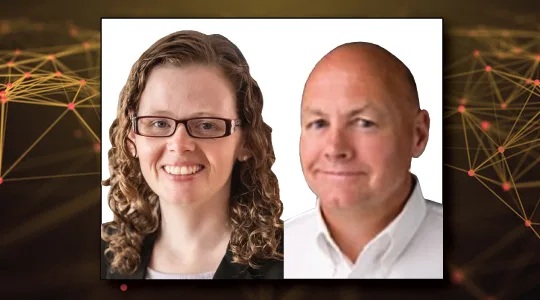
John Gilroy: Welcome to Constellations the podcast from Kratos. My name is John Gilroy, and I’ll be your moderator. Today, we have two guests, Dr. Kate Gilpin is the Director of Discovery and Engagement at Parallax Advanced Research and Chris Mather, Senior Consultant. Today, we’re going to talk about being an entrepreneur and what tools are available for those unique individuals who want to develop a business relationship with the Department of the Air Force. Both of our guests support the Department of the Air Force partnership intermediary agreement called the Academic Partnership Engagement Experiment. Also known as APEX, a little bit easier to pronounce.
John Gilroy: It’s a program that works closely with entrepreneurs and academic researchers to enable more successful Small Business Initiative Research, or SBIR, and Small Business Technology Transfer, STTR, outcomes. The APEX program is funded by the Department of the Air Force to provide free resources to academic researchers and innovators throughout the United States who are interested in applying for funding from the Air Force SBIR and STTR programs. Our guests again are Dr. Kate Gilpin, the Director of Discovery and Engagement at Parallax Advanced Research and Chris Mather, Senior Consultant. Kate, we’re going to start off with you. APEX is a unique program for the Department of the Air Force. It’s changed the way the Department of the Air Force approaches its SBIR and STTR program. So, how is it different and why?
Dr. Kate Gilpin: Yes, it has. That’s a great question. We understand that you can’t pick up the phone and call the Air Force. And so in a lot of ways, APEX as the partnership intermediary, can help bridge that gap between the university or the small business entrepreneur and the government stakeholders. And so, we do a lot of outreach to university and small business entrepreneurs in an effort to help them accelerate their transition of the technology that they’re developing, to get it in the hands of the right warfighter, at the right time, in the right location, in order to make their lives a little bit better, safer, or more efficient, whatever the case may be.
John Gilroy: You know Kristin just set the beltway here, there’s all kinds of specialized vocabulary. And one of the specialized terms here is the DIB, it’s called the Defense Industrial Base, 300,000 companies. And so, part of this purchasing and getting together with new innovation is an open topic. So, what is this Department of the Air Force open topic approach anyway?
Chris Mather: Well, it is a departure. A few years ago, the Air Force decided to go to this approach, which is much more venture capital like, the way I like to put it, is rather than saying, “Here’s a problem, tell us how you’d solve it.” They’re saying,” What do you have that’s great, that might solve a problem for us?” So, it really is open to a lot of different technologies and it’s much more venture- like, as I said, and the questions that the Air Force wants to know is how does your project, your product or a service solve a problem for us? Who’s likely to be the Air Force customer, but also who’s likely to be a commercial customer?
John Gilroy: This is such a switch in this town. Normally, there’s some request for proposal set out there and then Chris would propose something. But now we have Kate knocking on doors going,” Hey, what do you got that’s new? What’s for us? See if it’s a fit in here.” This case is really different, isn’t it?
Dr. Kate Gilpin: Yes, absolutely. There is definitely an element to what we do that’s both tech push and tech pull. And one of the things that makes APEX different than other partnership intermediaries or other organizations in general is that we do have an inward flow instead of an outward flow. So, like you were mentioning, most of it is asking for specific answers to specific questions, but here it’s very different. We are going out to organizations and saying,” What technology do you have that could help solve a problem for the Air Force?” That either they know about, or perhaps they don’t know about yet, but you have a solution that could fit the bill. And so, it really is quite different.
John Gilroy: Chris, there could be someone sitting in Kansas that has an answer for a problem the Air Force has, and doesn’t even know it. And so, this program tries to seek them out and say, well, maybe this is a good square peg and a square hole for us, isn’t it?
Chris Mather: Oh, exactly. Actually, we’ve had a lot of people ask whether we have technologies that the Air Force had never thought of. I had one in the last solicitation, there was a runway fixing application, which they weren’t asking for. This company found the right people in the Air Force and they’re working on their phase one right now. So they got the funding. And so now they hopefully they’re at the beginning of a relationship with the Air Force.
John Gilroy: Now, Chris, we’ve been doing these interviews for about four years. We have listeners in Kansas, Florida, Maine and even in Ohio. And so, let’s say I’m in Ohio, who knows, and I have a really cool product that I think the Department of the Air Force can use or benefit from. So, how would I go about understanding who specifically in the Department of the Air Force can benefit from my solution?
Chris Mather: Well, it is a challenge for sure, because that connection with the Air Force customer is a key element to the program. Before you are likely to get awarded for a phase one, you’re going to have spoken to at least one Air Force potential customer and had them say,” Hey, this sounds like a good idea.” As you go further in the program to go actually even apply for a phase two, you have to get an Air Force sponsor if you will. So, we spend a lot of time helping entrepreneurs with methodologies that they can use to connect to the Air Force. So, we try to help them with how they connect. We don’t actually provide connections very often, but we more suggest methodologies. For example, there’s a program called Air Force Tech Connect, which is very helpful and very valuable to get that first contact into the Air Force. And we find that the most successful entrepreneurs, they crack the code. Entrepreneurs are always aggressive and willing to take a risk. And that serves them very well because they usually find someone in the Air Force to work with. And it is a key part of the program.
John Gilroy: So, Kate, I want to focus a little more on this how to who approach and I’m going to ask you the Ghostbusters question is, “who you going to call?” So, that’s what I have for you Kate, so who you going to call? How do they even know how to call? The community in Washington DC is very unusual. If you’re in Texas, then you pick up the phone and calling someone, that may be a more difficult here, isn’t it?
Dr. Kate Gilpin: Absolutely. You have asked the million-dollar question and if every entrepreneur were able to solve that question, then every entrepreneur would be very happy. It can be a struggle. Definitely. I think one of the biggest keys is just expanding your network. You should always be selling your idea. You should always be pitching your idea to whoever will listen. And in 2021, we have great tools like LinkedIn and the ability to look up different organizations within the Air Force on different websites and try to cold call them, try to send emails. Of course, do Tech Connect, like Chris was mentioning, that’s a great tool, and really just expanding your network because sometimes it does come down to who you know and the more people you have gotten your idea in front of, the better off you’ll be nine times out of 10.
Chris Mather: And to expand on that because this is something that actually happened with one of my clients. We were talking about how he could connect. And I said,” You guys got people in your network.” And he wasn’t sure his network was that good. He said,” Well, I do know this guy in the army.” I said,” Okay.” And as we discussed, it was really clear that he had the right contact if it was the Army. And I said,” That guy in the army probably attends the same conferences as the person in the Air Force, who’s going to care about the same problem and the same issue. So, why don’t you find out?” Well, he contacts him and finds out that he connects the entrepreneur to the right contact in the Air Force and she called him back. So, all of a sudden, now they’re off to the races, he’s got the right contact in the Air Force and he’s in great shape.
John Gilroy: So, Chris, the founder of LinkedIn, Reid Hoffman, once said,” It’s not what you know, but who you know.” So, lets delve into this a little deeper with this whole Air Force Tech connect thing. So, you’re an entrepreneur in Idaho or something, who knows where, and you hear about Air Force Tech Connect. So specifically, Chris, how would it help a small business with its research?
Chris Mather: Well, and I would ask Kate to expand on this as well, because she’s highly aware of it, but it really gives you the first point of contact. Tech Connect asks you five- character limited questions. You can’t write a book, you just got to give them the bottom line. And the goal of that is to connect to you to someone in the Air Force who knows your technology really well. It is likely to be a researcher, somebody probably from the Air Force Research Labs or AFRL, but it’s a start. And you hope after that, that he or she can then direct you to people who maybe operationally can use your solution as well.
John Gilroy: Kate, you want to jump in on this question?
Dr. Kate Gilpin: Well, I think Chris did a really great job. The only thing I’ll add is that there are different organizations within the Air Force that the entrepreneurs should be looking at. One is AFRL, like Chris mentioned, Tech Connect frequently will connect you to a technical point of contact within AFRL. And there are AFRL labs around the country. So, it’s not just in Dayton, Ohio, there are other labs around the country. But there are also organizations called PEOs and those can also serve the entrepreneur quite well in terms of funding and signing the documents require to obtain a phase two within the SBIR/STTR program. So, I would encourage the entrepreneur to certainly start with Tech Connect, but don’t end there. I would say that you have to have broad sights for the organizations you’re targeting within the Department of the Air Force.
John Gilroy: Kate, when I’ve spoken to people at the AFRL, it seemed like it’s a room full of brainiacs. It’s kind of intimidating. And so, I guess you have to refocus on the solution of the problems rather than trying to match them technically, because you’re not going to match those folks. They’re way smart, aren’t they?
Dr. Kate Gilpin: I think the Air Force has done a great job of being able to recruit and retain high quality talent of course. And I think that there are a lot of opportunities for the university partners, perhaps that are listening to this podcast, to do summer faculty fellowships or visiting fellowships there as well because they run really great programs and it’s a way for the technology to find its way elsewhere outside of your lab and to just enhance your collaboration opportunities. And that’s really what is a key to success in terms of this, the SBIR/STTR program and especially with STTR, is the ability to collaborate with other people.
Chris Mather: She is one of those brainiacs.
John Gilroy: I noticed. I saw her background. We talked about LinkedIn earlier and I went to Chris’s LinkedIn. He’s got all kinds of startups. He’s worked with all kinds of companies helping them grow and people eventually talk about investment and money when we talk about startups and growing companies. And so, Chris, I got a money question for you here. So, why does the Department of the Air Force care about external funding that’s been involved in, let’s say, my company? Or why would they care about my plans to develop my solution? Where do you draw the line here, Chris?
Chris Mather: And they really do care. And it is a bit of a departure from what people have been used to in the SBIR or STTR program, historically. If a VC supports a company that financial support raises the odds of that entrepreneur solution being successful in the marketplace. Well, that’s good for the Air Force because that lowers their risk. They want to be buying products from people who are going to be around, A, and B, who are going to continue on a pathway for a commercial development, so that commercial development matters. And that time between when you have a great idea, and it can actually gain the funding has had the term value of “death risk” applied to it. It’s that time where you’re not sure you can make it. And the VC money often is the thing that helps you cross that valley of death, get though, and start selling products. So, they care.
Chris Mather: The second thing is that the VC community, they’re tough. They ask hard questions and they’re really good at sorting things out. So, if they’ve given the stamp of approval and they’ve been willing to invest, it really is a validation of the company and the technology. To the point that some later on follow-on programs that are past phase two actually require investment, typically, it’s VC as a match to the further on Air Force funding, which is great because the VC loves it. Because if you tell a VC that, that an extra million dollars is going to come into the company, that’s non-dilutive to them so that they maintain their ownership stake in the company. They’re going to love that. And they’re going to be willing to invest more money. So now, more money is around the technology to really get it to where it needs to be to solve problems for the marketplace and for the Air Force.
John Gilroy: So, Kate, I’ve got a question for you. I have a friend, who’s got a master’s degree in physics. He’s one of those brainiacs and he has a lot of innovation solutions, but I think he might benefit from maybe having a phone call from Chris to give him some guidance of how to grow the company and direct it. A company just can’t exist in a silo somewhere. You have to have both. I look at both of you on screen, it’s got the yin and yang here, you got the brainiac and you got the money and both of these grow small companies, don’t they, Kate?
Dr. Kate Gilpin: I cannot agree with you more. And I think if you have businessmen or women who are looking to grow their technology from both Department of the Air Force perspective, and from a financial perspective, one way to do that would be to sign up for the different cohorts that APEX offers. If that’s something that is of interest to the entrepreneurs, and they could do that through APEX- innovates.org. We offer different cohorts that are tailored to the different levels for which the entrepreneur is seeking an SBIR or STTR award. And if you do that, you would be assigned a one-on-one consultant like Chris Mather, who can help you through the process of the SBIR/STTR proposal process.
John Gilroy: Kate and Chris, thousands of people from all over the world have listened to this podcast. Go to Google and type in “Constellations Podcast” to get to our show notes page. Here, you can get transcripts for all 100 plus interviews. Also, you can sign up for free email notifications for future episodes. So, Chris, I want you to help our listeners navigate this world of acronyms here. So, we have SBIR and STTR, and we know they’re focused on developing innovative solutions to pressing problems that can be commercialized and as new products and services. So, what are the differences between these two programs for the typical listener here?
Chris Mather: The STTR requires that you have a university or research Institute partner that’s typically a university but doesn’t have to be. And they must get 35% of the award and therefore do 35% of the work. SBIR allows you to have universities as contractors, but the relationship is not as tight because it’s required in STTR and that university work can be research, but it could also be the use of testing facilities. We’ve seen people who use student resources, which are usually very smart resources and very cheap for marketing, as well as technical kind of things. As I mentioned, testing resources can be a great way to do it.
John Gilroy: So Kate, any comments on Chris’s definitions there? You agree?
Dr. Kate Gilpin: I wholeheartedly agree. Yes. The only thing I would add is that we’ve also seen some small businesses reach out to universities. If they have a theoretical problem that they need to solve and they could probably solve it, but it might take them six months to a year to acquire all of the resources that they need to solve that problem. And they go to the university who has a PhD there who has spent decades of his or her life studying that one problem. They could solve that problem near instantaneously. And that’s a real benefit to the small business because it is such a time savings to them. And it lets them continue on with their technology development. Whereas before they might have been stuck for a little while.
Chris Mather: Someone right now that I’m working with sees himself as a project manager and he needs some software done that he admittedly said,” I have no idea how to do this software.” So, we’re working with him to determine a university partner who can do that software, just like Kate said, they’ll just do it faster and tremendously better because they know that area.
John Gilroy: So, Chris, I want to delve into this. Who are you going to call question about universities? There’s MIT and there’s small local universities like Hiram College in Ohio, there’s technology schools like Virginia Tech, and there’s Stanford. Let’s say, John Gilroy here, I got a company, how would I develop a successful partnership with a non-profit group or one of these universities? I don’t know anyone at MIT.
Chris Mather: Well, one thing you can do is APEX actually offers a matchmaking process. So we will connect you with some people and then there’s a lot of considerations you have to make. So small technical, you said technical, Virginia Tech, they’re big, but Rochester Institute of Technology is a great school. And it’s one that should be on the list. But I think you need to look at, do they have the ability to do the work you need first? That is paramount. After that, if you have somebody who has a reputation for excellence. So, for example, if you’re doing software, it’s not bad to have an MIT, Carnegie Mellon, or Stanford working on your stuff. But there’s other universities that have a niche kind of a background.
Chris Mather: So, for example, the school that I went to, WPI, is known as a leader, probably the best in the world, in fire protection engineering. So, if you had to do that, you might go there. If a school has the availability for highly specialized equipment, semiconductor equipment, testing, evaluation, equipment, things like a wind tunnel that most entrepreneurs aren’t going to have access to. That’s a consideration. And if they have available student resources, because they are cheaper, they’re going to make that 35% go a little further. Those are all considerations that you need to make. And then the last thing is that once you get a hold of it, a common error that I see is that an entrepreneur jumps in and talks to the researcher and assumes that it’s all okay. And that’s the whole thing of the job’s not done till the paperwork’s done. It’s really important that the entrepreneurs engage with somebody, either the Vice President of research operation or the technology transfer operation, they know how the stuff happens and when it happens. The researchers do not care about administrivia, they care about their research. So, that’s one that you really need to get ahold of the tech transfer people because sometimes if you’re on a short clock, they’ll say,” Oh yeah, we can get that done with no problem.” And we’ve also had universities say,” We cannot meet that time schedule.” Well that could actually eliminate a university from that consideration in that situation. So, you really need to deal with those people because they really are good and almost all universities that can do this will have a technology transfer office.
John Gilroy: Chris, earlier I talked about navigating the world of acronyms. So, I’m going to toss another one at you, see how good you are at this one. This one is a Procurement Technical Assistance Center or PTAC. And so what is a PTAC and how can it help a small business?
Chris Mather: PTAC, they’re tax supported. So, you’re paying for them already. So, if somebody’s selling toilet paper to the Air Force or to any military installation, they work with the PTAC, it’s great for small, more sort of non-technology business as well. In our world, what they’re experts in is all the registrations that you have to complete to enable you to propose, because if you get to the end, one of the registrations isn’t right, you can and probably will be, not allowed a part two of propose. So, you can do a lot of work and find out that for one little thing, you weren’t there. Working with your PTAC, they’re all over the country. You can just search, “Find a PTAC”, you put in your zip code, and you find them. We generally refer all those questions to the PTACs because they’re just a lot better than we are. It’s not what we’re great at. We let them do what they’re great at. They’re great resource and we’re paying for them as taxpayers.
John Gilroy: So, Kate, I’m going to ask you a question and wrap up the interview and toss back to Chris. So, this is the Constellations Podcast. It’s about space and technologies related to space. We usually don’t talk about toilet paper, but every now and then I guess. So, can you share any success stories that companies related with the space sector had some success with?
Dr. Kate Gilpin: To be honest with you, I’m actually going to defer that question to Chris, because he’s more of a small business guru.
John Gilroy: Oh great. Chris, you want to handle that?
Chris Mather: Well, I can give you two and I’m going to deal with them generically, because I don’t know if they’re willing to share information, but one is a company that I worked with in the Cleveland area, way before APEX even existed. And he was selected for a phase one from the National Oceanic and Atmospheric Administration, NOAA. It was still pretty early. He did not get selected for phase two and this guy had to go and take a job at a university because he had to put his kids through school. He still kept working on his entrepreneurial dream, but he did it part-time, and an opportunity called Agility Prime, which was focused on UAVs, flying cars, and cool stuff like that came up and I suggested that he applied for it. Well, then all of a sudden things went great and he has a technology that is game changing for the drone and UAV world in terms of range. And he applied for Agility Prime, was selected. He had Ohio state, his university partner, which has worked out really well. He was recently awarded a phase two. And so a group that had been coaching him before we all met for dinner to celebrate with him. And I looked and I said, he’s now talking to VCs fully expect to be one of those companies that I can say, “Hey, I knew that guy way back when” because they are going to do well. And this program was a real enabler for him. And it’s certainly an enabler for that VC situation.
Chris Mather: And the other one, it’s a husband-and-wife team that came to APEX through our standard. They were just assigned to me, so the case processor just said, “Here, this is one of yours.” And what they do is fairly pedestrian, they handle interconnects and make sure that the interconnects are reliable, predictable, and serviceable. Which if you think of a car as having electrical issues sometimes, think of an airplane, the risks are higher and there’s a lot going on so that stuff has to work. They were selected also in Agility Prime for a phase one, they also were selected for a phase two, and now they’re on their journey. They’re going to be selling stuff to the Air Force in commercial aircraft manufacturers and a nice side note the CEO of the company, the wife of the husband-and-wife team, actually got her undergraduate degree in the small upstate New York town where I grew up. So, that was a cool thing that we discovered that this woman from Puerto Rico found herself in one of the lake effects, snow capitals of the world and how she handled it.
John Gilroy: Dreaming of palm trees too, huh? Kate and Chris, this APEX program is quite a twist on the classic public private partnership. And I think what you both have done is give and our listeners really a whole new world of investments. So, I think it’s been a great interview today. I’d like to thank our guests, Dr. Kate Gilpin, Director of Discovery and Engagement at Parallax Advanced Research and Chris Mather, Senior Consultant.