Transcript:
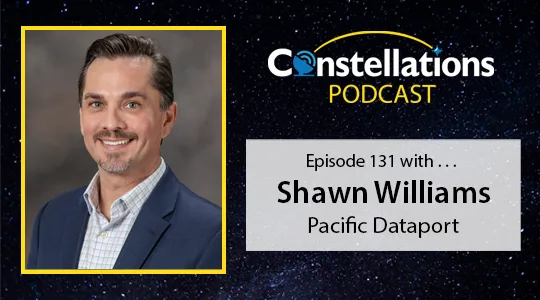
John Gilroy: Welcome to Constellations the podcast from Kratos. My name is John Gilroy, and I’ll be your moderator today. We welcome Shawn Williams, the Vice President of Government Affairs and Strategy at Pacific Dataport. During today’s podcast, we will discuss the process of delivering broadband to remote areas around the globe, specifically rural Alaska. Not just the challenges like reliability, integration and testing dynamic technologies, but how one group is actually overcoming those challenges today to deliver services and how the Aurora Network will benefit Alaskan communities.
John Gilroy: To walk us through the process of building this new network, we have invited Shawn Williams, Vice President of Government Affairs and Strategy for Pacific Dataport. Pacific Dataport is a new company, building an innovative network to serve Alaskans with reliable affordable broadband access. Okay, Shawn, you’re up to bat here. So, what is the mission of the Aurora Network Project, and how did it come to be?
Shawn Williams: Hi, John, thank you for having me. What I would start out with is that Microcom, our sister company, has been providing satellite broadband and TV to Alaskans, especially rural Alaskans, for almost 40 years. Microcom has tens of thousands of customers. And as a reseller, Microcom owners began to realize that satellite owners were running out of capacity when it came to serving satellite broadbands here in Alaska. The bottom line became that at the time, no one was interested in serving Alaska’s problem of connectivity. So in 2017, the owners of Microcom started Pacific Dataport, and Pacific Dataport’s first project is the Aurora Project. That consists of two satellites, the first one being our soon to be launched Aurora 4A MicroGEO.
John Gilroy: And the other one is the bigger one, the ultra hype one?
Shawn Williams: Yes, the second one will be a Boeing Flexa, and that one will have over 100 gigabytes per second.
John Gilroy: Well, this sounds like a classic business solution problem, and a problem solution for a business company. So the problem is running out of capacity. Were there other efforts? Were there other companies that tried to solve this problem and then couldn’t do it effectively or at a low cost?
Shawn Williams: Well, doing anything in Alaska is expensive. If you’re doing terrestrial fiber or microwave, you’re basically going to spend easily 125,000 plus per mile. And you’re talking about hundreds of miles of fiber over tundra and around mountains and the streams and the rivers that we have up here, almost everything is a barrier. And when you go into the realm of satellite, you remove all of those problems, especially when it comes to EIS, environmental impact studies. It makes things a lot easier when you’re dropping a user terminal in the community and just connecting.
John Gilroy: I got up early this morning and did research on you and your company. I went to your website and I learned a new word called a digital desert. I guess this is a phrase that happens in rural areas of Alaska. What happens with digital deserts, or communication deserts, you wind up with unserved or underserved communities. And so, what do these two words mean? What does it mean for Alaska?
Shawn Williams: That’s a great question. Since 2015, the FCC has defined unserved as quote, households or businesses that lack access to wire line broadband service at speeds that meet the FCC threshold of 25 down and three up. Since the big infrastructure bill and the NTIA’s new responsibilities, the new definition of unserved is where less than 80% of the population has no access to broadband at all, or no access to reliable broadband, which it defines as speeds of less than 25 by 3 upload and latency sufficient to support realtime interactive applications. Underserved is now defined as areas where at least 80% of the population has access to speed under 100 by 20 and sufficient latency. So when you start thinking about unserved areas in Alaska, I’ll give you an update of what that looks like right now. 36.3% of rural Alaskans still have no wired broadband connection of 25 by 3 or greater. No rural Alaska school meets the FCCS educational goals of one megabit per second per student.
Shawn Williams: In Anchorage, a lot of competition, a lot of fiber. In fact, interestingly enough, in my neighborhood, about two weeks ago one of the providers started running fiber to the home. And that is a very new development, and boy, am I lucky to have that in my neighborhood. But in Anchorage, we’re paying about 24 cents per gigabyte of data. In ADAC, which is at the end of the Aleutian chain at the far west side of Alaska, they’re paying $22.22 For that gigabyte. Digital red- lining’s a problem, so even where there’s fiber and it runs down the middle of the road, residents are often bypassed as potential customers for one reason or another.
Shawn Williams: Off the northern coast of Alaska, 25 by 3 fiber broadband is offered. It just started probably in the last 12 months, but that costs $499 a month. It does have 150 gigabyte per month limit and often, people meet that limit and they go to buy more. And the provider literally says, “Thanks, but no thanks. We’re not going to sell you more.” So that’s a possibility. We also know that rural Alaskan schools and health clinics often pay $40,000 to $60,000 per month for 25 by 3 service, and that is at each school or health clinic. And then finally, a stat that I like to share, is that approximately 240 rural Alaska villages are still considered unserved or underserved, and those statistics are current and factual.
John Gilroy: You know, Shawn, if I would just strip out all the information about Alaska and gave those statistics, you would think that’s rural Ethiopia.
Shawn Williams: I agree.
John Gilroy: Or someplace in Siberia or something, but this is part of the United States. It seems like we’re starting to think of broadband as almost like a utility, aren’t we? I think back of LBJ and rural Texas and electrification, and that was considered to be a new utility. But this is really part of living, isn’t it?
Shawn Williams: Yeah. It’s funny that you mention broadband as a basic utility. Just recently, I listened to an interview that one of our most amazing clients, Chief Mike Williams from the Akiak Native Community, it’s a very remote community of about 400 residents and about a hundred homes. And he literally equated broadband coming to his village, which we helped them bring. He remembers when electricity came to the village and for him, this is like when electricity came to the village. It opened up a ton of new opportunities, everything from telehealth to better education. If someone wants to go to college or earn a vocational degree, those are the kind of things that become possible.
John Gilroy: And if you just put in the big picture, for the last five years, I’ve interviewed people at the VA. And what they’ve said is that COVID’s forced them to be able to connect to hospitals and clinics in rural areas where a lot of veterans live. And finally, they can get the services that they put their lives on the line for. And I think we can provide that by opening up to more rural areas in Alaska. This whole medical thing, it’s very important. It’s just transformed with COVID, hasn’t it?
Shawn Williams: Yeah, well, COVID definitely made broadband, it put it on the front line and pushed it into that basic utility category. I’ll also mention that Alaska has the highest veterans per capita, more than any other state in the nation. And as you mentioned, it’s really important as far as making sure they have good healthcare.
John Gilroy: Okay. So quick summary here. Some of the reasons behind inadequate broadband all through Alaska is this geography, basically. And what you’re positing is that with this new system, you’re depositing the Aurora Network Broadband, which will solve all those problems and reduce cost as well.
Shawn Williams: Oh, absolutely. What we know is that subsidized fiber off the northwest coast of Alaska results in expensive and slow broadband. And the economics of it are pretty simple when you think about the fact that providers get paid top dollar for the capacity schools and health clinics are buying. We believe that creates a price floor and it keeps the prices really high for that capacity. And it’s so high that the providers ultimately decide not to go outside of those customers. Otherwise they’d have to lower their prices.
John Gilroy: You know, Shawn, thousands of people from all over the world have listened to this podcast. Go to Google and type in “Constellations Podcast” to get to our show notes page, here you can get transcripts for all 100 plus interviews. Also, you can sign up for free email notifications for future episodes. So we have a pretty good solution in the offering here. And so what I want to do is maybe review the steps by this. If you look at connecting communities, it’s a long journey, and like all journeys, begins with the first step. So in the case of building a satellite broadband network for Alaska, obtaining the right orbital slots is usually that first step. So what was that process like for you, getting that slot over Alaska?
Shawn Williams: Well, because we have two satellites that are part of the Aurora network, what we knew right away is that we needed to secure those two orbital slots. We also knew that directly south of Alaska would be best, not only because it’s easy to find, but also because there’s no kind of weird direction. We ended up procuring two slots at 163 degrees and 154 degrees west. And because it’s not a high demand area, we were able to get those in fairly easily and quickly. That might have been the easiest step out of all of this.
John Gilroy: It’s obvious there are military bases in Alaska. And I would assume that the military have a special communications satellite center flying overhead as well. I don’t know if we’re allowed to ask that question or not, but they probably do, don’t they?
Shawn Williams: Well, I would suspect that they do. And as with any good business plan, it is our intent to pursue those opportunities.
John Gilroy: Yeah. Okay, so we’ve got the slots picked out, we’ve got two satellites looking out. Now at the other end of the spectrum, for an ideally positioned satellite, there also must be an ideally located ground system. So what about the other end on the ground here? Can you walk us through the process of selecting a Greenfield site for your ground system?
Shawn Williams: Well, the LBiSat location in Eagle Mountain, Utah was perfect. They have almost 100% clear sky days and the atmospheric weather conditions are near perfect at that location. We also have access to low cost redundant fiber based internet services with multiple providers. The good news, I believe Google has a location there, Facebook, Amazon, everyone’s in that valley. You can pretty much assume that they’re all there for a reason. And one of those reasons is that there are plenty of options in competition when it comes to fiber in and out of the area.
Shawn Williams: So, power reliability was a really big deal, and clear look angles with no chance of future blockage by future construction. The LBiSats location is nice, big, and secure, so nothing is going to be built right next to it. We feel comfortable with that. We also looked at LBiSats experience as being an owner operator of the facility. Then it comes right down to the economics of it. What are we paying for access to the fiber? What are we paying to be at that facility? And everything works out really well. Our goal is to make sure that we do this the most economical way possible, because that directly translates to lower prices for our customers and, ultimately, lower prices for the consumer.
John Gilroy: Well, Shawn, we’ve talked about the satellites and we’ve talked a little bit about the ground systems, let’s focus more on the antennas. What are the features of the antenna system you installed, and how do they support the mission for increased reliability?
Shawn Williams: Well, probably the best thing about the antenna and all of the components is that they have a long operating history. That was really important to our engineering team, redundancy for all critical systems to include tracking. The sub reflector tracking adds a Z access component, which is able to further improve performance over traditional pedestal tracking by refocusing the antenna caused by thermal contraction and expansion. The fact of the matter is that the Kratos and ASC team have a long history of engineering excellence and support for their customers. And all of that was really important to our team here in Alaska.
John Gilroy: Okay. Let’s bounce back up to the satellites. What I’ve read is that Pacific Dataport decided to commission a MicroGEO satellite to pair up with this antenna system we just talked about. This is new world for me, so what is the difference between a MicroGEO and a typical GEO satellite? Is it technical differences or size?
Shawn Williams: Well, I’ve seen this satellite and it is awesome. It is pretty amazing. Our satellite, which was built by Astranis in San Francisco, is about 7.5 gigabits per second. It is literally the size of a commercial dishwasher. It fits into a sort of plastic composite box, and they’ve got it locked down in there. They’ll transport that to Cape Canaveral and it’ll go up on a SpaceX Falcon Heavy fourth quarter. So we’re pretty excited about that. The size of the satellite, just being smaller, translates to, of course, less weight and ultimately, less cost to launch. And we’re excited about getting that up in the air and start providing service to our customers.
John Gilroy: Well, I tell you, I have to add it to my vocabulary notebook. You got nano satellites, micro satellites, mini satellites. Cube sets, you got GEO, and then we got MicroGEO. So this is going to be a whole new world, another size to worry abou., But I have read that it reduces cost drastically for providing that service and that fits in line with your most economical model, doesn’t it?
Shawn Williams: Yeah. The way we planned this is that our first satellite would be more affordable, and then our second and bigger satellite is going to, of course, cost more. But this first one made it possible to start out with a slightly more affordable first step when it comes to our Aurora Network. It also allowed us to generate a revenue flow, which is always more attractive as we look for investors and partners. So yeah, it was a logical first step for us to go ahead and have a smaller, more affordable satellite. And then we’ve got the bigger one that we’re actually fundraising for right now.
John Gilroy: Shawn, I’ve seen a lot of projects, especially Greenfield projects, and anytime an organization, no matter where it’s at, Alaska or Alabama, decides to build a network to connect a community in a way it hasn’t done before. The process of integration and testing is difficult, maybe even challenging. So, can you describe that process?
Shawn Williams: Well, what I can share about that is that the MicroGEO still uses traditional ground station equipment. The process to commercialization of a GEO is normal. Post-launch will go through the alpha and beta testing and fully, in a month or two, will be up and ready for commercial service. We expect the process to go very fluidly.
John Gilroy: Well, I got to ask the direct question here. I’ll ask a question for citizens of Alaska. Once the Aurora Network Project is complete, what are the resulting benefits you expect to provide for Alaskan communities?
Shawn Williams: Our ultimate goal is to sell cellular and broadband backhaul capacity to tribes, tribal consortiums, schools, health clinics, and Alaskan telecoms. Our wholesale pricing will be a fraction of what everyone’s paying right now. In fact, it will bring Alaska very close to the wholesale pricing that you’ve see in the lower 48. And as you might imagine, that is absolutely market-disruptive. I would say that the board here at Pacific Dataport is 100% okay with that.
John Gilroy: I would imagine this project will be a model for other parts of the country, maybe even other parts of the world. This is a lot of innovation taking place, especially with the MicroGEO, isn’t it?
Shawn Williams: Well, if you consider the 737,000 residents in Alaska, half of those people live in what you might categorize as urban areas. That leaves about 350,000 people in urban areas. And we know that at least one out of three is considered unserved or underserved. So when you have a very targeted group of people, and you don’t have $500 million to spend on a satellite, this MicroGEO is probably the most economical option to reach those people.
Shawn Williams: It might even be a small country who decides that they’re going to do something with broadband or cellular backhaul. It really does open up a lot more possibilities if you are a smaller government or an organization where you want your own satellite, maybe for security reasons. These MicroGEOs are a whole new possibility for an organization to own their own satellite. And of course, we were the first one to buy an Astranis satellite, so we have a great relationship with these guys and they were amazing to work with.
John Gilroy: Well, I think in two or three years, my children or your children will do a case study on this and say, well, “look at this, look at this,” and see the incredible value you’re bringing to rural communities. There’s so many places so remote in so many parts of the world that I can see on the list. But I think anyone listening to this, they may be looking around saying they live in a rural community and they’re underserved.
John Gilroy: Shawn, I just want to thank you for helping our listeners get a better concept of how to provide broadband services to unserved and underserved communities, which is a lot more than we expected. I’d like to thank our guest, Shawn Williams, Vice President of Government Affairs and Strategy at Pacific Dataport. Shawn, thanks for your insight today.
Shawn Williams: I appreciate your time. Thank you for the invite. And I had a good time. Thank you, John.