Transcript:
John Gilroy: The views expressed in this podcast or on www.constellationspodcast.com, do not officially represent the views of the U.S. Military or the United States government. The appearance of U.S. Department of Defense, DoD visual information, does not imply or constitute DoD endorsement.
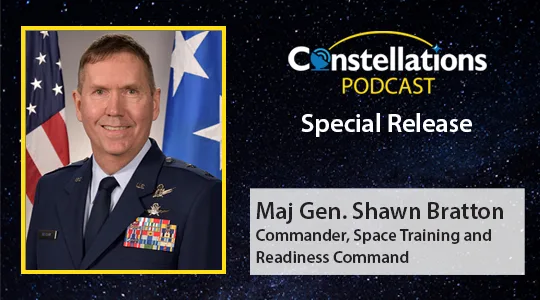
John Gilroy: Welcome to Constellations, the podcast from Kratos. My name is John Gilroy, and I’ll be your moderator. Today, we welcome Major General Shawn Bratton, Commander, Space Training and Readiness Command of the United States Space Force. We are going to talk training in the U.S. Space Force and what it will take to get everyone up and running in this new frontier. Major General Bratton, thank you so much for appearing on the podcast. We are grateful you took the time to meet with us to discuss training our Space Force and preparing them for future readiness. As a new commander of Space Training and Readiness Command known as STARCOM, you have your work cut out for you, don’t you?
Major Gen. Bratton: John, thanks for spending some time with me today. I’m excited to talk to you both about STARCOM and the Space Force, but just space in general. It’s an exciting time out there for the military, civil, and commercial, so glad to be here today.
John Gilroy: I’ll tell you in the Washington D.C. area you get in the Metro, you see all kind of teenage kids with NASA t-shirts on. And so if I tell them, “Hey, we’re going to talk about STARCOM”, we’re buying a lot of listeners there. So what exactly is STARCOM and what is unique about its mission?
Major Gen. Bratton: STARCOM is as you spelled out, the Space Training and Readiness Command for the Space Force. We do all the training activities, all the education activities, but we also do test activities. I think we’ll talk about that in a little bit, but combined together, it really comes down to preparing the force, in this case, the Space Force for competition and conflict in the space domain. As part, of course, of that broader joint force but we get to take them from right off the street into basic training and turn them into guardians. And that’s what we do every day.
John Gilroy: So geographically, this takes place in Colorado or where in the United States does this take place typically?
Major Gen. Bratton: Yeah, the command is in multiple places. The headquarters right now is in Colorado. We have training activities in Texas, Alabama and out in California at Vandenberg. We have test activities at places like Kirtland, Edwards Air Force Base in California and out at Nellis. And so a lot of the places where you would see similar activities in the Air Force is right where the Space Force is. Our education activities are partnered right now, both at the Air Force academy here in Colorado, as well as down in Alabama at Maxwell. So the command is all over the country, doing the work for training and education.
John Gilroy: Well, I don’t envy you. Must be some long days. Everyone is everywhere and you’re the central person with all this training, aren’t you?
Major Gen. Bratton: Yeah, I’ll tell you. I don’t know so much about me, but the team here at the headquarters is working hard. I’m sure you and your listeners know that the real work is done in the trenches, for us at the squadron level. And those guys are all over the place, working hard every day.
John Gilroy: This STARCOM is a new position and ultimately a new command. Not just for you personally, but as a position within the U.S. Space Force. So what is your priority here?
Major Gen. Bratton: Yeah, it is. You’re exactly right. It is a new command. We just stood up a year ago on August 23rd, so we’re coming up on our one-year birthday. I am the first commander and so honored to be the commander of STARCOM. And you got to admit, it does have the coolest name of anything in the Space Force, I think.
Major Gen. Bratton: The priorities. some of them were laid out. There’s of course a big planning effort, some before I showed up and then those I participated in when I came over from U.S. Space Command. But the priorities, some were laid out by General Raymond. So, for example, year one priority was independent professional military education for the Space Force. General Raymond really felt strongly that, “Hey, we need to really grow independent guardians. Take the best lessons, not just from the Air Force, but from the other services, and then define our own education.”
Major Gen. Bratton: So that independent, we call it PME, the acronym for Professional Military Education is one part, but two other year one priorities were building out the National Space Test and Training Complex. That’s our big technical challenge. It’s the playground or the gym that will go to work out the force and try out new capabilities and new tactics and techniques, as well as just defining the Space Forces’ training. We get so much from our partners in the Air Force but thinking through what things do we want to keep the same and stay partnered with the Air Force and where are some areas where it makes sense for us to maybe start to go our own way.
John Gilroy: General, there are people very familiar with the organization who are listening. But there are also some people that are just maybe trying to learn about the Space Force. And so let me set this up for maybe our brand-new listeners. The Navy is to the Marines as the Air Force is to the Space Force. Is that a good way to consider it?
Major Gen. Bratton: In some ways, yeah, absolutely. We are all in the Department of the Air Force and Secretary Kendall, the service Secretary for both the Air Force and the Space Force relentlessly states, “one team, one fight” within the Department of the Air Force. So that’s our civilian leadership in the Pentagon there with Secretary Kendall and then beneath him, you have a Chief of Staff for the Air Force, General Brown and the Chief of Space Operations, General Raymond, who is my boss. And so, we got the Pentagon leadership similar to others, and then the next echelon or the next level down in the organization, we call the field commands. There’s, three of them in the Space Force, and STARCOM is one of the three. We do training, education, and tests. And then there’s an operations command and an acquisition command, or the other two field commands.
John Gilroy: I can’t even imagine how challenging your job must be. My wife is a teacher and she has a master’s degree in curriculum education. And she goes into established courses. It’s very difficult to build it but you’re starting from scratch. You’re building out training programs that cover multi-discipline, everything from orbital and electronic warfare to engineering and acquisitions. Other than what has always been done in the past with the services, what kind of resources are you referencing and leveraging when determining the best way to build out new training and testing programs for an entire service in an area so vast and unmapped? I mean, you’re the pioneer buddy, aren’t you?
Major Gen. Bratton: I’ll tell you, it’s daunting but it’s super exciting to be on the ground floor. And first, we got to give a shout out to your wife and all the teachers. My wife’s a teacher too and I started my professional career right out of college as a high school teacher, so I’ve been in the classroom and that’s my background. And so, it makes sense that it all comes together here to be in charge of it for the Space Force. But I’ll tell you, there is a lot of new ground to break. We’re really thinking through what does it mean to be a guardian, everything from the kind of culture and identity aspects, and how do we impart those in training to the very technical aspects associated with space operations, and how can we benefit not just from the Department of Defense, but from what NASA is doing, what commercial companies are doing and how do we bring some of those best practices in to the Space Force, and really begin to exchange information as we grow our force, which is also the broader workforce in the space industry.
John Gilroy: When you look at a high school teacher, there’s Math, History, English courses, and they’ve been taught for decades, and you pretty much know what’s going on. In the environment you’re in, it’s such a dynamic environment. Things are changing almost constantly. It’s like you can have a rough overview of what one aspect’s going to be but look at all the dynamic activity taking place with launches and new technology. We’re going to the SmallSat conference here in a couple weeks, going to be stuff I never dreamt happening. So, you’re in a position where you have to cover all the basics and you have to have some flexibility for the new stuff that’s going to happen in six months. How can you train? You don’t know, do you?
Major Gen. Bratton: I’ll tell you, one of the benefits I think that will prove out over time is we’re such a small force. And so there’ll be about 18,000 folks in the Space Force, about half of that is uniform, where in military, that’s just a fraction of the size compared to the other services, but it lets us really be agile. And so, the idea that all of the training and education falls within a single organization, STARCOM in this case, as something new happens, we can introduce it right into the curriculum.
Major Gen. Bratton: And so, for example, last year or right at the end of the calendar year, we published new guidelines on planning for space operations within the Department of Defense, one of our first doctrine publications for the Space Force. And because the doctrine folks fall under STARCOM as well, as soon as that came off the presses, we turned across the room and handed it to the trainers and educators to incorporate immediately into the classrooms across the Space Force. So our small size lets us be agile like that and we find it to be a benefit. I think our ability to respond to rapid innovation, whether within the department or an industry will be proven out just because of that fact of our small size.
John Gilroy: Let’s go back to space. When a satellite is launched, I think it’s placed in a specific assigned orbital slot. So will there be room set aside similarly for life testing and training? What are some of the technical challenges you’re working through right now?
Major Gen. Bratton: Yeah, that’s a great question. There’s a couple of buzz words we use in the training and the range environment. You’ll hear the Pentagon staff talk about operational test and training infrastructure and we put a label on it called the National Space Test and Training Complex, but generally we just call it the range. How are we going to operate and test and train on a space range? And as you know, it’s so different than the land and sea and even the air domains where you can carve out some real estate in a place like Nevada for the Nellis Test and Training Range or the National Training Center in California that the Army uses. You can declare a piece of geography set aside for test and training purposes.
Major Gen. Bratton: We certainly can’t do that in low earth orbit or in geosynchronous orbit. So we have to think about it differently. And how do we meet our test and training objectives? The things that we have to do live, how do we communicate that? And how do we think about safety and making sure our intentions are clear so no one misunderstands the activity. But also, how do we benefit from the advances in digital space? What can I do in the simulators, in a digital environment so that I don’t have to do it live? And how does that reference to a level of confidence that our digital models have the fidelity, for example, to really deliver results that are accurate against live modeling. And so, there’s lots of folks who do this well, certainly NASA being one of those that we’re trying to learn from and understand how they do test and training in the digital space and on simulators before they go live in a range like environment.
John Gilroy: General, I read a press release this morning and it talked about the Space Test Enterprise Vision. So what exactly is that?
Major Gen. Bratton: Yeah, that’s one of the early documents from the Space Force. We went through a series of meetings even before STARCOM stood up, really trying to do both. A little bit of roles and responsibilities within the Space Force on who does what as well as, how can we do things? Where’s some innovation that we can employ. How can we speed up the process to get equipment into the hands of operators faster? And I think one of the things the vision talks about that we hit on is what we call integrated testing, and lots of folks are trying to do this or do this well, but historically for the Department of Defense, we do developmental testing, which has a lot to do with, “Did the contractor deliver the thing that we asked for? Does it meet the specifications as designed?”
Major Gen. Bratton: And then once a new aircraft or a new land vehicle comes online, they’ll run it through operational testing, which is now we’ll put it in the hands of the operators and see what they can do with it. And how do they integrate into a broader architecture or set of capabilities. We’re trying to combine those things into integrated tests. And the vision really speaks to how we think we’ll gain advantage really in the cost and delivery portions of the acquisition process delivery schedule. And so we’re getting after integrated tests, we’re putting operators and professional testers who work for STARCOM, operators who work for space operations command, and then the acquirers and engineers all together in the same room to field new capabilities.
John Gilroy: Let’s focus a little more on this training here. When training for a space mission, it seems that your guardians would require the realism of a contested environment. Can you train for this within a virtual reality environment?
Major Gen. Bratton: Yeah, that’s a great question. And quite honestly, one of the challenges I’m wrestling with is how do I weigh the value of live training versus training in a simulator? And how do I know that one way is better than or less than the other. I had a chance to talk to a couple astronauts and we talked through the incredible training capabilities that NASA has and employs to prepare them for going on orbit and conducting human space flight missions.
Major Gen. Bratton: It’s pretty incredible, the amount they do in the simulator like practicing docking, for example, and at least as relayed to me from the astronaut community was, “Hey, that first live dock was almost just like that last dock in the simulator” that the fidelity of the simulators and the level at which they’re operating really prepare them for live space operations.
Major Gen. Bratton: Now that requires incredible investment in simulating and training capability. So we’re trying to balance that and understand how to measure what can we do virtually, make sure there is cost savings with it, or some other benefit that we realize. And then how do we think about live training and what things absolutely have to be done live in the training environment. And so I wouldn’t say that we have all the answers for sure, but we are learning from, and relying on some of the experts out there and then working hard to really come down to an end state for the Space Force.
John Gilroy: I love when you used the word fidelity. I’m old enough to remember high fidelity, high-fi, and the idea was to have it just like the orchestra was right in the room with you, to have it right there. So what are the major considerations for creating a space training and testing environment that’s both digital and realistic? Are you getting help from industry and can you give us an example?
Major Gen. Bratton: Yeah. I’ll tell you, I talk sometimes about the greatest technical challenge ahead of STARCOM specifically, and it really is this. It’s the build out of the test and training complex, this weighing of value between digital and live in the digital space. We’re getting a lot of help. We’re relying on other parts of the Space Force so the Space Warfighting Analysis Center, who does a lot of our architectural analysis for future systems, they begin this process where they build a digital model of a system that we might acquire in future years.
Major Gen. Bratton: As we work that through the acquisition cycle, what we hope is that once the department decides, “Hey, we are going to acquire this system”, that digital model gains fidelity and interaction with industry has already started. And so we’re all contributing to the fidelity of the model, the accuracy of the model. Eventually, I get my hands on it and I can use that same model that now is that kind of high-fi element and use that for test and training. And that works great. It works great for friendly systems. And then we have to rely on the intelligence community really to try and help us best understand what the potential adversaries are operating, what’s the fidelity in their models, and then how do we bring those together in a training environment?
John Gilroy: Major General Bratton, thousands of people from all over the world have listened to this podcast. Go to Google and type in “Constellations Podcast” to get to our show notes page. Here, you can get transcripts for all 100 plus interviews. Also, you can sign up for free email notifications for future episodes. When you look at the Air Force, I think the Air Force has something called red flag exercises and if I’m not mistaken, I think the Space Force has space flag. So how are they different anyway?
Major Gen. Bratton: I’ve been to both and they’re very different. Red flag is an incredible event. It takes place, I think, always at Nellis Air Force Base. Certainly, all the ones I’ve been involved. I think sometimes they do an expedition up to Alaska, but essentially, it’s a large live fly aircraft, live fly exercise where the Air Force and allies and the other services all come together in a single place, and then they fly multiple evolutions over the ranges of Southern Nevada and they’re presented challenges, and then they got to fight through those challenges. And flying against them live or aggressor units that the Air Force operates that acts as the adversary. And then they do that simulated combat over Nevada.
Major Gen. Bratton: Space flag is not that, there’s no live activity in space flag. It really is a limited use of simulation, we’re using the capabilities that we have today. It’s more of a planning exercise where if the adversary does this, now what will you do? We’re back on, in some cases, using whiteboards and thinking through the tough problems, and then being able to explain it to the leadership for the event, and then present the trainees with another challenging scenario.
Major Gen. Bratton: We are definitely trying to up our game. I don’t think we’ll go as far as red flag is. And that incredible capability that the Air Force has where we would do so much live. But I think we will start to introduce maybe some more live elements in space flag or what the Space Force is going to go to.
Major Gen. Bratton: We’ll continue to run space flag, but we’re going to begin to run a new series of exercises that we call the Sky Series. So black skies, red skies, blue skies, and each of those is four different communities. So black skies, for example, will be for the electronic warfare community. Blue skies will be for the cyber operators in the Space Force, for that community. So on and so forth. And so, this is a focus. We got to solve the training complex, the range problem first so we have a place to go take the force to work out and own our skills. And then you’ll see us start to use those in both space flag and the sky series, as that comes online over the next few years
John Gilroy: Earlier, I mentioned I read a press release about the Space Test Enterprise Vision. I also read a press release about the Sapper Leaders Course. And in fact, there’s a guardian who graduated from the course. It seems like new terminology. Can you explain what a Sapper is?
Major Gen. Bratton: Yeah. I’d tell you. There’s always innovation in the force. And so the Sapper is really an Army program, it’s the title that they essentially call their combat engineers. And the Sapper course is the course curriculum and the physical challenges that you go through, kind of the Capstone event that you go through to be qualified as a Sapper. And so, one of our guardians found out there’s a way to apply and he got permission from his commander and enrolled and successfully graduated what is a very challenging course for the Army. And so now he brings those skills back to us and it’s like, well, what are we going to do with a combat engineer, qualified individual in the Space Force. But really what he brings is that understanding of what’s it like to be on the ground, that experience that he got as part of the joint force working with the Army, and then how can space help them?
Major Gen. Bratton: Because even if we were to fight in space someday, and we certainly don’t want to, just to make that point clear, but if that were to happen, we wouldn’t do that by ourselves. We would have Army, Navy, Air Force and Marines helping us in that event. Just like if we’re fighting on the ground somewhere, the Space Force contributes to that fight. And so this pretty unique perspective that this one guardian has and brings that back into the Space Force is pretty great. It also quite honestly helps us with our culture and identity. The Space Force wasn’t born just out of the Air Force. We have soldiers that have come over from the Army and sailors and Marines that have come over from those services and an experience like this really helps shape the Air Force’s culture just as we’re in our infancy in these early years.
John Gilroy: This has been a great interview general. Thanks for giving our listeners insight on the challenges in starting the new frontier of training for the United States Space Force. I’d like to thank our guest, Major General Shawn Bratton, Commander, Space Training and Readiness Command of the United States Space Force.