Transcript:
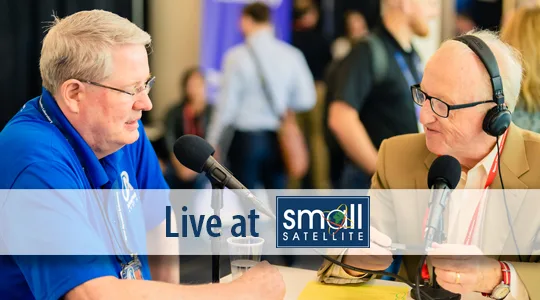
John Gilroy: Welcome to Constellations, the podcast from Kratos. My name is John Gilroy, and I’ll be your moderator. Today, we’re at the SmallSat show in Logan, Utah. Our guest is Thomas Gardner, Director of Engineering/Mission Systems at Advanced Space, a Colorado space technology company now working with NASA on cislunar programs. For your Twitter enthusiasts out there, we’re going to basically talk about three hashtags. One hashtag is #artemis, and then #cislunarcommunications. And let’s not forget, and this is a winner, #nearrectilinearhaloorbit. Now some of these hashtags may be new to you and may not be new to some other listeners, but they are all key to the success of so many planned lunar missions. This should be a fascinating interview. To put all these hashtags together into concepts we can all understand, Thomas Gardner of Advanced Space is with us today. He will discuss NASA’s exploration program and Advanced Space’s role in it, advances in lunar navigation and communication, and NASA’s plan to land the first woman on the Moon by 2024. Well, Tom, we got a lot of acronyms and even abbreviations here to handle. First one is going to be CAPSTONE, and then we have CAPS and NRHO. Let’s start off with CAPSTONE. What is it, and what is it designed to accomplish?
Thomas Gardner: John, I appreciate you. Thank you for having me for this. I appreciate it, so let’s start with CAPSTONE and what CAPSTONE is and what we’re trying to do with it. CAPSTONE is an acronym. It stands for Cislunar Autonomous Positioning System Technology and Navigation Experiment.
John Gilroy: Wow. That’s going to impress people at the 7-Eleven, huh?
Thomas Gardner: The first four letters are caps, Cislunar Autonomous Positioning System. That is our technology we’re demonstrating on this mission. It is a software system for doing absolute position and velocity estimation in orbit without having to do the standard deep space tracking and onboard … or on-the-ground navigation for a spacecraft. So the idea is that we are going to be talking to another spacecraft in lunar orbit that’s been there about 11 years now, 12, the Lunar Reconnaissance Orbiter, or LRO. So, by talking to that space … Simply by doing a radio signal between the two spacecraft, we’ll be able to estimate the position and velocity in cislunar space absolutely, which is hard to do without using radiometric tracking from the ground. Second half of it is technology navigation experiment, so in addition, like I said, the navigation we’re doing on it, we’re doing additional navigation tests using a one-way ranging algorithm from the Jet Propulsion Laboratory that we’re going to host on board. And so the signal will come up from the Earth, so we don’t have to do a, what they call two-way ranging signal, just absorb that signal and do autonomous position using that alone. So, put those two acronyms together, you get CAPSTONE.
Thomas Gardner: Actually, it’s been an interesting story. It was about 2019 sometime when we were putting this mission together for NASA. We had the CAPS program, which was funded under a Small Business Innovative Research project, SIBR, and what we wanted to do is extend it to do an actual mission system to demonstrate this. We have a group of guys at Advanced Space, we call them our acronym team, and they got together on the white board and worked with us. Mostly, they did it themselves, and they gave us a couple different suggestions about how extend CAPSTONE into a mission name, and that’s how we came up with that.
John Gilroy: You mentioned NASA a few minutes ago, and I think they have the Artemis lunar exhibition program. So, Artemis and CAPSTONE kind of go together, don’t they?
Thomas Gardner: Yes, they do. Artemis is the overarching program to return to the Moon and move on to Mars within the next, basically, 10 to 15 years. The first mission that NASA will launch that is designed around putting humans back on the surface of the Moon is called Artemis I. That is scheduled now to launch at the end of this month, on August 29th. They’ve been struggling to get it to the pad and get it off the ground. And so, that’s the Artemis program. But eventually, what they hope to do as part of the Artemis program is operate a small space station in what’s called Gateway, the Lunar Gateway, in or about this near-rectilinear halo orbit, or NRHO. And the reason they’re doing that is because it provides an ideal location in and around what we call cislunar space to move back and forth between the surface of the Moon, move back and forth between the Earth and eventually onto Mars. So, this orbit is unique and it’s what they call a near-quasi-stable orbit in the Earth/Moon system. And so, we balance the gravitational forces of the Earth and the Moon, so it takes very little fuel to get in and out of this orbit, and it takes very little fuel to maintain this orbit. So in doing that, then we’re going to demonstrate how Gateway will operate.
Thomas Gardner: Gateway’s much larger than our mission. We are a very small spacecraft. We only weigh about 50 pounds, basically, or 25 kilograms for those of us who work in the space world who always work in metric. And the idea is that operating this orbit’s going to be a challenge. It’s never been done before, so we’re going to be the first people to do that. First mission to do that, I should say. And then the Gateway will follow sometime in the late part of this decade and operate in that same orbit.
John Gilroy: When you read articles about this, it explains the orbits fairly well. But if you’re listening to this now, and you’re kind of interested in going to the Moon, you can go to YouTube and there’s all kinds of different demonstrations of this orbit. And it’s actually almost artistic, isn’t it? It’s really a beautiful depiction of how the mathematicians have figured out with certain Lagrange points and it’s just mystifying how elegant it is, isn’t it?
Thomas Gardner: Yes.
John Gilroy: I mean, really, the text doesn’t … the verbal explanation doesn’t talk about really how elegant this whole system is. It solves the key problem, is how to keep contact with there and how to make sure people are supplied on the Moon. Speaking of the Moon, I guess if you do research, you will find out there are, I don’t know, maybe a hundred different missions planned over the next decade. And some will say that these missions may be constrained by the availability of ground tracking, so CAPSTONE affected by this, and how are you resolving it?
Thomas Gardner: That’s part of what the CAPS part of what we’re doing is, the real reason we’re doing this, and the reason that NASA’s funding this, because they’re interested in supporting this. Basically every mission that goes outside of what we call geostationary orbit uses something called the Deep Space Network. There are other networks within the NASA framework that also can talk to spacecraft outside of geo, but primarily it’s the Deep Space Network. And they only have a limited number of dishes, and so you have missions that are going as far out as Voyager 1, which launched in 1977 when I was still a young man in high school, and that is now out at almost one light day out. And so they still talk to that spacecraft on the Deep Space Network. And there are a whole other host of missions going to all the planets across the solar system. There’s one at Jupiter right now. There are a half a dozen or so at Mars. And for instance, just a couple of days ago, the Koreans launched one to the Moon. We’ll talk about that in a minute. So, they’re a little oversubscribed. When we were planning our mission with the DSN, because we are not there yet doing the CAPS demonstration, we have to plan out all our tracks, our communication passes, very, very, very precisely with these guys. They have programs that help manage this, but they are often oversubscribed in terms of just back and forth. So, we had some challenges at the beginning of our mission, and so they actually had to ask other missions to not do their routine tracks so they could support us doing more communications. So, in doing this, and like you mentioned a number of missions, like for instance, Artemis I, there are a number of other CubeSats that are launching on that as well. All of them will be operating in the cislunar environment. All of them will require communication services, basically all at the same time. And so, having the DSN do that dance and figure out which ones are the priority, things like that. So having more ability to do autonomous operations, autonomous navigation, autonomous communications in and around cislunar space, that’s primarily one of the things we’re trying to demonstrate.
John Gilroy: And it’s really an exciting time of year for students because this is right this month. You can put it in your calendar and see what happens. I mean, the whole concept here is just kind of fascinating. So, if we try to take your team and get a whiteboard and try to design this, you see the Earth, Moon, you see an orbit going around the Moon, and I guess people, equipment going back and forth to the Moon. And so, on your website, you have something called ballistic lunar transfers to near RHO. What is that exactly, and how is it important to the Artemis program?
Thomas Gardner: Okay. There are multiple different ways to get from one planetary body to another. Often what is quoted is what we call direct transfer, or home and transfer, which is the most fuel-efficient way to do it within the minimum amount of time you can do that. All the Apollo programs back in the late 60s and early 70s, they used what’s known, a free return trajectory, which took about three days to get to the Moon and then swing around the Moon. If they didn’t do anything, it would come back to the Earth. And that is a fuel-efficient transfer.
Thomas Gardner: But in order to go into orbit around the NRHO, it is a little trickier to do it when you do it that way. So, what our chief technology officer and a few other folks have come up with is this deep space transfer using the Earth/Sun gravitational fields to balance and actually make it more fuel-efficient. So, we go out about three times the distance to the Moon, about 1.5 million kilometers, and then we fall back into the Earth/Moon system, which is about what we’re about to do. And then we basically, instead of getting in front of the Moon and going into orbit around it, we come up behind the Moon at a very low velocity. There are actually options off of BLT where you can just drift into an orbit about the Moon without any propulsion system. Be very difficult to do that because it’s very, very, very precise.
John Gilroy: And hence the need for absolute position.
Thomas Gardner: Yes.
John Gilroy: The word absolute, I wrote that down because the amount of mathematics involved, and it just is really unbelievable.
Thomas Gardner: There is a bit of cost. The launch vehicle that sends us to the Moon has to give us a little more of a kick than going the lunar distance. We basically balance some of the requirements on the launch vehicle’s performance. But getting in NRHO is less than a third of the amount of fuel, or what we call Delta V, to get into that orbit, versus going a direct transfer, what we call powered fly-by of the Moon. And there are other orbits like this, various acronyms. There’s what they call libration point orbits. There’s distant retrograde orbits, which is the one the Artemis I mission’s going into. And our folks at Advanced Space are well-versed in these things. This is why we hire them to work for us and design these trajectories, design these ways of getting to the Moon, getting to other places as well in the solar system.
John Gilroy: Let’s just take one of these terms, geo orbit. And so if you were speaking to someone at the trade show here, just contrast the geo orbit with this NRHO.
Thomas Gardner: Okay, so geostationary orbit or geosynchronous orbit basically is an orbit about 42,000 kilometers out that basically, at that altitude, the orbital period, the amount of takes it time to go around the Earth, is the exact same as 24 hours. So basically you hover over the same spot on the Earth all the time. The near- rectilinear halo orbit basically is a orbit that is … essentially what you’re doing is co-orbiting the Earth with the Moon. So we are not going around the Moon, we are going above and below the Moon as the Moon goes around the Earth. So, you basically are the same distance as the Moon from the Earth all the time. You’re also in visibility of the Earth at all times, so your communications, telemetry, data coming down from it are always visible. It has minimum eclipses, so we worry about that from a power point of view so we don’t have to go in and out of the Earth eclipses.Geostationary orbits have been around for quite some time, basically about 60 years. The first communication satellites in the early 60s started to figure this out.
Thomas Gardner: There are hundreds of them up there now. It can get quite crowded, actually, up there. But we’re just beginning occupying this cislunar space, and so there’ll be a lot of different requirements for doing that. And then obviously doing relay communications. One of the things about the Moon is, the far side of the Moon is not visible from the Earth. So one of the things we’re been working on with other clients is doing what they call relays, relay orbits from the far side. The Chinese space program is doing this right now with their lander that’s on the far side, and their rover that’s on the far side. But you have to have a spacecraft out there to relay that, and that has to be in a very stable orbit as well. So on the far side, there’s what they call the L2 Lagrange point. You put an spacecraft there, it can see the entire far side of the Moon and the Earth most all the time. So, doing relays from that is very important as well.
John Gilroy: Now, when it comes to managing this mission for CAPSTONE, Advanced Space or NASA?
Thomas Gardner: It’s interesting the way … NASA owns many missions, and by that, that means that they are the project management or oversight, folks that work at NASA centers like the project manager or the management of the … They do hire companies to build spacecraft and to help operate the vehicles. In this case, we are what’s called a commercial service, so NASA hired us to manage the mission, to own the mission. We own the spacecraft. NASA does not, but NASA is investing in us for basically the data, so the results of doing the mission, we publish reports. We have to supply data to NASA.
Thomas Gardner: There are many other NASA missions that have already contacted us now that we know we’re in space, “How are you operating? How are you doing this?” And we’re more than willing to help them with their future missions, but we own the vehicle and we own the operations, we own the system, so that’s the difference. NASA’s basically an investor in this operation.
Thomas Gardner: It’s a new way of doing business. They’re evolving into this. They are doing this now, what we call the Commercial Lunar Payload Services program, where they’re paying companies to land on the Moon and deliver NASA payloads to the surface and then just provide the data. So the objective there is that the deliverables or the data, or the reason they’re getting paid, is they’re supplying this data to NASA for its science teams, for its lunar scientists, things like that, and we’re doing something similar to that.
John Gilroy: Tom, thousands of people from all over the world have listened to this podcast. Go to Google and type in “Constellations Podcast” to get to our show notes page. Here, you can get transcripts for all 100 plus interviews. Also, you can sign up for free email notifications for future episodes. Earlier in the interview here, you mentioned Gateway. This is the planned NASA Moon outpost called Gateway. I guess what CAPSTONE will be doing will be testing navigation methods, so give me an example of a couple of these navigation methods you’re testing out.
Thomas Gardner: Basically, what we’re doing is extending what we call radiometric tracking, which is from the Earth to a spacecraft by sending a signal up and back, and you have a precision clock that measures the time from the Earth to the spacecraft and back. You can measure, it’s called an observation. By doing that, you can convert that into position and velocity, so basically what we call the inertial state of the spacecraft. And you can track that very precisely and estimate very, very, very precisely where it is at any one time, and more importantly, where it’s going, okay? So the idea is that then when you have to do a maneuver or target somewhere, you know exactly where you’re starting, you know where you want to go. And so by having those two pieces, two points, you can develop the solution.
Thomas Gardner: So what essentially we’re doing is something similar. Except when you have two different spacecraft operating in a gravity field and they can talk to each other, back and forth to each other, using radio signals, or we can use lasers or whatever, by doing that, you can do the exact same thing, okay? But the two spacecraft have to be in the same gravity field, but operating in slightly different … Basically one can be in a low lunar orbit and the other one can be out at L2, like I mentioned earlier, or in the near-rectilinear halo orbit. And then by doing that two-way communication, you can establish the position and velocity and the absolute reference in cislunar space, so without having to use the ground to support that activity.
John Gilroy: There’s a guy named Simon Sinek and he wrote a book called Start With the Why, so I’m going to ask the why about the Gateway. Why not go directly to the Moon? Why is the Gateway an advantage?
Thomas Gardner: Okay, there’s a couple things about that. One is primarily the size of the spacecraft’s propulsion system. NASA initially was going to land, or put Orion attached to what they called the Human Lander System. And at the time, they were going to put all of the Delta V required to go into lunar orbit on that system. And when they switched off of landing on the Moon as being the priority for the missions, the Orion spacecraft did not have that capability to get into low lunar orbit and get the astronauts back. So, what they decided to do was, and it’s a very smart thing to do, was put them into this NRHO orbit and then stage from there to the surface of the Moon with a different lander system. So, that lander system is now going to be designed and built by SpaceX, at least the first iteration of it, so the idea is that they will go to the Gateway, the astronauts will board that spacecraft at the Gateway, and then descend to the lunar surface. It’s also very convenient, as I mentioned earlier, for getting to places like Mars. So once you go into gravity, well, it takes as much fuel to get down as it does to get back up. So by doing this, they can save a tremendous amount of fuel from staging, from both the lunar service and for going to Mars, so that’s primarily the reason for it to be there. There’s all other kinds of things they’re talking about doing this with now, like create observation posts for things like telescopes, and for studying the sun, for studying the stars, things like that. And then operating this orbit to get to back and forth from the station to the Earth in case of things like an emergency or things like that is much easier than going from the surface of the Moon, or even from low lunar orbit.
John Gilroy: Earlier, you articulated this CAPS, Cislunar Autonomous Positioning System, and we talked about precision and everything else. So, what is the benefit here of not having to rely on Earth tracking?
Thomas Gardner: Primarily, it’s the oversubscription to the DSN, like I mentioned earlier. You don’t have to have as many, like I said, the tracking pass software the folks at JPL use. Now we’re putting less burden on those folks, in terms of how much time they have to spend moving from one spacecraft to another, going back and forth in terms of navigation. And then once the spacecraft does autonomously, you don’t have to have folks on the ground doing that estimation, doing that navigation estimation work. It’s almost sort of a self-defeating purpose from my company’s point of view, because basically it says, “Well, I don’t need navigators on the ground anymore if the spacecraft can do it,” but it’s like an evolving thing. If you have robots build things, then why are people necessary anymore? But we’re hoping to evolve that into more sophisticated navigation systems for doing things like when you’re far away from the Earth, you don’t have to talk to the Earth nearly as much.
John Gilroy: When I was doing some research on this NRHO, it has to be maintained. So there’s got to be challenges to maintaining an orbit so far from Earth, aren’t there?
Thomas Gardner: Yes, there are. We carry a propulsion system designed specifically for the low- thrust requirements. It’s not a low-thrust system. It is a monoprop system, but the low Delta V requirements for maintaining the orbit, very precise maneuvers. So, we have a series of very small rocket engines on the spacecraft that when we’re in the NRHO, about once a week, approximately, we make a very small maneuver on the scale of centimeters per second, in terms of changing the velocity, so to maintain that orbit.
Thomas Gardner: If we did not do that, eventually CAPSTONE would drift off into cislunar space and maybe potentially escape the Earth/Moon system into what we call a heliocentric orbit. So, it is a requirement because like I said earlier, it’s a quasi- stable orbit, which means it’s basically on the edge of the instability.
John Gilroy: Mm-hmm, good. I talked about Simon Sinek earlier. Now, we’re going to talk about Tom Cruise. This is the Show Me The Money question. CAPSTONE, does it have any implications for commercial cislunar activities?
Thomas Gardner: Absolutely. Our plan as a company is to market our Cislunar Positioning System as a system that people can use on their spacecraft. There are a fair number of folks out there who have decided that the cislunar environment is now where we want to go and where we want to operate. There are resources on the surface of the Moon that are potentially exploitable for doing things like deep space maneuvering, deep space … turning basically lunar regolith into fuel or into other commodities that can be used in the cislunar environment. There are a lot of commercial companies, especially here in this trade show, that are talking about doing these type of things. The other folks that are interested now are the United States military, because the Chinese have been operating out there for quite some time. The idea is that if there’s going to be commercial activity in this area, that it’s … could eventually become contested space, so they’re interested in observing what’s going on out there. The idea is that they might have a commercial company like they’re doing now with Earth observation to observe things out in cislunar space. So yeah, a lot of commercial activity going on right now. I will tell you, I’ve been in this business almost 40 years, over 40 years, actually. I’ve never seen so much interest in doing lunar missions, lunar operations, both commercially and from a scientific point of view.
John Gilroy: And if you’re doing some commercial activity, communications is critical. I mean, if we’re talking about mining exploration, even lunar tourism, I mean, you have to have that precision like we talked about earlier. Isn’t that true?
Thomas Gardner: That’s true, that’s true.
John Gilroy: Yeah. Good, good, good. Well, tell us about other CAPSTONE team members and the roles in this program, if you can.
Thomas Gardner: Okay. Sure. We at Advanced Space to have a team, a company of about 50 employees. I’m the program manager for CAPSTONE. Basically, there are about 10 full-time, what we call full-time equivalents, working on CAPSTONE, have been over the last couple of years. Basically, we started the project in the fall of 2019. We hired a company called Tyvak, which is now called Terran Orbital, to build our spacecraft for us. They’re in Irvine, California. They have a lot of very dedicated people that have helped out a lot in doing this, and they delivered the spacecraft this past April to the launch site. The launch vehicle was built by a company called Rocket Lab under a separate contract with NASA to launch it. A couple days ago, their CEO, Pete Beck, got up on TV here and talked about how great it was to actually have a lunar mission in their portfolio now. There’s another company that we hired called Stellar Exploration who built our propulsion system. They’re in San Luis Obispo, California. Very, very cool system. It was very small, but exactly what we needed for doing precise maneuvers, and things like that. We’ve hired the Space Dynamics Laboratory here in Utah. They provided the communications system for talking from the Earth to the spacecraft. And then another company up in Washington called Tethers Unlimited that supplied the S-band radio, which is what we’re using for doing that ranging experiment for CAPSTONE.
John Gilroy: Sounds like best-of-breed each category, isn’t it? And very carefully selected.
Thomas Gardner: Pretty much, yeah, pretty much. The guys at Terran have been great and they have their own subcontractors they hire to build parts for the spacecraft, things like that, do all the testing, things like that. But we provide the overall management. Also, our responsibilities are, like I said, the mission design, the maneuver planning, the navigation for it and the operations. So we oversee the operations, and then the folks at Terran, they have a separate facility for managing the spacecraft onboard systems, making sure they’re functioning properly. But it’s very busy. Activities since we launched and were let go by the Rocket Lab, upper stage on July the 4th, we’ve had, right now, as of today, 46 communication passes with the spacecraft. We are about out at apogee, as far away from the Earth as we’re going to get, in the next couple weeks.
Thomas Gardner: And then we start, as I said, falling back into the Moon system. And like I said, every day, most every day or about every other day now we’re having a communications pass with the spacecraft. And then the folks at Terran processing that data, looking at it, making sure things are working well. And actually, like I said, doing radiometric tracking for navigation. So, it’s a dance of a lot of different people. NASA folks obviously are directly involved in this. We had a review meeting with them yesterday, going over how we’re doing. They’ve been very supportive of all of this. The folks at the Space Technology Mission Directorate headquarters, the folks at NASA Ames, who are the small spacecraft office, they have definitely been involved, directly involved in all of this. It’s all been a really big team effort.
John Gilroy: I know a lot of people who manage large software projects and they use this term, orchestration. And that’s what I thought of when you’re … Maybe you should have a little baton and you’re the guy who’s orchestrating this. This is pretty complex.
Thomas Gardner: Well, yeah. I like to joke with people about this, but I used to be an engineer, but now I just manage budgets and schedules, but yeah. Schedule is everything. We were doing the dance of trying to get the hardware built, getting it tested. COVID definitely had an impact on us. I talked to everybody about this. I said, “Basically, between technology development issues we had on the spacecraft development, and then COVID, it cost us about 16 months of time.” We originally wanted to plan to launch this in the spring of ’21, but we ran … like I said, we launched on June 28th of this year. Most of that again was related to two different things. One was COVID and one was just the development. Some of the development activities on the spacecraft, and obviously some of the development activities on the launch vehicle, because Rocket Lab actually built a brand new upper stage just to do our mission.
John Gilroy: Wow.
Thomas Gardner: So yeah, so me managing the schedule, managing is an interesting word, trying to figure out how to make sure everything gets done when it’s supposed to get done. And then the budgets of course, because NASA is funding this project, so we have a very tight budget on this. This was a very cool, low-cost planetary mission by NASA standards. Typically, NASA spends hundreds of millions of dollars on a mission of this class, or even as low as 75 million. But we were doing this entire mission. Our share of it was under $20 million and the Rocket Lab share was under 10, so basically, the whole mission for under $30 million, which by NASA standards is very low.
John Gilroy: We talked about a hundred missions in the next 10 years going to the Moon. Is a concern about the basic system or infrastructure, and it could be a gating factor for these missions? What do you think?
Thomas Gardner: On the surface, a number of folks have talked about … NASA’s talked about establishing a base near the south pole. South pole is pretty optimal for doing things like resource extraction from basically the shadowed craters. It’s also very optimal from a thermal and power point of view, because there are areas in the southern end of the Moon and north pole of the Moon that are almost continuous sunlight. So for power generation, things like that. It’s also very easy to get in out of from what I call polar orbit around the Moon, so that infrastructure is one aspect of it. And then there’s, like I said earlier, the communications infrastructure. Like I said, there’s a far side, so you have to have relay satellites-
John Gilroy: Like we do on the Earth.
Thomas Gardner: Like I mentioned geo earlier where most of the geo satellite’s job is to just take a signal up from the ground and send it to the other side of the Earth. So, things like direct TV, things like satellite radio, things like that, or the weather satellites. So eventually, we’re going to need satellites in and around the Moon for doing relays, for doing communications, for monitoring the surface of the Moon, for doing operations. And then obviously I mentioned the Gateway for coming and going from the surface, for the people to come and go from the surface.
John Gilroy: You know what? No one could have predicted COVID, and it had an impact on your system, your program. So, if it is even possible to project out four or five years here, what do you expect the Artemis program and Advanced Space to have accomplished here five years down the road?
Thomas Gardner: Okay, so we hope to lead this to more missions that we will own and operate for doing cislunar operations. We’re the first company that are going to be doing this as a company. We’re hoping to support NASA and other customers, like you mentioned, commercial customers, Department of Defense customers, things like that, NASA security reasons for doing observations for supporting us. We actually, a part of a team that just won a mission from NASA, a commercial lunar lander mission, where we’re going to support the relays to do the communications and navigation for that mission. So, lots of opportunities out there. It’s a growing market. It’s a growing interest across the board. The number of requests like this podcast I’ve gotten to talk about it has been tremendous. And we hope to exploit that to drive a future business for Advanced Space, which obviously we’re a company. We’re a profit-making company, and the idea is that we’re going to be helping as many people as possible to enable the sustained exploration advancement of space operations.
John Gilroy: Yeah, and with all your precision, I’m sure you’ll do it. Tom, you have given our listeners a better grasp on lunar orbits and some practical aspects of lunar exploration. I’d like to thank our guest, Thomas Gardner, Director of Engineering/Mission Systems at Advanced Space.
Thomas Gardner: Thank you.