Transcript:
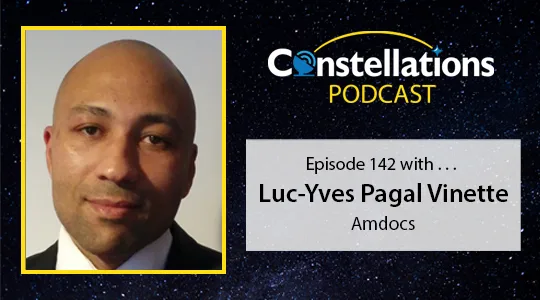
John Gilroy: Welcome to Constellations, the podcast from Kratos. My name is John Gilroy and I’ll be your moderator. Today we welcome Luc-Yves Pagal Vinette, Product Marketing Director for 5G service orchestration, network slicing, and service assurance at Amdocs. The satellite industry has gone through tremendous innovation over the last few years, with the emergence of software-defined payloads and LEO and MEO constellations. These new satellite architectures bring much more capacity and the ability to reconfigure and adjust payloads to changing missions on demand. These dynamic capabilities in space are driving the ground segment to keep up. Ground segment providers are embracing approaches proven in telecom and IT to overcome the scale and automation challenges being faced in the satellite industry. All of this has led to discussions on how virtualization, software-defined networking, and orchestration can enable ground networks to become much more agile to meet the new capabilities in space. To shed some light on these IT telecom concepts and how they can be applied to the satellite industry, we have with us, as we mentioned earlier, Luc-Yves Pagal Vinette, an expert in networking concepts such as Software-Defined Networks, SDN, Network Function Virtualization, NFV, the Edge, and disaggregated networks. In addition to all that, he is also the product marketing director for 5G service orchestration, network slicing, and service assurance at Amdocs. How are you?
Luc-Yves Pagal: I’m very good, thank you.
John Gilroy: Good. Let’s jump right in, I have a question here. So Luc-Yves, do you see any parallels with what the satellite industry faces today with what the telecom industry addressed in the past in terms of scaling and automating networks?
Luc-Yves Pagal: Yes, certainly. What we see in the satellite industry at the moment is really similar to what different telecom verticals have been facing. Basically on the mobile sector, cable fixed access, we’ve seen the same kind of strong dependence on hardware and hardware infrastructure that were supporting the value added services. So the goal of these verticals were to find a way to replace hardware attached services to something that would be much more software oriented services. So the same conundrum that the satellite industry is facing.
John Gilroy: In the world of computing here in the United States, what we’ve seen, is 15 years ago a transition from virtualization, virtual servers first came in and then over the years slowly they introduced concepts like software-defined networks, and maybe that is a model or a way that the satellite industry can look at them making these changes. So does this telecom experience offer a roadmap ahead for the satellite industry?
Luc-Yves Pagal: Yes, absolutely. There’s a transition towards cloud native possibilities. So when we say cloud native it sounds like it is about containers and Kubernetes (system for managing containerized software applications) and this kind of tools and capabilities. Not only that, if you consider cloud native it’s an evolution from the physical network functions that we call hardware and evolving gradually towards VNF, so virtual network functions (software applications). Then in that case, this is where virtualization is used in order to provide a sense of hardware being at the disposal of the software. Now, cloud native is getting a little bit further than that, so there’s no intermediate layer between the hardware and the virtualized functions.
Luc-Yves Pagal: So now everything is directly onboarded upon the hardware. So the goal of cloud native is to make things extremely flexible, light and extremely responsive compared to VNF or even PNF. So the roadmap that you mentioned is absolutely related to cloud native in the sense of CNCF. CNCF is an organization that is part of Linux Foundation that is pushing the view of CNF being part of an ecosystem of tools. So, these tools will allow basically to have configuration management such as Ansible, you will have Kubernetes, you will also have dashboard and graphical representation of the data, and you will have monitoring with things like Prometheus. So, the view of cloud native will push the bucket a little bit further to make this a total appropriation of the software on top of the hardware.
John Gilroy: I think what you mentioned is a very good concept for our listeners to understand, is that this virtualization of the network will allow it to run on standard computers and also it’ll give it this concept of observability. I think that’s one of the strengths of it, isn’t it?
Luc-Yves Pagal: Absolutely. The key thing about all these elements, if you look at the different verticals that exist in telecommunication space, is that there’s a different kind of silos that are treated separately, but nonetheless, the typical way to look at them across the board, is really observability (measuring system performance). And the goal of cloud native is to make these observability capable tools that will be used across the board, so there will be no boundaries anymore. So meaning that the cloud native will break up the boundaries between verticals.
John Gilroy: Now, an outside observer could look at the satellite industry and say, “Well, why do you think it’s taken so long for the satellite industry to embrace concepts such as virtualization and software-defined networks?”
Luc-Yves Pagal: Well, first of all, there’s something to take into consideration that satellite service infrastructure in place rely heavily on hardware capabilities such as the satellite dishes, you have the modern equipped with carrier ethernet and also IP capabilities, the PEP concept as well, that is really meant to accelerate TCP performance monitoring QS and even network management. So all these elements combined make the satellite environment or vertical to be evolving slowly, but at the same time, there’s a certain need when you want to take advantage of new capabilities such as MEO and LEO, you see the need to have a larger scale, but also to have a certain way to collaborate more easily with other verticals. So obviously what you are looking at when you consider satellite, it’s an opportunity for other verticals to leverage what others can’t do. Basically, you have an urban kind of oriented consideration for other verticals, typically 5G, but in that case, if you think about rural areas, and in that case it would be extremely difficult to leverage 5G over these places. So this is where satellite infrastructure comes in, it could bring something that other technologies can’t.
John Gilroy: About 10 years ago I had a radio show and I had an enterprise architect come in and he walked into the room. He had an 11 by 17 laminated piece of paper with teeny tiny type on it and millions of boxes of this going there and that going there and everything else. So I got to ask about this architecture question. So how do you believe the satellite ground network needs to be designed in order to take full advantage of today’s software-defined payloads and LEO, MEO constellations? And this is a dynamic situation, so you can’t take that laminate piece of paper, you got to throw it out the window. It’s just changing every day, isn’t it?
Luc-Yves Pagal: Absolutely. Well, the satellite teleports are really based on terrestrial’s network capabilities, when you’re looking at MPLS VPN, underlay routing (network responsible for delivery of packets across networks), but at the satellite level you see that LEO and MEO bring something a little bit different in a sense where it will bring new constellations or high-level methodologies. So if you looking at that thing, then in that case you need a new approach about network architecture and the service that we’ll be running on top of them. Typically, this is where we see the value of overlay routine. So things like SD-WAN (software- defined approach to managing the WAN) or VPN (Virtual Private Network) will bring something different in a sense where the payload will be distributed across the entire constellation in order to keep up with the flexibility that LEO and MEO provide.
John Gilroy: I have more questions about this dynamic capability, it’s really kind of interesting. Now, with these software-defined payloads that can be reconfigured in minutes to meet changing demand and supply. So how can the ground system be automated to keep up with that rapid change?
Luc-Yves Pagal: Well, that’s a very good question, because the way that it could be structured is really to take advantage of things like software-defined networking (software based architecture designed to make a network more flexible and easier to manage). So this is a difficult notion, especially right now because SDN tends to be dying at the moment. So SDN was a concept that was mostly driven upon silos. Basically, you will have an SDN capability to configure onboard devices dynamically and reconfigure service based on dynamic ways, and also to take in consideration the changing element that would make the requirement for these changes So SDN was mostly something on the silo consideration, but nowadays there’s a new concept that is evolving now that is called network automation that brings the question at the area level. Meaning that networks, if they’re in fixed access, if they are in optical, if they are in IPV VPN or eventually in satellite ground networks, then in that case it will be similarly proposing a view that whatever happens on satellite would have an effect on the fixed access and vice versa. So, in such a case, you need to align the way that the networks are considered on the end to end basis instead of looking at the silo consideration, which will make networks much more dynamic but also complex. So this is why there’s an evolution that is needed in order to tap into cloud native in order to leverage fundamentally all the requirements that are needed in order to implement network automation. Because, without cloud native, you don’t have the flexibility and the skill that you need in order to adapt the network on changing conditions.
John Gilroy: When you were speaking, I wrote down the word silo, and in the Washington DC area, there’s a company here called SiloSmashers. So maybe that should be the logo or the motto for the network automation? They’re SiloSmashers, aren’t they?
Luc-Yves Pagal: Possibly, yes.
John Gilroy: Luc-Yves, earlier you mentioned the term cloud native. Let’s go back to that. So let’s build on this concept of virtualization. So how can cloud native technologies help satellite network operators accelerate this transformation?
Luc-Yves Pagal: Yes, the concept of cloud native (built to take advantage of the scale, elasticity, resiliency, and flexibility the cloud provides), it’s different from virtualization. Virtualization means that you can basically take the hardware components and make them available leveraging what we call an intermediate layer that will be providing an obstruction view of these hardware components. So this will make virtualization a little bit heavy in a sense where you will have this intermediate layer and you will have the virtualized components. And to maintain this solution, it’s kind of heavy on the CPU, on memory, on the element to support virtualization. Now with cloud native, you go directly, you implement what we call containers or microservices directly on top of the hardware. You don’t need to have an intermediate layer to be like this intermediate layer to translate hardware component into virtualized component. So now you have the cloud native notion directly on top of hardware component, which will make things extremely light but also extremely responsive.
Luc-Yves Pagal: For example, if you want to change a notion of a service when you have a VNF, a virtualized component, that case you will have to restart the VNF and in order to implement the change with cloud native it’s totally different. You just push the common line and after microseconds or milliseconds, you will have the change that will be implemented. As well if you want to scale horizontally, meaning that you want to replicate the same service on the same device or different device, you can. You can also scale virtually, meaning that you can take more hardware resources in order to augment the capacity of a given service. Which means that with cloud native, you’re changing fundamentally the dynamics of what we call services, what we call service functions, that will become much more responsive, much more light. So if you want to take advantage of public cloud networks, in that case, you will be more capable of doing so by leveraging cloud natives.
John Gilroy: Luc-Yves, I’m thinking about my software developer friends and they use the term agile all the time. Well, this gives the tools to be agile, doesn’t it? I mean, this is what it does.
Luc-Yves Pagal: Yes, absolutely. And this is perhaps I didn’t use the adjective agile, but totally. And this is exactly what I was mentioning when I talked about vertically or horizontally, you can scale the service on demand and per request or dynamically based on conditions that you will set when you implement the service. So yes, totally the agility is actually something extremely important in the view of cloud native.
John Gilroy: Luc-Yves, the modern telecommunications industry has embraced massive scale in computing from cloud and data center providers, enabling telcos and mobile network operators to expand their customer reach, their commercial footprint and accelerate their monetization perspectives. Can we expect the same for satellite network operators?
Luc-Yves Pagal: Yes. The difficulty for any service provider, even though it’s using mobile as an MNO, mobile network operators or communication service providers or network service providers or satellite network operators, they have the same difficulty to have an extended reach. So they want to improve the reach to tap into different customer bases. So in such a case they need POP (point at which two or more networks or communication devices share a connection), point of presences. The problem is, if you want to have POP, it takes some locations, some investments in real estate and it’s not easy to do so, it takes massive investment. So this is why all operators at the moment, they invest and also they collaborate heavily with what we call public cloud providers, basically hyperscalers (data center and cloud providers providing massive scale in computing).
Luc-Yves Pagal: And it wouldn’t be surprising to me to see, in the near future, satellite network operators having the same collaboration that we see with the major tier 1, tier 2 service providers or mobile network operators to embrace the view of leveraging edge and mixed solutions from hyperscalers in order to extend the reach. But also the same goes for enterprise. If you look at enterprise, the main difference between an enterprise and a service provider is that an enterprise uses technology, they don’t resell them. Operators, they digest technologies, recycle them and make a profit out of them. So in enterprise, they will do the same. They will extend the operational boundaries, the operational footprint with hyperscalers.On the other side, an operator will extend its business footprint with hyperscalers. So satellite network operators will do, naturally, the same.
John Gilroy: Now, I was thinking about my introduction and part of your title is 5G service orchestration. That finally dawned on me all these capabilities you just enumerated, that’s the orchestration part. You’re combining all these different aspects of virtualization and combining them to reduce cost, but giving each customer almost a customized menu for what they want. That’s the orchestration part here, isn’t it?
Luc-Yves Pagal: Absolutely. This is a natural evolution of the service infrastructure. The first notion of monetization comes with the possibility of service orchestration (automating service delivery end-to-end), but service orchestration comes with a certain vision and a certain cost as well, because yes, you want to be much more efficient on the cost of operations, but as well it takes some investment because service orchestration means that you have different intra domain for an operator. You have, for example, if you take the example of an MNO, they have a RAN (Radio Access Network), they have a transport, and they have the 5G core. And that would be fundamentally the same for satellite network operators. They will have different domains. They will have to organize to make orchestration possible. Now, the difficulty is if you need cloud native fundamentally across the board in order to have orchestration and automation?
Luc-Yves Pagal: Not necessarily. There’s a notion that is quite important, is the notion of hybrid networks (network that contains two or more different communications standards). Networks will become much more hybrid than what we can imagine today. It means that you will have different possibilities within the service composition that will be the underlying structure of any operator. You will have physical network functions, you will have virtual network functions with virtualization, but also cloud native functions. Meaning that across the board you will have the same methodologies, the same ways to monitor them, to observe them, and on top of it, you will have service orchestration across the board, regardless of the different nature of these different components making the service composition
John Gilroy: Luc-Yves, we are recording this in the Washington DC area and the tech community here is really, really talking about edge computing. In fact, there’s a podcast called Feds at the Edge. So edge computing is really big. I think it’s true all over the world here. So how big a role do you think edge computing will play in terms of supporting the increasing data processing needs of LEO/MEO satellites?
Luc-Yves Pagal: Oh, that’s a fascinating question. Edge (where a device or local network interfaces with the internet) is actually an extended portion of the service infrastructure of any operators. So there’s a natural incline to leverage edge as a means to provide a better service experience. And service experience means that you need to keep in mind or to keep up with the capabilities that will be coming from LEO and MEO. LEO and MEO will provide a much stronger level of throughput, tighter time delays. So they will be providing a different means in terms of service capabilities. And as I was saying before, the notion of point of presence will become extremely important for satellite network operators in order to be closer to the end user. That will be obviously taking advantage of satellite, with the principle of having a solid ground networks that will be supporting the satellite infrastructure. So this is why edge is so important, because at the same time, you want to provide similar services or similar concept that you enjoy from MNOs or communication service providers. It also means that you need to improve the quality of experience. It also means that you will need to provide more enriched services. So edge will be also bringing the capability of bringing service functions or certain level of applications closer to the end user in order to improve this quality of experience and also the fluidity of the service that they will be receiving from the operator.
John Gilroy: Luc-Yves, when you use the word hybrid and edge, the next word I think is integration. So there’s been a lot of discussion about the need for more seamless integration between satellite and telecom networks. So what role can carrier ethernet play in making this possible?
Luc-Yves Pagal: That’s a very interesting question, because carrier ethernet (standard that defines service delivery) already plays a role in different aspects of the industry today. Carrier ethernet has been one of the fundamental technology for communications service providers, also for mobile operations in order to support the ground mobile infrastructure. So what I see with carrier ethernet is not only the possibility of connectivity with some level of flexibility, but as well connectivity management, fault management and service management with some level of performance monitoring for services. So carrier ethernet will play a significant role to connect the dots between what satellite network operators will provide in terms of robustness in the services, but also flexibility. Not only flexibility in the way that the service will be composed, but also about QOS. Because more and more differentiated services leveraging different class of services, will be fundamentally important. And carrier ethernet has been profoundly changed over the course of time thanks to the mutual internet forum that has been doing a lot of work around carrier ethernet in order to make it available for cable, for mobile, for fiber access, but also for optical. So, we see that carrier ethernet is a ubiquitous technology that can be leveraged in different places and fundamentally an element that will be facilitating the exchange between satellite network operators and other kind of operators in the industry.
John Gilroy: Luc-Yves, I was doing research for this interview this morning, and I stumbled on this phrase, enter domain orchestration, and it’s not a bad characteristic of everything you just talked about, carrier ethernet and edge computing and hybrid computing. It comes under this huge complex domain orchestration, doesn’t it? I mean so many domains we’re talking about.
Luc-Yves Pagal: Yes. So, this is why now the notion of, I’m sure you heard of it, it’s end to end service orchestration or cross domain service orchestration. It’s fundamentally changing the way that we understand service composition or service instantiation. It means that until a very recent past, and still valid today, you can still see silos of management. So you see that some operators still have difficulties to manage everything across the board. So this is why you need different aspects of elements that would be supporting or allowing the end to end service instantiation to take place. Typically, to have a federated inventory, to have a service catalog (list of services a provider offers to customers) that will be uniquely defined across the board, as well as the possibility of monitoring and observability across the board. So at the same time, you need end to end service orchestration. You need end to end service assurance, and as well, you need also to leverage new methodologies based upon AI, ML in order to have data analytics functions. So you see cloud native means a lot of more other things involved, also more complexity, but the reward is exceptional. You can easily imagine the flexibility that network operators, regardless of the distinctions, if they are satellite or mobile or network, the kind of collaboration that they can embrace all together, leveraging hyperscalers or leveraging direct collaboration, then it will imply ,naturally, to have orchestration across the board, but also to have service assurance and also to have data analytics functions.
John Gilroy: A lot of the terms you’ve used in the last 30 minutes are very technical and kind of appropriate for what’s going on. There’s a phrase in your world that I find kind of confusing. The phrase is network slicing. So can this function be extended to satellite service infrastructure? That’s kind of hard for a knife to go there for to a satellite, huh?
Luc-Yves Pagal: Yes, indeed. Once again, I believe that satellite will play significant role to extend the reach for other technology means, typically 5G, it’s complicated because it’s a licensed spectrum frequencies. We’re talking about fiber also that needs to accompany the development or the extension of 5G. So I see satellite playing a role in that. In such a case, what is network slicing (method of creating multiple unique logical and virtualized networks over a common multi-domain infrastructure)? At the same time, you need to consider that network slicing is the next large evolution of the operator industry or the telecom industry as a whole. So network slicing is basically the stitching mechanism between resources and capabilities that belong to given domains. Now, with these domains, you will create what we call network slice subnet. So each subnet from each domain will be stitched together to formalize what we call a network slice.
Luc-Yves Pagal: So network slice can be extended across different players, even companies that are collaborating together, but as well to be extended to these extended boundaries that we were talking about. It could be business footprint or operational footprint. Then in that case, you could extend network sizing as you see fit. So, if you imagine a 5G MNO that would be collaborating with the satellite virtual network operator, then in such a case, yes, they could collaborate to extend the notion of a slice of an end to end slice.Encompassing the domain one from the satellite network operators embracing, also ,what the mobile network operator can provide to contribute to the slice notion. So this is where I see the evolution of collaboration and competition, fundamentally fuse together to formalize really new generation of services for end users or enterprise, of course.
John Gilroy: Luc-Yves, when you mentioned the term 5G kind of teed up my final question for you. So what impact do you believe 5G will have on satellite networks in the future?
Luc-Yves Pagal: Well, fundamentally, I believe that there are a number of use cases that 5G will only be able to provide with the collaboration from satellite network operators. Typically, the MMTC approach, so the MMTC use case is actually associated with the network slicing, and the goal is to have something that could be addressing the need for IOT devices that could be fundamentally leveraged through technologies that will be associated with satellite. And typically this is the notion where you can question the capability of 5G to address rural areas and a place where you have low density of population in these areas, and this is where satellite could play a significant role. But as well for oil and gas, you could imagine a platform that is in the middle of the ocean, and obviously 5G is not capable of doing anything for them. So you can easily place and imagine satellite being the last mile technology that could be leveraged in these locations. But at the same time, it’s an industry 4.0. You see a lot of industry players in different industries like manufacturing and everything. You can see these companies investing into plants that will be located in the middle of the state in U.S. or in eastern Europe or somewhere in India where you don’t have any fiber penetration. So obviously this is where you see satellite playing a significant role over there to basically extending the backhaul possibilities for 5G for one, but also to leverage, fundamentally, satellite as a non-terrestrial networks extension of 5G services.
John Gilroy: Well, great. Luc-Yves, I think you’ve given our listeners a deeper understanding of the concepts around enabling dynamic satellite ground networks. Thank you very much for your time.
Luc-Yves Pagal: Thank you very much for having me.
John Gilroy: I’d like to thank our guest, Luc-Yves Pagal Vinette, Product Marketing Director for 5G service orchestration, network slicing and service assurance at Amdocs.