Transcript:
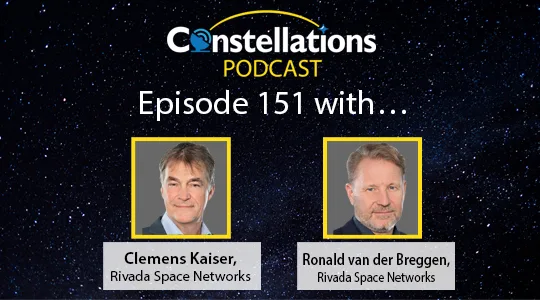
John Gilroy: Welcome to Constellations, the podcast from Kratos. My name is John Gilroy, and I’ll be your moderator. With billions of new devices coming online, satellite and network connectivity will become increasingly more complex and our expectations more demanding. Today we will look at what it will take to enable the new connectivity of the future and to lead us on that journey our guests today are Rivada Space Network’s Chief Program Officer, Clemens Kaiser and Chief Commercial Officer, Ronald van der Breggen. We’ll discuss the growth of optical satellite technology, what it means for satellite data networks, optical inter-satellite links, and how a LEO constellation evolves into a true data network. Okay, Clemens and Ronald, we’re going to jump right in here. In Constellations we’ve had previous guests discuss optical or laser communications, so I’m looking forward to hearing your views on it. But first, please explain a term that I assume will pop up a lot in this conversation, “free space optics,” when applied to satellites. So Clemens, can you maybe unpack that difficult phrase?
Clemens Kaiser: Yes. Thanks John, and thanks for inviting us here to your marvelous podcast. Free space optics means really breaking the barrier, let the optics out of the cage. So free space optics means really without the need of any kind of carrier because compared to optics on the ground than in terrestrial networks, light is in the fiber so to say. So free space optics simply means we don’t nothing else than only a laser beam, which is connecting two points in space to each other.
John Gilroy: There’s a consulting company called Mckinsey, and everyone gets numbers from them all the time. According to them, 60-70% of space company funding is now directed at low earth orbit ventures. So can the potential of LEO be unlocked for data network services? Ronald, what do you think?
Ronald van der B.: Obviously the answer is yes, John, and again, thank you for having us here. Really looking forward to this. 60-70% is quite a lot, so I think we also need to reflect on that number. About five to six years ago I was at the satellite show, which is coming up again next week, and if you said you were involved in LEO people were wishing you good luck in a way that would make you think twice and ask, “what do you mean by that?” When you got the question or somebody was asking, do you think that GEO ultimately will be replaced by LEO? You would say, well of course, it’s just a matter of whether it be 10 years or 20 years or 50 years, and 0% of people would agree with you. Whereas now, I think also 60% to 70% are saying there actually might be something there. So it’s already happening today. What we’re looking to do with our constellation is to go beyond the ways in which we’re currently unlocking that potential, which is more about reaching far and difficult places that have no connectivity or are in distress, as we’ve seen with Ukraine, and to make sure that they get access to basically the rest of the world. So that business objective is to pick up that data and get it down as fast as possible into a gateway, making sure it can travel down the rest of the earth’s cables. Whereas our objective will be to keep the data in our constellations for as long as possible and carry it from the very beginning to the very end. We believe and have seen in our discussions with customers, that this opens up a lot of new business opportunities for data networks and we’re very much focusing on that beyond what’s already happening today. So it’s an absolute and definite yes.
John Gilroy: I’m glad you opened up with a few years ago they’d raised your eye at talking about LEO. But let me tell you something that last question I asked you five years ago, if I would’ve said data network services, that would’ve been a really eye-raising question met with a lot of “what are you talking about?” So things have just changed and we’re in this big tsunami of a change here, it’s hard to keep up what’s going on. That’s why we’re going to go to Clemens and see what he has to say. So Clemens, what impact, if any, will all of this new type of communication have on LEO satellites? From architecture and design to manufacturing and network management? How is all this light going to affect it?
Clemens Kaiser: Yeah, this is really a new era here we are facing. We are entering into a complete new way of how data will be transported in space from any point on earth to any other point on earth. I mean the LEO compared to GEO simply means we are closer to the earth’s surface, this is physics, so a lot of people are always laughing at me , the non-technical people, when I say this is physics now. So the link in the atmosphere from space to ground is RF and the closer you are, so this means 1000 kilometers or lower, there is much less distance than from GEO, which is 36,000 kilometers away. This means the throughput can be much, much higher. So the distance is shorter and you can with the same level of power really push and pull a lot of more data to the ground. So we will always have this RF thing. Now the question is what do we do in between these satellites? The new way of doing this is really creating our mesh on a very abstract level. This is how we do it a Rivada and I tell the people, look, we have an IT network in the sky, nothing else. Forget the satellites. They are routers in the sky and they are managing the traffic. If the customers wants from one point to another point on earth to get a connection or service this is at the end using network protocols, the satellites, and the respective brain on ground managing all this. And here, the optical links, of course, help. This is new and is different to the, I would say first generation constellations we have with OneWeb and Starlink, which has done tremendous work. We learned a lot from them, but based off the fact that they need gateways and cannot interconnect between each other, this optical mesh allows for plenty of new opportunities of services for customers which even don’t know what they can do with such kind of a backbone in the sky.
John Gilroy: 10 years ago, a company like Brocade talked about a data fabric and that’s increasingly being used. But, I think your description of this optical mesh it must get so complicated. Oh, I think now I understand what’s going on. It’s a mesh that’s going to make things more productive and efficient for everyone.
Clemens Kaiser: You see that there have been discussions that people want to add and wonder about edge computing. What is this about a cloud in the sky? So with this mesh, yeah, not maybe with our first generation, but if you add this kind of functionality, you, I would say lift critical infrastructure from ground into space. We see currently what’s happening on ground, I would say in this crisis situation, especially in Europe, how vulnerable our terrestrial infrastructures are. So there is a trend to go into space with something I would say that it is not at all riskless, but at least be an alternative to make things safer. By putting them up into space and connecting them via light.
John Gilroy: Yeah. I want to talk about convergence and I have a question that maybe both you can jump in on. The convergence of satellite and wireless has been a long time coming. So what are the optimal architecture, hardware, and software requirements for a LEO constellation to become one of the, what’s called a true data network? Ronald, do you want to jump in on this and maybe we’ll toss to Clemens?
Ronald van der B.: Sure. But when you talk convergence, I think there’s ultimately, and I think Clemens explained it really well, what we’re trying to do here is basically putting a terrestrial network in space. So it’s not so much about convergence, it’s more about the integration of hardware and software components that will basically make that satellite system if you want, act and operate like a terrestrial network. So that for me is key. So again, it’s not so much about convergence, it’s about mimicking what we do in space or mimicking the terrestrial infrastructure that we have on the ground in space. This is, I think, what drives convergence, integration, or interoperability, whatever you want to call it. And the better we do that, the better we can integrate it with terrestrial systems and the more we can make benefit or we can benefit from the unique traits and characteristics of each system because sometimes solutions are just better put in space than they are a able to perform on the ground. So that’s what we are in the process of doing. And again, speaking to our customers, they see a real need for that because certain things are just better up in space than they are on the ground.
John Gilroy: So Clemens, what word are we going to use here? We’re going to use interoperable, convergence or orchestration? What are we going to use here?
Clemens Kaiser: Yeah, exactly. I know we are talking about the point and I’m coming at it from the space world. The point is if you lift the satellite up into the sky, it’s no longer accessible. So the point is that these satellites, of course, in contrast to ground based infrastructure, we can anytime go there and do the respective maintenance. You cannot do this in space. This means the trend in the space now is about software-defined radio and software-defined networks. This means we have now implemented into our satellite a brain and the possibility to be upgraded. So the challenges to put the right hardware on board and be flexible on the software. To put at a later stage to upgrade software to the customer needs and to the needs of our growing network. I think this is the key. You need something which can live and can also evolve in the sky so that this network can be maintained thoroughly and upgraded according to the needs. At the end, I love the word orchestration. It’s really an orchestration of plenty of things. It’s quite complex to be honest. I love complexity. It’s orchestration of these resources you have in this network in the sky where the customers get the maximum quality of their services in terms of reliability, availability, latency, and god knows what they also have in terms of security, and this all needs to be done in a clever way. This is at the end, really like an orchestra. You have, I don’t know, we have 600 routers in the sky, so this needs to be orchestrated. Indeed.
John Gilroy: Ronald, I got a question for you. I live in the Washington D.C. area. Of course, security is on everyone’s mind. You drive around the beltway, you drive around the Pentagon, security, everyone’s thinking about it. So I would think that an ultra-secured network is the holy grail for global enterprise and government communications. So is our friend here laser? Is laser technology the key to providing ultra-secure connectivity? Is that the magic sauce?
Ronald van der B.: It can be part of it. I think what is key is that it is a truly global network, that is the key. In today’s world, if you want to bring one piece of data from one place to another and you go to a global operator, let’s say we do BT or AT&T, that claim to be global, then the reality is you hand it off to one of their third parties who’s in a metropolitan area and running a metropolitan fiber system and before that there may even be a local telco provider. Then you hop onto the network in question of BT or AT&T, and then you may go across the ocean and then you go through a global crossing network. Then on the other side of the ocean there’s other third parties that may carry your traffic into other metropolitan areas, into other local exchanges. So before you know it, this global network that we thought we were writing is basically consisting of multiple pieces and patches that come together at various patch panels in various locations that can be hit, that can be targeted, where people can put their listening devices into. Not to mention cables can be cut with people putting shovels in the sand and what have you. So to really have an ultra-secure network, the key is to be able to be the one provider that really picks up the traffic from the very beginning and really carries it all the way to the end because now that comes with the capabilities to offer lower latency and offer real security because it’s one single network. You can also be much more firm and strict in your SLAs because you are in control of this very network from the very beginning to the very end, something that any terrestrial operator will never be able to be. And if that comes with the same performance or in our case sometimes better performance, then anything terrestrial, I think that is the key to a true ultra-secure network, and lasers are an important part of that. I think Clemens explained that, but it’s just that. It’s a part of what ultimately is the key and that is the being completely global.
John Gilroy: Yeah. Clemens, true confession here. I’ve been married for 40 years and I remember when we first got married, I turned to Jen, I said, “Well this summer do you want to go to the beach or we go to the mountains?” She said, “I want to go to both,” and I said, “I can’t afford both. You got one or the other.” This was a typical young married couple. We worked things out somehow or other. Well, let’s apply this to your world. Do you see the growth of satellite data networking services, eating into the growth of earth observation? Are there enough financial and technical resources to support the growth of each one, in other words, mountains and beach vacation?
Clemens Kaiser: Yeah, I come originally from earth observation, and this is quite fascinating for me now working in the telecommunication part of the space business. I know how huge the demand is of this is and the work that these monster satellites like Meteors, EPSSG, Copernicus’ satellites, are producing a hell of an amount of raw data as they’re huge instruments and the bottleneck is the RF link. So a lot of data compression, a lot of stuff is going on board to really get over the poles downlink to a ground station of this data once every 45 minutes or even 90 minutes if we have only one station. So with optical links, it’s completely a new world for them. We have already gotten requests from people who want to plan the new way of new earth observation satellites and say, “Hey, the bottleneck for us remains the downlink. We have plenty of data, plenty of pictures we record. How to get it down? Can we interconnect with your network with an optical laser and you take care that these data go down to the respective, I would say ground segment of our customer?” This is exactly what it means. The beauty is now that our mesh can be opened and other elements can be added to this mesh. It can be a GEO stationary satellite. So it’s also other planes so to say can be interconnected not only on telecommunication but also customers like earth observation satellites. Here I see a clear, I would say win-win situation for both. It would be a huge, I would say, step forward for earth observation if there is no more a limit in the data, a satellite can record over an orbit because he can permanently download this data. Otherwise he has simply to wait. He’s limited for an orbit maybe to 20 minutes and then I would say the buffer is full, the data is completed and he first needs to bump down the data. So therefore I do not see here any kind of limitation, eating one or other domains. I see here a constant growth and I think earth observation will even benefit from this new architecture and infrastructure in the sky.
John Gilroy: The Constellations Podcast was launched back in 2017. It was a small step for man, but a giant leap for podcasting. Today, thousands of people from all over the world listen to Constellations and thanks to you, we’ve grown into more than just a podcast. Sign up for the Constellations newsletter to receive articles on current industry issues, podcast summaries and contributed blog posts at constellationspodcast.com.
John Gilroy: Ronald, if we looked at a transcript of this conversation, data networks and data would pop up constantly here, I’m sure. Let’s maybe switch gears a little bit. So in addition to data networks, what other new opportunities are there for new end user services? Will they require a new business model?
Ronald van der B.: No, I don’t think they require a new business model. So speaking of business models, I look at that in the sense of a value chain. I mean you got the operator in this case, a satellite operator or data network operator, you got resellers who have the relationship with the end user who really require certain applications to be built for which components need to be bought, operating services of companies like us need to be bought and all that. They put that together for the end user so that model will continue to exist. As a matter of fact, these resellers on the left, right and center of the model have been bypassed by some of these operators who wanted to go directly to the end user and were effectively competing with their customers so to speak. I mean as a satellite operator, we’ve seen multiple examples of them bypassing resellers going straight to the end user, leaving the resellers high and dry. What are you doing here? That was all based on the fact that the services that they were offering in GEO that’s pretty obvious, we’re pretty similar in that if you buy it from one or the other, it really doesn’t matter that much. The satellite might be like two degrees to left, two degrees to the east or west, but the service themselves are pretty similar. And so therefore to have that direct end user relationship became really important for the satellite operator because the services themselves were not unique.
Ronald van der B.: Us having the unique services that we have that we’ve talked about, we don’t have that need to really get in touch with the end user other than inviting them to shows, talking to them at shows and all that. But for the solutions to be actually offered, we will continue to go through these resellers and be very confident that they’re going to be able to close the business with them and they in turn don’t need to be afraid that we’re going to go around them because of the uniqueness of our services. So in terms of the business model, nothing is going to change other than we’re going to basically reinstall it into its purest form and not go around things anymore, because of these new applications that we can ultimately go after. One great example that we’re working with on various resellers is for instance, enterprise networking with SD-WAN. That’s often talked about nowadays as being part of the future of networking, it will allow any enterprise to basically make a decision as to what network will we use for certain traffic to be routed. So if you have lots of employees doing lots of let’s say “internet stuff” in the category of not really requiring security, then clearly you can use cheap infrastructure for that i.e. the internet itself, broadband, modems and what have you. You pay a hundred bucks a month and then you have so many megabits. Or you have data that you know need to keep ultra-secure and god forbid it goes to some kind of public place because if the competition or anybody else would be able to get their hands on it, that would be a bad thing, and for that you want it to go on a very different network and that could be the Rivada network that will be super secure like we talked about earlier.
Ronald van der B.: So SD-WAN facilitating enterprises to use one network, one type of network, another type of network actually brings a lot of business that go well beyond any of the predictions that we have in the satellite industry about what the future market will look like because that’s basically only talking about internet access and last mile type of applications. This is a whole world that we’re currently not tapping into as an industry, and that’s a multi-billion, probably even more than that, industry of which we are more than able to take one or two or percent of that ultra-secure traffic and stick it onto our network. That’s completely outside of any prediction that anybody is making for the satellite industry in terms of our market. So we’re very excited about being able to work with our resellers and giving them an opportunity to tap into a whole new business and new applications. These are exciting discussions that we have with them because this is exactly what people are looking for, something new that’s a real solution for real companies that have real problems and have real money to solve those problems and that’s a much nicer discussion to have than can you please connect this last site for me? Oh, and by the way, it needs to be less than a hundred bucks per month because otherwise I go to somebody else. So very excited about the opportunities that we have there, but it’s exactly the same business model, but we’re sticking it to more rigorously than ever before, I guess, because of the uniqueness of the service that we have.
John Gilroy: I’m thinking all the marketing people over the world are going crazy now because of the total adjustable market, the TAM, how do you define it? I mean Ronald, may define it one way, Clemens may define it another. It’s very difficult and I think that’s a challenge people have in all kinds of innovative technologies that are out there. No one really knows what the potential is. Clemens, we’re going to talk about the ESA, the European Space Agency.
John Gilroy: From what I’ve read, they expect that optical transmission could take on the burden of handling increasingly high bandwidth traffic, replacing RF as a primary means of sending and receiving data from satellites. So in this scenario, what would be the role of, is it left out? What happens to poor old RF?
Clemens Kaiser: Yeah, poor RF. No, again, I’m sorry to say to my dear friends of ESA, there’s again physics. I mean, if I look out of the window, we have a quite cloudy day to day. Is that snowfall even? Do you see sunlight? You don’t see the sun. So the same problem with optics. If you have an optical link spearing down, so to say to the earth and you have massive clouds, nothing arrives to the surface. So RF goes through the clouds and this is a big advantage. We see it in applications like radar satellites, but we see it also on the communications side. So unfortunately, my dear friends of either, folks will simply have to respect physics and therefore, there will always be room for, I would say the RF. Think about the famous hotspots we have also, I would say headaches, for example, Singapore where we have permanent rain. Yeah, permanent high density. Also here, how to go with optics for this kind of atmosphere. Therefore, you are, so to say in terms of optical links maybe, then you go to places where you have quite nice climate, dry weather and so on, which is for example, in southern Greenland as we learned recently or in other places on the earth. So this means you are a bit limited to certain locations and have to respect the weather and it’s the same way in both direction. By the way, from ground to space, it’s even more severe because you have simply the atmosphere already at the, I would say exit of your laser and it’s over scattering the laser beam. So here is a lot of work still to be done from space to ground. I see the high possibility, especially respect to earth observation as we said before, ground to space with optics, there is still some homework to be done. Yeah, very powerful lasers needed and there are people working on that. Therefore, RF remains and I’m pretty sure that I would say in a complementary way, both technologies will stay alive and find their way thanks to physics.
John Gilroy: Yeah. Well you know Clemens, if anything comes out of this discussion today, I think we have a new T-shirt. You got to respect physics. That’s the T-shirt I can wear.
John Gilroy: You can’t run away from it. You got to respect physics. That’s our motto here. Ronald, from mottoes to something serious here. So a constellation like the one Rivada is putting together will incorporate optical, intra and inter-satellite links. So could you give us maybe a brief definition of what those are and what that really means for our customers?
Ronald van der B.: So like I said, they are interconnecting the satellites forming an optical backbone in space. They’re a means to get the data from one satellite to another in such a way that we can indeed close the link in space between any two points on earth. So that for me is critical. Particularly I would say as much as I really like it being optical because it comes with a lot of capacity, had it been RF with the same type of capacity, obviously that will need a lot more power, but that would not be the end of the world because it’s not the optical link that defines the system that we have, it is what we run on top of it. So like I said, we’re running a network in space, so we have a proper network protocol to run on top of these optical inter-satellite links. So where you can connect any two computers with the USB cable or you can connect them to a local area network. They’re both connected, but the way they will operate with each other and capabilities that you have towards one another are very different using the one system over the other, and that’s defined by the network protocol that you run over it. So that I think is key.
Ronald van der B.: The optical link is important because it provides the infrastructure and it basically makes the architecture, but it’s a network protocol that we’re going to be able to run over it that really determines how we’re going to be different and unique relative to all the other systems that may or may not be using inter- satellite links as some of them are already do. But typically that’s then being put in place to again get the traffic as quickly as they can to a gateway. Sometimes you want to use an inter-satellite link to basically increase the distance that you can go from the point where you pick up the traffic to the gateway where you want to basically bump the traffic into. So optical satellite links really important, but not the key definer of why our system is different relative to others also using optical satellite links. That make sense?
John Gilroy: Yep. Yeah. Yeah. So Clemens, we’re going to talk about these optical inter- satellite links. It looks like they’ll require one moving satellite to point a laser beam at another moving satellite. Now, what could possibly go wrong? All the T- shirts in the world are not going to solve that problem. Maybe all the mathematicians in the world can’t solve that problem. So do you use some kind of alchemy or how do you make all this happen?
Clemens Kaiser: Yeah, yeah, it’s absolutely clear. I do just do some lectures here in the University of Applied Sciences in Munich here in Germany and it’s orbital mechanics. If you speak about the velocities in space, the people fall from the chair and say bloody hell, this is quite fast. This is true, otherwise you would fall down to earth. So how do you interconnect now between two satellites with that level of speed? Well, the good news is that our constellations are all moving in the same direction and neighboring satellites, especially on the same plane are even moving at the same velocity. This means relatively to which other satellites have not such a high, I would say delta speed. We have only the challenge that over the pole, so to say, the planes are crossing and then I would say you have to swap to the laser link.
Clemens Kaiser: We have one famous seam, we call it seam, where you have one plane where the, I would say satellites are moving in counter direction. This is the really technical challenge where the laser link, and we can close this, has a very high relative velocity. Meanwhile, the technology is here to close it and if once a link is closed, it is stable fantastically. So the providers have really worked on technologies that if they once found it though the two hats found themselves, give them over distances over 7,000 kilometers they stay close even with micro vibration, but no knows what little tumbling colors are doing. The question is how to find themselves. So the strategy to find the other, I would say the counterpart, is a bit tricky, but you know where they are. We know the exact position to thanks to GPS and navigations, but there’s a kind of strategy in spiraling the links and then they meet and then they close and then it’s a closed loop control system which keeps the thing alive. So a lot of things has done thanks to, and I must say this, I’m proud to be a German because we have really two companies in Germany spearheading here this technology. Others are coming in the US, in Japan, it’s all here. But I see here a lot of things has done compared to really years before and we are there now to take really mature technology on board. It’s really off the shelf what we can do. And this is a big relief for us that we not have any technology development that really can take it from the shelf and put it on our satellite and it will work. Yeah.
John Gilroy: Clemens and Ronald, I got to jump all for you. I got a question you can jump in, either one of you can take it. We’ve discussed the impact of optical communications we’ll have on LEO constellations, but what will be impact on ground stations? And these are undergoing some significant transformation themselves as they migrate to a more virtualized environment. So who wants to grab that one?
Ronald van der B.: Well, so ground stations indeed are in the midst of all this and I think they have a fantastic opportunity already today with all the bent-pipe LEO constellations that we’re seeing requiring more and more ground stations, and so that’s I think a fantastic opportunity that they’re currently benefiting from. But typically a ground station, teleport, gateway, whatever you want to call it’s a building and they have a bunch of acres of lands in front of the building and there’s a bunch of antennas there, and that’s the business model. And with our type of infrastructure, we see them as great resellers because soon those couple of acres of land in front of their building, they will be able to go well beyond that because there’s multiple businesses and government agencies and all that in the typical territory of 200, 300 mile radius around these teleports where if people want to make use of the system that we’re going to be putting in place for those secure traffic that we talked about earlier and low latency stuff, then they will need antennas in more places than just on the couple of acres in front of the teleport. And so I see a great opportunity for them to go out, manage antennas in a larger area and be a great partner for us and able to tap into a whole new revenue stream with enterprises and agencies that they had not access to before, simply as a function of putting a terrestrial network in space. So we have great expectations for the teleport market both today for the existing constellations and even more so with what we’re going to be putting in place, allowing them to go beyond where they are today, both in terms of business opportunity as well as the geographies so to speak.
John Gilroy: Crystal ball time. We’re going to first go to Clemens, then toss to Ron. So Clemens, five years from now, what will be the driving force for data network services in regards to optical systems? What do you thinks going to happen in five years?
Clemens Kaiser: Yeah, we are discussing currently with the optical inter-satellite link providers. We need the future of really throughput of this system. So we in our satellites are using now 10 gigabit per second throughput for optical links. The future, the next step is coming soon, hundred gigabit per second. Hundred gigabit per second throughput and we are an optical laser link. I mean, okay, we have always a limitation with the RF. We spoke about this, there are physical limits. But in between the satellite or in space, you can really connect with more or less I would say open-ended throughputs. So this capability of hundred gig optics will support massively to increase infrastructure in space because if you have unlimited, I would say, resources to connect, yeah, then you can also add, I would say storage, data processing, edge computing in the sky. This will come because, so to say that the big cable in the sky, the optical link is more or less open to even higher throughput. And I think this will drive a lot. So therefore this evolution in the optical link will again allow complete new application of data handling, storage processing in the sky. And I think in five years from now, I see maybe it’s already standard, but the products are under development. We saw it already, and it may quite likely be that we are in a complete new world of higher data also in space.
John Gilroy: Ronald, we have a record here. I think we have a number two T-shirt, big cable in the sky. Maybe that’s the one. Your students might like that. So Ronald, in five years there’ll be a big cable in the sky. So what do you see in five years?
Ronald van der B.: Well, so I think there’s been a lot of focus on optical. Let’s also not forget what’s going on in the ground, guys. I mean the antenna technology is super important to us and the phase array technology is also going to be a great enabler of these space-based data networks. So my hopes and beliefs are that five years from now, ideally we’d like to have big and small phase array antenna systems that you can basically throw on the rooftop, power up, wait for five LEDs to turn green, put in an ethernet cable, and boom, you’re up and running. I think that’s the future. That’s the kind of user-friendliness that we need to go to. And so if we get that all in place in combination with the big pipes in the sky, then I think we’re going to be able to solve a lot of problems for multiple companies and government agencies in terms of cybercrime, latency, running huge ERP applications globally. All that will be made possible by terrestrial networks in space that we’re putting together. So I think we’re looking at a bright future here for this type of technology, both in space as well as on the ground.
John Gilroy: Clemens and Ronald, you certainly have opened up the world of optical communications to our audience. I’d like to thank our guests, Rivada Space Network’s Chief Program Officer Clemens Kaiser, and Chief commercial officer Ronald van der Breggen. Thank you gentlemen.
Ronald van der B.: This was great, John. Thank you.