Transcript:
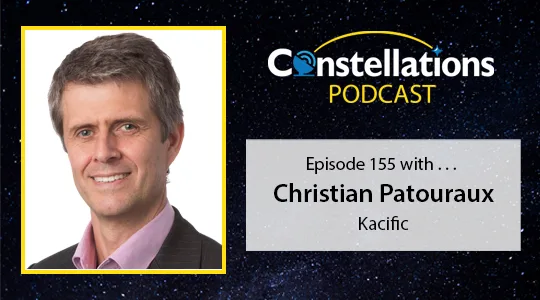
John Gilroy: Welcome to Constellations, the podcast from Kratos. My name is John Gilroy, and I will be your moderator. Our guest today is Christian Patouraux, Founder, CEO, and Director of Kacific Broadband Satellite Group. 56 Spot Beams, 25 countries and 600 million people with even more performance capacity on the horizon. These are the numbers supported by the NextGen satellite operator in their mission to close the digital divide by providing universal fast, high quality, low-cost broadband access across the Asia-Pacific or APAC region. Until 2020, there were millions of people in the region with little or no access to the internet. During today’s podcast, we’ll discuss the technology it takes to connect the unconnected across the unique landscape and communities within APAC. To walk us through planning and execution of this new network, we have invited Christian Patouraux, Founder, CEO, and Director of Kacific Broadband Satellite Group. Okay, Christian, we’re going to jump right in here. Let’s start at the beginning. In APAC, before Kacific and satellite internet, can you talk us through what connectivity looked like in the rural and suburban areas?
Christian Patouraux: Well, hi, John. Thanks for having me. Well, at the beginning, and I guess it’s still the case very much today in many parts of the Pacific and Asia, you had a low level of internet access, as you can imagine, enterprise in rural and remote areas where we’re not able to utilize the internet and online tools to improve their productivity. This was mainly due to the challenging terrain, large distances between activity centers, between villages, between communities, basically isolating these points of demand for internet. In addition to that, you have vulnerable and unreliable connections, and that is especially making these communities vulnerable themselves, living in precarious environments, generally exposed to disasters and the elements. So, we’re trying to fix that. We’re trying to improve this. It is quite a task, but yeah, we are very pleased that we’ve actually been able to address some of these issues in some places, bring a much better environment of connectivity, and fill the digital divide in some locations, but we still have to roll up our sleeves for many, many other locations.
John Gilroy: Well, Chris, let’s go back to the future. Let’s go back 10 years, back in 2013. I think that’s when you decided that you were going to take the challenge of providing critical connectivity in the region. You began the journey of becoming a new satellite operator. Could you share with us the story behind that?
Christian Patouraux: Sure. Well, in 2013 I had already about 20 years of experience in the satellite industry behind me and in particular, I had been a consultant for many years for broadcasters trying to transform their business to look at the broadband sector and see how they could address broadband. In addition to that, I had been, unfortunately, caught in the 2004 Asian tsunami and as part of that, as part of the journey, my personal journey, I put together with a couple of friends, a humanitarian action to rebuild some of the fishermen’s livelihoods. I had already installed one of those early satellite broadband connections in the village where I had set up this activity. I realized that there was a massive demand, actually. We were helping fishermen rebuild boats and things like that, but I realized that there was more interest for my internet in my office from all the villages around rather than for the boats. So that actually started the journey to think, well, there is a massive demand, there is a massive need, and those villages were not that far from the main city.
Christian Patouraux: Then in 2013, fast forwarding many years from that event, I was in between two consulting jobs here in Singapore and I was having a bicycle ride on the East Coast part of Singapore with a friend, and that friend had a small private equity fund here in Singapore. We were chit-chatting and he was asking me, “Hey, what’s your next move in your career?” And I was like, “I’m a bit tired of being a consultant because I’m basically always saying the same thing. I’m telling people, you need to launch a specific satellite to address the needs of rural Asia to go after the enterprise sector because there’s a lot of wealth in rural areas of the developing world.” The developing world draws its wealth from the primary industries, from commodities that they are creating in the rural areas. Indonesia, Philippines, places like that, they don’t draw their wealth from cities, it’s all commodities produced on the countryside. You need to connect that, and you need to make it more efficient to increase their productivity, but it’s difficult to connect them. So, we have this bicycle ride and I explain all this, and he says, “Well do it yourself.” Yeah, well, I’m here a consultant on a bicycle, what do I know? Even though I had a lot of contacts, I knew how the industry worked, so that’s how the journey started. He’s like, “Well, I’ll incubate your business in my office if you want. I’ll give you a couple of people in the government.” He gave me Cyril Annarella, he used to work for him and he is now our chief operating officer, and we snowballed the project from there from this bicycle ride and they gave me the guts and the support to start, and it was a wonderful journey. With the knowledge and the contacts I had in the industry, we pushed through rocky roads, but we managed to get to where we are today.
John Gilroy: This almost sounds like a movie or something. From a tsunami to a consultant on a bicycle. Boy, this is quite a storm we got here, isn’t it? So, you’re riding your bicycle, you look up in the sky and you go, “Yeah, satellite network is the answer here.” So why is the satellite network ideal for serving the rural and suburban areas of APAC?
Christian Patouraux: Well in a satellite you have a built-in distribution network that you absolutely need to penetrate the terrain, all the obstacles, the mountains, the expanse of water between islands, and you can’t do this with fiber, you can’t do this with microwave because the terrain is too difficult and the demand per activity center is not enough. It’s not large enough. You’d have an enterprise that is, I don’t know, 50 miles from the nearest one, and if you have to pull a fiber, it’s going to cost millions to pull that fiber, to dig it, and then to maintain it. The people putting down that fiber will never get their money back. What you have with satellite, especially with broadband satellite, is that you can pinpoint a beam at these activity centers. You just put a small beam of connectivity, high power connectivity so that you can have an exchange, a two-way communication, with these activity centers that are in need of that connectivity. Then you pinpoint those various beams have various pockets of demands and that’s how the satellite works and that’s how it competes with all the terrestrial systems. It’s a compliment, I’m not saying that it is the answer for everything. Of course, we are not going to connect cities and large capital cities, but we are also providing backup, important backup. Internet is also not very resilient, even in provincial towns or even in the middle of capital cities, and we have about 10 to 15% of our customers that are using our services for backup. This is essentially the landscape for satellite, the last little attribute that satellite would bring is the speed of deployment. You have nothing, you bring something there, you bring a terminal, you install it in half an hour, even in some cases you push a button and this thing goes alone, motorized and points at the satellite and there you go, boom, you have satellite connectivity within two minutes. That’s actually of course the answer for disaster response and disaster recovery. Since we live here in Asia in what is called the Ring of Fire, there’s volcanic activity everywhere, earthquakes, landslides, and tsunamis of course, as I mentioned earlier, as well as now because of global warming, we have typhoons and tropical cyclones. So, people are in extremely vulnerable communities, entire cities and regions are vulnerable to these disasters and satellite is the excellent response to that.
John Gilroy: I went to your website, and I saw the map of all the area you cover, lots and lots of islands. A poet once wrote that no man is an island and no company is an island either, I don’t think. What were some of the strategic relationships that you had that were key in moving your project forward successfully?
Christian Patouraux: Well, when I started Kacific, I already had a fairly long career in the industry, so I would say that I started with my existing relationships with people from the industry. When I started, the very first little seed money that we got into Kacific was something like half a million dollar, but you absolutely need that. It’s extremely hard to get seed money and someone who is actually going to put their money behind you. They would actually invest in me and believe that we could achieve what we had planned to achieve. So that starts with those relationships. So I called a few people I knew from the industry, sometimes they would call their friends and we managed to aggregate this kind of seed money from my contacts, my relationships in the industry from all kinds of walks of life or people from the industry, mainly from the industry. Some of them were like, “Yep, I like what you do, I know you. Here is the money.” Sometimes it was $10,000, $20,000 and they put their money there and sometimes it was more, and sometimes they were like, “Well, I’d like to discuss a bit more with you,” and they took a plane, they came to see me, and we spent a few days together. So that’s how it started.
Christian Patouraux: Then after that I had to build. I had to build the relationships. I had to build relationships with other operators because I knew I needed to have frequency rights that other operators would have. I would have relationships, of course, that I had a long time ago with some satellite manufacturers from the days when I had started as an engineer in the industry. So, I needed to reactivate those relationships with the various manufacturers and that took some time. Then of course relationships with customers. We were nowhere. So, what I did the very first time when I got the first little seed money, I went to a Pacific Island Association of Telecom operators. I went there with my slides and I said, “This is what I want to do.” Of course, people were smirking. They were like, “Why is this guy coming?” Plus, I didn’t really know how you dress in the Pacific. I was there with a tie and a suit, and everybody had a flower shirt on. So, I learned the hard way since then, but that’s how I did it and in the end it was through grit that these relationships happened and they saw that me and people surrounding me were holding the distance. Then of course at the end we had the relationships with our hub provider, the network provider, and of course with Kratos, which started sporadically at different conferences. I met the different executives from Kratos and I must admit I didn’t know them from the past life, and of course we had a wonderful relationship going forward.
John Gilroy: Let’s take a moment here and focus on the core components of this new network you’re putting together. Can you tell us first about the satellite Kacific One you launched in 2020 and some of the key requirements you needed to support your business case?
Christian Patouraux: Yeah, so I guess I’ve already touched on that topic because the frequency reuse, the pinpointing of your beams at pockets of demand. That’s the beauty of a high throughput satellite. You have a high degree of frequency reuse and essentially, it’s like a cellular network from space. The key requirement to actually choose that kind of technology was the throughput. You need to have a very large amount of bandwidth pushed through that satellite, repeated by that satellite, in order to reach price points that will be palatable to the market you’re going after. Our plan was to go after not residential end users, enterprise end users. So end users that would have a little bit higher willingness to pay that’s just residential, but still willingness to pay is limited. So, you have a four people office in a plantation, they may have, I don’t know, a $200 per month kind of budget for connectivity. If it goes beyond that, they won’t take it and they’ll just use SMS or whatever. So that was our business plan, the basics of our business plan, and we needed to have a very high level of frequency reuse. We needed to believe in our markets in order to set the price points. That was going to equate to a certain level of utilization rate of the satellite, because you need volume and price in order to fill your business plan. That’s why we went for that technology, and we needed consistency because we wanted to serve every area of a large country, say like Indonesia, with the same quality of service. That’s really what we were looking for. We were looking for a consistency of service from one end of the coverage to the other end. In the end we picked, after a long selection process, we picked Boeing for our first satellite and in the end, they delivered a wonderful machine through a very exciting procurement program that we run with them.
John Gilroy: The Constellations Podcast was launched back in 2017. It was a small step for man, but a giant leap for podcasting. Today, thousands of people from all over the world listen to Constellations and thanks to you, we’ve grown into more than just a podcast. Sign up for the Constellations newsletter to receive articles on current industry issues, podcast summaries and contributed blog posts at constellationspodcast.com.
John Gilroy: Great. I think most of the people listening to this podcast know that when there’s a satellite, there also must be complimentary ground infrastructure. It makes sense, Ian Young and everything. What was the process of deciding what you needed on the ground?
Christian Patouraux: Well, there were two key requirements, I would say. The first one was again that we needed to match the throughputs, the power of the satellite, with an equivalent ground system that was going to be able to absorb the kind of bandwidth that was coming from the satellite with the same level of availability that the satellite would provide, the same level of quality. We went to Boeing, it’s a world-class manufacturer, and we needed to make sure that the ground system was not going to give us problems if we picked one. So that was one. It was the technology that would actually match the technology of the satellite on the other end. We tried to select a certain technology that could push the envelope a little bit further in order to try to scrape the bottom whatever additional efficiency we could get, that was important for us because we wanted to push the prices down and have a higher volume. The other part was really to de-risk the project as much as possible. We took enough risk, we took enough risk through the whole journey, we wanted to work with world-class operators, world-class manufacturers in order to give us the level of quality and resiliency that we needed and as well as the reputation that was needed for the project to be seen as a reputable established project. When we embarked on the selection process for the ground partner, it was a very long journey. The ground partners are of course today, ST Engineering iDirect and Kratos, those are our two main partners for antennas and network systems, but also all the teleport locations that we had to choose. That was a very difficult journey because when you choose a teleport location, you need to make sure that it is going to be a home for the next 15 years for these very expensive and delicate machines that you’re buying around the world and you need to put them in an environment where they’re going to be well connected, well looked after, where they’re going to be able to express their resiliency at their best, and where the weather is going to help them as well. You can’t pick a rainy location.
John Gilroy: Yeah. Let’s focus on some of those machines. What were some of the key requirements you sought out for your antenna system?
Christian Patouraux: The antenna system, one of the key requirements was that this system was going to be stable. We wanted to have the confidence that whoever we worked with had the experience and demonstrated a track record that their system was actually something that could hold the distance and be efficient over a long period of time. When we started the selection process, we immediately weeded out a number of players that just couldn’t deliver that track record. The other thing that was very important was the accuracy of the system. Our Ka-band is a very high frequency system, it’s a very delicate system. We needed to make sure that it was going to be very accurate and, again, deliver the performance that we wanted. Now finally, there was a very interesting requirement because, after all, despite looking for somewhat dry areas for these teleports, we were still in rainy areas in Southeast Asia. Actually, a lot of people laughed at me when I tried to set up the first Ka-band system in Southeast Asia, which is notoriously rainy. What we needed to do was to have two teleports that would actually do what is called site diversity and that you could switch at a particular location when rain would hit one of the two locations. We operate in Indonesia and Philippines today with teleports that are about 60, 70 miles apart, so the requirement was how can we connect these two locations by pushing the traffic through fiber between these locations and essentially switch between these locations seamlessly when rain would hit one of the two places. That’s what actually Kratos was able to deliver with a novel system that they gave us in the early days, which was called spectral net. That is one of the reasons why we chose to go with Kratos.
John Gilroy: Well Christian, I’m listening here, it sounds like you’re a pioneer in many of these areas, and what I know is that anytime an organization decides to build a network to connect a region in a way that hasn’t been done before, the process for integration and testing can be challenging. Any challenges you want to bring up maybe in that process? We talked about the rain, so that was probably the obvious one, huh?
Christian Patouraux: Yeah, challenges, there were lots of challenges of course. One of the challenges is to adapt to the local culture because you are going to partner for the next 15 years. It’s actually very daunting. You go into a country that you don’t know, a developing country at that, where infrastructure is not necessarily at its best, where you have all kinds of people that come and tell you that they can’t help you, and what you need is to roll out a project in a matter of months in a location where essentially you have no real relationship and you haven’t really thought about it. We hadn’t really started very early. We were working on the satellite, on our customers, et cetera, and all of a sudden it dawned us that, hey, we need a partner there. So, we started an RFP to find partners and we got all kinds of offers. Some were just through the roof, some were more reasonable but they didn’t have track records. I must say that our manufacturing partners, our equipment partners, such as Kratos, other partners actually helped us in that journey as well in giving us the confidence that yes, there’s going to be some shortcomings with these partners that we have on the ground, but our partners may fill that gap because they don’t necessarily have this experience.
John Gilroy: Earlier in the interview you mentioned cost, and I think we all know that it’s one thing to provide internet service, it’s another to do it affordably for the homes, schools, and governments in your coverage area. What are some of the ingredients that helped to keep this cost low for end users?
Christian Patouraux: I guess I already touched on the different points there, but one is that you have to believe in your market. I have been a consultant for so many years that I was blindly believing in the models that I had studied for years on for different consulting contracts, for my own interest, and I really believed that the demand was there. I also had some primary research where I actually talked to people and the result of this analysis resonated with what I discussed with these people. Yes, there was a demand, and so I believed in that demand. I believed I could fill the satellite, and once you believe in your demand and the market you go after, then you can set a price that is much lower because you say, “Yes, maybe at first I’m not going to feel it at that level, but eventually I’m going to feel it at the level I want.” So, in order to feel it at that level, of course I needed to have a much lower price. It’s volume times price. If you believe your volume is going to be higher, you believe you can go much lower on price. But in order to achieve the volume, as I mentioned earlier as well, you need to be able to produce that volume on the satellite with your ground system. Over the years as we developed the satellite, we designed it, we had plenty of time as we were financing the satellite to design it until the moment we actually ordered it and we started really believing that yes, we can deliver all that throughput, all that volume, and so we can achieve that price. Now finally, what we wanted to do was actually streamline our entire business around that price so that we were not going to add a middleman. It was very important. We wanted to go as far down the value chain as possible. I know it is an issue in the industry, I’ve been in this industry for many years. The problem with many operators is that they don’t want to compete with their own customers. You need to find a business model where you can have customers that are a bit higher up the value chain, as well as another business model where you will allow yourself to go down the value chain on the side of your customers, of your more established customers, without the feeling that you’re competing with them. We managed to do this in order to push the volume.
John Gilroy: Christian, lots of hard work is what I’m listening to, lots and lots of hard work. Let’s talk about the benefits, the fun part, the good part. What are some of the ways that reliable, affordable connectivity has benefited these communities within the APAC region?
Christian Patouraux: Well, I imagine there would be around three pillars, and we’ve had reviews of social impact from external consultants who have reviewed exactly what we do and some of our investors and financiers are very sensitive to that, and there’s really three pillars. The first pillar is economic development, welfare for populations, and that comes with a low price that Kacific is providing the bandwidth ads for and we’re addressing the price points of affordable bandwidth as defined by UNESCO or ITU. The second pillar would be education. We are connecting today I think about 3000 education institutions, be it elementary schools, primary schools, all the way up to tertiary education in rural areas or in the outskirts of cities. That fosters, of course, a better societal fiber with people being better educated in the regional areas where they’re living in rural areas, but also that fosters gender equality because you are educating boys and girls the same way. Now the final pillar, and I would say this is the most important one, the most obvious, is healthcare. We are connecting about 1,000 healthcare institutions, dispensaries, clinics, all the way to larger hospitals, and we are directly saving lives. I’m quite proud of that. The estimation is that today we must have saved in the order of several thousands of lives just by sometimes calling for medevac for critical cases, sometimes for a nurse to be able to call a doctor in the city simply via WhatsApp or Facebook or Messenger or something like that and say, “Hey, I have a critical case here. I have a difficult birth. I have a young child who hurt himself with a machete cutting some bamboos and you need to tell me how to stabilize it.” We’ve had direct reports of that happening and saving the lives of these people.
John Gilroy: Great. Earlier in the interview you mentioned the digital divide, we kind of did that in the introduction here. If you could, Christian, could you provide some pieces of advice here for new startups? Startups that are trying to share your mission of closing the digital divide in other parts of the world. What advice would you give these new startups?
Christian Patouraux: Well, I guess if you try to close the digital divide, you have to put that first. That has to be in the DNA of your business. You can’t look at that and then just go do defense or multinational corporation network and then say, “Okay, I’m going to do that as a CSR.” No, you need to build your entire business and streamline your entire business around that particular issue, that dilemma. You need to have the right technology, you need to have the business plan, the business model. You need to hire the right people and structure your entire staff and org chart around that so that you are going to, like I said, use a technology that is going to be low cost enough so that it’s going to be affordable. You need to cut the middleman, and the entire business has to be streamlined around that. Then the other thing is it’s extremely difficult to actually make money through addressing the digital divide, so you will need a lot of grit. You’ll need a lot of tweaking of your business plan, a lot of back and forth, a lot of heartaches and headaches, and you have to be prepared for that. It’s actually probably one of the most difficult verticals to go after. There’s a lot more juicy areas, maybe more attractive, but also more competitive like connecting aircraft or shipping routes, et cetera with satellites, but eventually it pays off because the grit gives you the competitive moat around your business. Once you’ve pushed through that and you have all the requirements, nobody competes with you. Finally, maybe one word is that you have to work with the locals. You can’t do it yourself. You’ll work with the culture of those communities, and something to be prepared for is that as you provide internet for these communities or for these activity centers, you’re going to disturb the status quo. There is status quo in those villages, in those rural areas, and there are people benefiting from that status quo, so you have to be prepared to work with that and work it out without it exploding in your face.
John Gilroy: Now, Christian, if you look at the world with satellite where we’re in right now, it’s all full of change, all kinds of changes, and this has been the last three years here. In the three operational years that you’ve successfully accomplished this, how has the market demand changed in APAC and what do you think is driving this demand?
Christian Patouraux: Well, I think it’s changed because the demand is accelerating. In the last three years, you picked the right years, something has happened by the way in the world, that’s called Covid, and the world deeply changed. A lot of executives and leaders in various governments have realized that connectivity is essential to run their country. You can’t leave the rural areas and remote areas alone because in the end you won’t know what happens there. You don’t know if you have a center of infection in a remote place, you don’t know if you are really looking after your population, so this is a realization that has come up with a lot of governments and I think there are many programs that are now led by governments as well as communities, associations, intergovernmental organizations that are really pushing for that where the focus is really on connectivity because connectivity cuts across so many issues of the world, from healthcare all the way to disasters.
John Gilroy: So, Christian, we’ve had quite an interview here today. We’ve gone from tsunamis to consultants on bicycles to the Ring of Fire. I just want to thank you for sharing your success with our listeners.
Christian Patouraux: Okay, thank you, John. Thank you.
John Gilroy: I’d like to thank our guest, Christian Patouraux, Founder, CEO, and Director of Kacific Broadband Satellite.