Transcript:
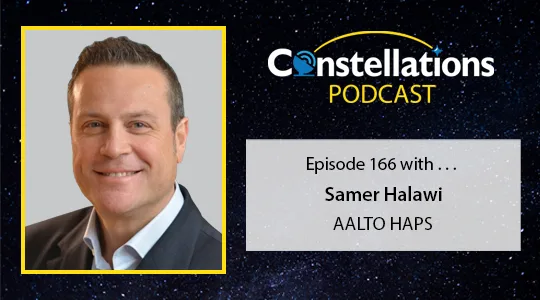
John Gilroy: Welcome to Constellations, the podcast from Kratos. My name is John Gilroy and I’ll be your moderator. Our guest today is Samer Halawi, the CEO of a company called AALTO HAPS, pretty easy to spell. The idea of High Altitude Platform Stations, HAPS is not new. It’s been around since 1945, but over the years the technology has been evolving and maturing to be able to effectively support the needs of the market. Recently there’s been a growing and rekindled interest in the technology. This is in large part because of a growing number of new players and approaches in the HAPS market. Moving beyond technology demonstrations to viable commercial solutions. Here to discuss their breakthrough HAPS technology and the opportunities and challenges of bringing this innovative solution to market is Samer Halawi, the CEO of AALTO HAPS. Samer is a seasoned telecom executive with the successful track record of building and transforming companies globally. He has held many senior roles from the CEO of Thuraya to the CCO of both Intelsat and OneWeb. Wow, great background for this discussion, Samer. We’re going to jump right in here. So Samer, what was the driving vision behind developing your High Altitude Platform Station or HAPS?
Samer Halawi: Well, John, like you said, the idea is not new, but what’s new is that battery technology has evolved so well over the last few years and probably in large part, thanks to the auto industry for pushing in that direction. But with improved battery technology, now we can have platforms that we can fly in the sky, in the stratosphere in particular over 60,000 feet and keep them there not for a day or two or for hours, but for months at a time. And with that, we can put different capabilities on those aircraft and serve different use cases. Now what’s so interesting about HAPS is the altitude at which it flies at –at around 60 to 80,000 feet because of the altitude is not as high as what satellites fly at. The ability of communicating directly to a normal end user device becomes real. So your iPhone or Android phone can communicate directly with the HAPS and it can turn the HAPS into a cell tower in the sky. This is a breakthrough. This allows a capability, a technological capability that is fully aligned with the economics of the markets that it’s trying to serve.
John Gilroy: Yeah, direct to device is really popular topic today in all kinds of areas. So what makes your HAPS technology different from the others in the market?
Samer Halawi: The HAPS technology is what we’re trying to build is new. No one has successfully or no one has yet built a market with HAPS yet. With HAPS, there’s different types of HAPS. There’s aircraft and there’s balloons. So you probably have heard recently about some stories with balloons. The balloons is one possibility with HAPS where you can put a payload, but the problem with balloons is you can’t control, as you’ve heard in the media, where they actually go. What we’re trying to do is build an aircraft that is capable of loitering in any particular position, but it’s also capable of following a certain defined path, a very fixed path and going wherever we want it to go. We have built an aircraft, an Airbus that is the result of over 22 years of development. So this is not new. This has been under development for a long time and we have built an aircraft that can stay in the stratosphere overnight. Why is that important? Because the way the HAPS work, or the aircraft in particular work, is they use the power of the sun during the day to power the aircraft and to also power the payload on the aircraft and to fill the batteries, fill up the batteries during the night, the batteries are being used. And what happens because you don’t have the sun, obviously as you are using up the batteries, you’re dropping in altitude. What’s very important in the HAPS model is to stay over 60,000 feet because below 60,000 feet is where you have regulated airspace. So the right technology is the one that can stay over 60,000 feet at dawn, but do that day in and day out for many days in a row. And today we at Airbus or AALTO, because we are 100% on the subsidiary of Airbus, currently, we at AALTO have the only aircraft that has managed to stay overnight in the stratosphere. And not only that, we have done that for 64 days straight last year. So the other programs that are trying to do this are nowhere close to our level of maturity.
John Gilroy: There is a phrase that is associated with your technology, it sounds like from a science fiction movie or Star Wars or something, and I think it’s described as a terrestrial tower in the sky. So can you explain what that means?
Samer Halawi: Yes. I live in McLean, Virginia and I probably look around my house and I’ll find a cell tower somewhere that is providing me the service for the communication service that I’m using to talk to you right now. And that tower probably serves a radius of what, 20 kilometers? Not more than that. What happens is the big carriers, the big MNOs will deploy those terrestrial towers in areas where there’s a certain density of population where there’s enough people to justify the cost of installing those towers. As you start going to more rural places, I was in Yellowstone this past summer, and pretty much you have zero coverage in most of Yellowstone. And the reason for this is because you don’t have enough population density to justify the cost of installing those towers. So the aircraft becomes a de facto better solution, better economical solution to offer services in cases where there’s not that much of a population density where it doesn’t make sense for the mobile operators to deploy terrestrial towers, but we can serve in the same fashion with the same level of technological capability, we can put an aircraft and provide coverage for that location without having to put a terrestrial tower. But the aircraft can function exactly like that tower that you see on a mass somewhere or on top of a building or on the side of a highway.
John Gilroy: Well, Samer, you have some interesting quotes that started with this technology here, and I think you said about this HAPS technology that it combines the best of satellite and terrestrial, but without the limitations of either. Well, can you unpack that statement a little bit further? That’s quite a statement.
Samer Halawi: Yeah, look, I mean the beauty about HAPS is, again, it’s a bit like satellite, but so much more flexible. Satellite is something that you launch into space and it’s pretty high up. So the communication with the satellites requires a big dish, a big antenna. Either the antenna has to be big in space, which means the satellite has to be gigantic or the antenna has to be big on earth in order to close that gap in distance in order to get any meaningful bandwidth. And you still have the latency to contend with anyway. So that’s one of the issues with satellites. And the other issue is obviously that you have to have a full constellation that costs multi-billion dollars because launching satellites is not cheap to do that. And then once you do launch those satellites, they are serving one mission. You can’t change the mission before you replace the satellite with another satellite. For HAPS, it’s basically an aircraft that can take off and land anytime. And because of that, you can put a certain payload on it, fly a certain mission, land it, change the payload, launch it again. And it’s very different from satellite in the fact that it’s completely emissionless. It requires only the power of the sun to launch the aircraft, to operate the aircraft and to land the aircraft. There’s no rocket fuel that burns in the atmosphere to do that. And the capabilities obviously because it’s lower to the ground are enormous in terms of being able to communicate with handsets and communicate with devices so that we can offer full 5G mode, which we cannot do from satellite and do that with very low latency. Now, the benefit of terrestrial towers again is the fact that it provides a bigger coverage than terrestrial towers. And in fact, it covers but the equivalent of anywhere from 80 to 250 towers on the ground. So it has better coverage than the terrestrial towers and has economics that are more suitable for rural and remote areas.
John Gilroy: So Samer, you live in McLean, Virginia. Now if I were to go there tomorrow and open up a restaurant on Chain Bridge Road, if I don’t have any customers, my restaurant’s going to out of business. So let’s apply this to your technology. What customers and applications are ideally suited for your HAPS?
Samer Halawi: Yeah, so look, I mean, today you find a lot of areas around the world and there’s about 3.9 billion people on the planet that are still unconnected. The reason for this is those areas are either severely under connected or unconnected completely. And the reason that happens again is because the incentive to cover them from an economic point of view does not exist for the MNOs. So we can change that equation. Not only we can provide a way for the MNOs to do that much cheaply than with terrestrial towers, but we can provide them with a solution where they can actually make a profit by covering those areas. And in many cases, the regulators around the world, they require those mobile operators to provide a certain level of coverage, and a lot of the MNOs don’t live up to that requirement. So some of them end up paying fines and penalties for not being able to do that. So with HAPS, again, they can turn those penalties that they pay into an investment that will actually bring them revenues. So it’s a solution that is quite interesting today for regulators that we speak to, some of which are subsidizing from their universal service funds. They’re subsidizing the connectivity to those rural and communities because we all know that with communications, wealth and prosperity comes with communication cannot happen without a communication service. But John, I’d like to also talk about the earth observation capabilities of HAPS, not just the communications capabilities of HAPS. Because with HAPS, again, you can put any type of payload that’s payload agnostic. And one key payload that we’re going to be using is an imaging payload is one that has the capability of taking high resolution images and providing live video from the aircraft. So with that, we have a solution that is frankly a breakthrough because today you look around, you see images by satellite all the time. The way the satellite takes images is it takes an image and then it goes around the earth because the satellite orbits the earth, comes back a day later or half a day later it takes another image. But what happens is you either have a really large satellites that have very high resolution, 30 centimeter resolution, and they come around maybe every day or two. And then you have smaller satellites that have lower resolution, like one meter resolution that come around a little bit more often so that you can see what is changing more frequently. Now with HAPS, because we can put the aircraft on the same location without having to go around the earth, we can then not only take very high resolution images all the time and we can show the change, but we can also take live video, 4K video. So this is a capability that is excellent for forest fire management, for precision agriculture, for border protection, and for government applications.
John Gilroy: Earlier in the interview, you mentioned the year 1945 and a lot of challenges along the road. What are the barriers to your HAPS technology to becoming a viable mainstream solution? What barriers did you have to overcome?
Samer Halawi: Yeah, look, I mean, this is a new technology. So as a new technology, multiple things have to happen. So first you have to have the platform, which is the aircraft itself. And we at AALTO have developed an aircraft where in the final stages of the design and the testing of the aircraft. So this is almost done. Then you have to have the payload that sits in the aircraft that actually is offering the service. The aircraft is just the bus, the payload is what is offering the service. So the development of the payload is important. Having a payload that is light enough that can sit on the aircraft, it’s easy to have a payload on the ground, but having one on an aircraft dealing with the elements at that altitude and that is light enough to be carried requires some work. And we have developed an imaging payload and we’re developing an even better one now. And we have developed a direct to device payload, communications payload that we’re currently testing. So that’s the second element. And the third element is certifications. So this is something new and requires type approvals and certifications so that the aircraft can fly over populated airspace. It can fly obviously over the international waters all the time, but to fly over certain countries over certain locations requires type approval. So this is something that is under development and under work, and we are leading the way given the fact that we have the aircraft that is the most advanced in terms of design. So we are leading the way with the civil aviation authorities of this work to get the certifications, but those are the three main elements to bring that technology to the market.
John Gilroy: Before the interview, we talked a little bit about Michigan. I want to focus on a different state, I want to focus on Missouri. Missouri of course, is the show me state. “Oh yeah, show me. Oh, you got this HAPS. Oh, show me.” And so I guess your organization is currently supporting proof of concept flights for customers. It’s the show me state, huh? So how are those proceeding and what feedback have you gotten from your customers?
Samer Halawi: Look, we are engaged with both commercial and government type customers, and they love the idea and what that can do for them. The government customers are not even waiting for us to be fully operational before they start using the technology. They’re actually paying us today to run some missions for them. And we have done so over the last few years in terms of the commercial customers, the first commercial customers that we’re talking to right now, we are very engaged with NTT Docomo and Space Compass of Japan. They are very high on the innovation and they are looking at what the technology can do for them and how that can integrate seamlessly into their network. And we’re planning a lot more proofs of concepts for next year as well.
John Gilroy: Well, Samer, if you look at the big blue marble, 70% water. Water’s everywhere on earth.
Samer Halawi: Yes.
John Gilroy: So, I assume that you’ve discussed plans for having hubs around the world to support your HAPS. So what strategic locations will these hubs be located in?
Samer Halawi: The intention for us is to fly out of what we call AALTO ports, about five or six of them around the world. And those AALTO ports will serve as hubs for us from which we can launch an aircraft and land an aircraft and then we can utilize those aircraft anywhere around the world because it only takes about 10 days to deploy an aircraft from one place in the earth to the farthest place from it. And so we will have five or six locations. We are looking at different countries that have a weather that is very favorable from which we can launch and land. There’s an aircraft, John, that is quite light. It has the same wingspan of an Airbus 320, but it’s 75 kilograms in weight. So it’s quite light. It’s really designed to fly in the stratosphere, not to fly through storms. So we’re looking for countries that provide for as long as possible during the year, a good weather. And the first country that we have been looking at very seriously is Kenya. Kenya has a lot of what it takes for us to operate year- long from that country, and we will be looking for a combination of countries in the Northern and Southern Hemisphere to complement each other and spread evenly around the world. Those will be our main hubs, but we would operate globally basically and provide services globally.
John Gilroy: Yeah, Kenya is interesting, right near the equator there. That’s an interesting choice. So let’s look at the future here. So your HAPS technology, is it still planned for launch at the end of 2024?
Samer Halawi: No, we’re looking sometime in ’25, probably closer to the end of 2025. As I said, there’s multiple elements that have to come together to bring this technology to the market. But having said this, as I mentioned, we are today operational and generating revenues from certain customers from whom a particular requirement, not a limitation, yet. A requirement of going live by the end of ’25 is not a requirement. So there are some customers that we can serve ahead of 2025 and some use cases that we can serve ahead of 2025. We have already built a number of aircraft and are in the process of building a few more. So there’s inventory coming to the market. It’s just a matter of for full service worldwide, we have to wait sometime in 2025 so that we have certification and availability of the aircraft everywhere in the world.
John Gilroy: Well Samer, let’s go from 60,000 feet down to zero feet, down to Wall Street, for example. So there have been reports that your organization was seeking external investments to scale the business and accelerate its commercialization. Is that still the case?
Samer Halawi: That is the case. So look, as I said earlier, we are 100% owned by Airbus. Airbus has invested quite a bit of funding into this business over the last 20 years. And the idea is Airbus is a great company, maybe the best company is the world of building aircraft, but Airbus is not very experienced in building telecom services. So what we have decided to do is to give the opportunity to strategic type partners that come with us and who can bring value into the project and to whom of course the project can give value in return and be partners with us on the equity of the project.
John Gilroy: Well, I have three grown kids and they’re very interested in sustainability and the environment. And you mentioned this earlier, I just want to reinforce this one more time. So sustainability is a big driver for technology. You mentioned earlier. So how does HAPS impact the environment?
Samer Halawi: I’ve done a lot of work in my life in satellite, and I believe satellite and communication services and earth observation services are things that really improve people’s lives and save people’s lives. And we’re going to be able to do that at AALTO. But I think the difference between us and everybody else is that our technology is completely sustainable. We do not require any source of power other than the sun to operate. And because of that, we are providing a service that is so good for humanity without having a cost to the planet, to the wellbeing of the planet. So I think we are in a very unique position and that really drives us every day and gives us a purpose like we’ve never had before in our life.
John Gilroy: Oh, that’s great. So how do you see HAPS technology evolving in the next five years?
Samer Halawi: So I think the most important element is the battery. The batteries that we have today are 90 cycles, which means that you can charge them and discharge them 90 times, and that gives you 90 days of being able to be in the sky. Once for next year our plan to be for 200 cycles, so we should be able to go to 200 days, and that would continue to improve, that would continue to evolve, and over time, we should be able to get to 300 days and beyond. And this is a key for the development of HAPS and the battery technology. Of course, the solar panels as well are important, but the battery technology is the key and that will keep driving the development of HAPS. And as batteries improve, what happens is you can pack more capacity into the small mass of batteries. With that, you can carry heavier payloads and be able to serve more people to do different things.
John Gilroy: Samer, I think you have given our audience a great perspective on innovation in the world of High Altitude Platform Stations. I’d like to thank our guest, Samer Halawi, the CEO of AALTO HAPS. Thanks, Samer.
Samer Halawi: Thank you for having me.