Transcript:
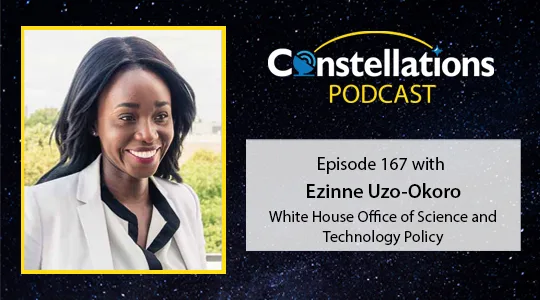
John Gilroy: Welcome to Constellations, the podcast from Kratos. My name is John Gilroy, and I will be your moderator. In today’s episode, we focus on the White House and some of the United States’ upcoming policies when it comes to space sustainability. For that conversation, we are glad to welcome Dr. Ezinne Uzo- Okoro, who is the Assistant Director for Space Policy at the White House Office of Science and Technology Policy, or OSTP. On any given day, Dr. Uzo-Okoro might be dealing with the increased proliferation and threat of space debris, crewed and robotic space missions, monitoring the Earth’s climate and space weather, or the International Space Station’s retirement in seven short years. Ezinne, we’re going to go through this fast because I know you got a busy day, so let’s jump right in here. I’ve read your background and it covers everything. It covers a lot of territory. What are you most focused on right now? What has the White House’s attention?
Ezinne Uzo-Okoro: Thank you so much for having me. We are fortunate to be living in exciting times, particularly for space. And what that means is there’s several areas that require attention, either in providing a presidential vision or an executable strategy that the entire Federal Government needs to plow forward and implement. And right now I’m focused on three key things. One is space weather. How do we ensure that we are a nation that is resilient to the effects of space weather? This includes geomagnetic storms, and sometimes when you see the light flicker in your home, you might think, “Oh, it’s just a thunderstorm.” Well, it might be actually a solar storm. And so we need to ensure the critical infrastructure here on Earth, in our country and elsewhere, our resilience to the effects of space weather. The second topic that I am heavily focused on is Earth observation. You may enjoy looking at your home from Google Earth today, but we spend a lot of time thinking about a vision for what we call civil Earth observation, which is how the civil agencies across the U.S. government look at the use of data and imagery from space. The use of this information when it is processed down on the ground. And this affects human health, it affects the climate, it affects our work with local and tribal communities. It really has a wide-ranging goal. So it’s important that we continue to advance, whether it’s coordination across what we call the Earth observation enterprise so that we increase the efficacy and efficiency of future Earth observation or efforts for promoting environmental and economic sustainability. The third thing we’re working on is on space data. What is the best way to provide this data that is in my book, underutilized. So that’s an effort we are currently working on because data we know from space is our most valuable asset . It helps our Ubers run, it helps our clock sync, it helps our utilities and a number of other sectors. We are looking to ensure that space data becomes increasingly utilized. And I’m looking forward to sharing the results of that.
John Gilroy: Well, you work at the White House Office of Science and Technology Policy, and again, all kinds of aspects to there. So what is the mission of OSTP specifically in regard to space?
Ezinne Uzo-Okoro: I love that question. Our overarching purpose is to create and leverage innovation to advance America’s goals, to reach our nation’s greatest aspirations in space. What does that mean? It means that we look at the plethora of topics I covered. It means that we look at orbital debris and space sustainability and think of how we are improving that effort and what our role is. It means we look at space weather, as I mentioned, or space capabilities such as in space servicing, assembly and manufacturing. It also means we look at things like microgravity research and ensure that we have the capacity, as you alluded to in the beginning, to transition smoothly from this beacon of success, the International Space Station that has been used internationally to something that will be commercially owned. That’s very exciting.
John Gilroy: I’ve read a lot of science fiction, and microgravity, to tell you the truth, does sound like science fiction here. So what exactly is microgravity research and why do we need a policy for something like that?
Ezinne Uzo-Okoro: The first thing I would say is let’s step back and look at the larger picture of why we need this effort in microgravity and then I’ll give you the definition. Think about the shuttle program. And when the shuttle program was retired, the last shuttle mission, I was a young NASA engineer at the time and I recall listening to the news and everyone thought NASA was shutting down, but we have to plan for the future. And right now, even though there is a gap when the government was taking astronauts up on American soil versus when now a commercial company is doing the same work, we were able to get it done. And that requires planning. It requires a lot of efforts that happen years before people even think about it because as the American people are moving on in their daily existence, they’re not really thinking about the long-term and that’s why we’re here serving the American people. So when you get to the subject of microgravity, it is something that is conducted on the International Space Station, and this is research that helps us ensure that we are conducting rapid, iterative researching space. It ensures that we are testing for health use cases. It ensures that we are testing for and preparing for autonomous research for either hardware or for human interventions, or even in some cases to drive applied research pathways that are just not possible on Earth. So when you think of microgravity, I would think about research in pharmaceuticals, research in potentially cancer solutions, research in synthetic biology that all help us to improve our scientific knowledge and enable sustainable human exploration to the Moon, to Mars and beyond.
John Gilroy: Dr. Uzo-Okoro, let’s go from the International Space Station to low Earth orbit, LEO. So what is the future of research in LEO look like?
Ezinne Uzo-Okoro: The future of research in low Earth orbit is another topic that really is at an inflection point, because moving quite like I gave with the shuttle example, moving from a government owned and operated system to something that’s owned by a commercial entity and operated by a commercial entity requires a lot of depth in order to ensure that there’s a smooth transition. So imagine space tourism, some of which we have seen in recent years, but imagine that being more commonplace in low Earth orbit. Imagine more research activities and that usually perhaps could happen in suborbital space, happening in low Earth orbit. And imagine also that a number of the capabilities and tools that we use nationally for our national security are now being provided by companies that are small and nimble and innovative and iterative, and that we have cell tissue research and biotechnology and biomanufacturing research are being conducted in LEO and multiple pods versus in one big station. So they’re just as a wide breadth of opportunities that we see moving forward in LEO.
John Gilroy: So if I’m not mistaken, I think your office recently published a whole LEO strategy. So can you discuss this strategy and the need for White House to drive that strategy?
Ezinne Uzo-Okoro: Well, when you think about what the United States wants and how it wants to lead in low Earth orbit, well who, but the president should set that vision. So that’s my answer to that. And it’s important that we empower, not just the U.S. government, but public-private partnerships and the private sector at large. This includes obviously not just industry but academia and research institutions to focus on innovation that will continue to drive not just economic growth and commercial development in space, but also STEM education and workforce development. It’s important that we facilitate engagement between these new providers of space stations that I mentioned and ensure that they’re working closely with not just the federal departments and agencies that they’re used to work with, but also additional departments and agencies who now have a crisp understanding of the benefit of conducting microgravity research in low Earth orbit.
John Gilroy: We have listeners all over the world. I want all our listeners to get a pen and paper because we have brand new acronym now. So we’ll play the acronym game later on this year. Brand new acronym, In-Space Servicing Assembly and Manufacturing or I-S-S-A-M, is national strategy written to require multiple US entities to develop multipurpose technologies that would enable a new space economy. So what types of opportunities are being enabled by ISAM?
Ezinne Uzo-Okoro: Thank you for mentioning ISAM. In-Space Servicing Assembly and Manufacturing really brings all your sci-fi dreams together because it’s a suite of space capabilities and tools and invention. So if you ever wanted to build a robot to be used on Mars, that could also be used on the lunar surface and perhaps could even be used on orbit to grab or dock or tug something. Why not? And so what we saw was that they were siloed innovative efforts. The lunar folks were building their things for the lunar surface, the Martian folks or Mars experts, and they built their staff for Mars. And then there are those who focus on services for in-space. If you think of refueling on orbit, you could use some of that technology to refuel on Mars or to refuel on the Moon. So we merged all those communities together and now we have this set of capabilities that will help promote and has already promoted a sustained economic activity and human presence in space. And so there are a number of ways we can do this. We obviously advance research and development in this area across the Federal Government. We give the private sector the demand signal that they need to feel empowered to go off and innovate, knowing that the customer will also be the government and it helps to provide international collaboration to achieve some of these goals and using these set of capabilities across the board. We’ve done this already with several countries that are allied with us, and it also helps to prioritize environmental sustainability and ensure that that child who loves robots and software and mechanical engineering and architecture can build a future lunar gateway and also contribute to a future space station.
John Gilroy: We know this time of year in the United States sports fans, they switch their attention from baseball to football. Something like that’s happening now. Now in your world, it’s a little more serious, I think in your world, you think about the priorities between Earth orbit and cislunar, a little bit more sophisticated than the Texas Rangers. So what do you think about these priorities?
Ezinne Uzo-Okoro: Cislunar is an interesting place. The Moon has changed from the Moon that our parents knew about. There was very little activity 60 years ago, now there’s a lot more activity going on and it’s important that for not just the lunar surface as NASA is charged to do and will be sending astronauts to the next few years, but also for the environment of cislunar space around it. Just because we have seen, I think NASA has put out the statistic, that human activity in cislunar space is going to be equal to or exceed all that has occurred in this region since the space age began in 1957. So we have new countries that are becoming space fairing nations. There is an incredible promise for advancing exploration science and technology. And why not use that opportunity to support research, improve or expand and strengthen international collaboration? Include some of our capabilities like space situational awareness and positioning, navigation and timing capabilities. We call that PNT, another acronym for you. So that is a priority, but so is the Earth orbit as well. Again, we see a lot of suborbital activity going on, which we encourage. We see a lot of new activities, constellations popping up often in low Earth orbit, and there is a lot of activity in space. It’s a very different place, and we need to ensure that we have guardrails in place, that we also protect U.S. assets that are publicly owned and privately owned that are participating in all this activity.
John Gilroy: Ezinne, we mentioned LEO and I kind of dabbled a little with GEO here. Let’s go beyond GEO. Many countries and companies are seeking to orbit or land on the Moon. How is U.S. policy addressing the increasing use of space beyond geosynchronous orbit, often referred to as cislunar space?
Ezinne Uzo-Okoro: Yeah, so I mean, as I mentioned, we have a number of capabilities that we are strengthening and extending space situational awareness and cislunar space is one of them because that will ensure that we have not just safe operations, but transparent operations for all entities in that space. We are talking to international partners and using the Artemis Accords as this cooperative forum to demonstrate how exploring and using at-risk space responsibly can benefit everyone. So this includes just developing responsible practices and also responsible norms of behavior. And there also is an interest in promoting early information capabilities that really help us ensure, again, a sustainable and cooperative ecosystem in that region.
John Gilroy: The U.S. announcement to ban direct-ascent anti-satellite systems has had some countries agree to the same ban. What other space sustainability policies is the U.S. government considering?
Ezinne Uzo-Okoro: So cislunar is one, because we have shown that space situational awareness, which is a form of space sustainability is something that needs to be extended to cislunar space. Another is orbital debris writ large. And orbital debris, you can think of it in three ways. There’s debris mitigation before you launch. There’s debris tracking and characterization what you can do while things are in orbit. And here the academic and research community helps us tremendously by tracking what is presently in space, both large and small objects. And then the third thing you can do is remediation. This is where again, ISAM comes in, the robotic tugs or the removal of large debris. So we have worked on space cooperation in three ways. One, we lead by example through the span of said example, and we saw others follow our example. The second is we lead bilaterally. And so we’ve seen other nations come along with us in a joint statement to talk about specific issues. And the third is multilaterally. So we have opportunities to work through the G7, which actually talks about space sustainability, and we put out a joint statement getting the other six nations to agree on sustainable practices and debris mitigation and remediation .
John Gilroy: No, we’re unfortunately running out of time here. Dr. Uzo-Okoro, I’d just like to say I think you’ve given our listeners a better idea of how the White House can impact the next generation of a space exploration. I’d like to thank our guest, Ezinne Uzo-Okoro, Assistant Director of Space Policy for the White House Office of Science and Technology. Thank you very much.
Ezinne Uzo-Okoro: Thank you for having me.