Transcript:
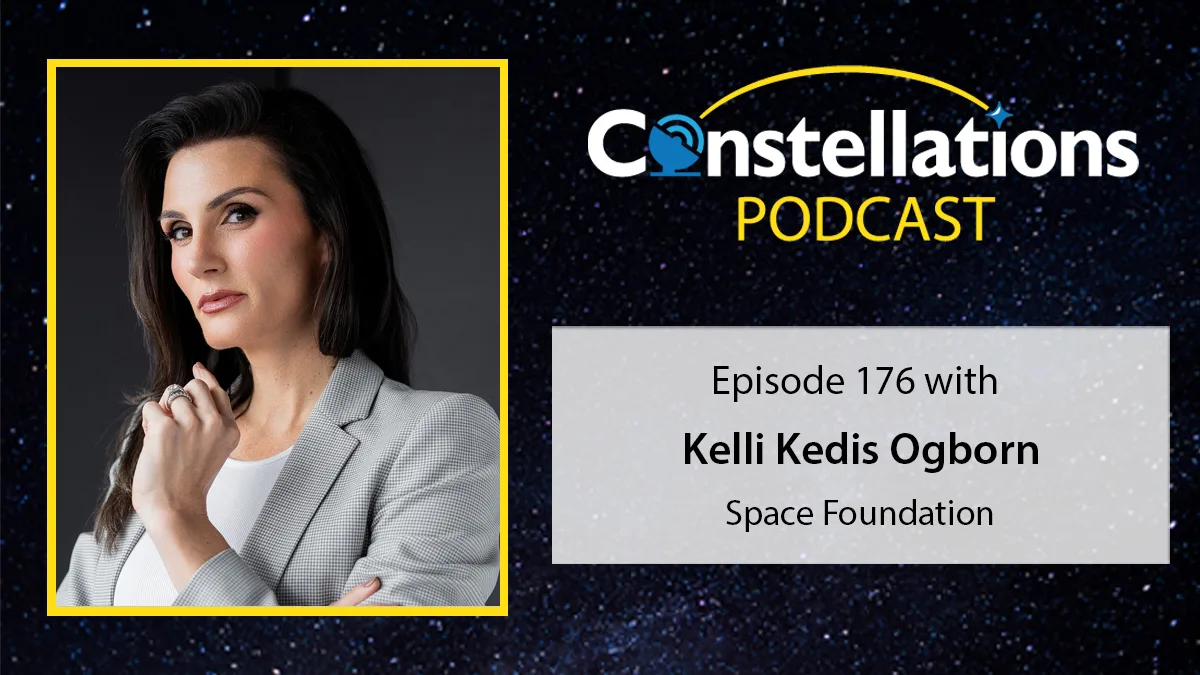
John Gilroy: Welcome to Constellations, the podcast from Kratos. My name is John Gilroy, and I’ll be your moderator. Today, we’ll be talking about business opportunities in space and what new capabilities will support the space ecosystem. Our guest is Kelli Kedis Ogborn, Vice President of Space Commerce and Entrepreneurship at Space Foundation. Well, Kelli, let’s jump right in here quickly. As an ongoing advocate of space entrepreneurship, you must have experienced many opportunities to leverage your background. So what technology or event happened that caused you to pivot towards space?
Kelli Kedis Ogborn: Well, thank you for the question, John, and it’s an absolute privilege to be with you and to be with your listeners today. Honest truth, if you would’ve asked me about 10 to 15 years ago that I would be doing what I’m doing now, I probably would’ve looked at you with a very blank stare on my face. So it was really a gradual transition. And what I mean by that is that academically I’m a sociologist. I’m actually trained in the psychology of conflict and why people go to war. So in my early career, I did a lot of international aid work overseas and domestically looking at overseas problems, and then happened to find myself working at DARPA, which was really the foray into my space world. So I went to DARPA initially as a researcher and then ended up supporting various DARPA directors on the congressional strategy. So I was a congressional liaison to the agency, and through that work I realized that a lot of the principles that I knew in sociology and the human aspect and impact of technologies and work really applied to this broader space.
Kelli Kedis Ogborn: And so when I was looking to leave DARPA, I wanted to still very much stay in this technological vein and really understand the human side of business. And so I started a tech commercialization firm called H.S. Dracones, which I ran for about seven years. It was really through that work that I got engaged more in the space community. The Space Foundation was actually a client of mine. They in 2018 won a grant through the Minority Business Development Agency, primarily looking at helping non-traditional actors find footing within space. I helped really design and execute those programs and what was really interesting to me was understanding the confluence of all the trends and various industries and inputs that are really driving the ecosystem forward. I really found a passion for being able to create strategies and pathways for non- traditional space actors or non-traditional space industries to find their place within space. So that just kept pivoting, pivoting, pivoting, and eventually led to me joining the Space Foundation and starting Space Commerce Institute, which is what I run now.
John Gilroy: Kelli, if you bum through your phone and look at all the headlines here, all kinds of stuff going on with satellites in space. You might even say it’s a perfect storm here. So what is creating this climate of opportunity for space commerce?
Kelli Kedis Ogborn: Yeah, it’s a wild time right now in all the best ways. A lot of us will always say that there’s really never been a better time to become part of the space ecosystem and it’s true. From my perspective, I think there’s really three aspects, and I’ll dive into each of them. It’s really activity, access, and then the belief systems and the conversations around space. So if we look at activity, what’s really fascinating is that there are more people joining, and more people paying attention. As of January of this year, there’s 91 nations that have reached orbit and 105 that have reached space. So what we’re seeing is that more and more people are starting to realize that they want to become part of this ecosystem and are trying to find ways that they can take advantage of space. And what it really shows for me is that the prospect of space is no longer just for companies led by tech experts or space enthusiasts. Every day increasingly, there are these disparate industries that are recognizing that they have opportunity and an entry point and a lot of that activity is driving it.
Kelli Kedis Ogborn: So you could look at SpaceX’s success. It’s hard to have a conversation about space without SpaceX or Elon Musk coming up pretty quickly in the conversation. They’ve generally inspired younger generations and also pushed the boundaries of what’s possible across the established commercial ecosystem as well. The other thing too is also NASA’s renewed interest in going back to the moon with Artemis and also the recent landing of Intuitive Machines on the moon last month would really put the United States back on the moon’s surface for the first time since 1972, which is amazing and so great as a nation and as a global community. Then also the increased global engagement and achievements like India landing on the moon last year. And so there’s just more and more activity where people are starting to realize that it’s not just a wish anymore, it’s a fact.
Kelli Kedis Ogborn: Then if you look at access, really it’s the rocket equation and increases of rocket activity and engagement to low Earth orbit. So in 2023, there were 212 successful launches. And when you compound that on top of the infrastructure build out that’s happening in low Earth orbit with the commercial space stations and the ISAM portfolio, which is in orbit service assembly and manufacturing, there will now be a lot more of the value chain to engage with. I have seen more and more people either create new business models or adapt business models looking at diversification beyond activities in geostationary orbit, which is where we normally saw a lot of the activity. I think the last piece is around the beliefs and the conversations. What’s really exciting is that we’re in a time where we’re moving beyond a moonshot to having very real conversations about a cislunar economy and what that could look like. So because of that, the landscape is now opening up to allow for more nontraditional engagement in space, both in the upstream and downstream effects that people are starting to realize that there is an entry point and just trying to figure out the strategy of how to take advantage of that.
John Gilroy: You mentioned the word conversation. If I were to have a conversation with an entrepreneur, inevitably market drivers would be coming up here. So what do you think the market drivers are for this new economy?
Kelli Kedis Ogborn: There are many, and I think it also depends on how you catalog a market driver. From my perspective, I look at it in terms of verticals that have tremendous growth potential, but also that have many subsets encompassed within them. I’ll explain what I mean by that. So Morgan Stanley, one of the major banks, put out what they catalog as their 10 major economic drivers of the new space economy, and I will touch upon a few of them. The reason that I pinpoint these ones in particular is that it’s not just what they as a vertical are bringing to bear, but it’s a lot of the other elements within it that it either activates, enables, or takes advantage of. So of course, we can’t really have a conversation about space without getting into satellites pretty quickly. As I mentioned in 2023, there were 212 successful launches. When we talk about satellite launched, because that’s a lot of what’s being launched, there already 20,736 satellites that are licensed for future launch, which is mind-blowing.
Kelli Kedis Ogborn: Because if you look right now, there’s roughly eight to 9,000 active satellites in space. So we’re talking about doubling the number of satellites in space within the next one to two years. So that is going to open up a lot of other industries to take advantage. I mean, one in particular is energy, so energy around launch, which is really looking at propellants. So new propellant technology, whether it’s green, more efficient, hybrid engines, all of that domain is really going to expand. The other necessary piece to grow this is really digital engineering, and then also service and repair is going to exponentially grow due to this as well. Another major market driver in a vertical is when we start to look at deep space exploration. And the reason that I bring this into the conversation, it’s also part of Morgan Stanley’s, but this is really where we are pushing the boundaries for future exploration and scientific discovery. The whole point of the Artemis mission is to go back to the moon, and it’s to go back to the moon to do research and science endeavors, but it’s also to create a lunar base to use as a future launch facility and verticals to get to Mars. And so technologically, I believe that we will achieve what we are hoping to achieve. When you start to look at this vertical of deep space exploration, it’s a lot of the other things that are necessary to grow and scale. It’s being able to study effects of gravity on the human body.
Kelli Kedis Ogborn: It’s looking at food engineers. It’s looking at agricultural practices about environmental assessment, creature comforts, refueling. It’s all of these other aspects that are going to be really, really critical to prop up that driver. Therefore, it’s a really important one because it’s bringing a lot of other people to the table. The other one that I will mention just because it gets people really excited is asteroid mining and what I like to point out about this is there’s no business case for asteroid mining yet. I mean, there’s a lot of people talking about that some of these asteroids contain more platinum than exists on the Earth and while that is true, what the vertical of asteroid mining is actually driving for is resources. So what’s interesting is that the mining definition has actually shifted because of these emerging space resources industries. So what we’re looking for here is water. What’s interesting about that in terms of the other industries necessary to prop it up is it’s looking at things like storage and transportation solutions, energy to be able to drill on these asteroids, construction companies who will use these metals. And so when you look at these drivers, it’s really a lot of the upstream and downstream effects that these market verticals bring to bear that I find more interesting because that’s actually how we’re going to grow out a scalable ecosystem.
John Gilroy: Kelli, I want to go back to non-traditional actors in this area. If I were to have a conversation with half dozen entrepreneurs and talk about, hey, had a conversation with Kelli and we talked about this and that, the first thing they’d say is, “Yeah, to get in that business, you got to be a rocket scientist or a tech expert, right?” And so how do you respond to that?
Kelli Kedis Ogborn: You absolutely do not. I like to tell people that this is not your grandfather’s space industry anymore, and really it’s not just about rocket science. So of course, when we think about space, our mind goes toward rockets and satellites and astronauts, which is a cornerstone of growing out the ecosystem and the industry. But really in order to achieve the collective wish that we are all pushing forward for, it’s going to require every background skill set, industry and interest to really come to the table and make this a reality. And so briefly, what I touched upon earlier about these drivers, these drivers are not able to be achieved without the curiosity and intellectual rigor and also a lot of best practices from other industries to bring it forward. What a lot of people also don’t realize is that space is not just about the upstream. It’s not just about putting things in space. It’s also utilizing space for Earth purposes. So when you start to realize that it peels back the onion. The agriculture industry, FinTech, biotech, healthcare, these are all already parts of the space ecosystem. And so it’s making space make sense for you, and it’s understanding how you can utilize it in your daily life or contribute what you have learned in another industry or something that you’re interested in to make it scale in the future pathway that we’re looking for.
John Gilroy: FinTech, my, my, my, that does open up the world for new people to get involved in this industry. So if we took a step back here and maybe just try to define the space economy, so what does the Space Foundation think its current value is in the space economy?
Kelli Kedis Ogborn: I appreciate that question. Thank you. So the Space Foundation every year puts out a space economy number that is part of our space report, and what it looks at is all of the previous data from the year before. So our new space economy number for 2023 quantifying the year will be coming out this summer. So the most current number that we have is looking at the 2022 values because we’re currently evaluating the 2023 market. So our most recent number is cataloged at $546 billion, but we are conservatively estimating that it will reach $772 billion by the year 2027. And so when you look at that breakdown of the current number right now of $546 billion, 78% of that is commercial revenue and 22% of that is global government spending. And so that global government spending number is looking at about 80 nations, and the commercial revenue of 78% is really broken down between two different markets. And I like to catalog those as things that are enabling industries and then those that are enabled by space.
Kelli Kedis Ogborn: So when we look at enabling industries, really this is looking at commercial infrastructure and support services, and this is about one-third of that number. So these are the things that we traditionally think of, launch, satellite manufacturing, insurance, some people may not realize that, but the insurance industry is actually quite ingrained in the space ecosystem, ground stations, space situational awareness, and on orbit servicing. And then commercial human space flight is also another one in that category, which is the dark horse that is coming from behind, but a lot of people are placing a lot of bets on this eventuality and it’s really exciting to see that grow. And then the second piece, which is the largest of these, it’s those enabled by space. And this is about two-thirds. And so this is really looking at commercial space products and services that directly rely on space assets. So it’s things like broadcasting, television and radio, precision, navigation and timing, PNT, which is probably the largest portion because it accounts for GPS, tracking capabilities. We talked about FinTech, your financial transaction stamps, or thanks to PNT, communications, so two-way communications to share data or connect voice and video. Earth observation is also another major, major one in this area because it’s utilizing satellites for unique perspectives of Earth in terms of remote sensing and data sales. And really this one is growing exponentially because especially as we talk about more and more satellites coming online, being able to use data in new and creative ways is really going to expand the market and the opportunities for people to access and engage with space.
John Gilroy: I know you’re based in the Washington, DC area, tons and tons of cybersecurity specialists in this area. I talk to them all the time. And they take, I’ll use your word traditional, take a traditional concept like critical infrastructure. I consider that to be water and electricity, but they’re pushing the boundaries. They’re saying, “No, no, no. Data centers now are critical infrastructure.” So what are some of these new approaches redefining the critical infrastructure as needed for the space business?
Kelli Kedis Ogborn: That is a great question. When you think about critical infrastructure, more and more as space is becoming connected to each other and becoming connected to all aspects of life, including ground stations, it all is this finely coordinated, finely tuned ecosystem to engage with. Especially when we look at business opportunities that are being evolved, tested, and demonstrated within low Earth orbit, it’s not just one company and it’s not just one country. There’s a lot of entities that have to work in concert to build out this eventuality. And so some of the new approaches that are really redefining this space, a lot of them fall into the ISAM portfolio, which is the In-space Servicing Assembly and Manufacturing Portfolio. What that is really looking at is taking Earth out of the equation and really being able to repair things in space, refuel in space, be able to launch from low Earth orbit to other orbits and to the moon as well. And that area is really budding with a lot of creativity, new business opportunities, new business ideas, I will say. And a lot of companies are paying attention to that. Another aspect to this though about critical infrastructure and protecting it is the area of space debris, which you talk about cybersecurity and the protection of data centers and other connectivity. Space debris is a major threat within space and especially in low Earth orbit and to a lot of these potential business models. And so that area is calling in a lot of new approaches on how we can track, mitigate, and then eventually hopefully de-orbit or reuse some of these aspects because that is a big piece that needs to be, I would say, dealt with before we can actually expand space in the way that we want to expand it.
John Gilroy: Kelli, I went to YouTube and I listened to a couple of your previous interviews, and in one of your interviews you talk about the Apollo era and the Artemis era. I thought this was like a classics class or something. So what’d you mean? What do you mean when you’re saying we’re switching from the Apollo era to the era of Artemis?
Kelli Kedis Ogborn: Yeah, that’s one of my favorite analogies because I think it really helps catalog where we are in this moment of time. So you can think of us book ended by these both returns to the moon or I would say focus on the moon, but in very different ways. So when you look at the Apollo era, it was a very different time and a very different focus. Obviously, the space race began with the United States and the USSR, and a lot of the focus was on national posturing first and technological progression and scientific discovery was secondary and tertiary to that. And it’s not that we did not achieve great feats, but it wasn’t at the forefront of what we were pushing forward. So really the way that our modern space industry evolved was that it was national priority, national directive, national funding, and then all of the activity was vertically integrated down. We are now moving into the era of Artemis where scientific discovery and exploration are at the forefront. National posturing still, of course, does exist because it’s very difficult to decouple commercial activities from civil activities and especially national security when engaging in space. But we are now pushing for an eventuality where we’re not just returning to the moon to show that we can, we’re returning to the moon to stay. And so what that requires is a very global and collaborative effort in order to achieve that. And so certainly with the Artemis Accords, I think we’re now up to 36 signatories of different countries that are recognized that they want to have peaceful engagement and push toward this collaborative future. And so it’s more of the spirit and the impetus behind it. Another really great thing that catalogs and I think helps highlight this moment is if you look at the number of satellites in terms of the percentage of government launched to commercial launched. So during the Apollo era and really up into the early ’90s, over 90% of all satellites launched were either done by the United States and the USSR. And if you look at all of the satellites that were launched just in 2023, over 90% were commercial. And so the model is changing, who is involved is changing, who’s leading and who’s following is changing. And I think it’s a really exciting time. There are a lot of lessons that we can learn from the Apollo era, but we are now trying to be more collaborative and realize that it’s the collective wish for the future that we’re all pushing toward and being able to take the best and the brightest globally in order to achieve it.
John Gilroy: Kelli, I’m going to focus on this little percentage. You talked about the percentage earlier of 78 and 22. You also mentioned that 80, it’s 8-0, which is hard for me to believe, but 80 nations are now involved in space. I mean, the only conclusion I have is that most countries realize there’s opportunities in space. How are they trying to connect that to their own industries and economies?
Kelli Kedis Ogborn: And what’s interesting about that 80 is that 80 is really just global agencies that we so far are tracking, because 91 countries have an active satellite in orbit. And so what we’re realizing too that beyond space agencies, there are a lot of countries that are now creating space strategies or offices that might be out of their trade ministries or other government entities to start to focus more on how they can get involved, which is very, very exciting because the numbers are constantly changing. And I think for them to make sense of their own industries and economies, and it goes back to this concept I mentioned before, but it’s really making space make sense for them. Because there is so much to engage with. And I mentioned a bit before about the downstream and upstream of market verticals and a lot of these opportunities, what’s going to be good for one nation is not going to be good for another. So some nations geographically it might make sense to have a spaceport to create an opportunity for launch services for other folks in their geographic area. For others, it might be utilizing space to help expand their agricultural sector or be able to better streamline digital financing on their phones. And so part of that comes into not trying to keep up with The Joneses and looking at what other nations are doing, because at the end of the day, you have to be able to communicate it to your population about why you’re even engaging in spending in space, but also knowing what you already have to bring to bear and how you can then either spin in industries to the space ecosystem or start to build out for a sustainable future. So a lot of times it’s not reinventing the wheel because what I always like to tell countries and companies when I work with them is that they probably already have a space ecosystem that they just haven’t realized is part of space.
John Gilroy: Kelli, if you go back to college, you take Econ 101, they talk about domestic markets and international markets. Let’s apply this to your world. I guess in your world, there’s a difference between space to space versus space to Earth markets. Is that right?
Kelli Kedis Ogborn: There definitely is, yeah, and there’s a nuance to them, but it’s really important. So the space to Earth market are goods and services produced in space for use on Earth. And these are a lot of the things that I mentioned before in some of the industries that prop up our numbers, but it’s things like precision navigation and timing, satellite data, technology transfer. For example, memory foam and clear braces came from NASA technology that was then used in other markets. Agriculture, for example, is a part of the space to Earth market because it uses satellite data to be able to track and contain better agricultural yields on Earth. What’s also interesting about the space to Earth market is that it’s roughly 95% of the current space economy, which a lot of people don’t realize. And that’s why I always like to mention that because it implicates people in space if they don’t think they’re part of space yet. And then the space to space market are goods and services produced in space for use in space. So this really goes into the ISAM portfolio, the commercial space stations, really taking Earth out of the equation and having space be this domain where people engage. What’s interesting about this market, space to space, is this is the one that catches headlines and investment or was catching investment for a while because this is the one that gets people really excited. This is when you start to talk about lunar outposts and commercial space stations and in-space manufacturing and refueling. But this market is also in its infancy to get off the ground because there are still many technological achievements that need to be accomplished for this sector to thrive. And so this sector, the space to space market, really pushes the boundaries and limits of what’s possible, where the space to Earth market is driving a lot of the economic priority now. And so they really are two sides of the same coin and both serve a really vital purpose, but they are very different in what they produce and who’s engaging with them.
John Gilroy: We mentioned entrepreneurship many times in this interview, and part and parcel of any entrepreneur is going to be investors or investment when you look at different communities and space economy. So what are the issues with convincing investors that no, no, really the space economy is valid, it’s a good place to spend money? I mean, what are these issues?
Kelli Kedis Ogborn: Yeah, so there are a few, and I will say that there is still a significant amount of investment that is going into the space economy. However, it’s started to shrink over the years and especially how they evaluate it. One of the biggest issues I would say, and maybe it’s not an issue, but it’s just a pervasive theme, is the concept around risk and return. And it really comes to understanding that the market is stable. It’s not quite the gamble that it once was, and that we do have these profitable and proven anchor markets, which I mentioned earlier, which allows for the market to be stable, creative, and risky all at the same time. But it’s knowing what segments to interact with and being able to balance competing priorities. And one of the things that is a challenge I think that investors faced and is really changing the investment landscape right now is the SPAC boom and bust created an environment that makes it a bit more challenging. Because there were hyped valuations, we’re now seeing reductions in valuations and the volume of fundraising, and the time that it takes to fundraise is a bit longer. Those all can be seen as impediments, but I actually don’t think it’s too terrible because we are now moving beyond hype to really needing to demonstrate real value and real business models. And I think a lot of the industry is realizing that it’s not just about cool tech anymore, it’s really looking at the ability to scale, the ability to make money, and really the ability to demonstrate capabilities or wins quickly. And so it’s a bit more discerning, which can be a good thing. One of the ways that you can convince investors, especially from an entrepreneurial growth perspective, is just being able to demonstrate capabilities and wins quicker. Because what we’re starting to see is that the investment is looking more at mature and identifiable product market fit, so things that we’ve seen historically like infrastructure, satellites, space hardware. And that doesn’t mean that there is an area for these growing riskier segments. I’m using air quotes. It’s just being able to show in a really tangible way how you plan to test, how you plan to validate, and how you plan to scale beyond just saying, “Trust me, there’s a market,” but being able to prove it because a lot of investors right now are looking more toward a three to five year ROI, which is sometimes difficult to demonstrate if you’re looking more for the moonshot type technology. So it’s more just how you posture and how you plan your tech development timeline.
John Gilroy: Kelli, this is really a wide-ranging conversation. I never thought we’d include public relations terms. There’s a public relations term called optics. You’ve all heard on TV and the pundits all use it. And I think that you’ve once said that the space industry has an optics problem, nothing to do with optical communication. So what do you mean by that and how’s it resolved?
Kelli Kedis Ogborn: I say this all the time. So what I mean by this is that we have an optics problem in the way that we talk about space. One of the good things about the space industry and really the broader ecosystem is that no one is going to say that space isn’t cool, which is good for us, because at least there are eyes on the industry, eyes on the activity. But the problem that we have when it comes to optics is that space is still talked about in mythical terms in a lot of the language and a lot of the vernacular that we use. And I understand it. Because if you actually look at the origins of space and when JFK in his famous speech at Rice University pointed us to go to the moon, we really were as a nation and really as a global humanity were confronting the unknown with optimism and enthusiasm, and we were really pushing the boundaries of what was technologically possible. Because at that time, nothing like this had been achieved. And while space now is still impressive and it is difficult, it is not the gamble that it once was. And as I mentioned earlier, we do have these very stable anchor markets that are making money, that are proving business models, but we still talk about it as the final frontier and the word exploration and all of these areas that collectively get people excited, but I think it actually obscures the fact that we do have a real situation where goods and services are exchanged for monetary gain. And I think those mythical terms make it feel not tangible when it is very tangible.
John Gilroy: People listening to this podcast know about low Earth orbit, but they may not know about low Earth economy. So what’s going to open up this economy?
Kelli Kedis Ogborn: So I really point to a couple of things. I mentioned before the increased number of launches, and so people having access to space, people being able to put things up in space. One of the cornerstones of that is really the commercial space stations that are going to replace the International Space Station. The International Space Station is going to be decommissioned by the year 2030, at least those are the plans right now. And there have been four companies that have been given contracts by NASA to build the next generation. And so the business model is going to shift where NASA is then going to be a customer to them as space as a service. What that opens up is a lot of opportunity for academic institutions, for research companies, commercial companies, to be able to put payloads in space for a lot of different ways. And one of the things that I’m the most excited about is really being able to utilize the conditions of space for manufacturing and for pharmaceutical advancement.
Kelli Kedis Ogborn: There have already been some tests that have been conducted where they’ve been able to expedite an osteoporosis treatment in the conditions of space and actually get it fast tracked through the FDA, or there was another company that because of the lack of gravity was able to manufacture a retina with the type of precision that you cannot get back here on Earth. And so being able to exploit the conditions, utilize the conditions for anything of that nature I think is definitely something that we’re going to see in the coming years. And then also the utilization of space data. Everybody knows that the satellite proliferation is coming and it’s coming fast, and what that is going to give us is more data, more ubiquitous coverage than we’ve ever had before. How that is going to affect industries, their business models and the utilization of it, we do not know yet, but that is a direct link to what’s happening here on Earth. Then I will say the other piece is also just the assembly and manufacturing that I mentioned, but it’s not just the utilization in space, but it’s also what it’s going to open up again on Earth. One of the great things about the space economy is that space as a domain really attracts frontiersmen and creative inventors and really smart people. Because we push the boundaries of what’s possible, we are going to get better processes, better subcomponents, better ways of doing things that are going to trickle into other industries. And so where that is going to land is still being decided and being determined, but the economic value and the viability is just going to continue to increase.
John Gilroy: Kelli, final question here, I’m going to go back to our investors. So what features and attributes in this new market would help investors and potential space companies better assess that risk before moving forward into the sector?
Kelli Kedis Ogborn: So for me, it’s really understanding the roadmap approach instead of trying to take the whole ecosystem head on. What I mean by that is that understanding what technologically needs to be achieved first in order to open up new markets and business models or understanding what needs to take priority to further develop and enable that future. Because space is exciting, people can get ahead of themselves and create, as we talked about, major valuations and different business models. But really understanding what space brings to bear now, how you can engage it now while building out for your further growth strategy and also where you want to be moving into the future is really how you need to balance it because the landscape is changing often. Really with a lot of these technologies, we are really demonstrating the art of the possible. We’re still kind of betting big on a hypothesis. So understanding how that’s going to pan out, what it’s going to enable, and then how you can move upon that business model further is really a critical aspect to know if your investment or your business idea is going to be able to scale. So it’s really paying very close attention to the nuance and the growth.
John Gilroy: Kelli, I think what you’ve given our listeners is a very detailed and thorough understanding of the business opportunities in space. I’d like to thank our guest, Kelli Kedis Ogborn, Vice President of Space Commerce and Entrepreneurship at Space.
Kelli Kedis Ogborn: Thank you, John. It was a pleasure to be with you today and thank you to the listeners.