Transcript:
John Gilroy: The views expressed in this podcast or on www.constellationspodcast.com, do not officially represent the views of the U.S. Military or the United States government. The appearance of U.S. Department of Defense, DoD visual information, does not imply or constitute DoD endorsement.
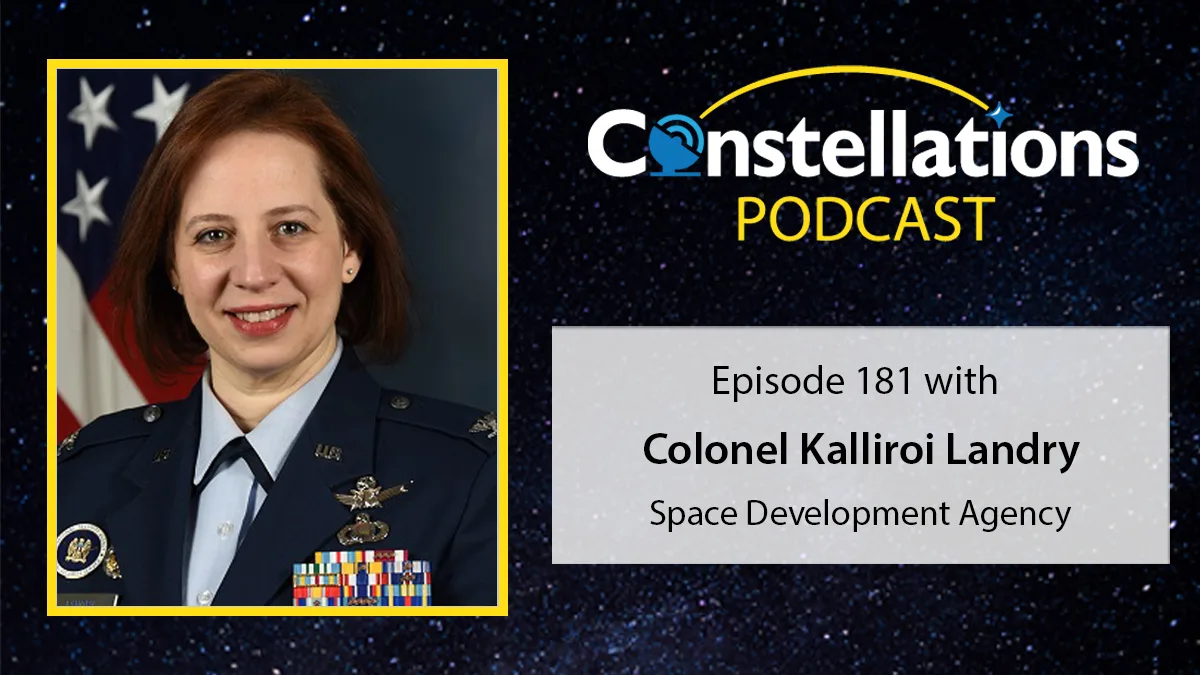
John Gilroy: Welcome to Constellations, the podcast from Kratos. My name is John Gilroy and I will be your moderator. Today, we’ll be talking with a member of the Space Development Agency, the government agency responsible for developing and fielding the department’s future threat-driven space architecture. Our guest is Colonel Kalliroi Landry, who oversees planning, acquisition, and fielding of launch, ground, and user terminal systems. Well, Colonel, we’re going to jump right in here. So, the first question is, well, we know you are part of the acquisition program for the Space Force that is looking to do things faster. What are your obstacles? What are your challenges? What’s standing in your way?
Col. Kalliroi Landry: Thanks, John. Yes, I am very excited to be working at the Space Development Agency as a constructive disruptor for the space acquisitions community. I’d say that we are looking at legacy acquisition, and oversight processes that kind of get mired in reviews and oversight. And so, SDA is looking at how can we use the tools that are available to us through the defense acquisition process to make things go faster. So, we’re not doing anything outside of the book if you will, but we are looking at the tools available through this defense acquisition process and utilizing that to deliver capability to the warfighter faster. One of the big things that we’ve got that we focus on is spiral development and being scheduledriven. So as with any acquisition program, the three legs of the stool are cost, schedule, and performance.SDA has chosen to prioritize schedule above cost and performance so that we can get that capability to the warfighter on a relevant timeline because war does not wait for the ideal solution to be delivered. And our warfighters need capability in the meantime to do their mission.
John Gilroy: There’s a T-shirt for you. War does not wait. We got to get it done today, huh? I was taking notes and I wrote down disruptor now when I was in school, “Well, that John’s a disruptor. He is a real problem.” Now today if you look at the Space Force, “Oh, she’s a disruptor. Wow. She gets promoted.” I mean, this is what trying to do, check an existing process and make it much more efficient. So you kind of need that disruption, don’t you?
Col. Kalliroi Landry: Well, you kind of need to shake things up a little bit and ask the why questions, right? And if it makes sense, press forward, like I said, that we’re not going outside of the book. There are ways to make it through our acquisition processes and approvals. There are tools out there to use, and a lot of times folks go with what they know, but it takes a little bit of extra effort to look into, well, how else can I do it? And looking at those other methods really can disrupt the normal way of doing things, but it also gives you an opportunity to excel and to be successful.
John Gilroy: So Colonel, most people would get a whiteboard and put commercial on one side and the military on the other. However, there’s a lot of activity in the commercial world now. And so why is this commercial model attractive to the SDA?
Col. Kalliroi Landry: Yeah, that’s a really good question. What SDA is looking at doing is taking capabilities and technologies that are already mature and integrating them into a solution for the military. So the commercial side is doing that, burning down the risk, taking care of that non-recurring engineering, reducing cost and schedule risk. And then SDA can benefit from the work that’s already been done on the commercial side. And then we can pull in those capabilities more quickly to deliver on that prioritized schedule timeline. Commercials can develop a marketplace that can keep the costs down and keep things consistent with competition in the marketplace. And so the military can benefit from that work on the commercial side to get better or more affordable solutions with up-to- date technology capabilities to meet our mission requirements.
John Gilroy: Earlier in the interview, you used the word spiral. I assume you’re referring to I guess what they call the spiral development acquisition process. So what is unique about the space architecture SDA has developed?
Col. Kalliroi Landry: Well, so SDA’s architecture based on spiral development is all about getting that 80% solution out to the warfighter and getting something out and fielded as soon as possible, knowing that it’s not the perfect solution. However, it gives capability to our warfighters in the field to do something better now and having the predictability that it’ll be better in two years. So our spiral development model plans for every two years delivering capability and improving on capability that was delivered prior. So like I said, 80% solution now and then improvements every two years, and that’s how the warfighters will be able to be more effective in their jobs.
John Gilroy: And with the way technology is changing, how else can you do it? I mean, call back tomorrow, so many new things coming up every single day. You have to be that kind of flexible and I guess spiral is the word you use. Let’s focus on this thing called Link 16. Colonel, tell us about the Link 16 testing you’ve been doing, what is Link 16 and why is it important and are other countries using it?
Col. Kalliroi Landry: Yeah, that’s a really good question, John. So Link 16 is the most proliferated tactical data network that the US and most of our allies are using. It’s been around for many years. The warfighter already has user terminals fielded that they’re leveraging to access this Link 16 capability. It enables our tactical warfighters to share information in their region of interest if you will. And so that is that first major capability that we’re delivering through our PWSA architecture. PWSA is the Proliferated Warfighter Space Architecture, which SDA is building and delivering. And so the Link 16 capability that we’re doing is injecting tactical data information from space into these regional Link 16 networks. And the benefit of that is that it will provide beyond line of sight information, passing of information between where the data is originating and where the data needs to get to our warfighters. So within our testing and development activities, we have been working with a Five Eyes partner to do our first Link 16 demonstration, which was accomplished last November. And that was the first ground demo of Link 16 capability from space to ground if you will, and then, like I said, disseminating that tactical data message over Link 16. We also have the opportunity to work with another international partner, Norway specifically. And later this summer we will have another opportunity to demonstrate Link 16 capability over Norway airspace with Norwegian test assets as well. Link 16 is used by the US and our allies. And so if we want to get to that coalition warfighting, Link 16 is one of those first steps to be able to communicate jointly.
John Gilroy: Well, true confession. I have a piece of paper here and a pen, and I’ve been trying to write down all the satellites that are planned for the next few years, and I’m running out of ink. I mean, there’s so much going on. I can’t keep track of it, but I’m going to ask you, okay, in the end, how many satellites do you think you’ll have launched and planned for communicating together with the ground? You’ve to have a good idea.
Col. Kalliroi Landry: Yeah, so John, as we said, we launched capability every two years. And so this fall we’ll start with our Tranche 1 constellation. So that’s going to be about a hundred and fifty-ish satellites there. And then Tranche 2 is going to add another two to 300 satellites. But really in the end, what we envision is a steady state of two Tranches worth of space vehicles, and it can have a range of about maybe 400 to 500 satellites total with the intent that we would be de-orbiting the older Tranche as we bring on a new Tranche, have the steady state of two Tranches, and then planning for a next Tranche to launch additional capability or improved capability. But the steady state, I would say would be about 400 to 500 satellites, definitely a proliferated constellation.
John Gilroy: Well, if you go back in time, even 10, 15 years, and say, “Yeah, the next one, two to 300 satellites,” I mean, it sounds very impressive. But in 2024, it’s oh yeah, seems pedestrian almost, huh? That’s really amazing.
Col. Kalliroi Landry: The great thing is that our commercial space industry is ramping up to deliver to be able to produce, manufacture, and deliver that many satellites. And I’m excited to see how that continues to grow.
John Gilroy: Wow. I just can’t wait to just watch the whole process. So Colonel, I’m pretty sure you go through a source selection process when deciding who to choose for one of these Tranches for your next Tranche, let’s say. So who makes up your source selection team, and then who decides what the next group will look like?
Col. Kalliroi Landry: So our source selection approach is really the same as any other defense acquisition solicitation. There is definitely a team pulled together from SDA, government military personnel and subject matter experts from partner organizations as well as support in order to manage and run our solicitation process. So it’s not just a tight small group from SDA, we really do branch out to bring in some subject matter experts to help us make some really good decisions. But really the intent is to compete every Tranche that we put out and have as much competition as possible. Our solicitation process is very transparent and we absolutely want to ensure there’s a robust industry marketplace so that we can continue to have multiple players in the mix as we look for opportunities to bring capabilities into our PWSA.
John Gilroy: Well, Colonel Landry, we’re going to go from the who to the how. Now we know the who, here’s the how. So how do you determine what capabilities you’re looking for in the next Tranche? So our other government agencies may be partnering with you and why?
Col. Kalliroi Landry: Yeah, that’s the cool thing about what we’re doing at SDA. We have a warfighter integration council that meets twice a year, and we bring together representatives from the combatant commands and the services and our joint staff, and it’s fed by working groups throughout the year. But really that’s where we hear directly from the warfighters, what are their current challenges, what are they struggling with in order to meet their mission objectives. And so I’d say it’s coming straight from the horse’s mouth there. What’s the warfighter struggling with? And then working through how we can bring in capability to our PWSA so that we can get the capability that they need sooner rather than later. And then also, publish a technology roadmap on our website, which allows us to telegraph to the industry what the demand signal is. We have some ideas of what the current state of technology is, as well as what warfighter pain points are. And so through the combination of this warfighter integration council, as well as this more general projection of what capabilities we expect to come in the next few years, we’re able to skinny down to what the minimum viable product is for every Tranche, minimum viable capability for every Tranche. And we just kicked off that whole process as we’re planning for Tranche 3. So, we’re already planning to deliver Tranche 1 this fall and start launching this fall. Tranche 2 is going to start launching in the fall of 2026, and then we’re in the planning process now to define what the Tranche 3 minimum viable capability will be. So by this time next year, fingers crossed, we will be putting out solicitations for Tranche 3 after we get the warfighter council next spring to snap the chalk line and say, “This is what we want in Tranche 3.”
John Gilroy: Wow, MVP, that’s a marketing term right there. That’s kind of fascinating. It fits in with the 80-20 rule that you said earlier. So, an MVP has nothing to do with sports, but it’s a minimal viable product. That’s fascinating. So Colonel, in your position working with acquisition, you got to see vendors every day. So they walk in the door and they talk to you and maybe show you their ideas and they tell you they want to bid on this next Tranche coming up. So are you seeing anything new that’s impressing you, that’s coming out of the commercial industry? Maybe technology that hasn’t readily been available to the DOD before?
Col. Kalliroi Landry: So I’ll talk from my perspective as the lead for the ground segment. I believe that, well, there’s always great improved technologies coming through. As the lead for all the ground segment activities at Space Development Agency, I am looking at how am I putting ground entry points around the globe in order to communicate with our proliferated constellation. And a lot of times you look at the problem and you’re like, I need lots of context to the ground. And so does that translate to having lots of ground antennas? And that becomes an emerging technology question. We are used to seeing parabolic antennas, and that is one contact per satellite to the ground per antenna. What I am looking forward to seeing is the maturation of phased array antennas that could have multiple contacts per ground terminal and multiple satellite contacts per ground terminal. And so, I think from my perspective, looking for cost-effective solutions, it would be great if I could buy fewer terminals on the ground, but still be able to contact lots of satellites. And so that is one of the things that I am kind of watching how the technology is maturing there and also delivering that potential capability for the operational RF spectrum bands that we’re working in. So I think that’s one of the things that I am looking for how that’s being matured from a ground segment perspective.
John Gilroy: Interesting. Earlier we talked about this little word disruptor. It turns out it’s not too bad a word. After all, the Space Development Agency has been called a constructive disrupter. I guess you’re disrupting, but in a way that is constructive for the entire DOD space enterprise. So we mentioned this earlier, so this seems to be important for you, but for the whole agency, huh?
Col. Kalliroi Landry: Absolutely. This is something that we are capitalizing on in our unique business model, and we value speed and lowering costs by harnessing that commercial development. And I think the big disruption there is the speed aspect. Yes, we want to deliver capability that works, and we want to make sure that our warfighters have the tools and technologies that they need to accomplish their mission. And what traditionally has been done is those deliveries don’t come until the solution is just right. And so what SDA’s business model shifts to is a good enough solution sooner so that we can improve on it in short order. But again, making sure that the warfighter has the capabilities they need to do their job on a relevant timeline. We’ve talked about the spiral development and proliferation. That’s really central to SDA’s approach and keeping things relevant on an every-two-year basis, right? We talked about how commercial industry is bringing capabilities faster and faster for their commercial purposes. We need to be able to leverage that on a faster timeline. We need to roll that into our capability deliveries on a faster timeline. And that’s where SDA is kind of shaking things up and getting things done faster, all with the intent of making sure warfighters have what they need.
John Gilroy: PWSA, the W stands for Warfighter. Let’s go back to the warfighter. So you are developing capabilities for the terrestrial warfighter. The SDA’s goal is to make it completely transparent whether the satellite is in LEO, MEO, or GEO. So it looks like you are focusing on the user of the capability and not the satellite operator. So that’s the warfighter. So talk to us about that. That’s really the end user here, huh?
Col. Kalliroi Landry: Absolutely. John. Our warfighter is the most important thing, and it’s making sure… And I’ve said this, I feel like I have to footstomp it. They need to be able to do their job now and make sure that they get what they need. Now, usually when a new acquisition program comes online, it also translates to some kind of new user terminal that also needs to be developed in conjunction with that. But SDA is trying to make that seamless. We are not requiring new user terminals. For example, Link 16, already has Link 16 radios. We’re just injecting the tactical data into the Link 16 network, and they can use their existing Link 16 terminals to access the data. The other thing is, regardless of which orbital regime we’re operating in, SDA is focused on LEO, we have other acquisition programs that are focused on MEO or GEO. We are hoping that information can be passed through our PWSA as a backbone for tactical communications. What we’re trying to do is set a standard, primarily the optical communication standard, so that when other space acquisition programs are being developed, they can use the same optical standard to communicate with our architecture. And therefore, that ends up becoming a seamless way of passing information between LEO, MEO, and GEO to the warfighter. They won’t know how their information is getting into their tactical data network. They just know that they’re getting tactical data with their existing user terminals.
John Gilroy: Colonel, we respect your time. So I have a final question for you here. People from all over the world listen to the Constellations Podcast, all over the place. It always amazes me. So there may be people who are interested in becoming a supplier. So what’s the best way to become a supplier of SDA if you have this new commercial technology?
Col. Kalliroi Landry: Awesome question, John, and I welcome new players into the community all the time. The best way is to go to our website, sda.mil, and look for our technology roadmap. That is where we kind of forecast the types of capabilities we need as we are evolving our Tranche development. Also, I encourage folks to keep an eye out for our STEC BAA. There are multiple topics listed in the STEC BAA that they can submit abstracts or papers. We are always having solicitations and RFIs and draft RFPs that are open for industry comment on SAM.gov. So definitely take a look at the information that SDA is publicly posting regularly. I also want to encourage small business. We have several tools that we’re using that small businesses can submit their technologies and their capabilities and their good ideas as an interest item. And so we have a team that does look for that, and we can review and see how we can roll technologies depending on how mature they are into our PWSA or our future program.
John Gilroy: Well, Colonel, I’m trying to summarize this interview, and I think if I step back and I try to get a perspective on it, you work for a relatively new agency. You’re dealing with new technology and a new acquisition method. I think what you’ve done is you’ve given our listeners a real good idea of how this process all works. Well, this has been a great interview. I would like to thank our guest, Colonel Kalliroi Landry, Chief of the Support Cell, Space Development Agency. Thank you, Colonel.
Col. Kalliroi Landry: Thanks, John. It’s been a pleasure.