Transcript:
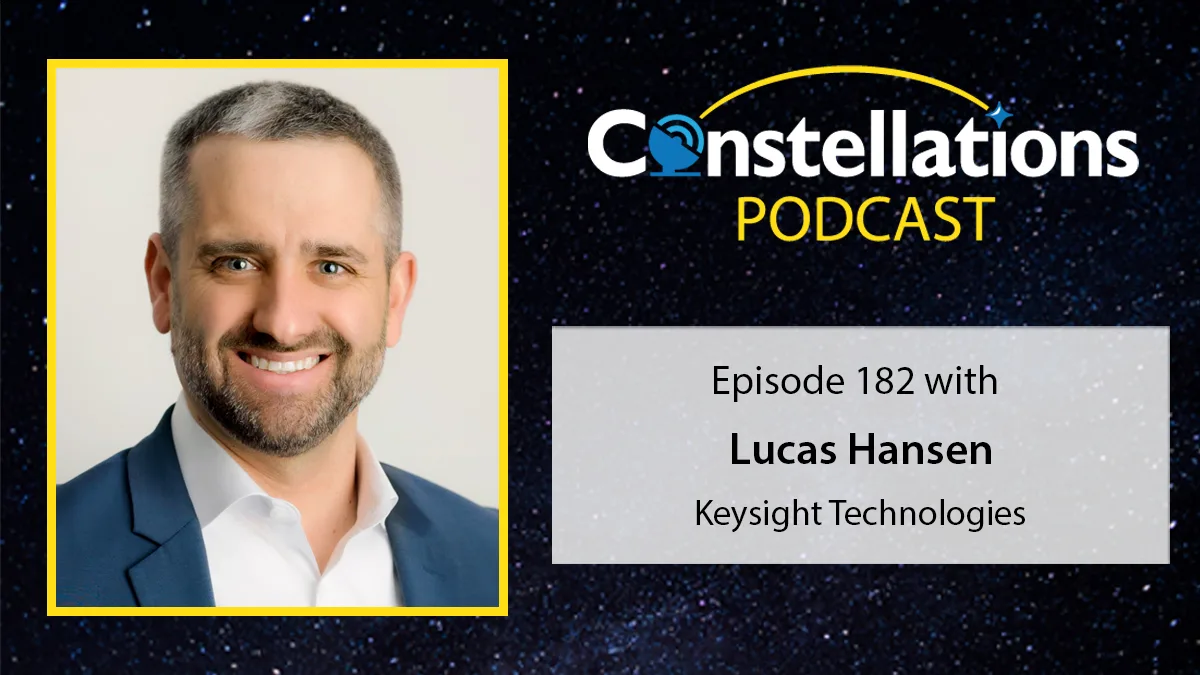
John Gilroy: Welcome to Constellations, the podcast from Kratos. My name is John Gilroy and I will be your moderator. 5G from space holds the promise to make mobile connectivity accessible to everyone everywhere. Past efforts to mainstream satellite communications did not have the advantage that 5G brings: a single technology standard that enables mobile network operators and satellite service providers to complement each other’s networks to deliver nearly ubiquitous, instantaneous connectivity for large numbers of devices globally. With us today on Constellations is Lucas Hansen, Vice President and General Manager of Wireless and Satellite Direct-to-Device Communications at Keysight Technologies. He will discuss the opportunities, challenges, use cases and the future of 5G from space. Lucas, this is a five-hour conversation, isn’t it? Wow.
Lucas Hansen: I’m looking forward to it. Five hours, 5G, we’re going to spend an hour on each G and we’ll make it happen, that sounds great.
John Gilroy: Wow. In the next 25 minutes, if we can scratch the surface, we’re going to mark this off as a big win. Wow. I’m going to try to get the mountaintops here, okay? Mountaintop to mountaintop and maybe we can give some insight for some of our listeners here. Okay. Here’s the first question, my friend. Mobile networks have been continuously evolving and advancing since the days of 2G. What makes 5G so much more transformational than the previous generation?
Lucas Hansen: Well, I think the key here is that 5G took a step forward, not just on single front, it wasn’t just adding data, but it was adding faster data, massive connectivity and lower latency all at the same time. And this was a major leap forward for the whole ecosystem to unlock new use cases and new applications. And in particular, as we talk more about the satellite today in the next four hours and 59 minutes, these low latency and massive device connectivity use cases are going to play right into our dialogues about non-terrestrial networks. So, 5G is really primed and has been built from the beginning to enable these sorts of use cases.
John Gilroy: Yeah, in my role, they call about digital transformation, and this is a transformation, maybe a communications transformation, but lots of changes ahead for us. Hey, Lucas, 5G has been described as a platform for future innovation. What does that mean from your perspective?
Lucas Hansen: As I just mentioned, it’s really about the new applications, the new services and the new technologies that are going to be unlocked with 5G. And people have asked, “Well, what is the killer app for 5G? What is that new application?” And really, non-terrestrial networks is the new killer app. There are use cases and scenarios where ultra-low latency and massive connectivity of IoT devices can only be realized with the satellite connectivity that comes to bear with 5G NTN. Think of those use cases of asset tracking. Think of these use cases of farming applications, remote areas, ships, airplanes, these are all scenarios which are difficult to address with a terrestrial network and a traditional terrestrial network. But maybe a little fun fact, when you are the high-speed stock trader in London and you’re trying to get that trade to New York first and faster than anyone, it’s actually theoretically faster to place that trade up to your non-terrestrial network satellite, your LEO satellite, and bring it down to New York because the speed of light is actually slower across those fiber optic cables running along the ocean floor. So, we’ll see if that one materializes for getting those trades in, John, but it’s an example of things that we are now going to unlock new use cases for these sort of future innovation as you described.
John Gilroy: We’re going to have to have you submit questions for Jeopardy because I would lost this question immediately. I mean, I would’ve thought cable instantly. Of course, I know the numbers. Let’s expand on this network-to-network things here. So, what role do you see satellite playing in the 5G network of networks?
Lucas Hansen: As we go forward, networks are going to become more complex. It’s not going to just be a satellite network. It’s not going to just be a terrestrial network, but it’s going to be a combination of these networks working together to extend coverage and apply the right technologies or the right networks at the right time. And so, whether it’s the high-speed trading application like I talked about earlier, or it’s connecting remote areas, unlocking remote schools for people who don’t have access to the internet today, these sorts of networks are going to work together and be a seamless experience for the users. And I think that’s really where, we’re going to talk more about that today, but it’s that user experience that’s going to be enhanced by unlocking these new use cases. And these networks coming together and working together, you can drive on your normal commute in a given day from Milwaukee to Chicago and you can find areas where you lose connection of your terrestrial connectivity, your data. And so, when the non-terrestrial networks and the satellite connectivity comes together, the 3GPP defined 5G will provide that seamless experience and make sure you maintain that connectivity.
John Gilroy: And especially for autonomous cars, there’s so many applications I can see coming down the road. I mean, what happens when you driving your car? What, do you pull over?
Lucas Hansen: That’s right. That’s right.
John Gilroy: Let’s talk more about these satellite networks. Can 5G make satellite networks as mainstream as other communication networks?
Lucas Hansen: And I think that the key here is that it will make it mainstream, because the market is just enormous, right? I think making it mainstream is absolutely going to happen. Any way you look at this, this is an enormous market with tremendous opportunity. Whether you want to connect the people who are not online, the 2.6 billion people who are not online today, or you want to connect to the people that already have a 5G smartphone, that number stands at 1.5 billion people that already have a 5G smartphone. And as you may know, that there are satellite networks that are planned to be launched to connect to any traditional smartphone. And then immediately that number jumps up to 7.3 billion smartphone users. And with announcements from folks like AST Space Mobile where they’re already connecting to the unmodified LTE smartphone, the market is just enormous. And every day we are demonstrating major milestones of the technical challenges and hurdles being overcome through the really smart work of industry leaders coming together to solve these challenges and solving those based on an industry standard. 5G, even 4G, connectivity to space has been demonstrated working and it shows that we’re on a tremendous path to mainstream adoption.
John Gilroy: You used the word innovation earlier and whether we like it or not, innovation normally means change. How will the satellite industry have to change and adapt to embrace this new 5G standard?
Lucas Hansen: Learning to spell 3GPP is a good place to start. I made it to the satellite show for the first time this year for myself. And so, I’m the telco guy, they called me, right? The telco guy coming to the satellite show. But I joke, because there were a lot of folks like me, the Qualcomm guy, the Nokia guy, a few of us were there for the first time, but we found it very informative and it was great to kind of build these new relationships and these connections to the traditional satellite industry players. So, when you say, “How are we going to adapt?” It starts with coming together as what was traditionally, I’ll say two siloed industries, but coming together, learning to speak each other’s language. I learned what a VSAT is, they learned what 3GPP is, and we can kind of compare notes because fundamentally what we’re trying to do, I will say, isn’t drastically different than maybe what we’ve done in our own worlds in the past, but it’s about bringing it together and talking the same language and unlocking the new potential in use cases we spoke about, which will change how we all consume our access and our data and our connectivity.
John Gilroy: Now Lucas, there’re parallels here. 20 years ago, people were talking about VoIP and they had to spill it all out, and now of course it’s an internal combustion engine. No, you don’t delineate that anymore. It’s kind of assumed, and I think this is a transition, I think where the humans kick and scream about it, if it benefits them, kicking and screaming is going to be a lot less for the innovation, isn’t it?
Lucas Hansen: Yeah, you bet. You bet. But it is change and change is often exciting and challenging, but worth it on the other end many times.
John Gilroy: Well, Simon Sinek says, “Start with why.” Well, I’m not going to start with why. I’m going to start with when. What is a realistic timeline for when satellites will be working as a part of 5G terrestrial networks?
Lucas Hansen: I’m going to kind of twist the question a little bit and say non-terrestrial 3GPP networks are working today. Now it’s 4G, so it’s a little bit of a subtlety, but when we look at folks like Skylo, Skylo has launched a 3GPP defined non- terrestrial network based on the NBIOT definition, which is a 4G technology. But that is now, that 4G NBIOT, has been updated for release 17 in 3GPP to be an NB-NTN application. 4G non-terrestrial Networks and satellites are working today and there are various partnerships around the world with big players like Deutsche Telekom that have been announced and are commercially available. Now, as we look forward to 5G networks, the acronym often used is NR-NTN and the NR-NTN will require some new satellites to be launched. It has higher data implications and working on the satellites necessary. And we’re going to see that towards the end of the decade here, where launches may come as soon as the ’26, ’27 timeline, and then really integration happening in the second half of the decade, such that as we are going into 2028, ’29, NR-NTN networks will be live and operational and come into our phones as a native 5G.
John Gilroy: Lucas, I’m sure there’s listeners, we have listeners all over the world, that can go toe to toe with you with these fancy acronyms, NR-NTN. But every single one of my listeners is interested in this acronym. It’s called P-R-O-F-I-T. It’s the money question. So, what are the business opportunities here for the satellite industry in terms of adopting a new 5G standard?
Lucas Hansen: The business situation’s really going to be key to driving this because we need to have the ecosystem to be able to make money at this. That’s unequivocally important. And again, it helps pay for all my engineers working on this hard work. But ultimately there is an easy application of just backhaul services. The satellite operators know this business today and it’s going to be expanded by using 5G to use the economies of scale, the 5G technologies. Bringing together an ecosystem of players will ultimately reduce costs and make it easier to scale these solutions across many different operators, many different handset makers, VSAT makers. There is tremendous opportunity across that value chain to reduce costs and make the hardware and software solutions more pervasive throughout the ecosystem. Now, that’s kind of the one side of it. The other side is accessing new markets, right? New IoT connectivity, new communication, new data service access. And back to the numbers that I spoke to before, the billions of smartphone that are already out there, the billions of people who have not connected yet, it doesn’t take too long to add up and to create a use case that shows that these are markets that are untapped and customers will pay for new access regardless of where they are. The other stack that I like to quote is the 5G operators in North America have spent a hundred billion dollars on 5G spectrum alone. That’s just the spectrum that they purchased. So, they are keen to being able to use that spectrum and use that spectrum most effectively. There are some challenges, and I’m sure we’ll speak about them more, about the regulatory implications of the spectrum into working between terrestrial and non-terrestrial, but using that spectrum and maximizing the return on that spectrum will also drive the operators to invest in these new use cases. And what’s a couple billion dollars for a LEO constellation when they’ve already spent a hundred billion on the spectrum itself?
John Gilroy: Yeah, let me get my checkbook. I’ve been taking notes, assiduously taking notes as you were speaking and I wrote down Skylo and maybe see if I can put this all together. We’ve seen the rollout of a number of satellite device-to-device solutions and partnerships, many proprietary. How do these solutions fit into the 5G ecosystem, this billion dollar big system?
Lucas Hansen: Yes. Yeah, I mentioned Skylo earlier today, and that’s an example of a direct-to- device or also known as a direct-to-cell, so D2D and D2C are another set of acronyms that you’re going to be picking up here as we dig deeper into this 5G ecosystem. And D2D really are dependent on a mobile network operator, a chipset, and a device, all working based on the same standard. And in this case, and in the Skylo example, we have a 3GPP defined NB-NTN standard, it came out with release 17, and we’ll have further enhancements with release 18 and beyond. And you have a Qualcomm chipset which speaks standard, the 3GPP standard, and then you have a device maker that designs the device. So, those chipsets, whether they be Qualcomm or MTK, and those integrated devices now come together and speak the same language of the NTN standard on the Skylo network. And this is where this will accelerate moving forward. That sort of ecosystem play will go forward as we go from NB-NTN, the Narrow Band NTN, to the 5G- NTN in the future. And the form factors of the devices will evolve and will change. So now, your direct-to-device may become a car. Maybe you’re streaming your internet or your autonomous vehicle scenarios, like you mentioned earlier, to an auto. So, the device or the cell in the device will evolve, but the use cases are similar in that they work between the terrestrial and the non-terrestrial network seamlessly. The proprietary solutions on the other hand will be there and will sustain over many years to come, of course, because perhaps they’re optimized for specific needs of that use case. Aviation scenarios, maritime scenarios, they may need these proprietary solutions for some time. The third scenario is that the proprietary solutions simply exist until the standards body can address the specific needs of those standards. And so, that’s where the pre-standards work goes into play by all the industry leaders that work together to develop the standards on these use cases. And they’ll evolve and then eventually launch with the right chipsets and operators and devices to support many different use cases, including the proprietary ones.
John Gilroy: Use cases, use cases. A guy named Donald Miller wrote a book called Storyboard, talking about telling stories, and that’s what a use case is, is telling a story because it communicates better than fancy acronyms or all these big numbers. So, I’m going to ask for a use case out of you. Tell me a story here. What do you see as the key space-based 5G use cases that will be deployed? Mobile connectivity, IoT, device-to-device? What do you think the ones are going to come out?
Lucas Hansen: What you’re describing are use cases that won’t necessarily be launched serially, but will all be able to be launched in parallel. And this direct-to-device, this direct-to-IoT scenarios, these are all use cases that are going live today with the Skylo example that I spoke about and will continue to expand moving forward. One of the use cases I can tell you will not be there anytime soon, is you’re streaming 10 gigabit data throughput test cases that when I’m getting on the plane and I need to quick download that big movie so I can watch the movie on the plane. Well, I’m going to depend on the great Verizon ultra-wideband network that’s at Chicago O’Hare Airport and I’m going to use that to download my movie. But once I’m in the plane and we’re in this future state, enhancing that data connection to the plane and giving me more than just the bare minimum of data connectivity as I fly from Chicago to London, that’s really the use cases that are really going to get disrupted early on and be expanded as we move forward with this ecosystem of users developing devices, developing chipsets, even developing satellites based on 5G.
John Gilroy: I used my acronym earlier, P-R-O-F-I-T. Let’s use it again here. We’re going to drag this one back up. Mobile network operators have not seen the ROI from their 5G investments to date. So, can chat satellites change that whole trend?
Lucas Hansen: Absolutely. And I think what I mentioned was getting the economies of scale to reduce the infrastructure costs of satellite deployments along with the reduced launch costs that we’ve seen disrupt this industry in the last five years or so, both of these coming together will help the mobile operators to become more profitable in their deployments to connect the underserved and the under- connected around the world. These networks cost somewhere maybe at, a LEO Constellation you can launch for 1, 2, maybe $3 billion, and again, a lot of money, but it would be orders of magnitude higher if the same type of connectivity to the same number of users would be built out in a traditional terrestrial model. So, you saw just this week, AST Space Mobile and AT&T formalized their partnership where AT&T is committing to AST as their partner to deploy these services. And I think you’re going to see more and more of these announcements as the operators are figuring out that ROI to the use cases that are going to drive the incremental revenue streams and AST can build out and offer that connectivity at a reduced cost as opposed to a terrestrial connection. So, it’s exciting because as we speak, we see the economics playing out and we see the operators expanding in these areas.
John Gilroy: So Lucas, we’re talking innovation, we’re talking change, and we might as well throw in the word that everyone encounters, is challenges. So, there’s challenges with all this. What are the challenges for the satellite industry in terms of adopting this 5G standard?
Lucas Hansen: When I think of the challenges on the satellite industry and the 5G standard, I think about two major buckets. There’s a regulatory and spectrum allocation bucket that is coming right out of the gate as a challenge, and we’re going to need to figure that out and how the spectrum is allocated and between the MSS spectrum and the terrestrial spectrum, how those scenarios are going to work together and ensure that there’s minimized interference and clearly has the regulatory support needed. That’s probably one of the big buckets. The other bucket that I like to think about is the user experience. What is the energy impact, the battery impact on the device? And that doesn’t just cover the device, it covers what is the energy impact on the satellite, right? When you’re charging off of those solar panels, can the satellite handle the processing required to drive these sorts of data rates and connections to volumes of devices generating hundreds and thousands of beams, hopping those beams around to maximize the coverage? Clearly the energy side of this is a big deal. Also in the user experience is mobility. How is my device going to hand off seamlessly between a satellite and a terrestrial network? And then finally, the third of these user experience challenges I speak about is the latency and the throughput. Customers have a certain expectation for latency and throughput and performance of a 5G network. Now, what happens when those data rates are dropped back because of the capacity in the system? So, I mentioned earlier that maybe full data throughput isn’t the killer app on satellite use cases, but latency and connectivity to many devices is, we’re going to need to make sure that that user experience is modeled, is tested, and is qualified so that when these networks launch, they’re launched with good quality and great customer experience. The small plug for Keysight is that’s what we do. We emulate those use cases in those scenarios, and we’re working with a number of the industry leaders right now to profile and model and help make decisions about network design that optimize for energy mobility and latency performance.
John Gilroy: Lucas, believe it or not, I have a mandate in front of me, well, I have to say the word artificial intelligence every 27 minutes of my life, so I have to say it. So, you know it’s coming. You probably use it five times already today if you follow the mandate. What impact will artificial intelligence and machine learning have with these advancements in mobile and non-terrestrial networks?
Lucas Hansen: Yeah, I know that one. That’s for sure. If we don’t talk about AI, my phone starts to buzz and it reminds me-
John Gilroy: Right, you got a reminder.
Lucas Hansen: Yes, yes. The AI-ML is really going to, I see, it’s going to have lots of impact, and you can kind of think of it again in two buckets. One bucket is, how are we going to enhance the network? How is the network going to make those right decisions, when to use the terrestrial network, when to use the mobile network, the non-terrestrial network, excuse me? How are we going to enhance the security? How is the allocation of the resources going to be properly applied? So, AI is going to make a tremendous impact on making those decisions smarter and faster. The second part I think about AI is really driving the fundamental use cases. AI- on-device is coming. I mean, we can see that train marching down and coming at us quick. So, with AI on the device, how is the device going to communicate back to the servers where these AI models are being trained and implemented? And I believe that that sort of low latency type of use case, where it’s communicating quickly back to the data centers to run the AI models and then provide the results to your device, is going to introduce a whole new wave of AI enabled devices. Those AI enabled devices and smartphones will refresh right at the time when non-terrestrial network connectivity is also being built into the phones and going to play out. One half, AI is going to make the networks optimized and run better and smoother and cleaner, and on the other half it’s going to drive a refresh cycle and a new user experience, terrestrial networks, non-terrestrial networks can work together and drive those usage by the device holders, which ultimately then, back to the profit, will pay for and drive the revenue for the operators who are deploying these technologies.
John Gilroy: Let’s throw out this artificial intelligence, I want real intelligence out of you now. Let’s throw out all the prepackaged answers and all the nonsense we’ve seen. Let’s look into the future here. What advancements will 5.5G and 6G bring to the satellite industry?
Lucas Hansen: The key here is that 5.5G or 5G advanced, it’s also called, and 6G is going to be that pivot time between when non-terrestrial and satellite networks came to cellular and then they were native to cellular, okay? And that’s really what 6G will be. 6G will have the non-terrestrial capabilities native at launch for 6G and those 6G launches are lining up pretty well with those timelines that I talked about earlier in today’s podcast. At the end of the decade, beginning of 2030 is when we’ll start to see early 6G devices and at that point, the non-terrestrial networks will natively integrate with your terrestrial networks and five-and-a- half-G, as you called it, 5.5 or 5G advance, is that proving ground where we got to figure out a whole bunch of those technical challenges that I spoke about today and to enable the higher data rates, the improved efficiency, the better security, all those kinds of things that are going to come with these network of networks, as you described, need to get figured out now, today. It’s about bringing together the ecosystem of traditional satellite and traditional telcos or wireless comms folks, like what we do, and solving those challenges together to know the tradeoffs that need to be made and how we implement those the best, such that as we move into 6G, we’ve learned from those experiences and we can really take that next step function forward of capabilities in the standard to really make satellites a realized native part of our everyday communications.
John Gilroy: Well, Lucas, we’ve certainly covered a wide range of topics here today. I think you have given our listeners an appreciation for the advancements in 5G from space. I’d like to thank our guest, Lucas Hansen, Vice President and General Manager of Wireless and Satellite Direct-to-Device Communications at Keysight Technologies.
Lucas Hansen: Thanks, John.