Transcript:
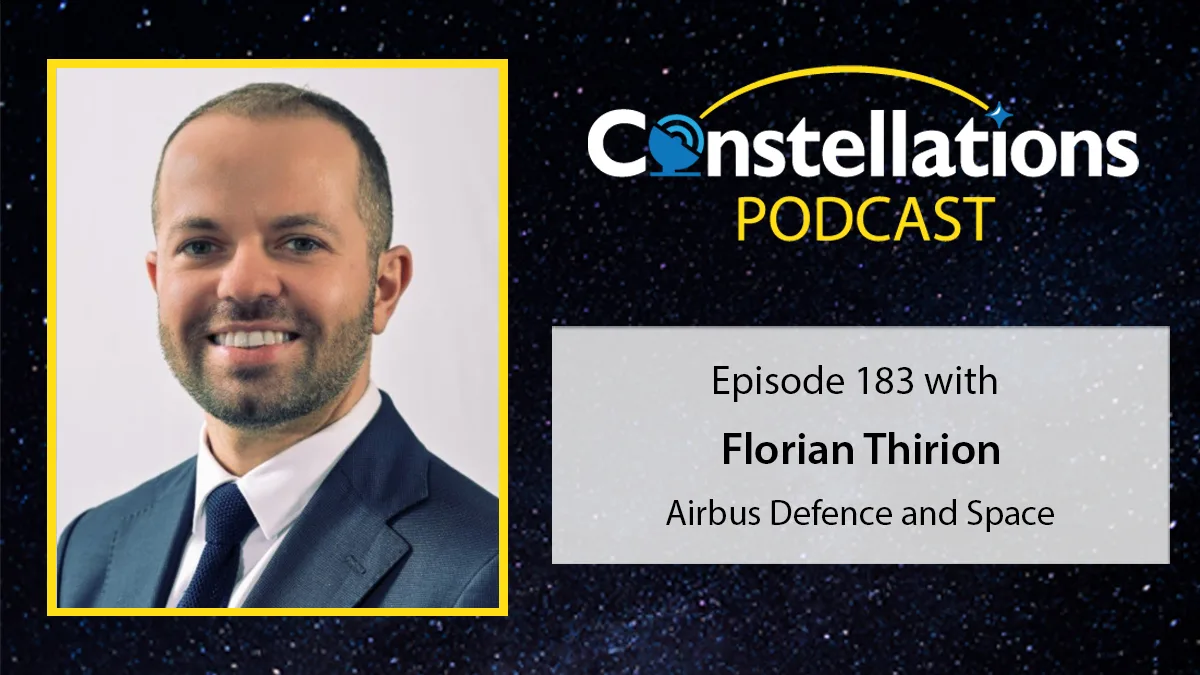
John Gilroy: Welcome to Constellations, the podcast from Kratos. My name is John Gilroy and I will be your moderator. Today, our guest is Florian Thirion. He’s the Senior Product and Portfolio Marketing Manager at Airbus Defence and Space. We’re going to focus on, believe it or not, satellites. Speaking of satellites, there are an estimated 27,000 satellites with flexible architectures, and these are all forecast to be manufactured and launched between 2021 and 2031 according to the folks over at Analysys Mason. Now, this change is a real game changer for the satellite industry. Generally speaking, they have been constrained by capacity and flexibility issues. These new software-defined satellites offer satellite operators dynamic capabilities to scale with their business models and the services they deliver for customers. Here to discuss software-defined satellites, the capabilities they offer, and the advantages they bring to address today’s market challenges is, as we mentioned before, Florian Thirion. Florian, let’s jump right in here. Can you discuss the satellite market and how it is evolving and driving the need for software-defined satellites?
Florian Thirion: Sure. Thanks, John. Hello, everyone. First, let me introduce to you to the telecommunication markets. This market is covering many applications. First, broadcast, providing direct television and radio to end users. We all know our habits are changing, we are more and more using streaming platforms, Netflix, Amazon, and many more. This is why this market is currently declining. Then we have broadband telecommunication satellite delivering high connectivity everywhere on the globe. It’s a complementary asset to terrestrial networks. We have also another one, mobile communication. Here the satellites are providing communication to people, things that move like boats or planes, in a region where you do not have coverage from terrestrial networks. These satellites are also distributing secure communication to armed forces and government agencies for the daily and overseas operations. Last but not least, low data rates. Internet offering also uses telecommunication satellites for a variety of missions such as autonomous car, for example. As I said, this market is changing. We see an explosion of data, internet in mobility, streaming, and on-demand video, Internet of Things and the capacity price is dropping in all bands and services. It means that the operators will need to find new markets, diversify their businesses. We also see that fixed satellite service revenues decline to the benefit of high-throughput satellites for a mix between video and data. We see also a market uncertainty with a lot of new players, start-ups, new companies. We see also emergence of constellations and the increased price per capital. It means that it’ll be even more difficult for operators to buy new satellites. So all these trends led to a massive demand for more flexibility to diversify operator services, improve their capacity price. It will lead also to very high pressure on the delivery and time to market and price sensitivity as well. The price is more sensitive than before. This is why the market is moving towards software-defined satellites, manufacturers aim to offer more sellable capacities and optimize operations to operators with easy-to-use operational tools, reduce the time to market with a generic design and mass production facilities and allow very high flexibility in coverage power and frequency to drive more revenues and open new markets.
John Gilroy: Florian, could you walk us through what has caused the evolution from traditional bent pipe satellites to software-defined satellites? What motivated this change?”
Florian Thirion: So as the market became more and more uncertain, operators have requested to shift from fixed coverage to flexible coverage. So if we do a short comparison, we can identify that in term of production, for example, with traditional satellites, bent pipe satellites, they are fully customized. So you can customize the payload as much as you want. It means that none are similar, which led to more complex ability and delay in production sometimes. With software defense satellites, again, it’s a generic design. So software defined satellites are offering shorter development production, and the production cycles will change as well with automatic processes, better test optimization, etc. If we look now to the price and procurement with traditional satellites, most of them, and most of the time, they are more expensive to build. You need to order new and different equipment from your suppliers according to customer requests, for example. Now if we look to flexible satellites, again, it’s a generic designs. This will enable mass production and reduction of the price through high volume of production, efficient procurement, and better stock management. The third one, if we look now to the architecture, it is most of the time very complex as you need to define a new architecture for each new customer. It is very dependent on hardware. So while software-defined satellites are offering simple architecture and simple design, this will lead to a different configuration and all these different configurations can be customized by software. So you have less hardware complexity, let’s say. Finally, if we look to the coverage and operations, it is also very different. With traditional satellites you will have a fixed coverage over the Earth. It means that over 15 years, an operator will deliver coverage over the same area and will not be able to change it. So you better have a good idea of your market and business case. While with software defined satellites you will be to change the coverage over 15 years and so meet evolving and uncertain market needs.
John Gilroy: Well Florian, I’m going to refer to an American movie here, years ago there’s this movie called The Perfect Storm. I’m listening to all these changes, I’m taking notes and everything else, and it’s like, well, how come this didn’t happen 10 years ago? I mean, why not 15 years ago? I mean, 2024. So from a technical perspective, do we have this perfect storm to allow companies like yours to develop these software-defined networks? You’re looking out the window, do you see a perfect storm for your technology?
Florian Thirion: Yes. We can speak about different type of technologies. We came up, let’s say, with software-defined satellites. The first one I will say is digitalization and also the miniaturization of processors. This will offer a coverage frequency and power flexibility and better resource management within the architecture of the satellite and within the operation of the satellite as well. It’ll also offer the ability to process a high volume of data. It is key. It is key as we are in the middle of an explosion of data, it is just the beginning. Another one is the development of active antennas. The development of active antennas has allowed the possibility to create digital beamforming. It’s a key element for generating more flexibility. The third one, I’m referring here to SSPA, SSPA for solid state power amplifier. So we have developed this technology instead of nanotube. This will provide the ability to embark larger and cheaper antennas. So it is key for software-defined satellites. Last, I will mention regenerative processors. It will reduce the price of ground segment and better use of capacity. We think that in the future, this technology will enable those satellites to be more and more autonomous. Impressive, isn’t it?
John Gilroy: My software development buddies, I’ll talk about the killer app. “This is the killer app and this is the app and that’s a good app and that’s a bad app.” I think some applications fit in this environment and some are not a good fit. So from your perspective, Florian, what applications are best suited for these dynamic satellites we’re talking about?
Florian Thirion: I would say all, everything is possible with this.
John Gilroy: Everything, wow.
Florian Thirion: Everything is possible with this new kind of satellite. I mean, it’s just amazing what you can do with it. But for example, if I give you some of them, I would say first the service transition from wideband to HTS, for example, or for example to video to HTS. It’s also a complementary asset to digital divide use. So for example, when a geographical transition occurs until the development of terrestrial network, so it means that you will be able to connect people that were not connected before. Just for information, more than two billion people are still unconnected in the world, so it’s very important. It’s a new market to target for operators. I would say also everything about mobility. So this is a new kind of satellite you will be able to follow with a dedicated beam, a boat or plane, all along its itinerary offering critical communication and high connectivity. This new satellite will be able to generate thousands of independent beams, simultaneously. Each beam will be unique in size, shape, and power, and can adapt in real time. Last I would say, for example, giving resources to crisis management services. So offering new critical and direct communication and connectivity for mission operation. So for example, during fires, during earthquakes, during floods, as it is flexible, you can just adapt the coverage and give a communication for supporting crisis management operation.
John Gilroy: Florian, this podcast will be available at constellationspodcast.com. We normally have a transcript with it, and I’ll bet when people review the transcript, they’re going to focus on the money because that’s what people focus on. They focus on, “Is this going to reduce cost? Is this going to increase revenue?” We have all these flexible options, all these two billion people, that’s fine. But is there a way there a marketing strategy for satellite operators to increase revenue and reduce costs? I mean, it’s really where the rubber meets the road here, it’s like, okay, you can do all these things, it’s great, but where’s the opportunities to increase revenue?
Florian Thirion: So very good question. I will say that software-defined satellites, they will enable lower and progressive CAPEX. I said earlier, we will be able to manage efficient gateway deployment. So lower CAPEX, share capacity between operators. It means that an operator will be able to resell, for example, 50% of its capacity to another operator. It is pretty new. Some of the manufacturers, as we do in Airbus Defence & Space, have used the opportunity of this new software-defined development to introduce better stackability within the launcher for medium-sized GEO satellites. So for example, with OneSat, OneSat today is stackable by two and the owner will be able to share the launch cost with another operator. It will significantly decrease the launch price, improve the business case of an operator. Just for your information, so launch cost usually represents approximately 30 to 50% of the overall telecommunication satellite procurement cost, so it is significant. It will also enable lower OpEx. The new operational tools based on software technology will minimize the operation cost, the required number of qualified people, and improve resource management. In addition to that, it will provide higher field rates, which lead to better financial performance. And at the end, this equation leads to a better cost per bit in orbit.
John Gilroy: Got it. Got it. CapEx. Next week I’ll be in a rural area and I’m sure I can look up at night and see satellites. But the satellites always come down to ground stations. So let’s talk about ground stations. So we’ve talked about software-defined satellites, we’ve talked about flexibility and dynamic configurations, we’ve talked about multiple topographies, we bounced around a whole lot. Let’s bounce back down to the ground. So how do these software-defined satellites work with ground systems?
Florian Thirion: Yeah, so with the development of software-defined satellites, it’s an end-to-end offer. Usually the manufacturers are not only selling a satellite anymore. With software-defined satellites, they will sell an end-to-end offer with the ground, with software operational tool to control the hardware and the payload configuration and the resource management and to optimize the configuration coverage and frequency plan. So in different words, with software-defined satellites, manufacturers are not only selling spacecraft anymore, it’s a complete offer. They will use operational tools to define the best configuration, to define the best dynamic target, and also to ensure seamless transition from one configuration to another. So what is changing from what has been done before with the processor on board, operators will be able to adapt the coverage and the frequency plan according to the demand and different type of events. They will be able also to allocate, adapt, and change resources in real time. While it was not the case before, as the coverage was fixed. All along the year, operators will be able to open or stop resources almost I would say every 10 or 15 minutes with new terminals. So it will be very, very dynamic. As it’s fully dynamic, operators will be able to optimize their planning of operation, use algorithms or automatic processes to get better efficiency. This technology will increase the number of operation, I’m sure of it, and optimize the revenues at the end. So in terms of support as well, it changed a lot with this software-based operational tool they will provide better maintenance and service support as maintenance or new version can be assisted or deployed remotely. It was not the case before as it was fully hardware. So with software-based operational tool, yeah, you will be able to give maintenance and any type of services remotely. So this is key for us. It’s key as well for operators. On the long run, it will also increase the ability to build and control multidimensional network to create global and diverse portfolio between GEO and non-GEO. So with this kind of software-defined operation tools, yes, there will be no limit between non-GEO or GEO operation. You will be able to control different type of constellations and satellites on LEO, MEO and GEO. This is where we’ll be able to develop all the multi-orbit orchestration roadmap that we are seeing today.
John Gilroy: Florian, to conclude, what do you believe this new software-defined satellite world will look like in the next five years?
Florian Thirion: Yeah, thank you, John. It’s always a difficult question to respond to, but I will give you my thoughts. Let’s say that first I think that GEO satellite will remain a very resilient asset. It will be a complementary asset to constellation. For example, I think there are some very suitable applications for GEO satellites, such as TV, video, and broadcast. It will also be the case for government applications So, I think there is a natural complementarity between GEO and LEO. It will still be the case in the future. GEO will definitely remain a strong part of the business for sure. Now moving back to what will be the future of software-defined satellites, again, difficult to predict, but I think that as soon as the commercial operator will test, and use this kind of satellite, see the potential of it, see how it is beneficial for their businesses, they will acquire more satellites, and open new market on top of their core business. It’s obvious, they need a growing demand for coverage, adaptability, and CapEx, a better efficient CapEx, to better structure and optimize their operations, their strategy, and also their business case. Also, I think constellations and GEO software-defined satellites have significantly changed the architecture for telecom system and ecosystem. So, space and ground segment are getting more and more integrated. Complementarity between orbit is a recurring topic. It will still be the case in the future for sure. So, I think that all the technology developed for GEO software-defined satellites will be spread into the full ecosystem on each orbit: LEO, MEO, GEO, and as a trend is to be more and more multi-orbit orchestration, more autonomous, and more flexible. About future technologies, I think these satellites will be 5G compatible with the 5G standardization that’s coming up. We will be able to provide the broadband connectivity within a unified terrestrial and non-terrestrial network. It will be fully transparent for users and it will enable seamless connectivity wherever it’s needed. And I think they will also embark optical communication for establishing ultra-high throughput laser links between GEO and ground infrastructure, for example. And also I think they will enable massive data transfer. So, I don’t know if you know this technology, John, but it’s very impressive. So for example, this technology will allow from 10 to 100 gigabytes. I repeat, from 10 to 100 gigabytes of data transfer, and also terabit per second for ultra-high throughput satellite system, so very impressive. It means that governments, operators using this technology will have the information before anyone else, so it’s a key enabler. We think also that everything about cloud connectivity will be a key enabler as well. One of the perspectives that we have in mind is cloud connectivity on the ground and in space driving the expansion of cloud computing and the need to feed data-driven business model with massive data sets. This will lead to cloud in space to accelerate data processing and artificial intelligence. All these technologies will be part of GEO software-defined satellite roadmap. We are pretty sure of it, and in Airbus we’re working very hard on all these topics. And to sum up in terms of markets now, the future of this flexible satellite will be, again, in complementarity in orbit to address the area connectivity market, for example. We think also that the integration with terrestrial network is essential for the business. So, satellite could become a node in a global network with full integration with the terrestrial network and multi orbit complementarity. In term of customers now and operators, software-defined satellites will be a game changer. It will be an enabler for new business model offering the ability to have a reconfigurable solutions with, for example, the overlay of services, video data, mobility. It will also be a key enabler for the collaboration between operators. So, partnership between Thaicom and Eutelsat has been a perfect example of it. And last, I would like to mention that it should trigger opportunities for new financing models. By new financing models, I mean leasing for example, all the second-hand market. So, this new type of satellite will enable this kind of new financing model as well. And finally, in terms of sustainability, as space enthusiasts, I think we need to think about protecting the space environment. I would like just to share with you that with only three OneSat in GEO orbit, you have a global coverage for a fraction of the cost of a LEO constellation. So, it means that at the end you will have less hardware in space, and so less orbit congestion and potential collisions. So, that’s it from me. John, thank you to Kratos. Thank you to you, John, and thank you all for having listened to this podcast. Have a good day.
John Gilroy: Good. Well, I think Florian, what you’ve done is you’ve given an optimistic outlook in a very detailed manner for our listeners to try to figure out where they fit in this whole world of software-defined satellites. I’d like to thank our guest, Florian Thirion. He’s the Senior Product and Portfolio Marketing Manager at Airbus Defence and Space. Thank you, Florian.
Florian Thirion: Thank you all for listening, thank you John and cheers, have a good day!