Transcript:
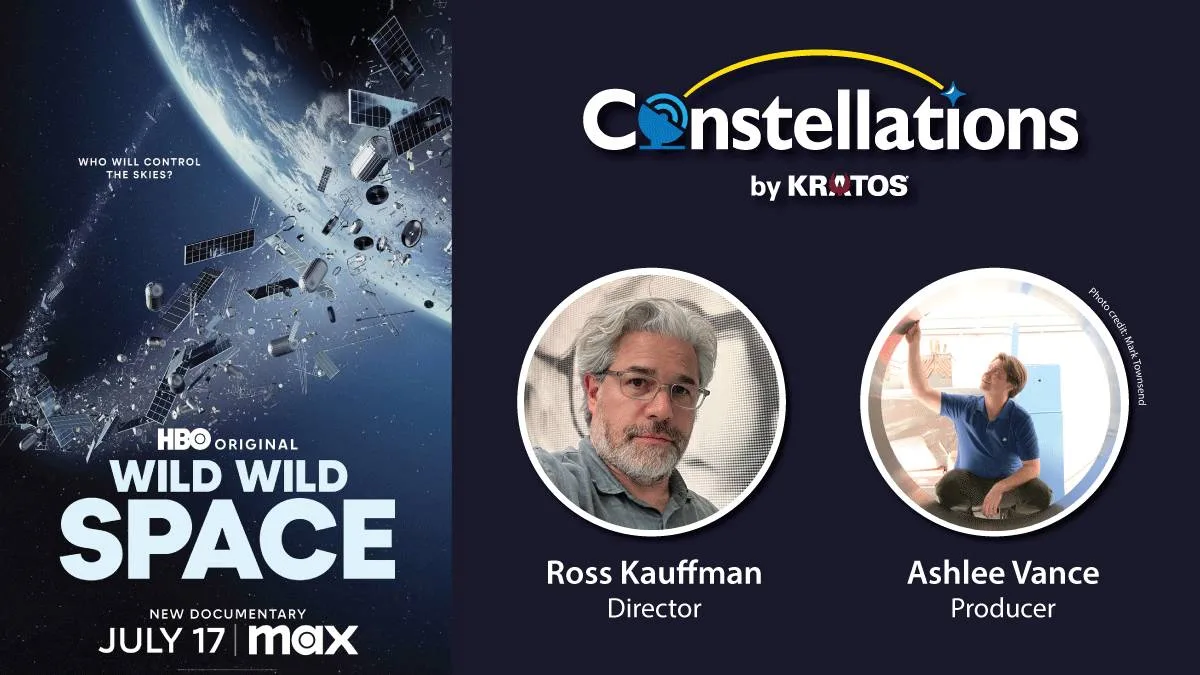
John Gilroy: Welcome to Constellations, the podcast from Kratos. My name is John Gilroy and I will be your moderator. Today we’ll talk about the documentary Wild Wild Space coming out on HBO today, July 17th. Joining me are director Ross Kauffman and producer and technology writer Ashlee Vance. Well, gentlemen, Wild, Wild Space is getting a lot of attention. Most of our audience is familiar with or even know personally the people in the movie, but they may not know what’s going on behind the scenes. Well, tell us what this movie’s all about.
Ashlee Vance: Well, it’s a story about the rise of commercial space in a lot of ways. I think people are familiar with the billionaire space race that gets covered in the press quite a bit with Elon Musk and Jeff Bezos and Richard Branson sending up rockets. And we tried to tell a bit of a different story here, which is some of, as the title suggests, the wild underbelly of this industry. And we have an amazing set of characters that we followed for a number of years. And I think this is meant to show people a very funny, entertaining, dramatic story about something they’re maybe not as aware of as they should be, which is capitalists coming for space.
John Gilroy: Ross, when I saw the title, I thought of that movie, Wild, Wild West, and thought of Gun Slingers and Indians and all kinds of trouble. So is that what you’re trying to get with the title? I mean, what a catchy title.
Ross Kauffman: Yeah, I mean, we were just trying to capture the feeling really of Ashlee’s book. I read Ashlee’s book about two years ago or a year and a half ago, I think. And it has this quirky, fun sort of sardonic tone to it and meeting the people in the film, I was just really taken with them. And as we started to film with them and as we started to really craft the story, it became very evident that it was a kind of bizarre wild ride. And I try to explain it to people, and I say, this is kind of a romp through space, but with a very intense kind of underlying message and the underlying theme. This is an industry, this is a part of our lives that we have to be really careful about and keep an eye on in the near future and now.
John Gilroy: Actually, I walked to my front porch this morning and I found this book sitting there, When The Heavens Went On Sale. So that’s your book. So this is kind one of the basis for the movie, huh?
Ashlee Vance: Yeah, I mean, I started this project about six years ago researching the book, and I’d done a previous biography on Elon Musk and sort was not a space junkie before, but got really into the SpaceX side of things. And coming out of that book, it just gave me great access to this new world. I looked around the planet Earth and saw there were people trying to be Elon Musk in all kinds of different countries, New Zealand, Ukraine, all over the place. And so that informed a lot of the storytelling here and just my interest in the subject. And then we managed to get cameras into places that you don’t usually get cameras inside of as a result of some of this access.
John Gilroy: Ashlee, I think your book focuses on three companies. Astra and Rocket Labs are launch companies, but Planet Labs are, I think it’s a earth observation company. So why those three?
Ashlee Vance: Well, I thought the rocket companies are always super sexy because you got the fire and the rockets and everybody tends to pay attention to them. I think it’s the most public facing part of the space business, but it’s the satellites that actually do stuff and is where the real money is and the real action. And that’s to some degree, the heart of our story in some ways, at least from a technology and business perspective, is that we are exponentially adding satellites to low Earth orbit. And I don’t think many people are paying attention to this. And so I felt like you had to cover both aspects of this. And then as Ross will probably tell you the story of Planet and Astra in particular are quite intertwined. They came out of this NASA Ames, the Silicon Valley NASA Center. And this is in some ways also the heart of our film is this group of friends who all met at NASA Ames and were led by this brigadier general from the Air Force, Pete Warden, who’s quite an iconoclastic figure and assembled this young group of people to think about space differently. And both the film and the book explore what all these people did.
John Gilroy: So Ross, is that what engaged you to make the movie? You have these dual champions here going after each other? Was there something particular you found exciting?
Ross Kauffman: Yeah, well, I mean, Ashlee’s book covers a number of different companies kind of all over the world, right Ashlee? I mean, 8, 9, 10 different companies and a number of characters. And as Ashlee just said, there was this one group of characters who really have known each other for a very long time. Chris Kemp from Astra, Peter Beck from Rocket Lab, and then Will Marshall and Robbie Shingler from Planet Chris Kemp and Robbie and Will and Pete Warden sort of know each other from NASA, right? So Pete sort of raised these kids and at some point I was even thinking about maybe naming the film Pete’s Kids because Pete Warden played such an incredible role in it. But what I really reacted to and what I liked is not necessarily- the rivalry is incredible between Peter Beck and Chris, Astra and Rocket Lab. But I love this idea of this family of friends, almost these found families. And a lot of my films end up being about these found families and people who just find each other and connect and support each other through thick and thin. And in some of these cases, there’s a lot of thin in this movie, people are having a hard time. But yeah, so that’s what I was really interested in. And the rivalry between Rocket Lab and Astra is obviously fascinating and it’s a fun ride and it’s a lot of stakes.
John Gilroy: That’d be a good thing for the book too. It was a fun ride, huh? Not bad. So Ross, tell me what it was like filming. I mean what technical difficulties? Logistical difficulties? I mean, Ashlee’s been, I don’t know, French Guiana and half the places around the world. So what kind of technical difficulties did you have?
Ross Kauffman: All the above. I mean, there’s always difficulties that are inherent to each different project, and this is no different. Ashlee really started filming. I mean, Ashlee, we never even talked about this. You kind of started as research filming, or did you start filming really with the idea of a series? Like in 2017, 2018?
Ashlee Vance: I was getting into these rooms and realized the access was pretty rare. And as I was doing my reporting and I was like, oh, would you guys let me have a camera in here too? I make a television show for Bloomberg called Hello World. And so dabble in this area, but was not an experienced filmmaker. So I started getting the cameras in there. I thought maybe there was this big global series and went at this very much as an amateur and got in over my skis and had to bring in the professionals to actually turn this into a film.
Ross Kauffman: So I mean, I came on probably about 2, it feels like 2 years ago, there was a lull of shooting during Covid, obviously. And coming out of Covid there was 250, 300 hours of footage and no real direction, which is great for me because I thought, all right, here’s a lot of footage, let me sift through it. Let me figure out if there’s a story here and what the story is. And that’s kind of my job. I have an editorial background. I was an editor for years, so myself, my editor, my producer, incredible editor, patient boarder, and wonderful, wonderful producer, Jay Callahan, the three of us really sifted through this footage and then had to figure out, all right, what direction are we going to go in? And there were a lot of different stories and a lot of different possible films that you could make out of this footage. And so we really just honed in on it, crafted and just came to this point where we’re like, all right, Pete’s kids, Peter Beck, Chris. And then as the film was edited, the stories kind of revealed themselves.
John Gilroy: Well, Ashlee, I’m based in Washington DC, and we used to have this guy named Donald Rumsfeld in town here, and he talked about the unknown unknown and the known unknown and all kinds of unknowns. So what about you and researching this book? Any unexpected discoveries from researching your book, maybe doing this film?
Ashlee Vance: God, so many. Well, Donald Rumsfeld, it’s funny you bring him up. He’s the inciting incident for much of this story. He actually fired Pete Warden, Pete was running this kind of disinformation campaign after 9/11, and the New York Times caught wind of it, and that spelled the end of the disinformation program. And Pete fell on his sword for that one, and Rumsfeld fired him. But as a reward, as payback for taking the fall, they gave Pete Warden the NASA Ames Center in Silicon Valley. So that sort of set this off. I mean, look, yes, there were a lot of discoveries. I think I really want to emphasize to people, almost everything we see about space is like our best and brightest, our most courageous people, these heroic engineers filling these rooms at NASA. And this is not that story, and people should know that that’s really not the story of modern space, current commercial space. This is a business now, it’s full of very eccentric, ambitious characters. When you walk into these factories, it’s guys with Mohawks at the mission control, all these welders playing whatever Guns n Roses as they do their work. And it’s just a very different set of characters. I’m quite certain this is the first film ever to show this actual side of where space has, what space has become. And so all that, I had this intuition, I guess just having covered commercial space, but the actual reality of how far this industry is from people’s perception for the last 50 years of films and books was probably the biggest surprise.
John Gilroy: It’s such a small world. I met Chris when he was back at NASA Ames, was just filled with geniuses. It was just an amazing group of people out there. I don’t know if it’s changed or not.
Ashlee Vance: It has.
John Gilroy: So Ross, I got a question for you here- There it is!
Ashlee Vance: It is actually.
John Gilroy: If you’re listening to this, that was an Astra, a little mug he had there.. So Ross, not going to kind of hide the ball here, the movie starts with Chris Kemp driving and telling the passenger, this is a little risky because he actually doesn’t have a valid driver’s license. The cars aren’t registered and he’s got no insurance. So risk could be a four letter word. Risk is one of the common factors in entrepreneurship. Can you elaborate on how the idea of risk is communicated in the movie?
Ross Kauffman: Yeah, I think that’s a good point. Every moment for these people is about risk every step of the way. For me, I’m a documentary filmmaker and we sort of get involved with these films. We don’t know if they’re going to work out. We have no idea. We might go into debt. We might be washed up within three years of possibly finishing film or possibly not finishing the film. And I kind of feel kinship with these people. I feel like I kind of understand this idea of risk. I mean, their stakes are huge, right? And it was really, that’s a huge part of this whole equation. How are you going to deal with that risk? How are you going to weigh the risk versus the reward? Chris is an incredible person. I give Chris a lot of credit for not only taking on the risk of starting a rocket company, but sharing that with a film crew, really letting us into his lives. Chris is a great, he’s a wonderful character, but he actually does have a sensitive side to him that he wants to share what he’s doing. He’s like the rest of these entrepreneurs as well. He wants attention and he wants success. But I really believe that Chris, him sharing this window into this huge risk that he took on, it was kind of, I don’t know, how would you say it, Ashlee? Not courageous, but-
Ashlee Vance: Yeah. I mean, there’s a reason in this movie you’re going to see, you’re going to be inside of mission control as rockets blow up and you will not have seen this before. And there’s a reason you haven’t seen this before, which is that this is, it’s a very hard field to be in. People try to put the best possible face forward on what they’re doing. And nobody, rocket failures are so binary, this is not some software product that you release into the world and you get to see how it plays out over months and years. It either works or it ends really badly, and there’s not many people that would let you film that. I actually think what Chris did, people are going to watch this movie, Chris is probably the most flamboyant, entertaining character in this film and has lots of ups and downs throughout it. But there’s no question him letting the camera in there. I think it was an admirable thing because the public actually gets to see how hard this is, what it’s like, the drama, the stakes. And as far as I know, I’m a space junkie now, I’ve never seen footage like this before where you actually get to be in the room when things go badly and see how people handle that.
John Gilroy: Yeah, it’s going to be a great, great scene. So Ross, earlier I talked about challenges just in going different parts of the world and putting this film together. Let’s switch to different types of challenges here. So when you were filming, what did you see as the most significant challenges and opportunities in the current space industry landscape?
Ross Kauffman: That’s really, it’s kind of more of a question for you, Ashlee.
Ashlee Vance: Yeah, I mean, we’re in the thick of it at the moment. The elephant in the room, which we do address in the film is Elon Musk and SpaceX and Starlink, which have all the appearance of a monopoly at the moment, won the credit to them for creating it and going faster than everybody else. But this industry is in a massive transition. This is also another huge point in the movie. For 60 years, this was a field that was controlled by a handful of governments that moved at their pace and did what they wanted in space. And that era is over, and whether it’s Elon Musk or Peter Beck or Chris Kemp, entrepreneurs are rushing into space, and now we cover this in the film extensively. There was a boom, right? There used to never be any public space companies. And around two, three years ago, all these companies went public. They’re under the scrutiny of investors, and now we’re seeing some of them fail and go bankrupt and on very hard times. And so it’s this fascinating period where there’s so much activity, there’s so much excitement. I still don’t think the business cases have fully borne out. Starlink would be the major success. Planet Labs with their imaging business is quite a large business. So I feel like we just captured this moment in time that is now going to play out over the next 10, 20 years, and we will see who survives.
Ross Kauffman: But even on top of that, I mean there are things happening up in space that are affecting us every day, and that could go wildly wrong at any moment. From space debris to anti-satellite maneuvering, governments losing control of space and it kind of being up for grabs in the private sector, there’s not a lot of regulation up there right now. Your audience probably knows this very well. It’s kind of an inflection point. It could go either way.
John Gilroy: Whether it’s collecting earth observation data that you just mentioned or launching payloads into space; this movie depicts how the balance of power has shifted. We kind of mentioned this. Space used to be exclusively the domain of the government. Now it’s primarily commercial companies leading the way. These companies are led by very charismatic, and as you mentioned earlier, maybe eccentric billionaires. Should we be amazed or scared that this is what our future looks like? I mean, do you expect viewers of your movie to forge an opinion on this issue after watching the movie?
Ross Kauffman: I try not to go in with any preconceived notions about how the viewers of any movie I make are going to go into it or come out of it. I don’t want to push people in that direction. For me, it’s about telling a story, telling an entertaining story hopefully, letting people go on this ride, whatever the film is, and coming out of it and making their own conclusions. What do I want people to take away from this movie? Whatever they take away from it. It’s not my job to give people answers. It’s really just about posing the questions and telling a great story.
John Gilroy: Ashlee, what about you? What do you think the viewers are going to take away?
Ashlee Vance: I come at a lot of my reporting, my book here, from an admittedly optimistic bent. I’m very interested in technology and I think we’ve already seen, I find Planet’s technology fascinating. This idea that we can watch all of the earth every day all the time and see what’s actually happening to our planet. I liken it to this real time accounting system for the planet. We get to count all the trees, see how much methane’s going up. If we’re going to actually do things like putting any kind of metrics around climate change issues, I think this is the way this will be done. And so I see this exploration of space is a quite positive turn. I think there are major, major questions that go with this. Part of the reason I did the book when I did it, I tend to run a little bit ahead of the curve on some of these things, is that I don’t think people were paying attention. We should be asking these questions. The worst thing we could possibly do is repeat all the mistakes in space that we’ve done on Earth. It seems a little bit like we’re heading that direction possibly. And nobody was really paying attention. If you go to the average person on the street and you say, for 60 years we had 2000 satellites around the earth and we’re about to have a 100,000, nobody knows that. Nobody’s paying attention to that. Nobody’s thought that through. And so I think this film is amazing because it’s going to reach a much different audience than the book in a more visceral way. And hopefully people will at least start to have this discussion.
John Gilroy: So gentlemen, any upcoming space related projects?
Ashlee Vance: Well, Ross and I are doodling on one that’s tangential to space that I don’t know if we can reveal just yet.
Ross Kauffman: We’ve got something cooking. But-
Ashlee Vance: Yeah, I mean, I continue to cover it, if I’m totally honest. I thought about this every single day for 6 years, and I’m a little spaced out for a bit. I think it’s something that I’m definitely going to follow for the rest of my life. But I need a little bit of a break for a second. And then Ross and I, we just met through this film and we’ve gotten along so well and I think have a lot of shared interest across things. So we’ll see.
Ross Kauffman: Yeah, as someone who really knew nothing about space, this journey for me has been this eye-opening, fascinating, really incredibly fun ride. So for people who don’t know anything about space, this is a really great movie to just jump into and sort of get a primer on what they’re about to witness and what’s going to happen in the world.
John Gilroy: Yeah, yeah. Well thanks for being with us both Ross and Ashlee. The HBO original documentary, Wild Wild Space, directed by Oscar winning filmmaker, Ross Kauffman, debuts today, Wednesday, July 17th at 9:00 PM Eastern Time and 10:30 PM Pacific Time on HBO and will be available to stream on Max.