Transcript:
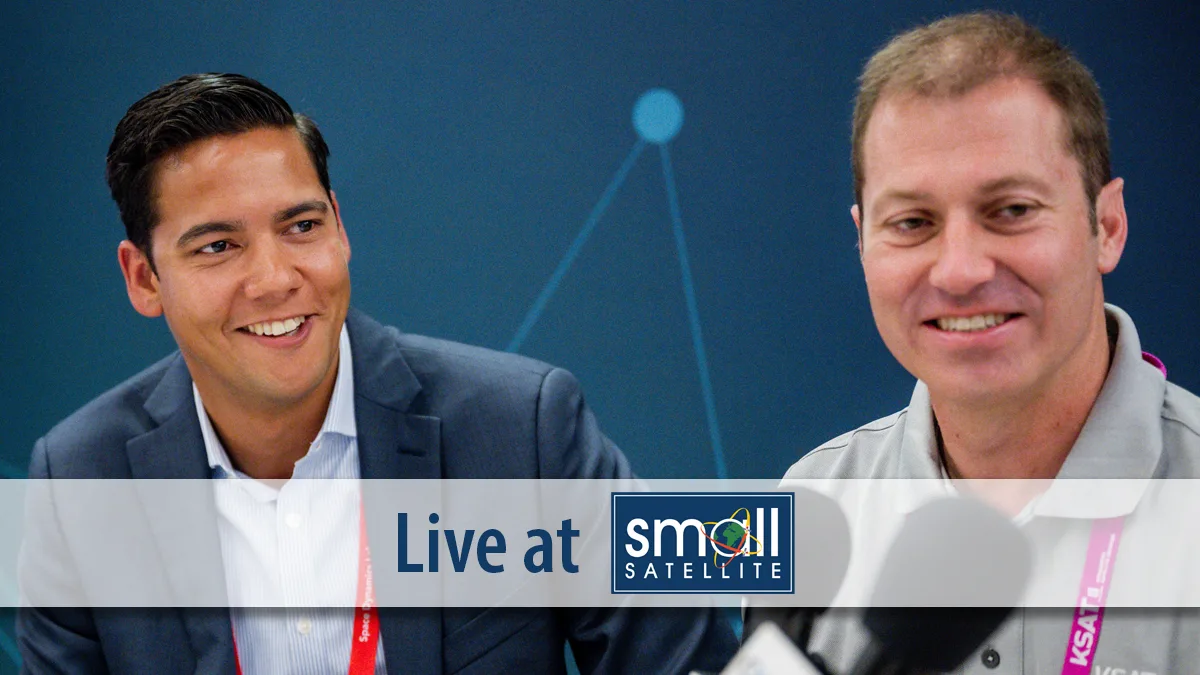
John Gilroy: Welcome to Constellations, the podcast from Kratos. My name is John Gilroy and I’ll be your moderator. Today we are at the Smallsat Conference in lovely downtown Logan Utah, and we’ll be talking about something that’s on everyone’s mind. What are some of the opportunities and challenges in a constellations market mostly dominated by a handful of big players? Our guests are Igor Alonso Portillo, and Eliot Nelson from the sales and BD team at KSAT, a leading provider of ground network services and earth observation services for Smallsat constellations. Okay. Igor, we’re going to start with you. There has been a wave of mergers and acquisitions in recent years with a few big players emerging as dominant forces in LEO. What are the factors driving consolidation in the market?
Igor Alonso Portillo: Hello, John. Actually this morning I was reading that Indra, a big Spanish technological company has bought Deimos, which is a basically small space company, even if it has been in the picture for over 20 years. So indeed this consolidation and these acquisitions keep happening, but also, and I was discussing here with my colleague Eliot, there are still smaller businesses, smaller companies pop up every day. So deconsolidation, it seems to be that companies reach a particular level when they are interesting for bigger players, then they get acquired. But then again, other new ones keep coming up.
John Gilroy: So Eliot, you think this is kind of just normal, a lot of startups and people kind of getting consolidated? Think that’s normal?
Eliot Nelson: Yeah, I believe so. Also, as companies start to mature, we see a lot of vertical integration companies start to focus on providing more end to end solutions to the market. So yeah, I’d say it’s a pretty natural progression in the market.
John Gilroy: So Igor, so I guess some of these driving factors or maybe high cost of entry, competition for spectrum, economies of scale. Is that what you’re seeing here at the Smallsat conference?
Igor Alonso Portillo: Yes, indeed. And I like the comment you made regarding frequency or spectrum. I think that’s key and that is a limiting factor where used to be launched. I mean still launch of course is a very important step, but it seems that SpaceX, another companies have solved that problem now of access to space, but still spectrum is totally key to get your slot in the business.
John Gilroy: Yeah. Eliot, I interviewed ITU yesterday and they were very focused on spectrum and regulation and it’s so new, I mean there’s going to be so many thousands of satellites in the air in the next five years. We’re going to have to be more and more familiar with these regulations, aren’t we?
Eliot Nelson: That is absolutely correct, and it’s going to be interesting to see how things play out with regards to government wanting to keep spectrum for their own missions, but also as governments start to look for more commercial augmentation, how they share that spectrum with the private market.
John Gilroy: We walk around the conference here, we see new companies. I haven’t seen, a lot of new companies. A lot of the small companies here, maybe they were employees of bigger companies and you probably know people in this situation. So we see small companies forming, we see consolidation. And so do you think that’s going to impact innovation? You think that’ll be a hamper on innovation or a proponent for innovation?
Igor Alonso Portillo: I think there’s absolutely no problem with innovation. I, not wanting to do publicity of our case, but just trying to explain, we have decided to catch that wave by having a separate innovation department, which actually pushes new ventures. Instead of entrepreneurship, I think this is another way again for bigger companies as we grow to capture innovation without people having to leave and do their own startup. Yeah.
John Gilroy: Yeah, that’s right. Out of the book of The Innovators Dilemma by Christensen. He said, if you have a big company, you almost have to have them physically away from the headquarters, so they don’t get poisoned by I guess bureaucracy or something. Huh?
Igor Alonso Portillo: So we have done that a couple of times. It worked fine, but now we actually have created it formally, this concept.
John Gilroy: Well, there was a documentary called Wild Wild Space, and it didn’t mention the big players. It mentions smaller players like Rocket Labs and Planet Labs and some of the smaller players out there. But we know there’s big players in this market and they tend to dominate. So is the market dynamic and evolving like it used to be three or four years ago, but do you think having just a few companies controlling space infrastructure, could there be concerns about access?
Igor Alonso Portillo: So Eliot and I were discussing about this topic last week? The answer, actually we wanted to answer you with a question. When you mean this domination and few players, are we talking about the satcom business, which again, we have Starlink and Kuiper coming up and so forth because if it’s in other sectors or in other niche applications, we don’t see any domination at all. So we wanted to ask you, are you referring to satcom in LEO or are you referring to other segments?
John Gilroy: New frontiers. People talk about the new frontier in space. New frontiers in space data will bring in clientele who are not necessarily interested in images, but in the answers the images provide. Will this help the old companies as they will be reliant not only the handful of sectors to survive?
Igor Alonso Portillo: Totally. For us, it’s fantastic thing that more people can use the images in this case acquired by imaging companies. The more usage, the better. Ourselves, we also do earth observation services. So any sensor in space, any extra data point that we can fuse into our analysis is always welcome.
John Gilroy: Remember the old story is that they don’t buy the drill, they buy the hole, the drill. And that’s what you’re talking about here, huh?
Eliot Nelson: Yeah. It’s also with regards to investments in companies that are launching satellites, I think we’re going to see investors start to ask more questions of the product that your payload is delivering on orbit. Who is the end customer that’s going to be utilizing this and why should we give you money to make that happen? So I think in the beginning of the new space market, folks were more concerned with just proving their technology on orbit without having thought about who their end customer is that’ll be buying the product.
John Gilroy: That’s really the question. So Igor, I think if you went to Google Trends and typed in sustainability, you’d see kind of a little graph going up and up and to the right. So sustainability is a key issue for many young people today and a key issue in technology sector as well. So let’s apply this to space. We’re at satcom after all. So space sustainability is a key issue that needs to be addressed. Can you talk about sustainability and do you see your partners and customers actively looking to solve this enormous problem?
Igor Alonso Portillo: Totally. Actually, if you go to Google and type in “sustainability” and “KSAT”, it would show you that we have in the last year created a totally new department with an executive vice president for sustainability which addresses of course the problem of having many satellites in orbit but also other things like the way we generate electricity with solar panels, the way we recycle into the circular economy. And our customers are actually demanding this from us. They’re saying in the requirement list, I need these 20 things and by the way, there’s a final one. I want you to address all of these topics regarding sustainability. So it’s not a, I don’t think it’s a nice to have anymore. It’s a must have.
John Gilroy: Eliot, I think it’s a must have to recruit people because people are looking at you going, do I want to work with those guys, KSAT? Then they find out you’re involved in sustainability all of a sudden that’s going to make you maybe lean towards working for KSAT, huh?
Eliot Nelson: Yes, absolutely. And it’s going to be interesting to see how the United States follows suit from Europe. We already see that there’s a lot of sustainability requirements that a company has to have in order to even bid on programs. So it’ll be interesting to see how the U.S. follows behind Europe on that one.
John Gilroy: I was preparing for this interview this morning and I learned that Planet Labs collects 4 million photographs a day. I mean, wow. So satellite imagery and remote sensing technologies are really hitting the sweet spot. So when do you think satellite imagery will become fully integrated into policy decisions and other sections of the economy like the financial sector, or is it happening now?
Igor Alonso Portillo: I think we saw in the last two, three years with the state of the world and even from Covid times that satellite imagery is just a total need. There’s no question. And I believe that when you said Planet is acquiring all of these images, they will just become normal. So no more do we count or do we realize how often, for example, an image on something as simple as Google Earth is updated. And then if you take it to the next level, to the professional level, I think it’s just going to become a common thing. We won’t think about it anymore. I don’t think people think about it anymore in that sense.
John Gilroy: Yeah. So Eliot, I walk around the conference, I meet people. I met a high-level guy from NASA, and he said, “Very few people understand the importance of images like this.” Their lives are dependent on it, and it’s getting to the point where it’s part and parcel of our economy, isn’t it?
Eliot Nelson: Yes, absolutely. And with climate change happening pretty rapidly, we see insurance companies looking for satellite data in order to prepare for responses to natural disasters.
John Gilroy: I mentioned the financial sector, but every time you run your credit card, you get that date and time from a satellite. So it’s integrated into all parts of our culture today. Igor, what do you think will be a key technology development we will need in the next 10 years to really kick this industry?
Igor Alonso Portillo: I think, and we are seeing a little bit of this now, onboard thrusters, onboard propulsion and what comes with it also, which is the maneuverability of a spacecraft, and then the next step actually maneuverability what for to do much more precise collision avoidance and be able to accept different risk levels. In the same way when we drive a car on the road, we have a steering wheel. Of course, the way I think space has been running until now is like a railway. You have the tracks and there you go. But I think space needs to go more towards a automotive, like a highway, again, like a road where you just steer when there’s a stop sign, you stop. Of course you wouldn’t do that in space, but that will allow many more satellites to go into orbit and also to properly manage what we right now sometimes think of being as a potential chaos when there’s a collision in orbit or there’s going to be debris, not if we actually have these type of maneuvering capacities.
John Gilroy: So Eliot, when I introduced you, I mentioned the fact that your company is involved in ground network services as well as earth observation services, kind of a space identity, right? At some point, do you see some of your customers and partners leaving their space identity behind and moving towards some other kind of business like analytics or telecommunications?
Eliot Nelson: I think that we’re actually seeing the opposite of that.
John Gilroy: Oh, really? Because it’s cool to be in space.
Eliot Nelson: It’s cool to be in space, but a lot of technologies that exist today in other sectors of the world are applicable to space. So I think we see a lot of analytics companies actually coming over to the space industry. So a big trend right now that you’re seeing is edge computing on the spacecraft. So folks can do processing of their images on a spacecraft before having a down link a huge ton of data to the ground and seeing if that image is worth keeping or not. So yeah, I would say it’s other sectors, folks from other sectors coming over to space.
Igor Alonso Portillo: I have to say I do agree with Eliot. We discussed this some days ago, but at the same time, I want to invite all our customers and everybody else to download every single bite they have on their spacecraft because that’s what pay our salaries.
John Gilroy: Yeah.
Igor Alonso Portillo: But I agree. I think processing, whether it’s edge at the ground station or even doing some pre-processing on board the spacecraft is something which is here to stay.
John Gilroy: I have to admit, I agree with you. Space identity is really a big thing. Six weeks ago I was at an airport in Kigali Rwanda and I saw a woman walk by with a NASA T-shirt, and so, hey, everyone’s going to be in space sooner or later, huh? Now we got to talk about economics and supply and demand, and this is what it’s all about too. Many companies just seek to serve a market demand and space is just a means to address this demand. So what kind of demand is out there, Igor
Igor Alonso Portillo: Demand for information, John, and demand for connectivity and demand for instantaneous connection. I was reading some time ago that if you were to ask a teenager, what would they rather give up, their connectivity or their privacy? Of course they would never give up their connectivity, but if you ask the same question to a 60 or 70-year-old person, they would tell you they’re very concerned for their privacy. So I think we’re going in that direction where we need and we want ubicquous instantaneous connectivity and information.
John Gilroy: So Eliot, I think if you asked a teenager question, your left foot or your phone? Take off the foot.
Igor Alonso Portillo: Take them both.
Eliot Nelson: That’s correct.
John Gilroy: So I guess the question is why? So do you think the private sector is playing as prominent a role as government agencies in shaping the future of space applications for earth?
Igor Alonso Portillo: Not yet. I think that was my dream 10 years ago. I think that’s still my dream, but I think there is no question that still government is running the business here. Maybe earth observation companies haven’t found the right business model, or maybe actually they have, but this is a lower process than I thought.
John Gilroy: I have a question now about this global dependence on space. I kind of mentioned casually because I talked to the NASA guy earlier. So Eliot, do you have a sense of how much the general public understands the global dependence on space? I’m sure the people at this conference all will, but if you walk across the street to the 7-Eleven, they may not have any idea that their sales reports are beamed up to a satellite every night, huh?
Eliot Nelson: Yeah, it’s pretty interesting. You’re starting to see SAR images in public news articles, even local news articles. So I would say yes, there’s a little bit more of an understanding. However, a lot of folks don’t know that using Google Maps every single day to go to work or go home, that all that comes from satellites, so.
John Gilroy: And I think that’s what human beings are like, they can’t connect the dots, have a hard time.
Eliot Nelson: Correct.
John Gilroy: Yeah. Yeah. So Igor, this is a tough question to look into the future, but this conference, I couldn’t look five years out, but let’s look 10 years out here. So what do you think space will look like in 10 years? What kind of new disruptive industries will be enabled and cannot necessarily be controlled by one of these two players? We talked about the possible monopoly here, huh?
Igor Alonso Portillo: Well, again, coming back to the topic of continuous information and constant connectivity, I think we will see space relay as a standard way of moving information. And we are actually at KSAT working on that to complement our ground network and each year and cheaper access to space is there, but there is a question here. The monopoly that SpaceX actually has gotten into, is that a good thing? It’s a great thing that they launch a lot of satellites for everyone, but it’s still a monopoly, right? So I’d like to see more competition. And then what I’d like to see in 10, maybe 20 years, at least in our lifetimes, is commercial human spaceflight, but not just for a few, but for many more applications. That’s what I would like to see. And also, we have supported some human spaceflight missions, which is super fun. Everybody gets very excited and every time we do, we get a new T-shirt. So I’m really hoping for it.
John Gilroy: You’re going to need a new closet for all your T-shirts.
Igor Alonso Portillo: Yeah, almost.
John Gilroy: So Eliot, did you bring a crystal ball from Denver? What does your crystal ball say about the next 10 years and disruptive industries that can’t be controlled by the big dogs?
Eliot Nelson: Yeah, I would say my crystal ball says that we’re going to continue to see more government programs looking for commercial augmentation of services, and that’s going to be the exciting thing that allows us on a global scale to all work together for a better future.
John Gilroy: Oh, great. I would like to thank you, gentlemen. I think you’ve given our listeners a real good idea of what’s going to happen in the future and ground services and earth observations, being flexible and working with these large organizations. You have been listening to Constellations, a podcast from Kratos. I’d like to thank my guests Eliot Nelson and Igor Alonso Portillo from KSAT.
Eliot Nelson: Thank you for having us, John.
Igor Alonso Portillo: Thank you, John.