Transcript:
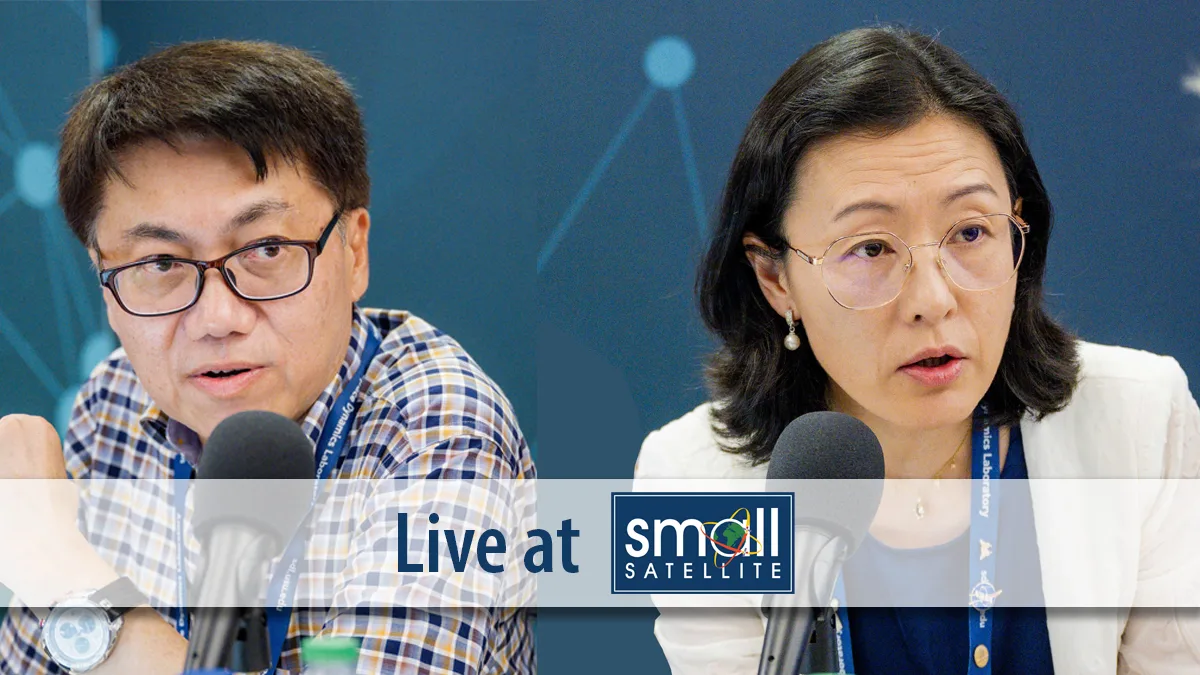
John Gilroy: Welcome to Constellations, the podcast from Kratos. My name is John Gilroy, and I will be your moderator. We are recording this from the Small Sat Convention in lovely downtown Logan, Utah. And we talked about many, many things involving satellites and small sats, we decided to bring in some folks from the ITU. Today in the Constellations Podcast we’ll discuss the regulatory implications of the exponential growth in small satellites, an estimated 26,104 small sats will be launched between 2023 and 2032 according to Nova Space.
John Gilroy: With so much growth on the horizon, how will regulatory efforts keep pace? What role will regulations play in terms of protecting the spectrum? How can interference be avoided to ensure a level playing field for new and incumbent players? To shed some light on these questions we have with us today two experts from the International Telecommunications Union. We have Chuen Chern Loo, Head Space Publications and Registration Division, and Ellie Xiuqi Wang, Head Data Treatment Section of Space Service Department Radio Communication Bureau.
John Gilroy: They will share their insights on the role of regulation in the rapidly growing and evolving small satellite world. How is the rapid growth in the small satellite market affecting the role and pace of policy from an International Telecommunication Union perspective?
Chuen Chern Loo: The small satellite industry is indeed experiencing rapid growth as evidenced by the increasing number of satellite launches and projects being announced. At the ITU, we are seeing a corresponding rise in satellite network filing submitted to the ITU. This surge in activity highlights the importance of ensuring that regulations keep pace with industry trends. One of the key objectives of ITU’s radio regulations is to prevent harmful interference. With this in mind, the role of regulations is becoming all the more important with the growth of the small satellite market.
Chuen Chern Loo: While regulations need to evolve with industry developments, they must also remain sufficiently stable to provide consistent framework for all stakeholders. Constant changing regulations could create uncertainty and challenges and may even stifle the growth of the industry. Now, the radio regulations are updated through the World Radiocommunication Conferences, the WRC, over a four- year study cycle, during which representatives from all member countries collectively discuss and decide on the rules.
Chuen Chern Loo: Even private companies and academia get to be involved in this study through the study period. As an example of how the regulation was adopted to meet the demands of the small industry, you are probably aware that the ITU regulatory procedures for recording satellite network in the master register includes the submissions of an advanced publication information, an API, and coordination request, followed by the notification.
Chuen Chern Loo: When the industry felt that the regulatory procedure was too slow for the short project life cycle for small satellites, the WRC in 2019 actually updated the regulations to reduce the time for publishing API from three to two months, and the time between publication and notification was reduced from six to four months, thereby reducing the minimum overall time for submitting an API to notification from nine to six months.
Chuen Chern Loo: In another example, when the industry felt that their satellite projects with short mission durations and that these missions would require additional frequency bands for TT&C, the Conference came up with Resolution 32 for short duration missions whereby the satellite networks have to comply with a host of conditions, including having a period of validity of not more than three years, in order to benefit from using newly allocated bands in the 137 and 148 megahertz for space operation service without having to go through a lengthy coordination procedure.
Chuen Chern Loo: So we have seen that the change in market dynamics from traditional satellite to growth of small satellites did impact the regulations and that the regulations did keep up to date with industry development. And I believe that we will continue to do so while ensuring that the overall regulations remain stable.
John Gilroy: So Chuen, what are the specific regulatory challenges posed by the mega constellations such as Starlink and OneWeb?
Chuen Chern Loo: Mega constellations such as Starlink and OneWeb, while providing benefit to all by widening the coverage of broadband satellite service to a global scale, also present significant regulatory challenges due to their size and complexity, stretching the boundaries of existing regulations. In 2014, when the first wave of these file links first started to arrive at the ITU, we had so much difficulty processing them.
Chuen Chern Loo: Our software was simply not ready to handle file links with that many satellites. Even up to today, we are facing problem with creating publications for some of these file links that are so large that it simply block our system and we have to invent new ways of publishing this information. Now, in terms of regulatory challenges, some specific challenges as follows.
Chuen Chern Loo: These networks are subject to equivalent power flux density limits, EPFD, for the protection of geostationary satellite orbits. These limits were adopted more than 20 years ago when there were no such constellations in operation. Now, ensuring that these limits are effective in preventing harmful interference with geostationary satellites is a major concern still today. On the other hand, there is also a view that the current limits actually overprotect the geostationary satellite systems.
Chuen Chern Loo: Then for a large constellation, the computation time for the EPFD takes a significant amount of time for execution. Due to this, there’s a rather long delay in examining these file links in the ITU. This has created some anxiety in the industry when the operators are not able to have the confirmation that their file links are given a favorable finding until maybe a couple of years later.
Chuen Chern Loo: So this is a real problem that we are facing today. Of course, with a large number of satellites providing broadband internet services, frequency sharing becomes increasingly difficult. New market entrants must navigate a congested spectrum environment, posing challenges for equitable access and interference management. The proliferation of mega constellations increases the risk of space debris.
Chuen Chern Loo: Effective regulations are then needed to address collisions, avoidance, debris mitigation, and end-of-life disposal to ensure the long-term sustainability of space operations. Given that this service and coverage provided by these mega constellations on a global basis, there has been concerns raised about unauthorized operations of non-geostationary satellite orbit of stations in some countries, meaning that there are earth stations transmitting to this mega constellation without a license issued by the respective national authority.
Chuen Chern Loo: Some of these constellations are proposing to implement direct-to-device services, often using frequency bands that are currently allocated only to terrestrial mobile services and not to space services. Such sharing scenario between space and terrestrial services have not been well studied at the ITU. So this use can only be on a non-interference basis. The outcome of this with respect to interference environment is still uncertain. So these are some of the challenges posed by mega constellations that we are facing today.
John Gilroy: So there’s a lot of challenges there. How can those challenges be addressed effectively by ITU regulations and guidance?
Chuen Chern Loo: Well, thank you for the question. As previously mentioned, the ITU Radio Regulations is updated by the WRC every four years, and many of these challenges that I mentioned earlier are currently being dealt with at the ITU-R study groups and working parties. ITU-R Working Party 4A has in its current work plan study of the validity of the aggregate EPFD limits and possibly also the single entry limits based on new data and emerging technologies to ensure they adequately address interference concerns without stifling innovation.
Chuen Chern Loo: All concerned parties, the NGSO operators as well as the GSO operators, will certainly be participating actively in these studies. With regard to the time required for processing these EPFD limits, we are already giving qualified favorable to satellite systems that meet all other aspects of the Radio Regulations and to only review the EPFD examination. As a second step, we are currently exploring various technical solutions to help to speed up the process and to seek for better optimization of the execution process.
Chuen Chern Loo: Now, in terms of frequency sharing, ITU can develop more effective frequency sharing mechanisms to accommodate the high density of satellites in mega constellations, and this might include advanced coordination techniques and spectrum management strategies that promote equitable access and reduce interference. Multilateral coordination meetings can be held to ensure that frequency sharing mechanism is agreed upon and applied by all concerned parties, and to jointly ensure that aggregate limits will be met.
Chuen Chern Loo: To address the risks associated with space debris, the ITU is addressing the issue jointly with other intergovernmental organizations such as UN Corpus and conducting its own study on the sustainability of frequency and orbits. And recognizing the demand for IMT service to be provided also through satellites to complement terrestrial IMT network coverage direct to device, the ITU has put on the agenda 1.13 of the next conference, this topic, to study and to report and to take a decision.
Chuen Chern Loo: Similarly, concerning the issue of unauthorized operations of non-geostationary satellite orbit of stations in some countries, this is also in the agenda of the next conference, and the subject is already being studied by experts in the ITU-R study groups. So by adopting these various strategies, the ITU can effectively address the regulatory challenges posed by these mega constellations.
John Gilroy: So Ellie, I have a question for you. The ITU has developed a small satellite handbook. Can you tell us why the handbook was created and what purpose it serves?
Ellie Xiuqi Wang: Thanks for the question here. I believe the rapid growth of the small satellite industry, particularly over the last decade, motivated the creation of the ITU-R Handbook on Small Satellites. The launch of the first artificial earth small satellites in 1957 marked the beginning of the space race and led to the development of larger satellites over the following decades. However, the increasing demand of radio frequency spectrum and orbit slots along with technological advancements has driven the dramatic rise in small satellite development.
Ellie Xiuqi Wang: Small satellites often have lower financial and technical barriers, making them accessible and affordable for startups, universities, and research institutions. The modular and standardized design, rapid build and launch cycles, lower latency from lower orbits coupled with seamless global coverage in concentrations of significant advantages for ease expansion and prompt replenishment of satellite fleets with innovative technologies. This evolution provides wider and easier access to space services for all countries.
Ellie Xiuqi Wang: Governments and companies right now are increasingly developing small satellite projects for a wide range of applications. In addition to traditional use like data communication, earth exploration, space research, and satellite navigation, these projects now supports environmental monitoring, education, agriculture, forestry, disaster recovery, scientific experiments, deep space exploration and testing innovative technologies and national defense.
Ellie Xiuqi Wang: So they also facilitate integration with 5G60 MT satellite internet access, the Internet of Things, smart cities, business intelligence, debris mitigation, and many other complex space tasks. Future advancement in AI and machine learning are expected to bring even more capabilities to small satellites technology.
Ellie Xiuqi Wang: Recognizing the rapid change and the global trend in small satellite technology, which benefits both developed and developing economies, Radiocommunication Assembly proposed to have comprehensive training and operational guidance for small satellites initiated by China in 2019.
Ellie Xiuqi Wang: This effort acknowledged the growing number of small satellites and their role in providing affordable access to limited spectrum and open resources for new entrance in space, as mentioned above. It emphasized the need for all satellites, including small satellites, nanosatellites, picosatellites, to use radio frequencies in accordance with Radio Regulations and ITU-R recommendations to avoid harmful interference with other satellite systems.
Ellie Xiuqi Wang: To address this need and instruction made by the Radiocommunication Assembly, the work has been done in the Working Party 4A to develop a handbook on small satellites since 2019. And with contributions from qualified ITU staff and a wide range of industry experts, the first version of the handbook was released in 2023 in July.
Ellie Xiuqi Wang: And this standalone ITU handbook serves as a valuable reference tool for the small satellite industry, especially offering detailed guidance on ITU regulations, frequency allocations and regulatory procedures to facilitate the submission of ITU findings for small satellites.
Ellie Xiuqi Wang: Overall, the ITU-R small satellite handbook bridge technical and regulatory aspects supporting the development, deployment, and management of small satellite systems according to the Radio Regulations. So feel free to review and refer to it when preparing ITU filings or having questions related to ITU regulations.
John Gilroy: Well, Ellie, that’s interesting. Well, now, that’s your handbook has been published, what is the next step to make sure that the handbook continues to be relevant?
Ellie Xiuqi Wang: Given the rapid growth in the small satellite industry, we often find that once we have completed a piece of documentation, the industry and the underlying technology has moved ahead already. Similarly for the handbook, once it’s published, it risk is becoming obsolete by the rapid change in the industry. Although regulations are updated every four years, each new submission brings new aspects in the application of regulations that may not have been previously considered or documented.
Ellie Xiuqi Wang: Understanding this rapid change and the need for the handbook to stay relevant, we maintain the dedicated webpage for the small satellite handbook. This page will be continuously updated with new content to supplement the handbook once there is. And we continue to encourage contributions from all actors in the small satellite industry for inclusion in the future updates. Proposals from ITR members should be submitted to the working party for urgency.
Ellie Xiuqi Wang: And for non-ITU-R entities, they can submit their submissions to the specific mailbox [email protected]. This is available also online. These submissions will be prepared as input for the Working Party 4A. And once it’s adopted by the Working Party 4A, the updates will be made available online as soon as possible and the handbook will remain freely downloadable.
Ellie Xiuqi Wang: In this way, the handbook will serve as a foundational resource for newcomers to learn about small satellite regulations and industry trends. It will be continually complemented with up-to-date information and insights, ensuring its ongoing relevance to the small satellite industry. So I would like to take this opportunity to call for continuous global contributions to the ITR Handbook on Small Satellites.
John Gilroy: Chuen, with so many constellations launching and other users such as military and terrestrial providers competing for the same scarce resource, how can the ITU ensure equitable access to the radio spectrum?
Chuen Chern Loo: Well, we have to first recognize that spectrum is indeed a scarce resource. We don’t make spectrum anymore. Whatever is there is limited. Therefore, its allocations must be managed with great care to ensure that all users, whether they are satellite operators, military entities or terrestrial providers, have equitable access to meet their needs.
Chuen Chern Loo: For any new or increased demand that has been identified in advance for spectrum for a specific service, the ITU-R will conduct studies on the forecasted demand for bandwidth, identifies possible frequency bands for consideration, and conduct sharing studies on the impact to incumbent services.
Chuen Chern Loo: Here are some several strategies that the ITU employs to address this challenge. Spectrum allocation. With advanced planning for the bandwidth required for a specific service, the ITU through the WRC process allocates blocks of spectrum to different services and imposes conditions on the utilization of these spectrums depending on results of sharing studies.
Chuen Chern Loo: Notification process. Now, all satellite networks using radio frequency will have to be notified to the ITU starting with either API or a coordination request. In this way, it is clear to all on the occupancy of the orbit and frequency. Annual system should take them into account. Coordination process. Effective coordination processes are essential to manage competing demands for spectrum.
Chuen Chern Loo: The Radio Regulations contain specific coordination procedures between different users and services to prevent interference so that all parties have access to the spectrum they require as much as possible. Spectrum efficiency. Radio Regulations promote the efficient use of spectrum. The ITU encourages technologies and methods that make you best use of available spectrum enhancing efficiency.
Chuen Chern Loo: Regular reviews and updates. We have talked about the WRC, how they actually meet every four years to update regulations. So this process allow us to regularly review and update the regulations, the table of frequency allocations such that the frequency is available to the service to the users who needs it most. So by implementing these strategies, the ITU aims to ensure that spectrum is allocated and used in a manner that supports the needs of all users.
John Gilroy: So what role does the ITU play in terms of ensuring the sustainable use of frequency and orbit resources?
Chuen Chern Loo: Now, the ITU, we can say that it is a highly effective intergovernmental organization in enforcing regulations on frequency usage. The ITU has recognized the need to ensure the sustainable use of the limited frequency and orbit resources.
Chuen Chern Loo: The ITU Plenipotentiary Conference, which is the highest body of the ITU, has adopted in Bucharest in 2022 Resolution 219, instructing the Radiocommunication Assembly to perform the necessary studies on the issue of increasing use of radio frequency spectrum and associated orbit resources in non-geostationary satellite orbits and the long-term sustainability of these resources.
Chuen Chern Loo: So the Radiocommunication Assembly met in 2023 and adopted Resolution ITU- R 74 which instructs the study groups to conduct technical activities including those on interference assessment and mitigation techniques among non-GSO system in support of the long-term sustainability.
Chuen Chern Loo: It should be noted that ITU’s existing recommendation, which is ITU-R S1003-2, environmental protection of the geostationary satellite orbit has been effective in making the geostationary satellite orbit relatively free of debris, despite it being only a recommendation and not a regulation.
Chuen Chern Loo: Therefore, this new resolution, ITU-R 74 from the Radiocommunication Assembly, also resolves to conduct studies towards the development of a possible new recommendation, providing guidance on safe and efficient de- orbit and/or disposal strategies and methodologies for non-geostationary satellite orbit space stations after the end of their life.
Chuen Chern Loo: While detailed studies are being carried out at the ITU-R study groups, at the same times we at the Radiocommunication Bureau, we are also doing our part to advance on the work on this resolution. We have sent a circular letter in March of this year inviting member states satellite operators, space agencies, et cetera, to share their strategies being used or to be used for the post mission de-orbit and disposal of non-geostationary satellite orbit space stations.
Chuen Chern Loo: And we have received a number of valuable inputs, which we have published them all on our space sustainability gateway webpage. We are organizing a Space Sustainability Forum 2024 on the 10th to 11th of September 2024, which will convene top leaders and subject matter experts to present, discuss, and dive deeply into the policies, best practices, guidelines, strategies to ensure that space remains accessible and sustainable for the future space activities envisioned today and in the future.
John Gilroy: How big a problem are cases of interference today and what is the outlook for the future with the increase in the number of constellations?
Chuen Chern Loo: In terms of harmful interference, the ITU is made aware of it only when there is an official complaint registered with the ITU in the application of Article 15 of the Radio Regulations. In terms of statistics, we have still relatively few cases of reported instances of harmful interference in most frequency bands, although there are issues in some specific bands. To put into perspective, according to our statistics, in 2023, 99.94% of registered spectrum are free from reported harmful interference.
Chuen Chern Loo: For reported interference cases, we could make use of the space radio monitoring facilities for which we have signed MOU with countries like Brazil, Oman, Belarus, China, Germany, Korea, Pakistan, and Vietnam to geolocate the source of harmful interference. The Bureau has also convened meetings among concerned administrations to try to resolve this interference issues. Of course, the prominent issue today is concerning interference to the radionavigation- satellite service, the RNSS.
Chuen Chern Loo: And the Bureau and the regular regulations board are taking this issue very seriously. And we remind all administrations to apply the necessary measures at the national level to avoid the commercialization, proliferation, and the use of illegal transmitters and to take actions to prevent and mitigate harmful interference affecting RNSS. In terms of mega-constellation, if we simply count the number of satellites in the filings that we have received over the years, we arrived at some mind-boggling figure of millions of satellites that will be launched over the next seven years.
Chuen Chern Loo: However, market dynamics is slightly to limit the coexistence of all these satellite constellations in the first place, just like the number of paper filings that we have received for geostationary satellite networks in the late 1990s. Subsequently, we found that the actual number of geostationary satellites that will finally launch remain realistic and manageable.
Chuen Chern Loo: Given the significant financial investment in these mega-constellations, I will expect that these operators will well respect the regulatory framework, coordinate with each other to ensure coexistence during operations, and work together in the ITU-R to improve the regulatory framework as needed to ensure an interference-free environment for all as we move forward.
John Gilroy: Chuen, how are the cases of interference mitigated or resolved today for small satellites?
Chuen Chern Loo: Well, the best way to mitigate interference is actually through prevention. That is why the Radio Regulations allocate spectrum to specific services with defined operating conditions requiring a procedure of registration of frequency assignments, coordination with potentially affected administration before notification and bringing to use. By making use of specific frequency assignments over specific service areas, it is often possible to prevent interference before it occurs.
Chuen Chern Loo: However, should there be an occurrence of harmful interference, the affected administration should submit the relevant information to the Bureau and follow the procedure spelled out in Article 15 of the Radio Regulations. Now, the Bureau has put in place a reporting system online to facilitate the ease of making such reports, ensuring swift action upon receiving such reports.
Chuen Chern Loo: A network of space radio monitoring facility system in place when required to geolocate the source of harmful interference. So to date, we have not received any significant reports of harmful interference from small satellites. However, one worrying train is the use of number 4.4 of the Radio Regulations, which is using bands that are not in accordance with the table of frequency allocations.
Chuen Chern Loo: We have, unfortunately, been receiving many such file links. Some are for experimental purpose, but there are some that may be using them for commercial systems. So this is a dangerous trend and we have reported this to the conference. So the WRC has expressed collectively their concern of this trend and instructed the Bureau to follow up on this issue and make such utilization transparent by providing statistics on our website.
Chuen Chern Loo: So the bureau is also doing its part by writing to administration whenever there’s an API received with potential non-compliance of the table of frequency allocation to ensure that the administration understands fully the implication of using frequency bands that are not in accordance with the table of frequency allocation. So this is spelled out very clearly to them right at the beginning of the filing process.
John Gilroy: Chuen, how do you see new technologies such as artificial intelligence impacting the use of small satellites, and will this require new regulations?
Chuen Chern Loo: Well, unlike traditional satellites, which requires decades for new technologies to be flag proven before they’re actually utilized in space, small satellites have shown that they can embrace new technologies rapidly, within months in some cases. There are many, many new technologies being explored at the moment, of course, including artificial intelligence and machine learning.
Chuen Chern Loo: We are seeing this being implemented into many new space technologies. For example, due to the scarcity of the bandwidth, using AI machine learning on board a satellite can help to analyze the huge amount of data that the satellites can collect and to select which data is finally transmitted to earth, thereby optimizing the use of frequency. And this is useful for the ITU in the sense that we are really making efficient use of frequency.
Chuen Chern Loo: AI can also help to optimize mission and to control large satellite constellations, significantly reducing the workload of ground operators. Some are considering the use of AI in cognitive radio to select frequency bands that are free or available.
Chuen Chern Loo: However, AI cannot be allowed to be so autonomous that it starts to make use of frequency outside of the Radio Regulations or maneuver satellite constellations in such a way that contradict far parameters that could create chaos in the management of frequencies and orbits. Therefore, I firmly believe that regulations need to continue to keep pace with this rapid advancements in technology.
John Gilroy: As you look at the next few years, how do you see spectrum regulation evolving with the increase in small satellites in orbit?
Chuen Chern Loo: Well, with more small satellites being launched into orbit, there is an increasing demand for spectrum for space services, even as more and more spectrums are being carved out for terrestrial service, like in INT, which is 5G, 6G, and so on. Now, if we look at the agenda items adopted for the next WRC in 2027, three- quarters of the agendas are actually concerning space services. So we can see that the trend now is towards importance on being adopted for space services.
Chuen Chern Loo: So small satellites can use the same frequency allocations as other satellites. However, the specific characteristics of small satellites should be taken into account when we are doing these studies. With more players, there would be a greater need for aggregate limits and multilateral meetings will be needed to convene, to coordinate, and to agree on the use of this spectrum.
Chuen Chern Loo: The regulations could assign a more significant role to the ITU Radio Communication Bureau to assist and facilitate the coordination process. There may be a need for monitoring. Therefore, all the regulations could advance to say that monitoring is essential to validate the power limits, to validate the power levels as part of their submissions. So we see also recent trends for satellite direct to device service, suborbital flights, et cetera.
Chuen Chern Loo: So we are starting to see the blurring of the separation of spectrum between terrestrial and space services and regulations will have to adapt to this change. In terms of orbit utilization, the conference has adopted resolutions that requires the ITU to validate the deployment of constellations by milestone and to verify the orbital tolerance of deployed satellites, but it’s only applicable to some specific bands and services.
Chuen Chern Loo: So to really manage well the orbit utilization, given the increasing number of satellites in orbit, this may have to be extended to all satellites in all frequency bands and services. So in summary, regulation should continue to involve to ensure the rational, economical, equitable, and effective use of the spectrum, and to ensure that spectrum is available for those who really need it for solving world problems.
John Gilroy: Great. I’d like to thank our guests, Chuen Chern Loo, Head Space Publications and Registration Division, and Ellie Xiuqi Wang, Head Data Treatment Section of Space Service Department Radio Communication Bureau, from the International Telecommunications Union.