Transcript:
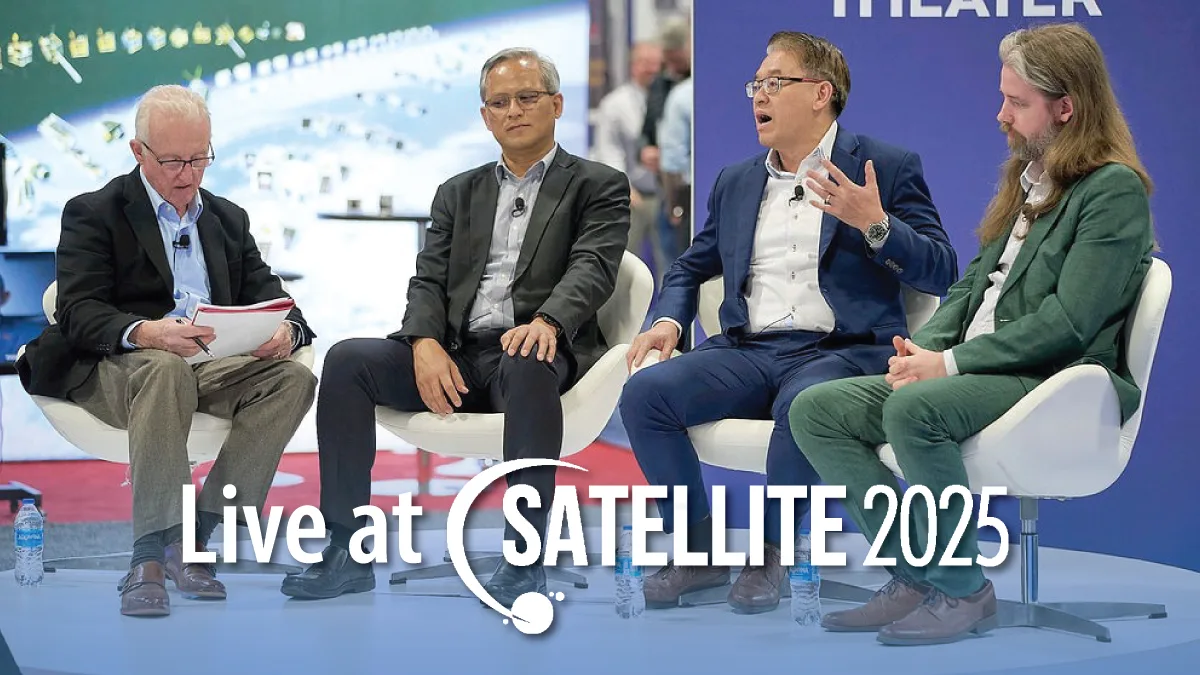
John Gilroy: Welcome to Constellations, the podcast from Kratos. My name is John Gilroy and I’ll be your moderator. Today’s episode is a recording of the panel discussion I moderated at Satellite 2025 in downtown Washington D.C. My guests were Park Boonyubol, THAICOM Senior Vice President of Technology and Satellite Operations, Dallas Kasaboski, Analysis Mason Principal Analyst, and John Chay, Kratos Vice President. We discussed unleashing the full power of software-defined satellites. Let’s join the discussion. Unleashing the full power of software-defined satellites offers operators the potential for a competitive advantage by dynamically adjusting capacity and coverage while in orbit to adapt to customer demand. This opens opportunities to deliver new services, capture more revenue, and enable innovative new business cases for customers. These benefits, however, are not possible without enabling a more dynamic ground system that works in tandem with these new flexible payloads. On this Constellations podcast, you’ll hear from industry experts from a market satellite and ground perspective on how to enable the full power of software- defined satellites and have competitive advantage. So Dallas, I’ve had you on the air before a couple times. Just jump right in here. You know that. Can you discuss the satellite market and how it’s evolving and driving the need for software-defined satellites?
Dallas Kasaboski: Yeah, thank you. Happy to be here. So software-defined satellites, the easiest way to think about them and where they’re coming from, what’s driving them is flexibility. It’s just a natural evolution where we’ve gotten to the point where manufacturing and launching satellites in general is getting easier. There are more options, and players want to have flexibility, they want to have more capabilities. So in some places, and we’ll talk about that in future questions, there is real need for these capabilities. And in other places it’s more of a want. I want to stand out, I want to do more, I want to prepare for the markets of tomorrow. And software-defined satellites is just the next step for connecting with the ground and connecting with the changing global market demand.
John Gilroy: So John Chay, how about you? How do you think this new satellite market is evolving and driving the need for software-defined satellites? Is it going to be all software-defined in the future?
John Chay: Yeah, and good afternoon. All right, so software-defined satellites is really defined as an investment production. I think most of us would agree in today’s satellite market there’s a major disruptions going on. So there’s no one, well, including satellite operators will be able to make a business plan and ensure it will be the same for the next 15 years to sell the capacity that they have planned for. Disruptions happening today, disruptions happening tomorrow will change very much the market plans that you have built up to launch the satellite. And this is where software-defined satellites will allow you to really protect the investment, reshape the beams, point it to where business will drive the revenue in the future.
John Gilroy: Park, what do you think about software-defined? Is it evolving? I mean, five, six years ago, we never mentioned software-defined satellites. It wasn’t a thing, and it just came up on us suddenly, wasn’t it?
Park Boonyubol: Yeah, yeah, exactly. Firstly, good afternoon, everyone. Actually, if you look at the basically background of THAICOM, we are the regional satellite operators, and we have a total of eight satellites. All they are fixed satellites. We start to procure the next two satellites. The first one is we call semi-flexible satellite, which is THAICOM-9. THAICOM-10 is fully flexible satellite. So in our definition, maybe continuing from what John say, definitely now today, it’s difficult to find a concrete requirement for 15 years. So the satellite have to be adaptable for any market demand change. And secondly, that’s another benefit of software- defined satellite is that usually you have maybe a bit of technical term, you have a megahertz that convert to megabits, that’s usually a fixed ratio. I believe if you can manage the market dynamically, technically you can oversubscribe your megahertz. So meaning that the actual throughput, effective throughput of the software-defined satellite is actually higher than the fixed satellite.
John Gilroy: So I read the biography of Elon Musk about three or four months ago. And it sure seems like they’re just waves or things happen all at once. And I’m wondering, Dallas, do you think the next wave of software-defined satellites being launched in the next few months or when it’s going to happen?
Dallas Kasaboski: Yeah, likely in the next few years, next couple of years. Specifically, there are specific orders that have been made for satellites that are expected to come out in 2026, 2027. But it also makes sense in terms of the flexibility of the satellites, monitoring, keeping track of, and following the trends on the ground. There’s a lot of, as I’m sure my colleagues here will talk about, there’s a lot of movement being made on the technologies on the ground. But for software-defined satellites, they essentially stalled. We saw that, again as you said, the term came out of nowhere. A lot of technology was being defined, Airbus’ OneSat and so on. And then, the appeal or the necessity for it became a bit muddled, a bit under questioned. And now. We’re starting to see, again, procurement for partially flexible and fully flexible satellites, which we expect to roll out in the next year or two.
John Gilroy: So John Chay, do think it’s going to be a whole group of companies launching software-defined satellites, or just one or two or three or four. So what do think’s going to happen in the next four or five years?
John Chay: Well, so the two big manufacturers of software-defined satellites are really the Airbus and the Talos group, and they have contracts to deliver these satellites. So with no further delay, we’ll probably see the first launch coming out in ’27. And I will also put a caveat provided no M&A going on this year between that though.
John Gilroy: Well, good luck predicting that, huh? Who knows what’s going to happen there? I don’t have an M&A question for you, Park. But when I think of satellites, I think of NGSOs, non-geostationary orbit. And so what are the advantages of software- defined satellites, when you compare it to something like an NGSO?
Park Boonyubol: I think first of all, what I believe is that there’s no one-size-fits-all solutions. So NGSO they have a lots of advantage. And on the other hand, the GEO satellite also has the unique advantage that the NGSO basically cannot meet. So as a satellite operator and we start to become a service provider as well, I think we see the trend of putting a base solution to the fit to some specific requirement, and some part you need to optimize dynamically between the two. So that’s some sort of solution that we are pursuing now.
Dallas Kasaboski: Yeah, I’ll add to that, that really software-defined technology, in most cases, is there’s a floor of necessity that non-GEO satellites require. They require some flexibility, whether it’s steerable beams or reconfigurable bandwidth, just to make the constellation work or to make it work a bit more efficiently. So there’s a bit of a floor that pushes them toward partial flexibility. But in GEO, it’s becoming all or nothing. There’s very few satellites that are looking to be launched that don’t have any flexibility at all, but there is a trend toward full flexibility with GEO to work with non-GEO with or around really.
John Gilroy: So John Chay is your competition other companies that do software-defined satellites, or is the competition the NCO, the Geostation? What’s your competition, Geostationary or other companies?
John Chay: Well, I don’t think we really put the two in competition. I think what Park mentioned, multi-orbit is going to be a common architecture where most countries will adopt. So you need a geostationary, you need the software- defined satellite to provide you the flexibility, the high density that you will get out from these satellites, and coupled with a Neo Constellations to give you the additional flexibility that grow beyond. And I also like to point out many sovereign countries, many sovereign satellites will still rely very heavily on the geostationary to fulfill their local needs.
John Gilroy: So Park, what are the advantages that a software-defined satellite offers for an operator when competing against the NGSOs?
Park Boonyubol: Competing, maybe not the word. I probably try to directly answers, but software-defined satellite from the GEO perspective, and you have the NGSO on the other side. I think in the middle, some sort, if need to link the two as a one solution, you need a flexible ground that basically can manage the portion or the timing of how to make the software device usage in one particular specific scenario. And maybe at an added harm, LEO might be a better option. So that’s from the end user perspective, that’s the way that you create the best value in term of user’s experience.
John Gilroy: So John Chay, imagine you’re talking to customers, you’re talking about the flexibility and what happens if things happen where they dynamically increase the number of data coming through. So in a data center that’s important. I imagine with you it’s important too.
John Chay: Definitely, definitely. I guess when you start having a flexibility on the satellite, that is different from the traditional satellites. In the past, you launch a satellite, you leave it up there, you plant the ground, any new business comes, you manage the ground to meet the business needs. But now, with a new software- defined satellite, the payload is flexible. You can reconfigure the beams, the power, where you point to, when you want it to go to. So you will need to have a software-defined ground to match, to provide that dynamic capability to allow you to realize and harness the capability of the software-defined satellite. So this is where I think on the software-defined ground, that’s the next topic we’re going to talk about is really on the ground side. You need to be able to be really flexible and dynamic and virtualization is a key to that. You want as much of the ground to be virtualized as possible so that you can scale, it can be elastic where you can provide capacity when you need it, and when you don’t need it, release the resources for other applications for other users. So software-defined ground virtualization will go hand in hand as we talk about harnessing the capabilities of software-defined satellites.
John Gilroy: Yesterday we interviewed a couple of people, we talked about use cases and business models. And I imagine there’s use cases here where you can show how to increase revenue and reduce costs. So, Park, you want to give me an example for increase revenue or reduce costs?
Park Boonyubol: Because of the flexibility, so being that you provide the bandwidth to any users at any given time when they need it. So that’s a real business case of the solve edify ecosystem. So which one of them, what we would see is that there could be a network of disaster recovery, which mean that they might need the bandwidth, huge bandwidth, but they don’t need app all the time. So you don’t need to allocate the bandwidth all the times. So meaning that whenever they need or whenever we, in term of prediction, you can just basically provide the bandwidth to that particular area. I think this could play a bigger role in the mobility as well. So which means that mobility, you talk about the large area. In current, today’s world, SDS, you’re going to need to allocate the capacity in this beam and this beam, so that it’s basically fulfill all the parts of the mobility. However, with the flexible system, technically you look at the demand, predictively look at the demand, and then you can pre-provision or that demand can search up and you can allow the headroom for that demand to grow. So that’s some sort of business care that we are looking at at the future.
Dallas Kasaboski: And adding onto that, if you look at the wider ecosystem, not just the satellite itself, but launching the satellite. In the traditional model you would put a GEO satellite up, it acts as a flashlight essentially looking down over a continent. Everything is rigid and defined. But some companies are looking at that and saying, “Well, instead of raising the amount of capacity that my satellites have to grow with growing trends, if I make my capacity more flexible, maybe I can offer less total capacity per satellite that’s more flexible, make the satellite smaller, which may help with launching it, may help with lowering launch prices.” There’s a lot of interconnected parts between the satellite, the ground, and everything that supports that.
John Gilroy: John Chay, 15 years ago I interviewed a woman from a virtualization company and VMware and we had no idea where it was going to go. It was brand new. He’s like, “Well what’s the use case?” She didn’t know. So what happens is, I guess, you provide something that has all kinds of flexibility, and someone by golly is going to figure out what the use case is. We’re in the early stages of software-defined satellites. I mean, there may be applications that we never dreamed of, huh?
John Chay: Exactly, exactly. I guess there are many, many use cases, new business models for us to explore. Park mentioned about disaster recovery in the past. If you need certain capacity, a searching capacity in a particular region, if you don’t have the amount of bandwidth there, you couldn’t support it. You don’t have the right amount of gear on the ground, you cannot support it. But with a software-defined ground and a software-defined satellite with a software- defined ground, you can actually meet all this sudden searching requirements just based on what the customer needs. You can put additional capacity, put in additional reset resources, fulfill the need, and release those resources back. Another good example is really using data analytics and artificial intelligence to look into the pattern of life of the utilization on the satellite. In the daytime, you’ll probably have a little higher capacity over a city region, while it goes through the night, it may have gone down and you channel the capacity and the power to another city that is in the daytime. So you are allowed to now overbook the capacity, which Park mentioned earlier. A hundred gig satellite, you potentially can sell 120. That’s a lot of revenue if you can fulfill the full capacity of the satellite by reselling, moving this capacity dynamically from one region to another region depending on the needs.
Park Boonyubol: Actually the word is like you oversubscribe the network.
John Chay: Yes.
Park Boonyubol: Yeah. So the wording I used to talk to the team.
John Gilroy: Good, good, good. Dallas, I know you’re not from the United States, and so some things may seem strange to you. There was a company in town called SiloSmashers, and they would go into federal accounts and try to smash the silos. I think it was a noble but futile endeavor. I don’t think they succeeded. What about in the satellite world here? Satellite ground systems have historically been developed in silos. We know that. Are satellite manufacturers and ground system developers now working together to maximize the value of these satellites?
Dallas Kasaboski: That is happening. There’s more conversations that are happening between them. I think currently, more present are the operators themselves strategically facilitating those conversations. I think manufacturers are being aware of what the ground is doing to some extent. The ground is looking at maybe the capabilities or limitations of the satellite world. But it’s still the operators because they have a specific network in mind. They know the customers and the landscape, and they are the ones bridging that connection. But those connections need to happen more and more so that both technologies can develop in tandem rather than in silos.
John Gilroy: John Chay, the question is real simple. If you walked around here and you asked someone what a satellite operator was, they’d probably got an understanding of what they kind of do. However, how does the concept of operations change if we’re talking about software-defined satellites? Complete difference, isn’t it?
John Chay: Yeah, well definitely. I just want to add on to the previous one. In Kratos, we actually were one of the early adopters or supporters of software-defined satellites. We have been talking to the satellite operators. Our office in Toulouse has been interacting with both Talos and Airbus three years before talking about how we are going to interact and manage the software, the satellite payload, and also the resource management. So that interaction is very important to realize a end-to-end connectivity. So you need to be able to connect the satellite to the ground, orchestrate all the resources, ensuring all the subsystems operate in synchronized to realize a service, to provide a service whenever you need it.
John Gilroy: Park, the whole idea of what a satellite operator is going to change. I mean, it has to. It’s going to be managing software instead of managing, I guess endpoint, three quarters of the way around the world.
Park Boonyubol: Yes.
John Gilroy: So how do you think it’s going to change?
Park Boonyubol: The operation, with the fixed satellite you talk about changing the transponder, changing the power, you send the command. But for this, I think that’s going to be a lot of automations, analytics, and basically intelligence that will basically provide the profile to the network to change. And secondly, the concept of orchestration come into play now, because you cannot change the satellite, only because terminal connect to the ground segment. So there will be some system in the middle that basically synchronize the chain between the twos, according to the profile or the demand or the predictions. And I believe the operator side, I think from us, we need to look at the more on the interconnection with other system. So the proprietary things start to get [inaudible 00:18:19] now because every system has to be connected, has to talk to each other. So that’s how the SDS will work with the ground.
John Gilroy: Well, Dallas, the name of this presentation is Unleash Software-Defined Satellites with Virtual Ground. So I got to do a virtual ground question here. So how does the ground system need to evolve to maximize the full value of these new flexible payloads?
Dallas Kasaboski: Yeah, I think John brought it up with the topic of virtualization and digitization. So again, the shape and the design of networks is evolving to be much more flexible in its early design and much more capable and flexible over time. So essentially, what needs to happen is the ground needs to get better at orchestrating and coordinating all the different assets that are intended to be connected, but also to look to the future. If you designed a network to connect to X number of sites, and you have a clear understanding of exactly how satellite to the ground are going to talk to each other, and maybe it’s even flexible to account for them moving or them changing their demand. What happens when you add another 50 sites, 100 sites, whatever that is? So the ground needs to continue in this process of creating a virtualized orchestrated network that can be flexible in its actual requirements, but flexible with new change and new demand.
John Gilroy: And Park, there are requirements for security as well in these new dynamic systems. So you have to really-
Park Boonyubol: Yes.
John Gilroy: … put that at the top of the list.
Park Boonyubol: Yeah, yeah. You exactly right. Because of a lot of more IT automation coming to play with the satellite configuration, which used to be a very private network. So now, you connect to outside, you connect to the system, and given all the advancement of the computing resource now, mean that cracking the encoding, it’s actually easier than before. So basically, what we strengthening, it’s mostly the starting with the satellite link, the satellite controlling, it’s going to be very encrypted and very secure. And the operation and the design of the network orchestration system connected to the ground, we have to look at the security fencings and where, that’s a lot more to do in this domain.
John Gilroy: So Dallas, what new advancements do you need from a ground network to fully harness the minute-by-minute flexibility satellites? Really it’s dynamically that?
Dallas Kasaboski: It can be. I mean, if you want to unleash the full power of it can be. I mean, an example that was given earlier is if you think about daily or seasonal changes in demand. That’s not minute to minute. That’s where we’re getting to now, where demand is changing during the day, you shift your network somewhere else. If you’re serving mobility like aircraft or something like that, the demand is shifting. Getting down to minute to minute, really, there are applications that are doing that. We’re talking about commodity trading or business or financial interactions. They’re millisecond to millisecond. So depending on the application you’re looking at, and it’s only going to increase. Everything in this market increases in demand, in speed, wanting lower costs. So in terms of what needs to be done, we’ve kind of touched on it already, but again, orchestration, coordination, automation, just the ability for the system itself to be flexible in its capability and to be able to monitor and react to changes with more automation.
John Gilroy: Well, John Chay, he just used the phrase that pays, orchestration. And I think that’s what it boils down to. It’s like when I talk to software developers, they are really herding over several different systems at the same time and orchestrating on them. So that’s a skill set that needs, especially with the minute-by-minute changes. Huh?
John Chay: Yep, definitely. So we have, on one hand you need to have a real-time network management to know exactly what has changed, to have a instant picture of the current networks loading situation. You need to have a flexible ground. Virtualization is going to be key to allow you to really be dynamic and scalable. The third piece is really to have the orchestration piece, to be able to then chain up all these changes coupled with our first data analytics and artificial intelligence to make the necessary changes, to preempt any congestion, to provide additional oversubscription capabilities on the software-defined satellite. So these are the changes on the ground that we do not see in today’s traditional ground systems we have today, where you are pretty much stovepiped where every VSET systems will be pushing the limits of what they can do. Every carrier monitoring systems will be doing what they’re doing. They’re all pretty much stovepiped. And now, in the new ground you need to chain all this together to make them all happen at the same time.
John Gilroy: Right, right. More orchestration, huh?
John Chay: Yep.
John Gilroy: Yeah, that’s the phrase. So Park, when you look at resumes for people to hire, are you look for orchestration now?
Park Boonyubol: No, it is more on the software rather than the hardware. Maybe I want to add a bit on the virtual ground. I mean, okay, we look at the one satellite only for flexible chain of the beam and many things. But with the GEO satellite you can have multiple satellites, with multiple orbital slots that can use the same frequency, which mean that you technically increase the amount throughput. And the beauty of the virtual cloud is that with the more standard with the Telco. So you can create a roaming between the two SDS, two software-defined satellites as well.
John Gilroy: Right. Flexible.
Park Boonyubol: Yeah. This is not only within one operators. If we going to a certain standard, it will be a multiple operators. If you look at very long term, I think what we see is that it should be similar to your handset, that you use the SIM card. You can do international roaming, any carrier. So that’s probably another step away from after we have the first software-defined satellite launch in the next two years.
John Gilroy: So Dallas, time to look into the future. I’m not very good at looking into the future. My crystal ball broke back in COVID, so I’m not looking in the future. But I’m asking you. So let’s say in the next five years, how do you see software- defined satellites and ground systems working together?
Dallas Kasaboski: Yeah. Generally speaking, software-defined, generally speaking, satellites themselves have been a bit slower to develop. I mean, you can physically on the ground, you can go and update your hardware, you can develop a lot of software, field test it. I think the ground segment has some work to do, but its pace is very quick. Satellites themselves moving to software-defined satellites now, fully flexible, the future is for satellites to become even more flexible and more capable. So one example of that you’ll hear a little bit about is onboard processing, edge computing. Essentially, both of these systems, ground and space, need to work together. And where the work happens is really up to you, the technology you have, the network you’ve defined. And in some cases having your satellite have more onboard processing and automation, may free up the ability on the ground. Other technologies, regenerative payloads, that’s just another fancy term for a more capable satellite. So yeah, briefly, the satellite itself needs to continue to be more flexible and more automated.
John Gilroy: So John Chay, I asked Park the question about looking for orchestration and resumes, and they have all kinds of different keywords that they search for. So is that going to be the future of ground system, is just that someone very flexible understands the engineered systems real well?
John Chay: Yeah, it’s pivoting more and more to the IT system than the proprietary and the networking solutions. So you really need to build up cloud skill sets. You need to build up virtualization skill sets. Also, I just like to add on to the point on the future. Park was talking about this interoperability. One key topic that’s been on the ground this week is really about 5G NTN. That will be next generation of waveforms that will allow us to seamlessly integrate with the MNOs. We know the MNOs have much, much bigger networks. We will enable them to scale a lot faster. A one-point growth in a terrestrial network is a large growth for the satellite industry. So we want to be able to integrate seamlessly with the MNOs and the 5G NTM with the path to allow us to have that seamless integration, and allowing the N-terminals to be able to roam from one satellite operator to another satellite operator to really unleash the power of all this software- defined satellites.
John Gilroy: So Park, we’ve had all kinds of words tossed around here, and I’m trying to get a prediction for the next five years. Do you think it’s going to stall or do you think it’s going to be embraced by people because the added flexibility that software- defined ground gives?
Park Boonyubol: Oh, for sure. It’s going to be embraced by the people. I believe on-demand is something that everyone needs now.