Transcript:
John Gilroy: The views expressed in this podcast or on www.constellationspodcast.com, do not officially represent the views of the U.S. Military or the United States government. The appearance of U.S. Department of Defense, DoD visual information, does not imply or constitute DoD endorsement.
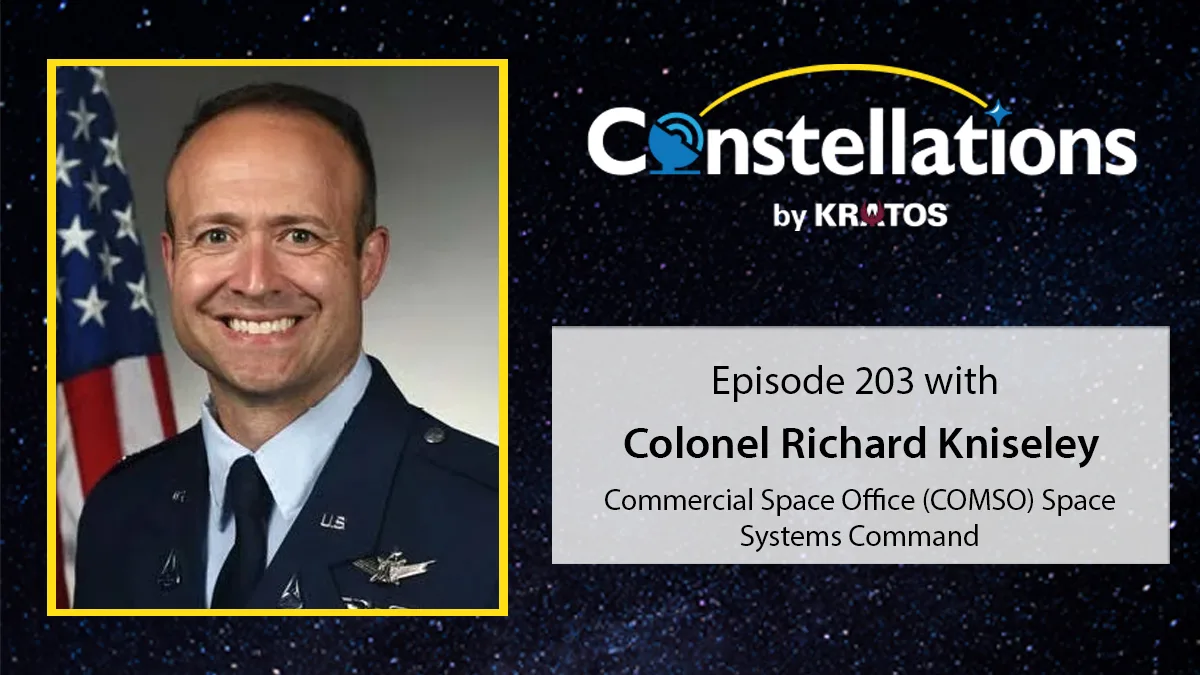
John Gilroy: Welcome to Constellations, a podcast from Kratos. My name is John Gilroy and I’ll be your moderator. Today, we’ll be talking with a member of Space Systems Command’s Commercial Space Office or COMSO about buy before build strategies, bridging commercial space capabilities with DOD needs. Our guest is Colonel Richard Kniseley, who is responsible for leading a team to deliver those needs. Welcome, Colonel. We’re grateful you can join us. For any listeners who might not be deeply familiar with space operations to see commercial space services like those providing surveillance, communications or data analytics being integrated with US government systems, specifically, how can they help enhance capabilities like early warning, overwatch or even accelerate the adoption of emerging technologies?
Col. Richard Kniseley: Hey, John. So first of all, thank you very much for having me and thank you very much for everybody for joining. So just to kind of go over a little bit of history, so we rebranded the Commercial Services Office as the Commercial Space Office in April of 2023. And kind of going back to your point, it’s really to get after the buy what you can approach. When we stood up Space Systems Command, we took on the mantra of exploit what we have, buy what we can and build only what we must. And in the Commercial Space Office, we wanted to tap into the innovative nature of the commercial industry to better equip our joint warfighter and to get capability out there as quickly as possible. Because what we’ve been seeing and modeling through the force designs produced by the Space Warfighting Analysis Center is that commercial plays a very vital role in how we are going to compete against a pacing challenge such as Russia and China. And commercial capabilities provide an added layer of resiliency as well as, like I said earlier, speed of fielding. So a couple mission areas that we’ve been seeing great results in have been commercial SATCOM. We’ve been buying commercial SATCOM services for many years. That is done primarily through the commercial SATCOM office led by Ms. Clare Hopper, located at Fort Meade, Maryland, which is actually under the Commercial Space Office. And we expend about $1 billion per year across all services in combatant commands providing all the service and combatant command needs for their commercial SATCOM, whether it’s bandwidth, capacity or the equipment like the terminals. So that area has been integrated very well into the overall hybrid space architecture. But another mission capability area that we’ve been really utilizing is tactical surveillance, reconnaissance and tracking or what we call TacSRT. We really kicked that off about a year or so ago. And the goal of that is to utilize commercial analytics and take many different commercial phenomenologies like commercial imagery and get after what the combatant commands need. So through a global data marketplace, a combatant command can provide a question that they need and through that data marketplace we’re able to take that query, compete it with many different proven commercial analytic providers and then get that answer back out to the field in less than 72 hours, less than three days to provide real-time or quick-time answers back to the warfighter. So answering things at a tactical speed is huge. But what we’re also seeing is, and you can read in the news some of the upcoming initiatives by the new administration like a Golden Dome, there are definite ways that commercial can play in that, especially from a remote sensing standpoint as well as some of the capabilities that they have out there to track different missile profiles. So along with that and the recently released commercial space strategy by the Space Force back in last April, the industry can take a look at that, see the nine or so missionaries that we feel that commercial can play a lot more with. And then we’re ready to have those conversations and understand your capabilities by visiting the SSE front door. And we’re going to link you with investment opportunities as well as with the right decision-makers so that we can assess your capabilities and work to get you integrated with our space capabilities.
John Gilroy: Colonel, can you help define the buy what we can approach and how do you envision the effort being expanded?
Col. Richard Kniseley: So buy what we can is to get those capabilities out there as quickly as possible. And the great thing about commercial is in my office, I’m not looking for the hundred percent solution right now. If you have a capability that meets let’s just say 30, 40, 50, 60 percent of what we need in our requirements, I’m going to work with the correct PEOs to try and get your capability on contract and get it out to the field. And it’s important to do that so that our operators can utilize that capability, understand how to utilize it, get it integrated into concepts of operations, integrated more into exercises and war games. And then if that capability is useful and we need to integrate it better into the fight, we can innovate in the back end, provide investment dollars to get after or to increase the ability of that capability to get it to the more hundred percent solution. But then also work with our PEOs to palm down range, if you will, to sustain that capability of record as well. Buy what we can really is all about getting quick capability out there as fast as possible while also understanding what we have to do, what I would call a more traditional space acquisition approach, where we’re going to have to be the lion shareholder, that there’s probably not a commercial market out there and that we’ll do a longer development cycle and most likely also operate that capability as well.
John Gilroy: Colonel, what changes do you think will help improve both the acquisition process and the funding budgeting approach as they relate to these commercial capabilities referred to?
Col. Richard Kniseley: And that’s a great question and I’m going to kind of take this right back to our Space Force Commercial Space strategy. COMSO, lucky us, we are the executing arm of that strategy and what we did was we dissected that strategy into over 30 lines of effort and we have OPRs and OCRs associated with each of those. But what were the four main areas that we’re looking to tackle all align with partnerships, budgeting, requirements and integration into operations. So we have many different initiatives that we’re looking at to get commercial out there. But how we can expand this, and we have ongoing efforts right now to find or to assess our missionary requirements and understand what can go to commercial and what can also go towards international and what we feel is more inherently government. And what I hope over the course of the year is that we have conversations with commercial industry to show them what those requirements are, hopefully not make them so strict that we are putting them in a box. And what I really want commercial industry to do is to provide a solution. I don’t want to provide the solution or prescript a solution to them. I want them to come with their ideas on how to get after our problems. And we’ve been doing that a lot through industry days and reverse industry days where we’ve been having one-on-one conversations, but we’re going to kick that into overdrive over the course of the year. We are also working with our PEOs on how to go after commercial initiatives better in the funding process. To get after these capabilities, we do need to get additional funding. You’ve heard our senior leadership talk about how working in a CR is very binding for us, especially when we’re waiting for those dollars. And that in my mind goes a little double for commercial because a lot of the efforts that I’m going after are new efforts and it is very hard within a CR to do any new starts. So we’ve talked about requirements, we’ve talked about funding. Additional resources are definitely needed to get these efforts on contract. We’re going to need more contracting officers. I feel like we have a great amount of contracts available to us that provide a lot of flexibility to get these on contract, but I’m also going to need the resources to do the actual work. And then it is all about integrating this into operations. I would love to expand the joint commercial Ops sell run by Ms. Barbara Golf. She’s already doing great things with space domain awareness. She is also transitioning TacSRT into the joint commercial Ops center with a couple of initiatives. Slower going there, but we are trying to get that more operationalized. But there is a design out there to expand that into other mission areas as well. It will require funding, dedicated funding to do that, but she is definitely leaning forward to do that and that is a great way to integrate that with industry, government as well as our international partners.
John Gilroy: Colonel, the Commercial Augmentation Space Reserve program, or think you pronounce it CASR, encompasses different capabilities. How do CASR partnerships with commercial space domain awareness and RF sensor operators differ from partnerships with commercial SATCOM operators?
Col. Richard Kniseley: So that is definitely a lessons learned that we’ve had since we’ve gone through this process of CASR. We started CASR in February of 2023 when we wanted to understand the appetite of industry to stand up a commercial space reserve. We started with the Civil Reserve Air Fleet as a model to start with for the air domain, but we quickly moved away from that because space is inherently different than the air community. With space, you are over the area of responsibility or over a pacing challenges AOR at any given time like China and Russia. You don’t exactly steer away from China or Russia, it’s just a known thing of doing business that you are going to pass over an AOR. So what we wanted to do was bring industry and government together and understand how can we incentivize industry, how can we build a good partnership there? And so we stood up the Tiger team to get after this. We built a framework that shows that we are going to need to have these capabilities on contract during peacetime. And when I say that, that means when a company comes on for CASR, they are providing a peacetime level of capability. I need that in order to get it integrated better into the overall space architecture. I think there will be a couple CASR contracts where I would say you go zero to 60, meaning they’re just on reserve and ready to go. But I think that’ll be the exception, not the rule. The majority of contracts and capabilities will be on during peacetime and then scaled through the spectrum of conflict. But what industry really appreciated is there will be different CASR frameworks for each different mission area. Going back what you said, remote sensing operates completely differently than the SATCOM community, both in operations, customers, incentives, types of contracts, number of different providers. So we are tailoring the framework to be applicable to each of those. And we plan to have CASR frameworks for CASR, for commercial SATCOM. We just awarded our first pilot contracts for space domain awareness earlier this month. We awarded to four different providers, three month period of performance. And this also gets them, exclusive access to exercises of war games, which is what industry asked us to do. And we’ve built a pretty good incentive plan for industry, increased threat sharing, access to exercises at war games, longer duration of contracts. Most space domain awareness contracts are a month to month. We were able to work with Ms. Golf to make it a three-month period of performance. With additional funding, we could do a lot more, but three is definitely better than one. And we look to expand that into other mission areas. But each framework will be tailored based on the mission area to make sure that this is a member or a partnership that each of those mission areas want to be a part of.
John Gilroy: Speaking of CASR, the R in CASR is for Reserve. So does industry currently have the capacity to support conflict? If not, how do you incentivize peacetime investment?
Col. Richard Kniseley: So what we’ve found so far with the missionary analysis that we’ve done for commercial SATCOM, there is additional capacity out there. A lot of companies do hold capacity and capability in reserve because they are looking for a new business that’s out there. Especially in a robust mission area like commercial SATCOM, there’s a number of different providers out there, different orbits, different bands. So we are going after CASR frameworks with a very robust mission areas where we know we’re going to have a number of different providers so we don’t get into vendor lock while also making it proliferated. We’ve seen the benefits of having a proliferated architecture. I’d like to do that with CASR as well so that heaven forbid a provider were to go down, I know that I can continue my mission because I have a number of different members that are out there. And the same can be said with a commercial space domain awareness and a lot of different providers that are out there that have additional capacity. So when we set up those frameworks, I want to have a good number of providers and we’re doing the analysis to understand how much I do need to get on contract so that I can extrapolate how much I’m going to have to surge across the spectrum of conflict to ensure that the joint warfighter gets the commercial capabilities that they do need.
John Gilroy: Colonel, as the CASR’s program pace has shifted, are there specific strategies or avenues being explored to reengage companies that may have stepped back or maybe lost interest?
Col. Richard Kniseley: Oh, absolutely. My goal, and I could kind of bring this right back to Mr. Calvelli’s acquisition tenants before he left the seat as the service acquisition executive. We will not have what I would call long-term contracts. So you will not see a CASR membership that will be a ten-year contract. Long-term contracts, a lot of times kind of, I don’t want to say stifle innovation, but it definitely doesn’t incentivize innovation to maintain their membership in something like CASR. So I plan to have short-term contracts. We will plan to make sure that we’re keeping an eye and also partnership and keeping dialogue going with companies that still want to be CASR members, whether they need to build their capacity or capability in order to be competitive as a CASR member or they’re just kind of waiting in the wings and they’re innovating and I want to get the best capability out there to our warfighter at any given time. So it’s keeping the partnership and also the conversation going. And I really do applaud Space Systems Command on increasing the number of industry days that they have, how vocal they are with industry. And back in the day it was kind of frowned upon to have very frank conversations with industry. I think we’ve definitely changed our attitude about that because we know especially in space, industry is a partner. Especially commercial, commercial is out there right now providing capabilities to the warfighter and they’re in the fight whether they like it or not. It’s kind of the price of doing business in space that you’re taking the calculated risk that you at any given time could be subject to cyber attack or any other potentially nefarious act. So I try to tell everybody that commercial is here to stay, great Patriots definitely willing to help out the governments. I do also tell the governments that they are a business and we want them to make a profit. We want them to succeed. And the best way to do that is to also make sure that our requirements doesn’t stifle commercial companies and that we should be looking on how to get after commercial capabilities, drive that into our architectures while also looking at how we can adopt commercial standards as well to make them easily integrated.
John Gilroy: Colonel, you just mentioned industry days, COSMO has been very active in engaging industries, multiple RFIs and the industry days you mentioned. So what has COSMO learned and how is this changing their plans?
Col. Richard Kniseley: What we’ve learned through many of these industry days, number one is how eager industry is to get involved with us. Part of the things that we’re also looking at in COMSO is number one, threat sharing. Threat sharing allows us to show what’s going on in the AOR at any given time. It allows companies to make their architectures more robust while also showing where we are having potential capability gaps. Or it also shows where maybe industry knows that we’re going to be looking for excess capacity and they may want to launch a few more satellites or make more capacity available to us. So having that open dialogue has been great to do. But what we’re also doing with those industry days is showing where our problem points are. Going to industry and say, “Hey, we have these problems and we’re able to articulate them at different classification levels,” so that industry knows what to do. They may be producing a product that they thought was going to be built for the government, but if it’s something that it doesn’t really fit into our model, they can make their own pivots and so that they can not spend valuable capital on something that just won’t have a chance to make it to the market with the government. So we’ve been having a lot of dialogue with that. And then also building the partnerships and showing how we can do investments, whether that’s through space works, teaming together with the Defense Innovation Unit or DIU and going after direct to phase two’s TACFI, STRATFIs. Because the goal is to increase the capabilities of companies so that we can get our requirements out there and so they’re building towards stuff that we need and then working with the PEOs to fund for those capabilities for a sustained period of time.
John Gilroy: So Colonel, CASR is often compared to the civil reserve air fleet model for commercial augmentation and space. So why is that and what makes it different?
Col. Richard Kniseley: So when we started with CASR, we did need to… everybody needs a starting point and a lot of times the mission area that relates a little bit more to space is the air domain. So you started with the CRAF model or Civil Reserve Air Fleet. And with CRAF, they have partnerships with commercial air providers and they have the hooks in with industry that if they do need to do a call-up, they have already been providing a set of business for these providers. And when that call- up happens, they provide the capabilities for the DOD use. Now the model quickly stopped there because when you invoked or you increase CRAF, those civil or those commercial capabilities are only used during peacetime operations so that we can move more of our, of what we need our DOD aircraft to do, which is what we’re going to be taking into the AOR or what I like to call the last tactical mile. So for instance, when we were doing the Afghanistan withdraw, DOD aircraft were in the Afghanistan AOR performing operations. And what we were utilizing those commercial air crew or airplanes for were peacetime operations. So they weren’t in my mind in great danger or in harm’s way. And that’s the great thing about CRAF. But kind of going back to what I was saying earlier, space is different because those capabilities are over a contested AOR at any given point and the danger is there. But what we did was we took all the goodness from CRAF, we took how you were able to surge through the contract, we looked at how we can utilize some of the potential of CRAF which is potentially access to business. As we build out our funding, we should have more excess business that we can give towards CASR members for space. Threat sharing, access to exercises. These are all things that we had conversations with industry about and they have outlined those were incentives that would actually make them want to be members of CASR. But also with CRAF, they have a readiness model or a readiness plan so that I can monitor a company and make sure that they are going to be able to execute per the contract. So we’re going to be looking at supply chain, we’re going to be looking at who invests in those companies, who they are also on contract with so that I can make sure that they don’t have any nefarious capital or that they are not contracting their capabilities over to somebody that we would not want them to. So we took a lot of the goodness of CRAF and then we’re building upon that to make it more about CASR and what makes the space industry churn, if you will.
John Gilroy: I’m going to turn the tables on you here a little bit. So what are lessons COMSO has learned over the past year that industry can benefit from to provide commercial solutions for prioritized warfighter needs?
Col. Richard Kniseley: I would say a lot of the lessons learned that we’ve gotten through the years is we’ve got to be pushy customers with the operational community, build the partnerships with the combatant commands. And in the case of Space Force, we need to show Spock where commercial can definitely help out. And kind of going back to where we’ve been at in space, I mean, predominantly US has been the force in space, but challenges like Russia and China have caught up to us, so we need to change how we do things. We’ve talked throughout this podcast about changing how we do acquisitions, going after those quick wins and getting capability out there. And then just spending a lot more time on the stuff that is really more inherently government or a requirement that commercial isn’t really interested in or doesn’t really fit a commercial model, but it’s something that we need as far as being a military force for the joint warfighter and for our allies. But we need to show where there is great capability and then get it out there and have them learn more about it. Another avenue that commercial can definitely get involved in is our newest program executive officer who has got the operational testing and training infrastructure under him or OTTI. And his mission area feeds into STARCOM, which is our test and readiness commands. So this is what guardians are going to be utilizing as their training to be full- fledged operators. And so having commercial get more involved, they can onboard a lot of their technologies. We can potentially train against on-orbit assets that commercial can provide. And so I’ve been introducing a lot of companies to Colonel Corey Klopstein and his team to show here are the very mature companies that are out there so that he is well aware of their capabilities and as he’s building out his architecture, he can integrate commercial early and often.
John Gilroy: Colonel, I think you’ve given our listeners a better understanding of the concept of buy before build. I would like to thank our guest, Colonel Richard Kniseley, Space Systems Command Commercial Space Officer, or COMSO.
Col. Richard Kniseley: Thank you, John.