Transcript:
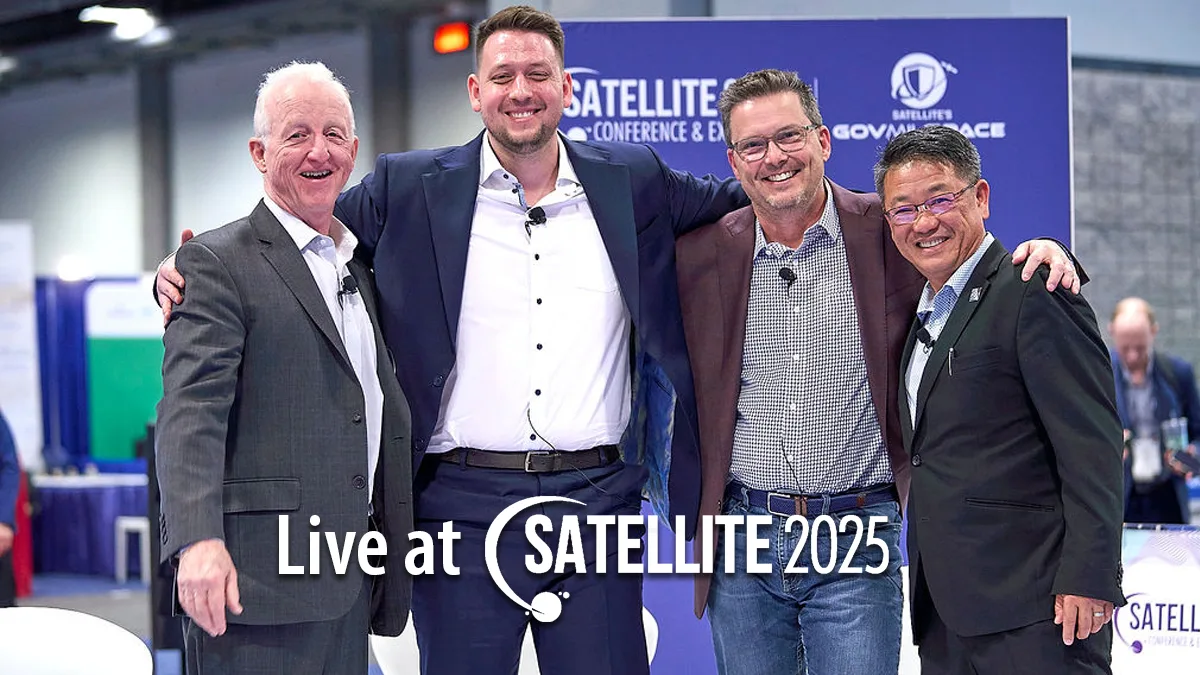
John Gilroy: Welcome to the Constellations podcast. My name is John Gilroy, and I’ll be your moderator. Today’s episode is a recording of the panel discussion I moderated at Satellite 2025 in downtown Washington D.C. My guests were James Trinh, Director of Global BD at VIAVI Solutions. Greg Quiggle, Senior Vice President at Kratos, and Andrew Cavalier, Senior Analyst at ABI Research. We discussed the why, how, and when of telco satellite integration. Let’s join the discussion. Well, you’re the tallest one here, Andrew, so I’m going to have to pick on you first.
Andrew Cavalier: Sure, yeah.
John Gilroy: So, what do you see the primary driving in this whole new dynamic?
Andrew Cavalier: Sure, yeah. So what we really see is standardization playing a key role in helping the integration between telcos and satellite communities, right? With Release 17, this is really where we got a set of rules and protocols where both telcos and satellites can integrate together and provide a more converged solution, right? And so, that’s really kind of one of the major drivers that we’re seeing in this space. I mean, it’s no secret but if we saw the attendance at NWC last week, there were so many satellite players over there, and that’s no coincidence. It’s certainly because the satellite players see this opportunity, and so do the telcos. And so this is really not just standardization, but a desire by both the satellite community and the telco community to help integrate and provide more value- added services.
John Gilroy: So James, this is like a chicken or the egg. Who’s going there first? Is it the telcos or is it the satellite operators?
James Trinh: I think what you’re seeing is both side are coming together, because as Andrew said, there’s opportunities on both the telco side, as well as from the satellite provider side. The telcos are trying to figure out how they can tap into new business models by leveraging the satellite. The satellites are seeing how they can tap into the billions of devices which they didn’t have access to before. So by combining these two markets together, you’re developing a new business model for both sides. So you’re not just increasing the pie, you’re getting a whole other pie, in effect.
John Gilroy: So Greg, where do you stand on this, chicken or the egg? What comes first? Do you see telcos actively seeking out satellite partners, or is this primarily being driven by a satcom at this point? So, who’s pushing it?
Greg Quiggle: So historically, I would tell you that a lot of the integration work was driven more so by the satellite operators. But what I think is fascinating now with the release of a 3GPP Release 17, now 18, which is a 5G NTN, I see the telcos actually getting way more comfortable with the use of satellite as another access technology, it’s a way for them to expand reach to hard-to-reach places. And instead of dealing with satellite as a special thing on the side, they can actually seamlessly integrate it into their back office, their service plans, and really offer a whole unique breed of new services for their customers. So, I would actually tell you it’s been flipping. It historically was more satellite motivated, and over the last two years we’ve seen a huge shift to where the mobile network operators in a broader telco base are actually much more engaged in what space can do for their business.
John Gilroy: I like the word historically, because this show five, seven years ago, it’s a lot smaller than it is now. And some of the terms that are used back then, people are starting to use very comfortably now. And when I was at Udvar-Hazy, I’m pretty sure those people were talking about LEO and GEO. I think they knew what LEO and GEO was at that place because those satellite things were flying off the shelf, it was great. So Andrew, is there an opportunity for GEO players in delivering these convergent use cases or will LEO dominate the market?
Andrew Cavalier: Absolutely. I mean, look, LEO is really well suited for low latency applications, right? And there’s a lot of capacity up there to do that, but ultimately, GEO is going to be able to free up LEO’s capacity to take on those use cases. So GEO can really tackle some of the more use cases that don’t really require low latency. So machine to machine type communications, IOT, really mobile applications where you can connect devices that don’t need that kind of low latency requirements that LEO can provide.
John Gilroy: And if you listen to people from the Pentagon, there’s millions of devices they have to keep track of. I mean, this isn’t a small problem, is it, Greg?
Greg Quiggle: No, no, not at all. And I would tell you that there’s going to be opportunity for any of the orbits, whether LEO, MEO, or GEO. So a lot of the hype in the near term has been around the LEO constellations and use cases like direct to device. But when you compare that against some of the key advantages of GEO, such as very strong coverage in high density areas, or the ability to support private networking versus large public networking, more B2C type use cases, you can really see how the two orbit layers play off of each other. So we see many of our customers, they’re interested really in multi-orbit use cases, right? You want to use the orbit regime for the use case, and this goes back to why 5G really matters, right? That was really hard to do when the LEO system was on proprietary vendor A, and the GEO system was on proprietary vendor B.
John Gilroy: I know.
Greg Quiggle: Then you try to get those to work together in a seamless hybrid service, just didn’t work, right? So this push for standard, not only does it help with integrating more tightly with telcos, it starts to bring forward the promise of multi-orbit services because oftentimes we talk about complexities like the antenna is a difficult part of multi-orbit and it’s very true. Everybody looks past the complexity of the network. Network’s really hard when you’re trying to land a single seamless service into two completely different teleports because they’re on different orbit regimes.
John Gilroy: So James, I’ve done a lot of interviews with people from Booz Allen, Accenture, and those people, they won’t go three sentences without saying use case. I mean, if you ask if it’s snowing outside, they’ll say, “Well, there’s this use case or that.” And so use cases seem to be a popular item here, and so I think it takes and encapsulates lot of the benefits of this new technology. So, I’m going to ask you about use cases that GEO specifically is well suited for.
James Trinh: Well, because of the higher orbits and I guess the benefits that you get from the number of satellites, you could deploy, it’s not as prone to ultra-liable low- latency technologies. So from that standards, IoT tracking, maritime tracking, you can do it a lot more cost-effectively. Whereas with the LEO network, you’re going to need a lot more satellites to cover that kind of area. I mean, as you know, the earth is more water than land. So if you want to track a maritime application, you’re going to need a lot more LEO satellites versus the GEO satellites. That’s one example. I’m sure, use case is one, I like to say business case is a driver of all of this, whether it’s LEO, MEO or GEO, at the end of the day, it’s about the business case. And I think there’s a play for all three of the satellite orbits, depending on what business case. The service providers as well as the satellite providers can come up with, and what drives the most cost-effective solution.
John Gilroy: So Greg, what with Elon Musk being a few blocks from here, all the cool kids are talking about LEO. All the cool kids and LEO. They got their NASA T-shirts and they’re talking about LEO, it’s great. So what are the use cases for GEO here? What do you think there?
Greg Quiggle: I mentioned a key one already, which is high-density areas, and it actually speaks to the business case topic that James brought up. Let’s just take an example. So let’s say we want to provide satellite coverage and a really high-density port, like Singapore. If I want to do that with a LEO constellation, as those satellites get over-utilized, the few that are actually over in serving Singapore at a given point in time, a LEO constellation has to launch hundreds of satellites really, in order to increase coverage or density in a given area. And then of course while those satellites are in other parts of the world, they’re largely rendered underutilized. Versus in a GEO use case, especially as you start to look at some of the more modern GEO satellites that are software-defined, you can actually focus a significant amount of bandwidth and throughput in a high-density area. So when you start to get to the economics of that, the reality of it is both will work, right? Which one makes more economic sense? And you can actually cover high density areas with a GEO stationary orbit in a way that’s way more cost-effective than LEO. So that’s one example. I think another really good example that would drive easier adoption of GEO satellites is private networking, right? When you think about a LEO constellation, it’s thousands of satellites in many cases, landing in hundreds of gateways. So the way that you would provide a private enterprise, let’s say Maersk as an example, a private network, which is what they want for their fleet, you have to be able to manage that across thousands of satellites and hundreds of gateways. Versus if you do that with a GEO coverage, you’re not talking about typically three satellites to get global coverage and a handful of gateways. So your ability to light up and sell private networks, B2B style networks, tends to suffice very well for GEO. Two examples.
John Gilroy: Yeah, good, good, good. I got up early this morning and I typed in Andrew Cavalier’s name on LinkedIn and I went to the company. Wow, it’s pretty big company, way bigger than I thought. It really has a lot of experience. I mean, it’s just way bigger than I ever thought, maybe because I haven’t been around long enough, but it’s a really well-known company in a lot of different areas. That means you must know about GEO. So, where do you think use cases are for GEO, Andrew?
Andrew Cavalier: Yeah, so like I discussed a little bit earlier, a lot of the mobility use cases where devices are moving in and out of cellular coverage, so we can talk about drones, we can talk about aircraft, boats, even, right? Any of these kind of applications where the chip sets are moving in and out of cellular coverage, is really going to be kind of the key areas where GEO can provide that kind of connectivity. And they have that regional coverage as well, right? So that provides more seamless solution than maybe having to worry about handoff between LEO satellites as well. And so that’s a really compelling solution for a GEO play, right? When you want to be able to connect devices seamlessly across networks, then you want to have that continuous coverage, as well as that stability in mind and for a long-term use.
John Gilroy: When I was in high school, I ran track and the relay team, they practiced the handoff every day, and every day they practiced how key and crucial it was. And this is really true, I mean, the handoff is really important and some people kind of assume it’s not going to be any problems, all kinds of problems there. Now the Tom Cruise question, Tom Cruise once had a movie where he said, “Show me the money.” So Andrew, show me the money here. So, well, what are some of the key convergent use cases that will move the needle on revenue for both satellite and telco?
Andrew Cavalier: Well, I think we all know what’s that top of mind. I mean, we see what SpaceX is doing in D2C and we see plenty of companies moving into D2D. Really, this is, as I see it, the big market opportunity because we have billions of devices, user devices that move in and out of cellular coverage. And connecting our cell phones, our smartwatches, our iPads, whatever it is, this is going to be something that’s going to be really a revenue driving opportunity, not just for the satellites but for the telcos. But that’s why both industries are interested in this. They see this D2C, D2D opportunity as something that can really provide deeper value for their networks and keep those customers on those networks for longer as well. You can keep those customers 15, 20 years and keep them on longer, and it’s a big differentiator to have that ability to provide coverage where you weren’t originally able to.
John Gilroy: I also looked up James this morning on LinkedIn and he has a solid, solid technical background, but I’m going to ask you the money question. So, show me the money. So what do you think are the use cases that will move the needle for revenue for satellites and telco? It’s a money question, man.
James Trinh: Well, you look at what’s happening in the satellite industry, the cost of a subscriber is extremely high. I mean, a device itself is in the thousands of dollars, and you only use that for a small limit of time. Whereas on the flip side, every single one of us carry at least one cell phone. Imagine having the ability to offer a service when you go on a vacation, you go hiking, you go on a cruise, at a subscription model. You created a completely different offering to your standard customer base. You can offer services as a subscription for ad hoc requirements. So, that’s one use case. I think the other use case is, it’s not a revenue generation, but I think it’s mission-critical and that’s with priority service and emergency service. Living in LA, we have the Palisades fire. That knocked down all telecommunication in the area. So, if you can go out there and provide satellite communication within minutes and offer that service, you could save a lot of lives.
John Gilroy: Yeah, no, no. Well, Greg, you’re a local fellow like me, and if you get in your car and drive up to Gaithersburg, you may wind up at NIST. And I’ve been there many times and talk about buildings full of smart people and loaded with standards, and so you got to talk about standards if you go up to NIST. And so, we got to ask the standards question because the telco people may want their standards and the satellite people may want their standards, and then you get a little fun discussion. So Mr. Greg, can you give me a high level perspective on how 3GPP standards enable the integration of non-terrestrial networks into the terrestrial infrastructure?
Greg Quiggle: So before I answer, I’m just going to tell you I’m a little hurt you didn’t look me up on LinkedIn, but now that I’ve gotten that off my chest, I’ll go ahead and answer your question three. So, 3GPP standards have largely governed the way the terrestrial industry has worked now for about 20 years. It started with 3G, and then onto the 4Gs, and now well into 5G. I mean, it’s the basis of why I can fly anywhere in the world, which these days I seem to, I can land, and my phone works just fine, regardless of the operator that’s providing the coverage, or whether the base station is Nokia or Ericsson or Huawei, the network just works. And the reason for that is a massive investment by that industry to govern and maintain these standards, right? And if you’ve ever gone to a 3GPP event, it is like none other, right? It is thousands of individuals from hundreds of member companies debating out what is core to the next rev of the standard. So, when I compare that to the way historically the way our industry’s worked, we just never really put that level. We, space, never really put that level of effort and investment and energy into maintaining standards. And as a result, many of our customers have more stovepipe-based networks. So if I wanted to draw the analogy, if I wanted to roam around the world with a satellite terminal, odds are it’s not going to work from one operator to the next. So a really key part for our industry to step forward and to really make good on the growth prospects that comes with working closer with the telcos, is actually embracing these 3GPP standards. They were built initially for terrestrial networks. As Andrew mentioned, 3GPP Release 17 was the first case where space was embraced as non-terrestrial networks. Release 18 was ratified not long ago, and a lot of activity right now around Release 19 and standardization of things like the KU bands. So, these are a critical role for our industry to really be able to make good on that promise and show not only seamless integration with telcos, but also enable things like roaming across operators to really become reality versus good PowerPoint.
John Gilroy: So James, Friday I’m going to do an interview with a software company, like I always do, two or three times a week. And they have something called the SDLC, software development life cycle, and it’s talking about maturation. And so if you listen to Greg, does this mean that the whole 3GPP standards are maturing and to the point where he can go to Rwanda and get a signal, he can go to Japan and get a signal? So, it’s almost at the point where the standards are already there or they just have to ironed out.
James Trinh: The standards as Greg mentioned, I mean, there’s different versions of the standards, Release 17, Release 18. It is continuously evolving, right? We started with Release 5, 6, 7, we’re up to 17, 18. We’re still looking at Release 19, and I think Release 19 with 6G coming into the picture. NTN and terrestrial networks are going to be more integrated as a technology. So, it’s not being added as an afterthought, it’s actually being incorporated in the beginning of this life cycle with the technology. So, the standards will continue to evolve and improve as time goes by.
John Gilroy: Yeah, yeah. So Andrew, NTN and standards. So, where do you think they’re heading?
Andrew Cavalier: Yeah, I mean, as I mentioned earlier, it’s all heading towards unification, right? And I believe the 6G standard is currently under work right now, they’re talking about end-end network slicing, integrated remote sensing and communications. Right? There’s a lot of unique use cases that are coming out of the proposal for 6G here, but really that means that satellite and telcos are going to have a very much more integrated role, if not a baseline, a standard really, for those networks to be able to provide connectivity. So, that’s really where I see it going, it’s towards unification.
John Gilroy: James, you walk around here, satellite show, all kinds of companies, but very few companies are an island. They’re always partnering with other people in many aspects. And so, how important is it for technology providers like Kratos and VIAVI to establish best of breed partnerships to enable satellite-telco integration? Just walk around, grab someone?
James Trinh: No, I think obviously it’s a lot more complicated than that. First of all, I want to say thank you to Greg for enabling this partnership between VIAVI and Kratos. It’s great, huh? At the end of the day, it’s about helping each other understand specification and enabling the technology. It’s not about what we know, it’s about what we can both understand. The specification is a technical documentation. The way I read it, the way Greg reads, it may not be aligned.
Greg Quiggle: That’s right.
James Trinh: Whereas if we collaborate, talk together in the very early days, we’re able to talk it out and say, “Let’s agree to what the specification mean and start developing a mutually working solution.” And by doing so, you can put interoperability, test specifications, test standards, and getting all of that worked out as early as possible, rather than wading into the talent.
James Trinh: It’s about making everything shift left, as they like to say. Shifting everything further into the development lifecycle.
John Gilroy: Well, yeah. So Greg, I use the phrase, “Best of breed partnerships,” and if you go on LinkedIn, you’ll see, “Strategic alliances.” So, what do you prefer and how do you work them?
Greg Quiggle: So, I think it’s always important to focus on a common customer and an unmet need, right? There’s lots of partners we can work with because we can or because the technology of work, but at the end of the day, we’re all here to solve a business problem. So it’s understanding, who are the key customers, right? What’s the unmet need that they have? And then what partners can we seek out at Kratos in order to solve them? And that’s really what makes the process work well. I’m not going to use the cliche, win-win, but in the end, if you have a focus like that, the partnerships that you pick end up paying out for all parties involved. And I think back to James, I appreciate the thank you for the partnership, but I have to tell you, Kratos won’t be successful without a tested verification strategy.
James Trinh: Right.
Greg Quiggle: Right? In the old days, I could, if I built a satcom system, it was my NMS, it was my hub, it’s my remotes. I didn’t need an independent test company to verify that it worked. I would deploy them in the lab, verify them over time, and they worked. Right? But if we all want to make good on the promise of 5G, on the flexibility and the scale that comes with it, you need organizations like VIAVI that validate your implementation and interpretation of a standard. And it’s a very real-time thing, right? 3GPP revs roughly every 18 months, so it is a relentless cycle and you need partners that also are willing to invest in keep pace with those revs of the standard. And when you do that, then I can go to a satellite operator or a mobile network operator and they can pick their 5G core. Right? It doesn’t have to be a 5G core from Kratos. It could be Mavenir, it could be Druid, could be Radisys, it could be Nokia. And the reason why that works is there’s standard interfaces between a Kratos RAN and a 5G core, and VIAVI is one of several companies that allow you to validate those. So it’s a critical part of making the promise of 5G play out for our industry.
John Gilroy: So Andrew, there’s a guy named Simon Sinek and he famously said, “Start with why.” So, I’m starting with why with you. So why did you come all the way here to the satellite conference? Are you trying to deepen relationships with customers? Is it to establish strategic partnerships, or everything or nothing? So, why? Why are you here?
Andrew Cavalier: It’s a great question. I flew over 20 hours from Singapore. I’m still pretty jet- lagged, to be quite frank. So it was a heck of a trip. But yeah, no, we’re here ABI Research, we see ourselves as a bridge between the telco community and the satellite community. We have a big presence at NWC.
John Gilroy: I know, it really is.
Andrew Cavalier: A lot of our heritage really is in the telco community and the hyperscalers and the RAN vendors, the whole value chain, right? And a lot of my job is really trying to build strategic alliances and partnerships. We want to help grow this community and this future possibility together with the space community, and that’s why I’m here. I’m here to build partnerships and build this future that we’re all looking forward towards.
John Gilroy: So James, if you listen to Greg, he trippantly said 3GPP. So, there are other standards though. So what other standards and specifications are important for this integration?
James Trinh: There’s the ITU, there’s O-RAN, I mean, there’s a lot of different specifications and standards out there. I think if you look at something like O-RAN, where they’re trying to define open interface for the RAN itself, what’s driving that is about economy of scale, which is very similar to what the satellite industry is trying to do tapping into 3GPP. At the end of the day, it’s about economy of scale. The more you can tap into standard-based technology, the more economy of scale you can leverage. So there’s ITU, open RAN, there’s a lot of different things that you can look at. Etsy is another standard that is I think, very relevant in this space.
John Gilroy: So Andrew, Singapore, different standards there. Some have more priority than here.
Andrew Cavalier: Yeah, absolutely, yeah. I mean, no telco network is going to have the same composition of RAN and core. And so you got a lot of heterogeneous networks out there and I think that’s part of the challenge for sure, but I think it’s something that both communities are willing to come together to overcome.
John Gilroy: So what about this end-end provisioning, Greg? How do you ensure the seamless end-to-end provisioning and management of integrated satellite telco services? What has to happen in the back end?
Greg Quiggle: So a lot of this really is two key elements that are important, beyond just continuing to talk about standards. Right? So the first thing is we all know we all carry a device, some of us carry two or three. Our profile is defined by a SIM card, and that SIM card is what drives a lot of a very seamless experience in activating a new device, changing your service profile, and or flying really anywhere in the world and having the coverage that you need. So, I think the SIM card is a key piece of it. The other piece of it is a 5G core, right? So 5G cores largely drive the whole workflow needed to run subscribers and associated service plans, really globally within each given mobile network operator. So as our industry embraces 3GPPG and 5G, what it really allows for is we can leverage those common components that made a mobile network operator scale and have great experience, to do the same thing with a satellite network. Right? And this is part of why the telcos now, I feel like they’re more directly engaged in making space a key element of their portfolio. In the past you had to manage satellite differently, right? It was hard and many would question, was it worth it, right? Now, they can actually manage the space domain in the exact same workflows that they do their terrestrial network, which allows then for that end-to-end provisioning to happen in a way that’s more common and seamless.
John Gilroy: So Andrew, I think 5G started around 2017, 2018, something like that. And when I first started studying it, they said, “Well, every 10 years there’s a new G.” So let’s talk about the next G. Not Gilroy, but the next G would be 6G. So, much of the world right now doesn’t have access to 5G. The industry has started talking about 6G. So how will 6G progress telco-satellite integration?
Andrew Cavalier: Yeah, so as I mentioned, really, satellite is going to be a foundation towards this total network solution. Being able to provide ubiquitous connectivity means that the telcos and satellite operators will have a more concrete standards in play, where they can provide connectivity, right? And so that’s where we really see this opportunity, is that the standards are really helping evolve the use cases and the ways that satellite can address those gaps in the cellular network. And so 6G is really a play for both telco and satellite. It’s not just 6G terrestrial, it’s six G satellite and telco.
John Gilroy: James, I see people wary to develop 5G, hardware. And because they’re saying, “Should I start working on 6G?” And so that’s why there’s these problems in the market with 5G and 6G. So, do you think the development of 6G will add to this integration or will this be problems for it?
James Trinh: I think, I mean, if we look at, as you said, the technology is evolving every decade, and I think 5G and 6G is no different. It’s going to continue to evolve. As Andrew said, 6G is going to include not just terrestrial network, but NTN is becoming a part of 6G. It’s not something that’s being added after the fact, it’s actually being developed into the specification in the very the early days. And the reason for that is, as we talked about earlier, it’s all about the business case on business opportunity, for both the terrestrial network and the non-terrestrial network players. And there’s different business drivers for both sides, and that’s going to create the demand for 6G and NTN.
John Gilroy: Yeah, I can see what you’re saying there. I think we’re running out of time unfortunately here. Just a reminder, free is not a four-letter word, so if you want a free T-shirt, let’s go over there and sign up for the podcast and you can get a space cowboy, it’s very fashionable, all the latest people are doing it. Thank you very much ladies and gentlemen.