Transcript:
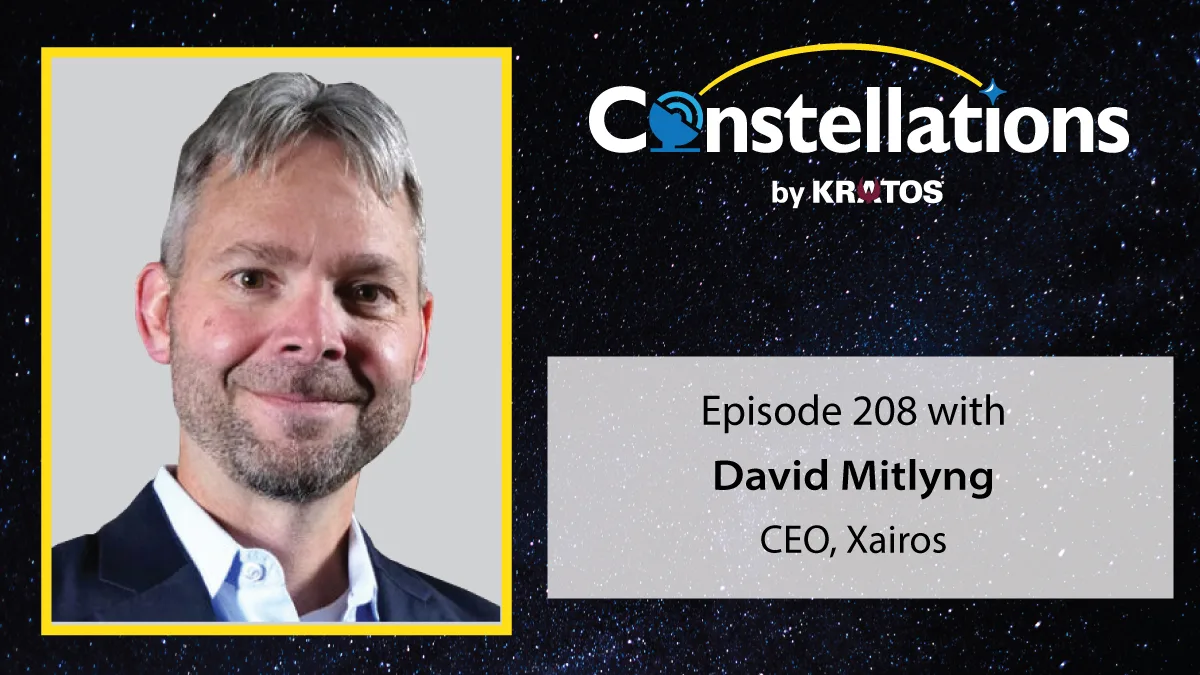
John Gilroy: Welcome to Constellations, the po dcast from Kratos. My name is John Gilroy and I’ll be your moderator. Today, we’ll be talking to David Mitlyng, CEO of Xairos. Traditional global navigation satellit e systems, or GNSS, are increasingly vulnerable to jamming and spoofing, impacting their ability to provide accurate location and timing information. Xairos is developing a space-based timing architecture based on entangled photons to augment timing from GPS. So David, we’re going to jump right in here. Given our overarching dependence on GPS for critical infrastructure, can you explain the consequences of the GPS timing signal failing and how that would affect our daily life?
David Mitlyng: Well, yeah, thanks, John. Apprec iate the opportunity to be here. And you are correct. We are very dependent on that timing signal from GPS, and if it ever went out for an extended period of time, it would be disastrous. I think when people think of GPS, they think of position. It’s in the title, global position system. And you think of the location app on your phone. But in reality, the majority of the nearly $2 trillion in economic benefit provided by GPS is as the clock for the world. And that’s because all networks, all financial transactions, all communications and data centers and power grids rely on that timing signal from GPS. And if that timing signal ever got disrupted, these networks would degrade, and eventually, if the outage was long enough, we would lose communications and we would lose power and we would all be sitting in the dark.
John Gilroy: Yeah, think about the number of transactions of stock transactions that take place based on the timing, and that can make thousands of dollars of difference. So it’s really important for everyone listening, isn’t it?
David Mitlyng: Oh, absolutely. I’m just recently at a conference where they talked about there were local GPS outages, maybe malicious, in the Middle East. Sometimes they were turned off, and the first thing that was shut down were financial transactions. You couldn’t use your credit card, you couldn’t go to the ATM. Emergency broadcast services, they went out immediately. So even any short extended period of time, imagine commerce going down for hours at a time.
John Gilroy: When you use the word quantum, you can apply it many different ways, but I think today we’re going to talk about quantum communications with you. So what does quantum communications really entail?
David Mitlyng: Quantum communications is just a form of quantum technology, but in this case, you’re using the quantum properties of photons, all particles of light. I think when people think of quantum, they immediately think of quantum computers. That’s what’s getting all the press. That’s what’s getting all the funding and all the buzz. And quantum computers are definitely valuable. You’re using stationary particles for some new computing applications, but there are also a lot of work going on with what they call quantum sensors and quantum communications. Now, we’re not a quantum computing company. Very clear on that. We are quantum communications. We deal with entangled photons. And the nice thing about quantum communications, even though it’s overlooked by the public, is that the hardware and the systems are much more mature and simple than quantum computing. You’re leveraging a fairly basic laser and detector technology that’s been around for about three decades. A lot of the core hardware and technology was developed for quantum key distribution, the secure delivery of encryption keys. But since then, it’s been opened up for a lot of other applications that require entangled photons: quantum random number generation, which creates truly random numbers for security applications; quantum networking where you’re networking quantum computers and quantum sensors; and even some crazy things, like quantum LiDAR and quantum radar, require entangled photons. Now, of course what we’re focused on is quantum time transfer, the secure and accurate delivery of time using these entangled photon systems.
John Gilroy: Three decades, I wouldn’t h ave got that on Jeopardy. Wow. Really?
David Mitlyng: Yes.
John Gilroy: So this isn’t just brand new out of the box. This is a lot of tried and tested and proven technology. So let’s go back into this time tran sfer. So how would quantum time transfer fundamentally differ from traditional GPS timing systems, and what’s the advantage in terms of security and accuracy?
David Mitlyng: Yeah, so GPS works with an RF signal. The way a GPS signal works is the satellite transmits its position and time to a receiver on the ground. It transfers this time, your receiver doesn’t know its time, but gets it from the satellite by a change in phase that’s sent from the satellite. And with that, it’s able to synchronize the clock on the receiver, and with multiple satellites in view, you actually resolve your position and your time. Now, that all worked well. I mean, GPS is a brilliant design. It’s been around going on 50 years now, but it’s limited because it’s, number one, it’s a fundamentally very weak signal. These are satellites that are 20,000 kilometers above your head. The signal is about 1,000 times weaker than your weakest cell phone signal. And also, just naturally that nice, crisp RF signal gets distorted and delayed through the atmosphere. The nice thing about using entangled photons is that there’s a security inherent with the entanglement so that if somebody tries to jam it or spoof it, the entanglement is broken and both parties know it. And the other thing is the accuracy because when you’re dealing with the detection of individual photons, you’re not really worried about the dispersion effects that occur with a phase change in a RF signal.
John Gilroy: Well, I’m in the Washington D.C. ar ea and this is where security is everywhere, and you just drive down to the Pentagon and here—used every 10 seconds down there. So, in what way would quantum technology address the Department of Defense’s need for resilient PNT solutions in this GPS-denied environment?
David Mitlyng: That’s because what the military is seeing is the real, rapid advancement in what they call electronic warfare, this ability by an adversary to jam a GPS signal, which is critical obviously for the troops, for guided munitions, for aircraft, and for the systems being deployed. But what’s more insidious, what’s more scary for the military today is the rise in capability of what they call spoofing. Now, jamming just means simply yo u transmit a stronger signal and you overwhelm the weak GPS signal, but spoofing is more malicious because it’s a case where the adversary creates their own fake GPS signal and makes the receiver think they’re in a different location or a different time. And there have actually been documented cases where drones, uncrewed vehicles strayed into enemy territory and were shot down because they thought they were in friendly territory. So this is what the military is really fo cused on is what they call systems that work in a GPS or RF-denied environment, and that’s what you get with entangled photons. It’s provably authenticated source of timing and position so that you know you’re getting the right position and timing. There’s nothing an adversary can do to block that.
John Gilroy: It’s not the easiest thing to do. I’ m sure there’s real serious challenges in this technology. So what are the technical challenges in achieving sub-nanosecond synchronization using quantum clock technology?
David Mitlyng: Well, our core technology was invented in papers in 2018. We’ve since demonstrated in a lab, and for us, getting to single-digit picosecond-level precision with fairly simple off-the-shelf hardware is fairly easy. And we’ve demonstrated it, and we’ve demonstrated it’s resilient over long distances so we can get that accuracy with fairly simple hardware potentially over very long distances. The challenge for us right now, frankly, is just getting this moved into a package and system that can be rapidly deployed at scale, installed on satellites and installed on ground receivers very rapidly. So that’s really our technical challenge in the near term.
John Gilroy: David, many companies in this area here have to balance commercial and then government contracts and applications. And so how do you balance the development of technology for both commercial applications and military requirements? That’s a juggler, huh?
David Mitlyng: Yeah, and I think that’s a situ ation a lot of companies, small companies are facing. We are focused on the commercial market. So we have this vision of taking our hardware and hosting it on other satellites, deployed on a small constellation around the globe to provide a resilient global timing service traceable to UTC, the global timing reference, at some nanosecond accuracy. Now, unfortunately, the commercial sector doesn’t want to fund the development of the system. It costs an amount of money to get this into a compact package that we can roll out at large quantities, has costs associated with hosting this on other people’s satellites. So this is where we’ve gotten very good support from military users. We’ve gotten very nice contracts from NASA, from the US Air Force, US Space Force and SpaceWERX, Space Development Agency, SDA, European Space Agency, UK Space Agency. They also see the value of this, not just for the commercial market, but for applications that they’re looking at. So they’ve really helped us provide the funding that we needed to build that commercial solution. And as part of that too, then we’ve st arted to develop also the more exquisite capability that those end users are looking for.
John Gilroy: When you said 20k kilometers, I wrot e it down and I said, “An RF signal from 20k kilometers.” You know, I can understand why it’s weak and vulnerable. And so I’m pretty sure and you said that there are increasing threats to GNSS, and so then how does your company enhance cybersecurity for critical infrastructure and these military operations?
David Mitlyng: Well, by providing this kind of quantum time transfer on a global scale, and if we focus just on providing this for enterprise timing users, it also provides that resilient and secure timing signal that is necessary for both the military users and the critical infrastructure. Think power grids, think major telecommunication centers that really are only reliant on GPS. GPS is fairly well known for being… It’s actually being quoted as being a single point of failure for the modern world with the idea that we, as ubiquitous as GPS is, if it ever goes down, and it is a nice, ripe target for an adversary that wants to do malicious harm, then the whole Western world and their networks would fail because of that. So by launching our system, not only providing something that’s more accurate, more resilient, and more secure, we’re also taking the target off of GPS a bit. And I think that’s also a major focus from the groups that are looking at backups for timing for critical national infrastructure and military operations.
John Gilroy: When you look around the globe, you see existing infrastructure for satellite communications. We know that. And it’s obvious just from listening to you for even two minutes, you have a vision for establishing a global timing service. So how would that integrate with the existing infrastructure?
David Mitlyng: No, you stated it very well. We are going to develop our system as much as possible to plug and play with existing space and terrestrial infrastructure, and part of the way we’re doing this is working with existing timing and synchronization providers. There’s already a number of these companies that provide these units for the networks and around the world, they deliver units that deliver local time distribution products through NTP and PTP and White Rabbit, but we’re really focused on is the infrastructure that what they call the grandmaster clocks. These are units that are on top of every office building, on top of every data center, on top of every cell tower that gets that global timing from GPS. And these tend to be fairly expensive units. They’re critical for these networks operating properly, but they’re still reliant on that weak signal from GPS. What these timing and sync providers have done to provide a little bit of resilience is they now are leaning on what they call multiple signals of opportunity, getting signals from Galileo and other satellites in addition to GPS, but it’s just kind of a bit of a Band-Aid, Spackle on a crumbling foundation. So we want to have our system that plugs into that existing timing and sync infrastructure with just a separate receiver next to that GNSS antenna on the roof.
John Gilroy: We mentioned PNT earlier, and I’m su re because the proliferation of satellites in the next five to 10 years, all kinds of new requirements for communications, secure communications. So how do you envision the evolution of PNT technologies over the next decade, and what role will quantum technologies play?
David Mitlyng: Well, first of all, there will al ways be a use for RF-based PNT systems, and there’s new commercial PNT satellite operators coming online that are putting their satellites a little bit closer to Earth and LEO constellations, and they’ll always have that role there, particularly for rural users and aircraft and mobile users. We look at having the quantum technology, again, hosted on a half dozen, dozen satellites around the world that provides that enterprise timing within terrestrial infrastructure. And at a certain point, you get that accurate synchronization for cell towers that can provide the last-mile position navigation and timing signal to your cell phone, especially in urban and indoor environments where just satellite can’t penetrate. And that would be then augmented in this kind of vision of a PNT future with quantum sensors, very sensitive magnetic field and gravity field sensors that can be used to find your position, even if you’re underwater or underground, as well as some other very stable quantum optical clocks that will then provide this resilient, truly resilient and accurate PNT system.
John Gilroy: Podcasting gods have a mandate that I have to say, “artificial intelligence” every 17 seconds, so I got to throw in AI before I get bounced from the airwaves or something, so let’s go into the AI question. So will AI, artificial intelligence, or ML integrate with quantum timing systems, and are they already being used to enhance performance and adaptability?
David Mitlyng: Well, the tech startup go ds also dictate that I talk about AI.
John Gilroy: That’s right. You better not. You wr ite that. I got a calendar here. I’m marking it down.
David Mitlyng: It’s a necessity nowadays. Yeah, so we’ve started to use an AI ML algorithm with our current system primarily just to provide the clock stability within a clock ensemble that our system integrates with. But you’re absolutely correct. I mean, the long-term vision is we’re not delivering a point solution. It’s a timing node that you install within the network. It’s a network infrastructure that’s monitored by AI ML algorithm, and it will be there to detect those subtle changes, and that includes time of flight distribution and sensing that you get with entangled photons that could actually not only detect a malicious actor trying to mess with your PNT signal, but also potentially some intrusion effects. So there is that vision that AI ML is going to be there to monitor your network.
John Gilroy: Yeah. I imagine if you go to Google Trends and type in trending phrases and see what’s going on, we know AI is there, but guess what? China’s also there too, so a lot to talk about in all kinds of different areas of applications. So I think this is the 500-pound elephant in the room we got to bring up here. So where does China fit into all this? Are we ahead or are we behind in this technology?
David Mitlyng: Ah, well, we’re behind and we’re behind in both areas, I would argue, both the PNT and the quantum space. Quantum is fairly well-known. This has been well- documented and has led to a number of bills being sponsored in Congress. By some accounts, China is responsible for nearly half the global spending in quantum. They’re in a race with quantum computing, that’s been well- documented, but what’s not disputed is their lead in quantum communication systems and quantum satellites. They launched their first quantum satellite in 2017, did a number of groundbreaking satellite-to-ground quantum demonstrations. They since launched two more and are planning to launch three more LEO satellites and a MEO and GEO satellite in the next couple of years. Globally, everybody else is a goose egg. Nobody has satellites on orbit, and the US doesn’t even have satellites of this caliber planned. So this is fairly well-known, and so we are playing a bit of catch-up. We’re looking to put our system on a satellite, but China’s already announced they’re putting quantum timing on their next MEO and GEO satellites, so we’re already behind where they are, even though we invented the technology. Now, PNT is also another area, but it’s b een reported by experts in the field that China’s BeiDou system, their answer to GPS, already has capabilities that are expanding above and beyond what GPS can do. And they are kind of fortunate. They’re now leveraging the GPS signal, which is available for the world for free, while starting with a blank sheet of paper to design something new. And I think that is one of the major challenges for moving beyond GPS is it’s so ingrained in both commercial and military infrastructure that it’s made it hard to move on to a new system, a new platform. So it’s a challenge for all of us, I think.
John Gilroy: Yeah. David, earlier I mentioned the DOD, and there’s a phrase that’s used frequently with those folks, and it’s called a contested environment. And so what you’re saying is that well, in a contested environment, quantum communications is going to have a leg up on the opposition. I mean, let’s put the cards on the table because this is what it is. They’re going to not be impacted by any nefarious activities disturbing GPS, huh?
David Mitlyng: That is correct.
John Gilroy: This is a takeaway. This is a takeaway for this conversation.
David Mitlyng: Yes, that’s a major takeaway. Yes.
John Gilroy: Oh, well, good to know. Well, interest ing. I hate to leave this on a serious note, but it’s a serious topic here and we got to give all kinds of information about it. David, I think you’ve given our listeners a better understanding of quantum communications. I’d like to thank our guest, David Mitlyng, CEO of Xairos.
David Mitlyng: John, it’s been a pleasure. I really appreciate the opportunity. Thank you.