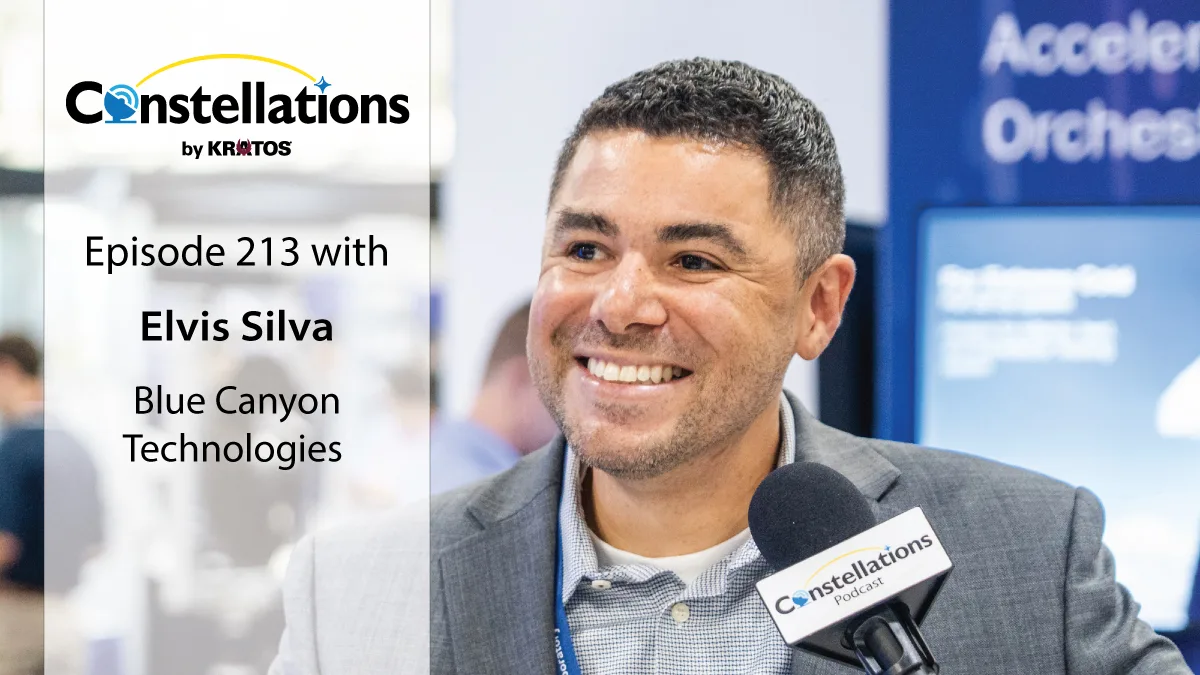
Transcript:
John Gilroy: Welcome to Constellations, the podcast from Kratos. My name is John Gilroy and I’ll be your moderator. In today’s episode, we explore why cislunar SSA matters, how new approaches can transform deep space monitoring, and what it’ll take to protect critical assets as humanity expands its presence beyond geo. We are joined by Elvis Silva, the Executive Director of Strategy and Business Development at Blue Canyon Technologies. Elvis, thanks for jumping in.
Elvis Silva: Hey, thank you so much for having me.
John Gilroy: So Elvis, why has cislunar space become such a critical domain for situational awareness and how does it differ from the traditional SSA environment closer to earth?
Elvis Silva: Well, that’s a good question, John. There’s two categories, two reasons why. One is commercial and the other one’s strategic for national purposes. From the commercial perspective, there’s been a lot of growth and applications for resource prospecting out of the moon, water, minerals, those kind of things. And there’s also been a lot of interest by commercial industry to put payloads that do different things on the moon. From a national perspective, there’s strategic importance to the moon and the area around it. Obviously, you have emerging space competition from other countries. The US, China. We’re expanding our presence in the space domain, expanding into the moon cislunar space. It makes it the ultimate high ground effectively for space domain presence. There’s also defense implications, right? We have a lot of assets out in GEO, cislunar space and access to those assets from the cislunar domain is actually very easy. So having presence in the space domain and the cislunar domain allows you to have capability to defend those assets in GEO as well.
John Gilroy: You mentioned the moon. So what are some of the unique technical and operational challenges in tracking objects and spacecraft that operate beyond GEO, such as cislunar orbits?
Elvis Silva: Well, one of the biggest ones is lack of infrastructure that we have in cislunar space. If you think about the space around earth, we have GEO, we have MEO satellites that do GPS. None of that infrastructure is present in the moon, so you have to do different things to be able to get position velocity locks on spacecraft or be able to have awareness of those things out there in cislunar space. The other thing that’s pretty complicated is the orbital mechanics around cislunar. Around earth, things move pretty easily. Motion is known, the dynamics are known. So you get further away, you start getting third party perturbations, you start getting sun perturbations and the orbital mechanics fall apart a little bit. So you have to do a little bit more rigor to do that. You have data predictability, that’s another issue. And then operational autonomy and operation centers, how spacecraft operate in cislunar, how they take commands, how they operate in those commands, the predictability of those things, and operations of those spacecraft is also something that’s pretty different. The further distances that you have between here and cislunar just drive you to a point where you have to have more autonomy on spacecraft.
John Gilroy: So how do limitations and sensor coverage and tracking fidelity impact our understanding of spacecraft behaviors in this cislunar orbit?
Elvis Silva: Well, one of the things that matters is just incomplete or delayed detection of things out in cislunar. There’s a lot of space. Being able to cover that space effectively with the sensors that we have is something that is very sparse, I would say. Things can go undetected for a long period of time, so you have to put a little bit more rigor on how you monitor that space. You have to be smart how you monitor things going back and forth from the earth and the moon. And then sometimes you lose things, right? You have poor custody of objects that you do see. You might catch something, record its position on velocity, go back and look for more other things. And then just because the orbital mechanics are a little different, you might lose those objects and keeping custody and keeping track of those objects becomes a little bit more difficult.
John Gilroy: Losing something in your garage versus losing something in cislunar orbit, bigger challenge there, isn’t there?
Elvis Silva: Oh yeah. It’s a big space and when you lose it, you have to go search for it pretty heavily.
John Gilroy: So that leads into the data question here. So what kind of data or measurement techniques are needed to improve accuracy and confidence in cislunar object identification and characterization?
Elvis Silva: Well, the biggest thing is having onboard data processing. So to minimize the time, comes back to earth and back to the spacecraft. You have to find a way to do onboard data processing, how to measure, how to process those measurements onboard, how to synthesize those measurements into tracks, if you will, of those spacecraft to be able to keep awareness of them. That in a way helps you reduce how much data you’re passing back and forth to the earth. Another way to do that is also to use different sensors. Right now we have visual sensors, there’s different wavelengths you could look at IR, there’s RF, there’s different things that you could leverage to be able to improve observations of things out in deep space. And then sensing fusion, fusing those measurements RF, IR this into a cohesive picture of what’s going on out there is very important for us to understand and to keep predictability of those objects out there in space.
John Gilroy: Could you share perspectives on how navigation and timing challenges compound SSA for these distance objects?
Elvis Silva: Yeah, so I’ve been doing SSA for a while. One of my favorite topics in space. One of the biggest things that we tend to focus on is the lack of timing synchronization between object in this space. I think you have to go and go through very rigorous efforts effectively to make sure the timing on a spacecraft. And we’re talking about milliseconds of accuracy, even smaller, to make sure that when things are measured and you’re estimating position of velocity and time and those things that they synchronize on board. Once again, as I said earlier, lack of navigation accuracy from things like GPS. That’s just not out there. You have to go through some steps to be able to provide spacecraft with ephemeris for it to know where it even is. I think that compounds into objects that you see in the accuracy that you’re tracking. And then once again, the gravitational models in deep space get pretty interesting and pretty dynamic. So having accurate models, having timing, having good measurements for yourself, having good measurements in your payloads, I think that all synthesizes into accurate tracking of space objects.
John Gilroy: Why is it essential from both a civil and national security standpoint to maintain persistent awareness of activities in cislunar space?
Elvis Silva: Well, as I said earlier, there’s national assets in deep space and just having awareness of everything that’s around there, having awareness of if things are maneuvering and how they’re maneuvering just helps us maintain a situational awareness of objects in each space. Early detection of adversaries. If somebody launches something out there that we maybe didn’t notice or maybe gets noticed later on and gets tracked and gets put into our custody effectively, we know where they’re at. We can track their maneuvers so we know if they maneuver what they’re doing, if it’s a nefarious or not. So it’s all for the safeguarding of national assets as well, and it helps us just maintain a strategic advantage. Just like in knowing in maritime domain, it’s a key to naval power. I think space domain awareness is key to space power.
John Gilroy: What unique technical capabilities, whether in spacecraft autonomy sensing, or data fusion are emerging to fill the SSA gap in cislunar space?
Elvis Silva: Yeah, so I think autonomy is one of the biggest topics that we talk about. Self‐organizing capabilities, constellations, just based on the changing space conditions, just having that awareness and being reactive to it. For example, collision avoidance is one of those topics where if you have objects that are coming close by, just being aware of them and autonomously reacting to that is very important. Using machine learning. A lot of the AI field that’s nascent at the time, and we were starting to use it in space, using a lot of those onboard algorithms to help synthesize a lot of data for awareness and for reaction to that awareness, I think is very important. As I mentioned earlier, sensing techniques, seeing a lot of growth in capabilities from a sensing perspective, as we brought costs down for small satellites, costs are coming down for payloads from different phenomenologies. So this radar, RF, all those different things. Being able to synthesize that data into a cohesive approach so that the data makes sense and that we can react on it intelligently, I think is really important for us. And then once again, having innovative orbit and deployment concepts for getting out in deep space, I think it’s very important as well.
John Gilroy: Elvis, you mentioned adversaries, and I’m sure the people in uniforms at this conference, their ears kind of pick up when you say the word adversaries. So in what way could adversaries exploit gaps in tracking or attribution beyond GEO here? How does improved cislunar SSA help deter or counter these adversarial activities?
Elvis Silva: So I think the biggest thing is about awareness, right? So having eyes in the skies everywhere allows us to know where all what the adversaries are doing or even the commercial industry is doing, and make sure that we maintain coverage of areas and awareness of those areas is really important. Confirmation of the accuracy of that data is actually pretty difficult to do. I mean, you have sensors out there that are taking measurements and they’re creating hypotheses of what spacecraft are doing and making sure that the accuracy of that data and the accuracy of those… What do you call it? Predictions are accurate and are consistent with what we think those adversaries are doing. Continuing to develop models. Commercial and government collaboration will help develop more effective models by simply providing larger data sets. So Oracle‐M is a very important mission from that perspective, right? Getting out to the moon, we’re going to have observations from different regimes and path to the moon. So that’ll help us inform how do we evolve that field?
John Gilroy: How can data sharing and integration between military intelligence and commercial SSA providers accelerate the development of a more complete cislunar operating picture?
Elvis Silva: Yeah, as I mentioned earlier, having that data and being able to share within commercial and government, helping validate models, helping validate how things behave out there, trying to understand, for example, how a sensor may see something out in this space. Trying to understand how maneuvering and timelines by which maneuvering occurs is very important, as well. As the activity in cislunar space increases, having that data, that awareness that gets shared across commercial and defense industry just helps us keep a safe environment awareness of everything that’s going on and helps us continue to protect the assets that we have in deep space.
John Gilroy: Elvis, what role do you see autonomous sensing platforms or responsive SmallSat missions playing in supporting defense and intelligence requirements for cislunar monitoring?
Elvis Silva: So I think one of the things that we can leverage from the field right now is the ability to desegregate a lot of the capabilities that you see in larger spacecraft. For example, you can have spacecraft that do data processing and do transport of data back to the earth. You can have nodes that support sensing or support the different RF or radar technologies for sensing spacecraft in this. I think being able to disaggregate based on capabilities, based on different capabilities of spacecraft at different nodes can help you improve the sensing architecture in deep space. I think the ability to launch and reconstitute these capabilities very rapidly, something that is also being afforded by small‐sat industry right now. For example, if you have a relay in deep space that goes down, you can easily reconstitute that capability without having to launch a brand new large satellite into that deep space. So I think the way just we think about how space is evolving and how we’re leveraging these tools in a piecewise fashion will help us continue to develop the infrastructure in cislunar.
John Gilroy: Elvis, AFRL’s, SSA, microsatellite bus, AgileSat, is designed for multi‐year operations way beyond geo. How does this platform’s design, the satellite bus autonomy, the payload flexibility, how do these provide unique advantages over traditional larger SSA platforms?
Elvis Silva: Well, I think one of the biggest challenges and advantages as well is the industry‐leading avionics that BCT produces for these spacecraft. As you know, Blue Canyon Technologies is known for guidance, navigation and control systems. We focus on precision pointing, precision stability. We focus on GNC effectively to enable a lot of these missions for SSA. So a lot of that technology, a lot of that IP, a lot of that capability not just in the hardware, but a lot of the staff that supported this mission is a capability that we’re delivering for AFRL for this mission. So pretty excited about the capability on a spacecraft. The other thing is radiation tolerance. In cislunar environment, you have different radiation environment than you would find in LEO. As a result of that, we have to go through extra steps to make sure that the avionics can live in this environment. So a lot of the heritage at Blue Canyon Technologies on our spacecraft and a lot of different regimes that we’ve been to help enable the capability to tolerate radiation in each space. And then finally larger small set platform that pack a lot of punch, if you will. Lots of Delta V, lots of agility, lots of transport capability. We have all those things in mind when we work on our designs here at BCT and working with AFRL to deliver that capability. So yeah, these were challenges that the team took on and we’re able to deliver for this mission.
John Gilroy: Earlier we talked about the vastness of the cislunar space and how big it is. So given the large volume and complex dynamics of cislunar space, effective SSA has to rely on sensor fusion and onboard autonomy. So how can onboard data processing or facilitating sensor integration improve real‐time tracking and handoff in deep space in this deep space scenarios?
Elvis Silva: Well, I think as I mentioned earlier, deep space has a delay associated with how fast data gets back and forth. So when you’re talking about onboard processing, the main goal is to be able to reduce a latency between what these sensors are collecting, what sensor making out of what’s going out on in deep space and how you’re enabling decision‐making, timely timelines. So I think that’s one of them. Superior track accuracy is another aspect of onboard data processing. So integrating data from multiple sensors allows you more accurate and resilient space object tracking that’s going on on the spacecraft in real‐time as those sensors are collecting that data. Target handoff. So reducing the time from when you sense things, when you make sense of them, and when you hand off that intel or those decision‐making data to the next spacecraft, I think those timelines are also greatly reduced, help us transition there. And adaptive testing and prioritization. For example, programming your spacecraft so that you could prioritize what kind of actions you’re taking on that data and how you’re using that data to make decisions effectively onboard. And then you’re optimizing bandwidth. As I said earlier, getting data back to the earth is very difficult from these long ranges. It requires us to optimize, compress, if you will, how the data is sent back to earth so that we’re sending every single bit that matters and none that doesn’t.
John Gilroy: If we look 5 to 10 years out, what advances do you expect will transform how the United States and its partners understand and manage cislunar space activity?
Elvis Silva: Boy, there’s a lot going on right now, and as you look around the conference here, there’s a lot of new technologies. Every year, I see something new. I think the leveraging of AI systems and machine learning to help predictability of our sensor measurements and what they’re sensing, I think is one field that has a lot to grow. Finding ways to implement those algorithms or those capabilities on board I think will be important for us over the next 5, 10 years. I keep hearing a lot about quantum sensors. I think that’s another emerging field that’s very important. Quantum capabilities is still nascent, but we’re seeing a lot of progress being made, a lot of demos, a lot of interesting capability demonstrations around that technology. As I said earlier, hybrid architectures, not just merging of different sensor phenomenologies. When I say radar RF this, but also sensing merging larger and smaller architectures as well is very important. I see that continuing to evolve. As we get smarter around how to feel these capabilities, we’ll get smarter about where it makes sense to have larger, where it makes sense to have smaller, where it makes sense to have different types of phenomenologies as well. Another thing that I’m seeing is on orbit servicing, that’s been a lot of buzz around that, where other spacecraft come up to your spacecraft, and one of the obvious one is refueling, but also other servicing approaches where change out batteries or change out processing capabilities or those kinds of things. I see it as all possibility in the next 5, 10 years. Another field that I’m noticing just walking around is propulsion. We’re making some leap and bounds around propulsion, not just efficiency, but high impulse capabilities to get out faster, higher delta Vs Or get out using more efficient propulsive techniques. I think one of the most important advancements I hope to see over the next 5 to 10 years is a continued collaboration internationally on how we manage that space, not just within the US, but how data shared by international entities to maintain that awareness, to maintain that safety. Think about it as CFA. Early on, someone had to establish how the airspace is monitored and controlled, and we’re at a point in our space path here where we’re starting to get the volume of spacecraft and the volume of users out there that we continue to try to figure out how to coordinate that and how to share that information effectively across various entities.
John Gilroy: I think you’ve given our listeners a real good understanding of the challenges of cislunar space. I’d like to thank our guest, Elvis Silva, the Executive Director of Strategy and Business Development at Blue Canyon Technologies.