Transcript:
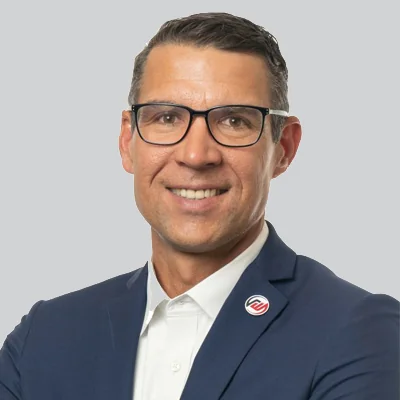
John Gilroy: Welcome to Constellations, the podcast from Kratos. My name is John Gilroy and I’ll be your moderator. Today we’ll explore the strategic advantage of multiple orbits and the escalating importance of space resilience. We are joined by Tom Campbell, President Space Missions at Redwire Space. Tom will discuss forms of resilience such as dynamic maneuverability and flexibility, and the ways in which they sustain space superiority. Tom, are you all ready?
Tom Campbell: Ready to go, John. Great to be here. Great to be at the conference.
John Gilroy: I should let the listeners know we’re recording this from the Small Sat Conference in lovely downtown Salt Lake City, right across from the Redwire booth. This is almost planned this way, wasn’t it, Tom?
Tom Campbell: Yeah, it looks great. Right here at the Salt Palace.
John Gilroy: Yeah, the Salt Palace. That’s what the locals call it, I guess. Good, good, good. Tom, how should mission planners think about the strategic benefits of operating in LEO, MEO, GEO and cislunar space beyond just traditional coverage and latency considerations?
Tom Campbell: John, great question. So I think as we approach the topic of space superiority and defending the high ground in space, I think the best thing for the listener to do or for people to think about is really to consider it as a warfighting regime. And if you go back and think about history and how for each branch of the military, there were protocols developed around warfighting and it had to do with what advantages they could seek from those layers. Whether they were on the ground in the army, in the navy, or airborne space is the same way we want to think about it. And traditionally, spacecraft were always just quiescent or stationary in space or orbiting, but not moving around. Today, we think about space as a continuum, really from airborne all the way up through to cislunar, and we gain advantage by any means necessary, therefore, multiple layers changing orbits in distributing your assets to gain an advantage through resiliency.
John Gilroy: I mentioned the Small Sat Conference here. I imagine if you try to walk around, list the conversations, the term cislunar is going to come up. I just used cislunar.
Tom Campbell: Yeah.
John Gilroy: So how do you see the increasing utility of non‐traditional orbits, such as cislunar and hybrid architectures changing how the United States and allies think about deterrence and persistence in space?
Tom Campbell: It’s all about holding our enemies at threat, really. And General Guetlein talks about our adversaries flying their spacecraft around like dogfighting, and in that way it’s provocative and we need to be able to do the same and match them to hold them at risk so we can maintain our superiority. I would like to speak a minute about very low‐earth orbit, which is really the newish regime that’s being studied within the Redwire specifically, we have contracted to develop a very low‐earth orbit spacecraft, and this is flying below traditional LEO spacecraft. Yeah. And big advantages there is that it adds a whole new layer of resiliency. Have you heard of the Kessler Syndrome before?
John Gilroy: No.
Tom Campbell: This is the concept of if there’s a collision in LEO that‐
John Gilroy: Oh, the domino effect.
Tom Campbell: … the debris can knock out all of those assets and this regime at very low Earth orbit would fly below that. And it has other advantages where it’s super close to earth, as low as 200 kilometers. It’s a self‐cleaning orbit such that if there is a collision, the debris de‐orbits very quickly and the space becomes a place that we’re free to operate again. The difficulty of this orbit and why it’s such a great engineering challenge and can allow us an advantage when we solve it is that it’s a mixture of air and space, and so it’s high drag. And so we have to be able to solve for that drag environment and create enough thrust continuously to stay in that orbit. And we use advanced digital engineering tools to help us find those solutions.
John Gilroy: So LEO, GEO and multiple orbits means both higher and lower than the standard three.
Tom Campbell: Yeah. And then also the paradigm of orbits themselves are falling apart a bit and with the concept of highly maneuverable spacecraft, and John, if I go back to my opening statement about thinking about space warfare like we have thought about any other traditional warfare regime, everybody started out stationary. Initially the army built forts and they just stayed in one place to try to defend it, and then eventually they had logistics and they started moving about. Same thing in space. So what used to be satellites and spacecraft are now moving, right? And so we want to continue to have more and more Delta V to be able to change orbits, go to where the fight is and keep our adversaries guessing.
John Gilroy: So Tom, what are some of the technologies that support mission assurance in a denied, degraded or disrupted space environment?
Tom Campbell: The most important thing, first off, is an advanced digital engineering ecosystem. So it’s typical for an engineering group to want to hurry up and bend metal, build a satellite. It’s cool, right? We want to go build something, get it on orbit. At Redwire, we think first digitally, therefore we can have highly optimized solutions. And in fact, today we relaunched an important software tool we call Acorn 2.O, which is an advanced digital ecosystem that allows us to design constellations and in fact infinite number of nodes that might be non‐ homogeneous in type to design a war fighting regime or a business regime that can be highly optimized first digitally before you ever bend metal. To answer your question about resiliency, some of the key aspects there, spreading your spacecraft out. So being in many orbits, having high Delta V ability to move them around to evade an enemy is an important factor. Cyber security is an important factor. The ability to autonomously maneuver so that if your comms go down or if you find yourself in a fog of war and you’re not able to command the spacecraft, it has the ability to see around itself and make its own decisions. These are all concepts that are becoming very important as we think about space as a war fighting regime.
John Gilroy: When you said dogfighting earlier, I wrote down the word tactics, so we got to get talk about tactics now. So given the increasing focus on tactics like deception, disaggregation, and proliferation, how should technology architects build flexibility into systems to respond to these dynamically and evolving threats? They’re changing all the time.
Tom Campbell: Yeah, that’s right. So just like Top Gun had to train its fighters, we have to train our satellites. And so not only is it making sure the satellite itself has enough technology to dogfight, this goes back to the concept of high Delta V. Also, modern spacecraft are going to need more advanced propulsion systems. And there’s an analogy I like to use. Traditionally, spacecraft, they would have tanks of fuel or use electric propulsion to station keep, and that was the only thing they had to do is just make sure that they were in the right place. Today, we want to be able to do that, plus we want to be able to hit turbo boost if we need to and go to where the fight is or go evade an enemy. So advanced propulsion, which might be multimodal and mixture between electric plus chemical where the electric could be used like a Prius around town, and then when you need to go 80 miles an hour, you can punch the gas and go faster. That’s an important technology that’s going to come forward to support advanced tactics. Logistics, again, hearkening back to other regimes of warfighting. Have you ever heard the saying that World War II was won on logistics?
John Gilroy: I’m somewhat familiar with that, yeah.
Tom Campbell: And so space will be no different. So today we’re very constrained where we have to launch one satellite at a time, and when it’s out of fuel or out of batteries or something goes wrong, it’s done. But in the future we should be able to refuel them. And in fact, Redwire is working with space systems command on the Tetra missions, which will be the first demonstrations of refueling for the US.
John Gilroy: Let’s talk about this maneuverability and Top Gun and Dogfighting and everything else. Space maneuver has traditionally been associated with fuel and what’s called station keeping, right?
Tom Campbell: Yeah.
John Gilroy: So how is the concept of maneuverability evolving in today’s era of responsive and intelligent space operations, really moving quickly?
Tom Campbell: Yeah, I mean, it comes down to being able to fully characterize the battle space. So having eyes and being able to make sense from all the data. And then again, having the assets in multiple orbits that allow you to maneuver without regret is a term that’s often used or do more rendezvous in proximity operations without having to worry about running out of fuel. So again, it comes back to not building satellites, but building spacecraft that have the ability to move locations and do so in a way that the warfighter doesn’t have to always be worried about the gas tank being empty.
John Gilroy: Here at the Small Sat Conference, you can talk to people, and I think a real popular word around here is autonomous. So let’s combine autonomous with your word maneuverability.
Tom Campbell: Okay.
John Gilroy: So how do you see autonomous maneuverability, particularly in small satellites or tactically responsive missions, how are they providing strategic edge and future conflicts?
Tom Campbell: Yeah, I think the key is that in all wars there can become a fog of war where there’s a lack of information or certain pieces of infrastructure go down, maybe a communications layer, maybe a ground antenna, maybe the operator couldn’t report to work as the bridge was blown out or something like that. But going forward in order to have very low latency and be able to operate through the fog of war, spacecraft should be able to understand their surroundings, know where they can make a link to another satellite to get comms down and be able to act on their own based on the pre‐supposed design, on how they were trained to behave. This is really the key for autonomy and also to take the burden off of the operators to do the things that are maybe less routine. So a very basic level autonomy would just be managing the health of the spacecraft. A more advanced level of autonomy would be able to react if it sees something that it doesn’t expect, and then maybe turn itself around or go somewhere else or call on another asset to investigate what’s happening.
John Gilroy: When I was in high school, I tried to learn tennis and they teach you hit them or they’re not. Okay. In other words, be unpredictable. And sometimes in battle tactics, unpredictability can be an advantage, can’t it? So what are the challenges and trade‐offs involved in designing systems that can maneuver often or unpredictably while still maintaining mission continuity and system longevity? You want to be unpredictable, but you want to win the tennis match.
Tom Campbell: Yeah, well, it’s about, as I mentioned, this concept of maneuver without regret or having very efficient means of moving itself around through advanced propulsion systems or multimodal propulsion systems. Also, back to the concept of fully digitizing the warfighting environment or the space environment so that you can make better decisions on where to move and when to move and how to get there to conserve fuel or to await for someone to approach you before you go approach it. So the orbital dynamics play a layer in that, and that’s where tools like this Acorn 2.0 modeling solution really can help you optimize your motion through space and reduce the amount of fuel use.
John Gilroy: As more proliferated systems come online how critical is the role of intelligent tasking and command and control in orchestrating real‐time advantage?
Tom Campbell: I mean, that’s a great question and a huge challenge really, because on top of not only just the fact that there are so many spacecraft that will be on orbit, they’re operated by disparate entities, different agencies, and really the strongest posture for the United States would be the ability to cross‐network, back to the concept of autonomy, but allowing all these spacecraft to be interoperable. In fact, maybe autonomously understand how to close a link budget, for instance, if it needs to be able to make a communication back to a decision maker. So that’s important. And having an operating picture by way of a software tool such as our Acorn 2.0 software offering that allows you to characterize all the assets in space and use AI, in fact, to help solve for the best positioning and the best connections of the satellites to provide the information to the warfighter is really the key. It’ll be a software battle
John Gilroy: Warfighters and battles, interesting discussion here. Some people will say that success in war will go to the side that possesses superior battle space knowledge and can make better decisions sooner. From a technological perspective, what role does sensor distribution across multiple orbit regimes play in a future contested environment?
Tom Campbell: Yeah, great question. I think there’s two axes to answer this. One is a strategic and one is more tactical. So strategically distributing sensors allows us to understand what are potential adversaries are doing. So in order for us to maintain an asymmetrical advantage, should we need to, it’s important to know what we’re up against. So just understanding the battle space today is important. Tactically, should we end up in a scenario where we are fighting a war in space, maintaining freedom of action, maintaining yourself out of this fog of war such that you’ve got sensors at all locations so that they can rely on each other for backup is really critical. Further, you’re able to fuse data. So if you have information from one altitude versus another or different phenomenology, fusing that data together can give you a richer view of what the adversary is doing and allow the policymaker to make better decisions. And frankly, it comes back to resiliency. So spreading the assets around gives you that layer of resiliency and different view angles and different phenomenologies, first to understand the enemy and then to make better decisions.
John Gilroy: Tom, I talked about the number of satellites in the next few years. I think everyone knows that. Let’s look ahead in a different view. Looking ahead at what technologies or architectural philosophies do you believe will define what the Space Force calls space superiority in the 2030s and beyond? That’s a tough question. 2030s, man.
Tom Campbell: Yeah. Well, actually, I’ve got a clear view on this, and I think first off, it was very important for the Space Force to be formed, and we’re still in early days in the Space Force. I think our five‐year anniversary was recently celebrated. The most important thing that the Space Force and all of us here supporting them, an industry that supports the DOD can do is to adopt a war‐fighting ethos, frankly, and this is the transition that the Space Force is currently undertaking. It’s one of first organizing, and then they were considered to be potentially an acquisition group, and then maybe just operators of spacecraft. No, if we want to maintain advantage, we need to have war fighters that are building spacecraft and operating spacecraft and the systems that they’re going to use to maintain superiority from space. This is a big shift for our industry, but I can see it, and each time we come to another conference, you can hear language start to change. You can hear people say things like, “What if we have to fight tonight? Or are we on a wartime footing? Are we falling behind?” Even just the concept of talking about war‐fighting in space would’ve been alien a few years ago, but today is becoming more adopted and it creates the culture whereby we’re putting more energy behind what we do here to support our way of life in the United States.
John Gilroy: Tom, I think you’ve given our listeners a pretty good perspective on the requirements and need for flexibility in multiple orbits. This has been the Constellations Podcast. I’d like to thank my guest, Tom Campbell, President Space Missions at Redwire Space. Thank you.
Tom Campbell: Thank you, John.