Transcript:
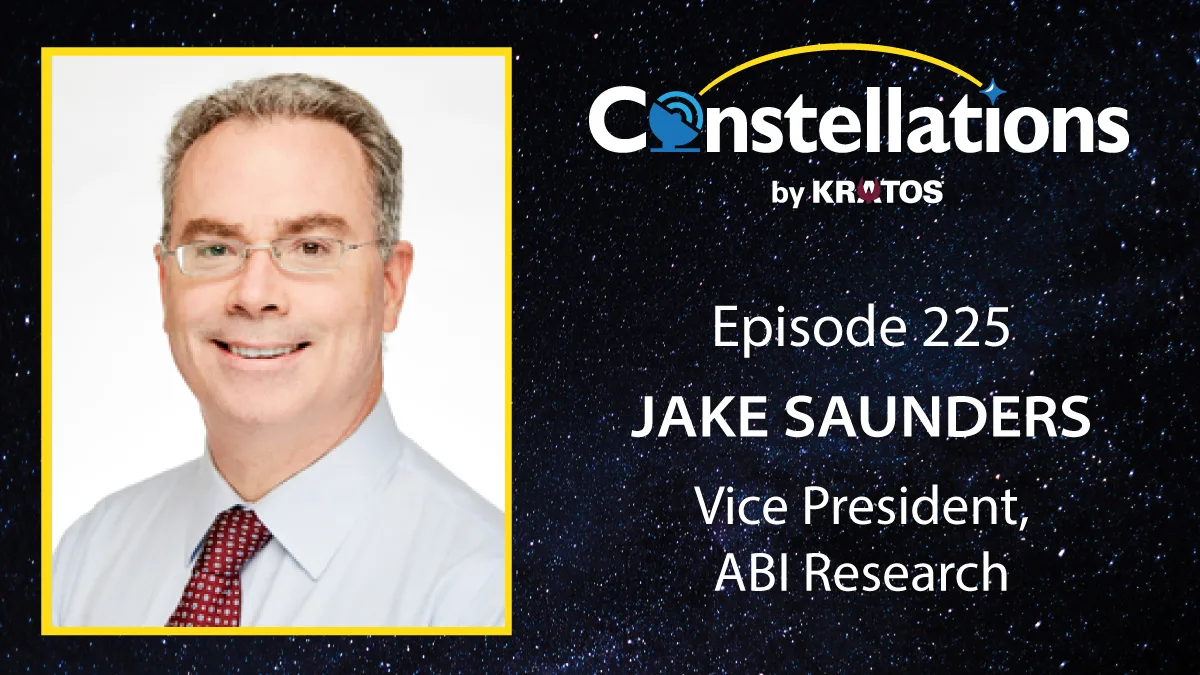
John Gilroy: Welcome to Constellations, the podcast from Kratos. My name is John Gilroy, and I’ll be your moderator. Joining us today is Jake Saunders, Vice President covering the Asia Pacific region for ABI Research, a global technology intelligence firm. ABI’s newest report, can satellite IoT take on the terrestrial IoT market and succeed? Predicts that the satellite IoT market will reach $3.1 billion in revenue by 2030. Wow, that’s quite a number. Jake is going to walk us through some of the key data on the state of satellite IoT, including the biggest untapped commercial opportunities, the competitive landscape, and the evolving relationship between satellite and terrestrial. Big topic, Jake, you ready to handle it?
Jake Saunders: I’ll do my best. Thank you, John. Great to be on. And yes, we’re pretty much the other side of the world, but we run this as a 24/7 business.
John Gilroy: Yeah, you’re based in Singapore. Been there for like 20 years or something, huh?
Jake Saunders: Yes. Well, actually I was born here and I grew up here, but then returned back to England in my mid- teens. But loved it so much I came back in 2007 and been here ever since.
John Gilroy: Great, great, great. So Jake, what is satellite IoT and what do you see as the strongest market drivers accelerating demand for IoT over satellite today?
Jake Saunders: Sure. Well, Sat IoT has a terrestrial version. So there is the internet of things, which is primarily used cellular technology, also low powered area technologies such as Sigfox and LoRa. And these have been round for a good 10 to 20 years in different forms. And then helps us roll up coverage kind of into the fringes of the countryside, into the smaller parts of small towns and villages, perhaps some sort of fleet management, asset tracking, and so forth. But there’s still places, and there still are places where cellular coverage can’t reach even in the current generation of 5G. So satellite fills in that very important role, providing coverage, perhaps for oil rigs, for pipelines, perhaps even for yachts for people using recreational boats or even vehicles, crossing America. And you want to make sure you’ve got reliable coverage and you want to track your vehicle. So it plays a vital role to compliment what terrestrial cellular hasn’t been able to achieve.
John Gilroy: Jake, in your new report, you cite the satellite IoT market reaching $3.1 billion by 2030. So where are the biggest untapped commercial opportunities and how do those evolve in the future?
Jake Saunders: Sure. I think before I sort of delve a bit more into satellite too, I think we need to talk about two other pillars of the satellite communications market. So the first is broadband. So satellite broadband. And I think that a lot of that sort of attention and focus has been on what indeed Starlink through SpaceX has achieved in ramping up [inaudible 00:02:58]. Prior to Starlink, there was clearly Viasat and a few others, Hughes Network Systems that had sort of broadband services. But really Elon Musk would also ramp things up to number 11 on the dial as it were. So we’ve seen satellite broadband grow and then also more recently become hip and trendy to talk about NTN. So NTN, non-terrestrial network, another phrase we’re referring to satellite, but NTN is seeing an opportunity for emerging between cellular networks and satellite and perhaps we’ll go deep into that later on. But that has provided an opportunity for sort of what I call NTN mobile or mobile type services. Where for example, at the beginning year, we saw a lot of fanfare with sort of T-Mobile collaborate with Starlink where people can get essentially messaging type services, and indeed also Apples, Apple service, able to get SOS type messaging to your mobile phone. And then satellite IoT is the third pillar. It is a smaller pillar. So whilst I wouldn’t mind having potentially by 2030, $3 billion dollars in my bank account, it is a growing sector and as a part of the overall sort of fabric of services that are on the cusp of really growing substantially. Now there’s more sort of traction and competition in the marketplace.
John Gilroy: So what are the satellite IoT technologies available to end users and how do they stack up to each other?
Jake Saunders: Sure. It is actually quite a fascinating landscape that is evolving. I was sort of talking about that sort of NTN, non-terrestrial network. So that came about through the 3GPP. I don’t want to throw too many acronyms on a call, but the 3GPP is a standards body, which has helped to push and accelerate the development of many terrestrial cellular standards from what we had as analog, which is 1G, which was clunky horrible, now to be sort of baked into your car to 2G, which is GSM based, which really got sort of voice services on the go, 3G, which got a bit of data in your pocket, but it’s a bit clunky. Apple helped to accelerate it with this big screen form factor. 4G helped capacity build up for that and then 5G. So 3GPP has done a tremendous job in that process and it’s trying to do the same for NTN. So we do have IoT, NTN. So there is that internet things again. Which is essentially a very sort of narrowband form of technology you’re providing using the very small snippets of Spectrum, which is available out there right now to provide sort of telemetry and connectivity, really supporting more SMS type of activity. But then there is NR, so new radio. So NTN, NR will help to amp things up a bit more, providing a quote unquote more of a 5G experience, not quite the experience you would see on the ground with your very latest phone from Apple or Samsung. But it’s certainly a more sort of 5G sort of satellite experience. But the challenge is there’s a lot of momentum and people are trying to really strike ahead and get momentum going. So even in fact, by 2030, almost sort of 19 million odd connections are still with proprietary systems. So Global Star proprietary, there’s just a number of still proprietary. Iridium is proprietary. Basically, they foraged ahead. I mean, Iridium started operating in the year 2000s and was providing some telemetry type services, but as sort of voice-based services. So it’s going to take a little while for some of these end-to-end technologies to build up. But we believe that the ecosystem they’ll get by, especially when you get to 6G. So in 2030, 6G don’t necessarily have to upgrade your mobile phone to 6G right in 2030, but certainly there’ll be markets in Asia that’ll be keen to move to 6G and indeed countries, perhaps in the United States will also be quite keen. Verizon and AT&T are keen to keep on the cutting edge of developments. But with 6G, the satellite component and [inaudible 00:07:13] network merge into one and you have one seamless network.
John Gilroy: You talked about a lot of innovations there. So what are some of the major innovations and technological advancements that are serving as growth catalysts for satellite IoT and could ultimately lower total cost of ownership, I imagine, huh?
Jake Saunders: Well, I mean, there’s a few different things taking place. And I think with this podcast, you’ve covered a lot of different aspects of satellite and clearly geostationary and low Earth are part of it. But I think just fundamentally being able to get satellites in low Earth orbit, I mean, Iridium’s, like I said, has been doing it from the year 2000s with about sort of 66 satellites, but where we’ve seen with Starlink, what is it now, almost 8,000 satellites in orbit ramping up. There’s even more aggressive plans to add another sort of 15,000 odd satellites. This has made a transformer difference in terms of link budget, especially for NTM mobile type services, but it should also have benefits even for some of the IoT type services. So a lot of the IoT right now is using geostationary systems. So like Skylo is using geostationary. Inmarsat has been using geostationary and it’s been very effective. It’s also helped to keep it a low cost. But I think for some of the more, when you get to more growth in number of users, number IoT devices per square kilometer, having that improved link budget will make a big difference. But also standardization chip set will make a big difference as well. So that’s what we’re anticipating with NTN, greater standardization, really help to bring down the cost of the terminal. Because fundamentally they’re not cheap pieces of equipment, easily sort of several thousands of dollars, if not sort of tens of thousand dollars. So if you’re trying to put a module into a low altitude drone or something like that.
John Gilroy: Jake, market disruption has been a common term lately in the satellite industry. So let’s take a minute here and talk about the competitive landscape for the little IoT subset here. How has satellite IoT been impacted by this rapidly evolving competitive landscape?
Jake Saunders: Sure. I mean, maybe to try and sort of to paint a picture. I mean, I can sort of give some metrics for end of 2024. Unfortunately, can’t give you the numbers to ’25 yet. Going to have to wait for a new report in the new year. But sort of media research demonstrates that IMRSAT has the largest market share with about sort of 34% of the Sat IoT market. The second place is Iridium with about a little bit over 19% of the market, followed by ORBCOM, a little bit over 13%, then Skylo, Marlink, Yahsat, Globalstar, and Speedcar. So it is a very competitive landscape, but we’re seeing some seismic shifts taking place. I think one of the most notable one will indeed come from SpaceX in terms of IoT. SpaceX has acquired ECHOSTAR’s S-band spectrum, for a cool $17 billion. That’s an awful lot of money. But also has filed plans for a 15,000 additional low Earth orbit satellites to put into constellation and that should be able to support a more aggressive push into the IoT market, the device-to-device market. But you’ve got a number of existing players. So for example, SES has been able to put together an acquisition with Link, which I think has got about sort of 30,000 IoT connections along with Omnispace. So with SES Link and Omnispace, they’re trying to build some more competition sort of capabilities. And then we’ve seen AST Space Mobile has acquired Ligado’s S-band and then Iridium, NTN, they’ve gone full bore with released 19 of the NTN standard. So that brings them along lines to better support the interests of Vodafone IoT, CarrierOne, and Deutsche Telecom, terrestrial seller operators, which have pretty sizable IoT portfolios and IoT customers. So yes, I think they’re all going to be falling over themselves to try and capture a slice of this Sat IoT market.
John Gilroy: Earlier you mentioned 5G. So as 5G NTN becomes standardized through 3GPP releases, MNOs and MVNOs are exploring new roles in satellite IOT. So Jake, do you expect mobile operators to become major competitors or collaborators for satellite providers?
Jake Saunders: Yeah, I’ve overheard some conversation from time to time going over the years. And I think when NTN first raised its profile, there was an expectation that people could just go straight to satellites. Indeed, there was some discussion at a conference where Elon Musk was talking about what his service can do. And I think they can do tremendous things. It was even indicated that perhaps you can use the Starlink service indoors. There’s some speculation about what he were saying there. It might well be he was more referring to perhaps a more sort of single dwelling type building, single unit, perhaps ground floor with no sort of multi-dwelling type units in sort of a condo-type place with lots of concrete and rebar and a lot of glass windows and so forth. But I think there’s opportunities for using sort of Sat NTN in your garden, perhaps inside your house, perhaps he was referring to perhaps you’re using his broadband service with a VSAT dish inside your house. But then you go out on the street and then once you’re out on the street, you could perhaps be using the service. But I think still will be challenges. And I think ultimately there’s an opportunity here for the satellite service providers to collaborate with also the terrestrial mobile operators. In downtown areas, in business districts, the mobile operators have just the better capacity, better coverage. But there are certainly smaller towns, definitely villages, where even the cellular coverage from that terrestrial operator is pretty marginal. I am British. I’ve got my mother living in a place in Norfolk, just north of London, and there are still places where the coverage is spotty, especially in a vehicle and even in parts of the village that she lives in. And I can see therefore satellite providing infill coverage, not just simply to IoT devices, but to end users who just want universal guaranteed, I just should blooming well have reliable coverage.
John Gilroy: Yeah. Yeah. You mentioned competition earlier. So can you share with us some of the ways that satellite does better than terrestrial-based IoT to best stand up against terrestrial competition?
Jake Saunders: I think there’s any places where, as I say, I was sort of hinting with those places where there isn’t coverage.
John Gilroy: Yeah.
Jake Saunders: I mean, harking back to a recent trip I’d done to Britain, I was up in Scotland and there’s an awful lot of places in Scotland with coverage, but one place that doesn’t have coverage is Moidat. And Moidat is this incredible wilderness, sort of moors and glens, just north of Mallaig, if anyone knows where that is. It’s the end of a railway line. And in that landscape for where I was doing some hiking with my two brothers and a very good cousin, the whole day, there was no cellular coverage whatsoever. And therefore, I think you see scenarios where you just want that sort of peace of mind. And indeed, there’s been a ramp up of sale of not just simply Apple devices, but also Garmin smart watches, which have inbuilt embedded IoT. So that is Sat IoT. It’s a niche market. It’s growing very rapidly. It’s one of our fastest growing segments, but there is going to be definitely a number of places across the great wilderness of America and Canada, even Southeast Asia. Even just go more than 20, 30 kilometers out to sea, you’re beyond the coverage of a cellular network. So therefore, Sat IoT could provide peace of mind. There are requirements that certainly not just simply tankers, oil tankers, but it’s an expectation even near to shore ships will have a requirement for tracking. We did a project beginning of the year for NOAA, which was looking in terms of the opportunity for fisheries to have reliable sort of tracking of the vessels, the boats, their fishing gear. So there is a lot of interest in making sure all of us, wherever you may be in any commercial business or prosumer or even a consumer, I’m going to walk up that mountain, be reassured you’ve got reliable access to being tracked and to be in touch with loved ones and friends.
John Gilroy: Governments are increasingly investing in mega constellations and national connectivity initiatives. So how are public sector programs shaping the trajectory of 5G NTN and satellite IoT adoption?
Jake Saunders: Well, I just entered one just now in terms of what NOAA is interest.
John Gilroy: Yeah.
Jake Saunders: We’re seeing in Europe, they’re interested in trying to put in place a program Iris2 to also sort of support sort of NTN mobile type services. In China, there is Space Sale, there’s Gouwang. So there’s a number of initiatives. I think the challenge is when you’re trying to offer even just a regional service, the monies are substantial. Iridium, I mean, it started its network and Iridium is based upon the natural element Iridium, which I think it’s atomic number, which is 66. I think they have a few spares, so actually technically it’s about 72 or 73, especially at launch. They may have some more now. They’re doing some more upgrades. So you could have a global low Earth orbit constellation with that number. There’s been geostationary satellites with just four or so satellites in geostationary being able to cover the world. But if you want capacity, you want throughput, if you want reliability, you need to put those satellites into low Earth orbit. And then also just crucially, there’s also latency. So satellites in a geostationary, it’s about sort of 600 to 800 milliseconds in terms of latency gets signal to bounce up and down. And this is a priority focus for Starlink. I think it’s around sort of 40 to 50 milliseconds. They’re interested in trying to put satellites into VLEO, very low Earth orbit, which would bring it down to I think around 30 milliseconds, probably even lower. So this is crucial, especially if they’re trying to go head-to-head with sort of 5G services. For you and I to talk, latency isn’t a big issue, but especially when getting to data center type applications, telemetry tracking, then becomes quite important to try and get latencies below 10 milliseconds, even five milliseconds. I think 5G is trying to sort of deliver two to three milliseconds. So it all counts in terms of reducing that latency.
John Gilroy: So I guess the question is, so how are the IoT module manufacturers responding? How will they leverage the opportunities from satellite IoT?
Jake Saunders: Well, I mean, it’s been a very competitive market and even in that space and there’s competition. There’s a few sort of players. I mean, there’s Nordic, there’s Quectel, there’s MediaTek, Qualcomm, Sony Altera. These are module manufacturers that we have regular discussions with and they’ve been innovating and iterating. Their challenge is, one, they’ve got to get into a small form factor. But when it comes to IoT, internet of things, in many respects, yes, they’re kind of competing against other Sat IoT providers, but also they’re competing against the terrestrial cellular IoT operators. And the terrestrial players will have the leading edge in terms of innovation and development. They’re just being ahead of the game. But for a terrestrial IoT device, there’s an expectation to be able to put a module into the environment and have it last at least 75, if not ideally sort of 10 years. If Sat IoT can get to that levels of battery performance optimization, link budget capability, data throughput, it can then start to take on some of those more increasingly marginal situations and go head-to-head against sort of cellular IoT. Still a lot to take on there, but it’s a big market and I wouldn’t underestimate what sort of Starlink is trying to achieve. And indeed, some of the other players, Iridium and Globalstar are trying to achieve in the marketplace with IoT.
John Gilroy: AI is everywhere, so I got to ask the AI question. You know that’s coming. So how does edge computing and AI impact satellite IoT?
Jake Saunders: It’s an evolving one. I think right now when you look at the whole sort of architecture, the link, especially the uplink and the downlink, one, there’s latency and two, the amount of frequency that’s currently being allocated. Mobile Congress, 2027, might help to further improve the amount of Spectrum’s being allocated, but Spectrum is a vital commodity. So anything we could done to perhaps do processing in space, I think is going to be a cutting edge capability, which some of these satellite server providers will start to put in place. And indeed, I keep coming back to him, but you’ve got to admire the guy. But in terms of Elon Musk is trying to achieve with Starlink, there’s expectations. He wants to put sort of edge computing, dare I say, data centers in space. Maybe there’s not sort of full-blown mega data centers, but there is discussions, perhaps even putting with optical links between satellites and having data centers using optical links, maybe we could process gigawatts of capacity in terms of sort of the power supply needed to support the compute. Having that sort of scenario, that may be very bold and visionary to say that. And there’s a lot of Earth observation, a lot of satellites pointed down, taking pictures of the Earth, that processing, more of that could be perhaps be done in space in terms of analyzing telemetry or moving of vehicles down highways, perhaps that processing be done in space and therefore the output is then processed and sent down so it doesn’t have to then go through additional processing in a data center somewhere in France or in Florida or something like that. So there are opportunities to do that processing in space. And of course over the next, I would say certainly, hopefully within the next decade, dare I say perhaps the next five years, perhaps even sooner, there is expectations of putting operations back on the moon with therefore connections. There’s going to be satellites overseeing the moon. There’s going to be people on the Earth who need to talk to people on the moon and therefore having telemetry processing done in moon orbit or in EVMD space. If we get to Mars or mining of asteroids opportunities, IoT really comes into the fore there and that processing needs to be done in situ before it then comes down to Earth.
John Gilroy: With 5G evolving towards B5G and eventually maybe even 6G, researchers anticipate even deeper satellite terrestrial integration. So what long-term capabilities do you expect future standards to unlock for IoT over satellite?
Jake Saunders: I mean, I think this still has people sort of scratching head, partly because we’re already starting to see that vision right now. So in terms of what release 18, release 19 are doing is already very exciting. I think certainly what sort of 6G does, it helps, instead of it being sort of bent pipe, it’s fully regenerative. That’s already now sort of possible release 19, but it really fully integrated. And clearly there’s still some challenges. And I think people sort of conceive, you walk outside with a handset or an IoT module talking up to a satellite. But if it’s a low Earth orbit, that satellite is whizzing overhead. It’s in view for perhaps minutes at a time, perhaps even less than five or seven minutes, maybe it’s just one or two minutes, even less. So there’s a Doppler effect to compensate for there’s timing. You need to also make sure you’re getting information about where the actual, the UE, the end unit device. So with 6G, they’re hoping to be able to not make it so tethered to exactly where the actual end user device is on the ground. I think one of the challenges we’re seeing in different parts of the world is interference perhaps with jamming and spoofing, sort of the ways of sort of mitigating need for GNS information to be tethered to the signal for processing or to knowing where the initial device is. But I think just having a complete seamless fabric of applications and use cases and scenarios. So really there’s no, “Oh, why don’t I have signal? Why don’t I have it?” From on a plane to cycling on a roads, being an emergent situation, being able to tell a loved one what to do with how to take the turkey out of the oven and so forth because you’ve forgot to turn it off, something as mundane as that. Before you just have to accept that the turkey might have to be burnt to a crisp. Now you could do it and still continue with your cycle ride.
John Gilroy: Well, Jake, I think our listeners really appreciate how deftly you handled all these acronyms you were just throwing out and help define some of them for people who may not be that knowledgeable as you are. I’d like to thank our guest, Jake Saunders, Vice President covering the Asia Pacific region for ABI Research.
Jake Saunders: Thank you.