Transcript:
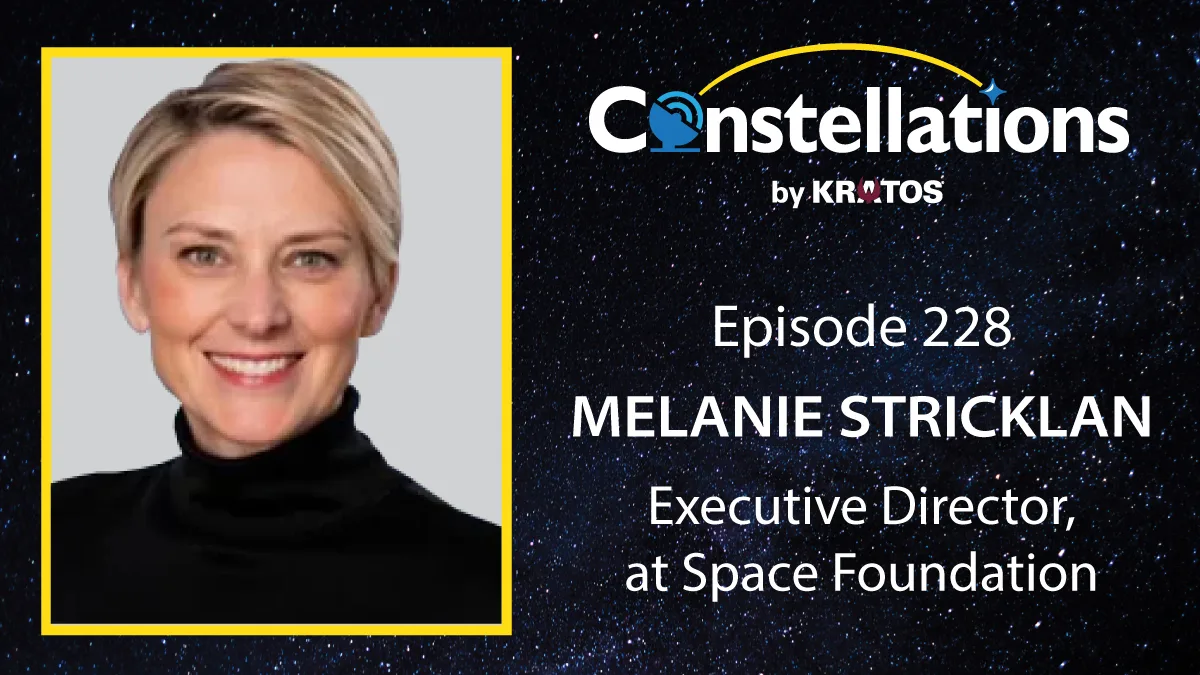
John Gilroy: Welcome to Constellations, the podcast from Kratos. My name is John Gilroy, and I’ll be your moderator. Today, we are talking about the hidden complexity of modern space operations. Why success isn’t just about satellites, but about orchestrating entire ecosystems across space, ground, and cloud. Joining us today is Melanie Stricklan, Executive Director of SWFT, and Chief Innovation and Advancement Officer at Space Foundation, to unpack the unseen challenges like semantic misalignments, operational debt, and AI-driven autonomy that shape the future of space missions. Welcome, Melanie.
Melanie Stricklan: Thanks for having me, John. Glad to be back.
John Gilroy: Good, good. Cloud-native platforms and automation are reshaping space operations. From your vantage point, what’s the most underappreciated complexity behind that shift?
Melanie Stricklan: Yeah, great question, especially in today’s world. From the outside, satellite operations, they look a little solved, right? It looks like a solved problem. You launch, you point, you downlink, and you get your answers. In reality, launch is just the very beginning of a very long campaign of systems engineering. And it’s a long campaign of contact with a dynamic and very often nowadays, a contested or congested environment. And so what’s most underestimated from my perspective is that we’re really no longer operating individual satellites or individual systems. We’re really operating tightly coupled cyber physical systems that really span space, ground, infrastructure, cloud compute, spectrum, and really the broader orbital environment that consists of objects, signal, all the things that I just listed. But that means that day-to-day work is making abnormal conditions really a pure routine. We used to worry about aging hardware and radiation effects and RF congestion, cyber probes, and those types of things. But now we’re bringing all of that together and layered on top of that is understanding how you’re operating with and among other operators, interpreting their maneuver behavior, not just your own. Tracking conjunction risk across a very complex environment today. And so the complexity really isn’t just technical anymore. It’s that modern space operations layer upon layer that behave really less like a machine and more like a living system. And I think that’s what we’re here to talk about today and how we have to continuously adapt operations to that living system.
John Gilroy: Yeah. In my introduction, I used that word orchestration, kind of a fancy word, but the industry is moving there. So as the industry moves towards orchestration across space, ground and cloud, what does that mean for how missions are actually run day to day?
Melanie Stricklan: Yeah, it means that the most important shift happening in space right now is really that the center of gravity is moving. For decades, the center of gravity was the platform. Again, the spacecraft, the launch vehicle, the sensor. And today, the center of gravity is increasingly that orchestration layer, the software, the data, the operational systems and subsystems that coordinate assets across ground space and the digital realm, the cloud, et cetera. And so in other words, that vantage is really shifting from hardware performance to decision speed. And that decision speed is becoming more and more important as those complexities arise. I do think that day-to-day operators are less focused on flying that spacecraft and more focused on managing the flows of sensing comms, compute, and the decision advantage or the data across that architecture.
John Gilroy: Yeah, so much more complex. Some people say the answer to complexity is AI. Well, AI is often portrayed as this game changer. So where is it truly moving the needle in space operations right now and where is it creating new challenges?
Melanie Stricklan: Lots of places. I do believe in AI. I started an AI native company when it was still considered just a buzzword, and it’s already making real impact by compressing decision cycles. I think our modern space architectures generate just an enormous volume of data, whether it’s telemetry, environmental sensing, operational information, et cetera. And so the AI today is really helping to triage that data, detect anomalies, identify patterns, and really highlight signals that actually require human judgment. In many ways, it’s becoming the nervous system for those complex architectures that we talked about, helping operators see what matters across those systems that would otherwise overwhelm the human attention. The challenge really appears today when AI moves closer to that operational decision making, and that’s where we’re going. And we’re going at a pace faster than we’ve seen in the last… Well, in my lifetime. And at the point the question becomes, does the model work, to is it understandable? Is it governable? Is it trustworthy under stress? And in that dynamic environment and in the contested environments that we’re seeing now, really those AI models encounter conditions that were never trained on. And so the real challenge isn’t developing AI and is it mainstream now? It’s really, we’re at the point of designing systems where humans have to be able to trust, have to be able to supervise that trust parameter and then adapt AI behavior when the environment changes. We have to be able to have that accountability over and put those boundaries on that AI behavior now. So the winners, they will not be organizations that deploy the most satellites or the most AI. They’ll be the ones that can close the AI-enabled decision loop quickly as it continues to evolve at a pace that we’ve not seen before and understand and govern that outcome.
John Gilroy: Let’s explore this whole decision concept a little carefully here. So when autonomy is making or recommending decisions in orbit, what does that look like operationally and how do teams balance this speed and trust?
Melanie Stricklan: Yeah, the speed and trust balance is a continuum for sure. Operational autonomy today is like what I discussed a few minutes ago, it’s about decision acceleration. Those types of decision that need to happen at machine speed, we’re starting to see that today. Systems that continuously analyze the telemetry, the orbital dynamics of the system or systems, environmental conditions, mission priorities, and then they recommend actions, whether that’s adjusting a tasking or responding to an anomaly or planning maneuvers. And then at the constellation scale, some of those decisions are already automated. I mean, think about some of the mega constellations today that were built from the very beginning, sketches to be fully autonomous on orbit, to do collision avoidance in real time at the edge, that have scheduling optimization and resource allocation built in and handled by the software on board. That balance between speed and trust that you mentioned is really a progressive authority even in those systems that are launched today and operate pretty autonomously on orbit. They didn’t start that way. They had to test and get comfortable with the confidence that grew because those teams, those engineers built the guardrails, those were defined, certain decisions were not automatic or autonomously driven like they are today. And so even in those fully autonomous systems or near fully autonomous systems, the goal was never to remove the humans completely from the loop. That balance between speed and trust is really allowing machines to handle the time compressed analysis while the human remains responsible for intent, for the judgment and for ultimate accountability there. So it’s a continuous effort to balance trust and speed that grows over time.
John Gilroy: Yeah. I think the word accountability is coming more and more in our vocabulary in the next several years, especially with this automation. So Melanie, what is the biggest barrier to scaling automation across multi-orbit, multi-provider ecosystems?
Melanie Stricklan: I’m going to say seems a lot in this answer, John. The biggest barrier isn’t tech, it’s not algorithms, it’s the seams between systems, between organizations and behavior. And so for me, modern systems, modern space missions, they span constellations, they span sensing networks, cloud platforms, multiple operators, multiple orbital domains, and each piece has to function well on its own, but automation stresses what happens between them. So the interfaces, they may technically connect. We may have APIs in different ways now with agentic agents to connect, yet the systems behind them have to interpret information differently, from availability to those confidence levels, to latency and operational priority. And so humans still have to deal with those differences in different ways and they have to smooth that experience. Automated systems can’t smooth those differences right now in a way that allows the scaling of that automation to strengthen the ecosystem. And so I think that automation and AI will scale when systems interpret information the same way, not just when they exchange it, if that makes any sense.
John Gilroy: Yeah. Yeah. We’re kind of dancing around this topic of cloud. Cloud-based mission platforms, they promise agility, but they also expand the attack surface. So how do you see the trade-off between openness and security evolving?
Melanie Stricklan: Yeah. I think security becomes less about perfect protection that we’ve seen in the past and where our space heritage began and more about mission continuity and designing systems that can maneuver, degrade gracefully, I would say, and then recover quickly when dependencies fail. I think cloud-native architectures really rely on that shared infrastructure. Nowadays, commercial services and different providers, different supply chains that extend beyond the traditional program boundaries. And so the question really isn’t as simple as open or closed any longer. It’s about design architectures that remain resilient when parts of that broader ecosystem are disrupted.
John Gilroy: Yeah, it’s a contested environment. Yeah, that’s important. Dynamic scheduling and real-time tasking sound great in theory. So what’s the hardest part about making that work in space?
Melanie Stricklan: Yeah. It’s not the mathematics. The mathematics behind that dynamic scheduling, we’ve always wanted it. We’ve solved the math parts of dynamic scheduling and real-time tasking. The harder problem is translating the human judgment into something machines can execute. So I would say dynamic scheduling forces organizations and humans to really make explicit trade-offs that historically lived in our heads. I was a space operator, right? Whose tasking takes precedence, right? What is prioritized? What constitutes as acceptable risk, and how are those priorities shifted when everything becomes urgent? And in traditional operations, those decisions, again, were often resolved through experience and conversation and lessons learned that were documented in a drive somewhere. And I think that once you automate those types of things and once you introduce agentic AI to that, every ambiguity is going to become visible. So the real challenge is encoding that operational doctrine clearly enough that these AI agents and automated systems can act without surprising the humans responsible for that mission. So the real challenge is in optimization at that point.
John Gilroy: Encoding clearly, kind of a difficult concept to put into effect here. So why does something as simple as shared definitions matter so much when automation and AI are in the loop and what happens operationally when those meanings drift?
Melanie Stricklan: Yeah. I think in automated environments, we’re going to see that definitions become operational infrastructure almost. So different teams use same terms, priority, confidence, availability, latency, but attach significantly different meanings to those. They use the same terms, but the meanings are different and meanings are even different across commercial to defense to civil today. So humans usually reconcile those differences through conversations. Machines don’t. So when automated systems interpret those definitions differently, then small semantic differences really can lead to diverging operational decisions, I think. The architecture can appear integrated because the interfaces connect and those seams connect technically, but the system becomes cognitively… I would say cognitively fragmented. One of the most important things, I think, least visible investments that we see in large architectures is shared operational vocabulary. Common definitions, thresholds, metrics across the entirety of the ecosystem and their partners that are doing business with them or subcontracting. And when those meanings align, I really do think ecosystems can scale cooperatively. And when they drift, ecosystems would scale that confusion layer. And so as we move into this more autonomous world and agentic world, semantics matter, definitions matter.
John Gilroy: As more missions rely on cloud-native platforms and automation and move from bespoke programs to persistent, contested infrastructure, what factors will determine competitive advantage that may not be visible from the outside?
Melanie Stricklan: All right, visible indicators, right?
John Gilroy: Yeah.
Melanie Stricklan: Launch cadence, satellite counts, how much data, those are increasingly poor proxies for capability. The real advantages come from factors that are much harder to see, more invisible, composable architectures that allow missions to reconfigure quickly across the assets or across the networks or both. That end-to-end resilience that really allows the systems to continue operating through disruption. Operational data engineering that transforms the telemetry or the logs into actual early warning rather than a postmortem explanation and fishboning, et cetera, for anomaly resolution. I think that that is perhaps one of the biggest opportunity spaces there. But I think the workforce capability is something we also don’t talk about a lot. I think that teams that understand how software, networking, security, and then the adjacencies of orbital mechanics and spectrum interact across that entire operational system, we need that workforce capability to be cultivated. And I think that’s an invisibility to some of us at some parts of our ecosystem and industry. I think in the next phase of development, advantage will, I would say, come less from what you launch and more from how quickly you, your workforce, and your systems adapt to what we already have in orbit and the complexities of the evolution within that orbital domain.
John Gilroy: Melanie, looking ahead, what’s the most surprising way you think automation and AI will reshape space operations, something most people aren’t even talking about yet?
Melanie Stricklan: This is a harder question, right? I think it’s organizational memory. It goes back to the human factor here. It’s, as our architecture scale, as operations accelerate, as geopolitics continue to evolve and technologies continue to increase, I think our organizations quietly accumulate dependencies, workarounds, informal procedures from the very first space business. This is tactic knowledge held by experienced operators, and those elements really, they don’t. They rarely appear in architecture diagrams or schematics, right? Yet they keep our complex systems functioning day to day today. And I think that as automation changes workflows and experience personnel rotate and we continue to evolve our workforce and the skills needed, those hidden dependencies become visible and failures don’t really appear as obvious as technical faults did in the past. I think that that type of operational debt, I’ll call it, will appear. And so the challenge is really understanding how humans and automated systems fail together and recover together under real operational pressure.
John Gilroy: And Melanie, I think you’ve given our audience a better understanding of this complex cloud-connected ecosystem we’re dealing with here. I’d like to thank our guest, Melanie Stricklan, Executive Director of SWFT and Chief Innovation and Advancement Officer at Space Foundation.